A dc isolator switch OEM decision should confirm the exact product route, private-label execution, documents, sample approval, revision control, packing, and export handover before price is treated as comparable.
Confirm the route against the buyer’s application, destination market, maximum DC voltage/current, string/pole arrangement, enclosure, mounting, and cable-entry needs.
Approve artwork, markings, drawings, datasheets, certificates, samples, and packing against the same exact model.
Treat ratings, IP class, certifications, MOQ, lead time, and local acceptance as exact-model, drawing, certificate, market, and application dependent.
What export buyers should decide before asking for a private-label quote
A useful OEM quote starts with a defined product route, not only a logo request or annual volume estimate. The buyer should first decide what must stay fixed for technical approval and what can be adjusted for branding, packing, or commercial terms.
Requested drawing, datasheet, certificate, and packing documents.
Sample quantity, approval method, and whether a retained sample is required.
Forecast, first order quantity, and requested delivery window, recognizing these are quotation-dependent.
How Shieldhz confirms a PV DC isolator OEM route
Shieldhz confirms an OEM route by matching the buyer’s application, destination market, electrical and mechanical requirements, branding scope, documentation needs, and sample-control process to current product documentation. Final suitability is confirmed against current product documentation and the buyer application.
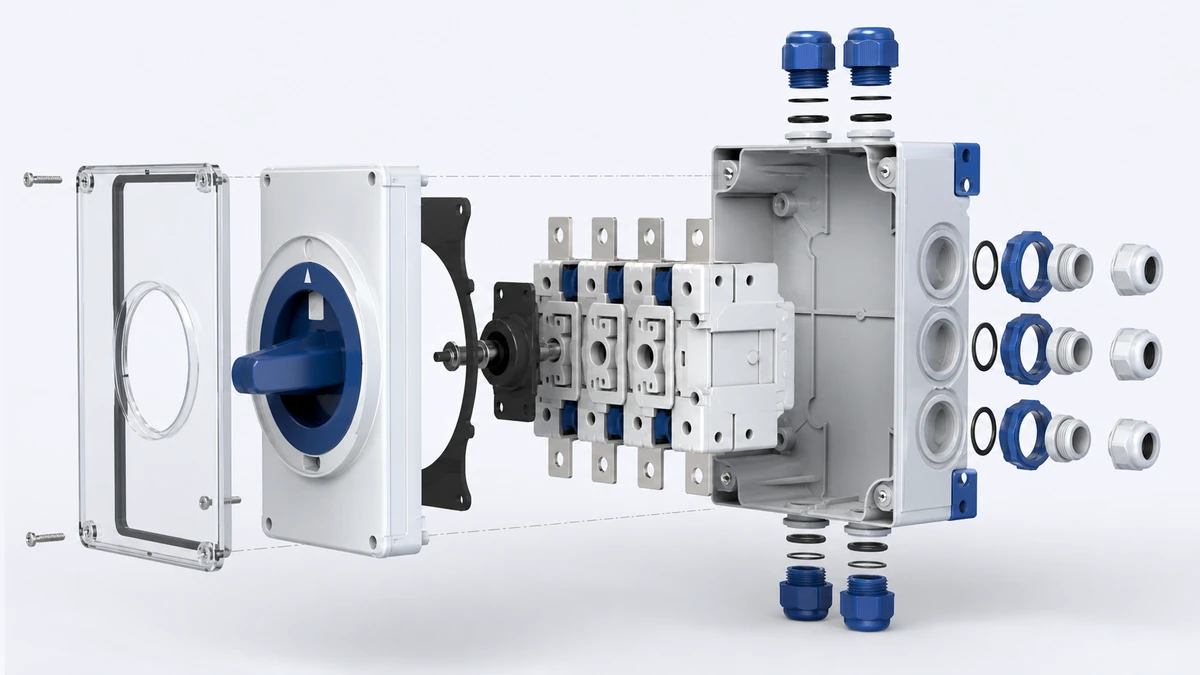
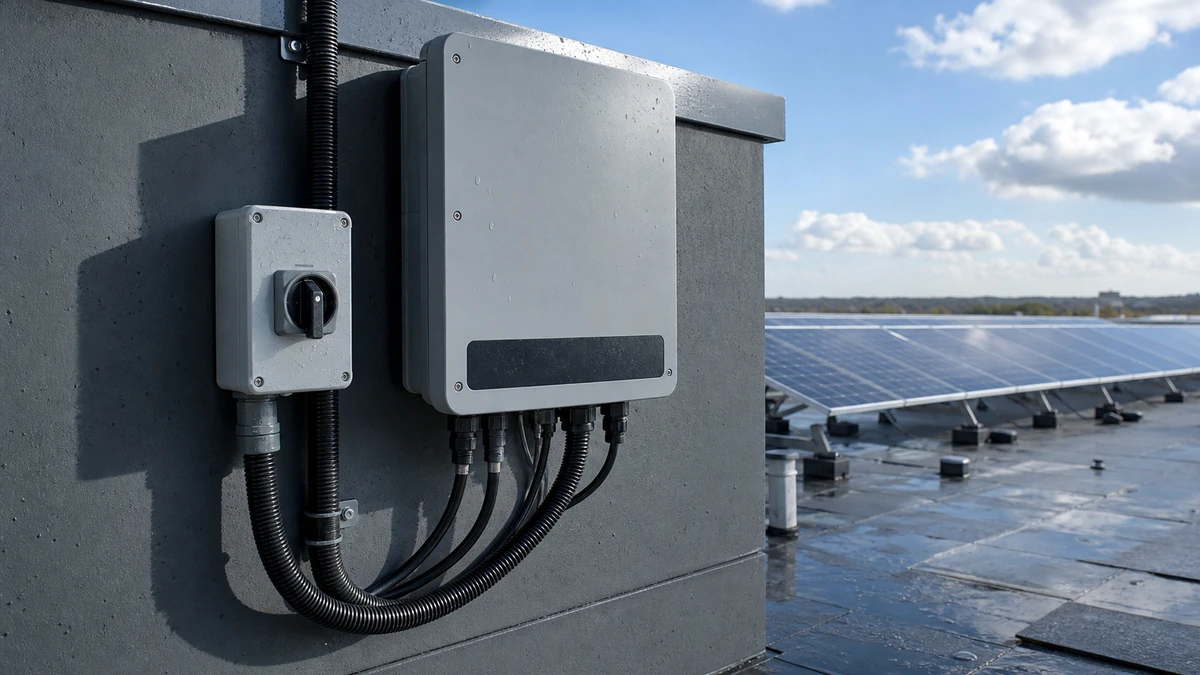
Model-route confirmation starts with the mechanical and electrical interfaces shown in the current drawing.
Confirmation inputs Shieldhz needs
The confirmation process starts with the buyer application and destination market. This is followed by the maximum DC voltage/current, string/pole arrangement, enclosure and environment, mounting/cable entry, and any installation constraints that affect the exact product route.
Shieldhz also checks the private-label artwork/marking request, including logo position, label layout, product references, carton marks, and any language requirements. The requested drawing/datasheet/certificate package must be tied to the exact model being quoted.
Route confirmation output
The output should make clear which exact model route is being discussed, which documents apply, what artwork is being reviewed, and which sample version is under approval. If any input changes, the route may need to be rechecked before production release.
A practical confirmation sequence is:
Buyer sends application, destination market, and route requirements.
Shieldhz identifies the relevant model route for review.
Buyer reviews drawing, datasheet, and requested certificate package.
Artwork and marking files are aligned to the exact model.
Sample version is approved or revised.
Production release follows the approved revision and packing plan.
Selecting the exact model route before artwork or certificates
Model-route selection should be completed before private-label artwork, certificates, and packing are treated as final. Different routes may have different drawings, enclosure interfaces, markings, document sets, and approval paths.
A sample review should tie the exact model to its drawing, datasheet and requested documentation package.
Confirm model-specific drawing, datasheet, and marking limits
When to stop route selection and recheck
Stop the route decision if the buyer changes the destination market, maximum DC voltage/current, pole arrangement, enclosure format, or cable-entry requirement. These changes can affect the exact model, drawing, and document package.
Do not approve artwork or print carton labels while the route is still open. A private-label design approved for one route should not be assumed valid for another route.
Private-label artwork and marking control
Private-label artwork should be controlled as a technical approval item, not only as a branding task. The label, handle marking, model reference, carton mark, and document identity must align with the confirmed route.
The buyer’s installation condition determines the required enclosure and cable-entry review.
Artwork approval package
A useful artwork package includes the buyer logo file, product label layout, required product reference, carton mark, and any market-specific wording requested by the buyer. The supplier should confirm what can be printed, what must remain unchanged, and what depends on the current model documentation.
For OEM programs, the buyer should approve artwork together with the product drawing. This avoids a mismatch between the physical product, label, datasheet, and packing identity.
Marking changes that require review
Request review before changing:
Model name or buyer part number.
Electrical rating text.
Standard or certificate reference.
Warning or installation wording.
Country, importer, or distributor identity.
Carton description or barcode information.
Manual or datasheet cover identity.
Ratings, certification wording, and market references should not be edited as marketing text. They must follow the exact model documents and applicable certificate scope where relevant.
Exact-model documentation for distributor and panel-builder approval
The document set should be exact-model and revision-controlled, not a generic folder shared across several routes. Export buyers need documents that match the quoted product, artwork, and sample version.
Model, dimensions, mounting, cable-entry interface, and revision
Enclosure or panel integration error
Информационный лист
Exact model reference and stated ratings
Incorrect distributor or engineering approval
Certificate package, if applicable
Model coverage, certificate holder, standard reference, and validity
Unsupported market submission or customer rejection
Artwork proof
Logo, buyer part number, warning text, and route identity
Incorrect private-label production
Packing specification
Inner pack, carton mark, pallet mark if required, and buyer reference
Warehouse and resale identification issues
Certificate and standard wording
Сайт IEC 60947-3 scope page describes switches, disconnectors, switch-disconnectors and fuse-combination units for its stated distribution/motor-circuit scope and limits. That page should not be read as evidence that every OEM product route is certified.
For OEM approval, ask for the exact certificate package that applies to the exact model, where applicable. Certification status, certificate coverage, and local acceptance are dependent on the model, document revision, destination market, and buyer application.
Sample approval, golden sample, and revision control
Sample approval should lock the product route, marking, document revision, and packing identity before production release. Without sample control, an OEM program can drift between quotation, artwork, production, and export shipment.
Sample approval sequence
A practical sample approval process is:
Confirm the exact model route and application.
Approve drawing and datasheet revision.
Approve label, handle marking, and carton mark artwork.
Receive and inspect the sample against the approved files.
Record the approved sample version, date, and buyer approver.
Define whether the approved sample is retained by buyer, supplier, or both.
Release production only after open comments are closed.
Revision-control rules for OEM programs
Every change should identify what changed, why it changed, and whether the buyer must reapprove. This includes changes to markings, drawings, packaging, document references, or supplied accessories if applicable.
Use a simple revision log:
Change area
Buyer approval needed?
Примечания
Logo size or label layout
Usually yes
Must match the approved artwork file
Electrical rating text
Да
Must match current product documentation
Drawing revision
Да
May affect enclosure or panel integration
Certificate reference
Да
Must be checked against certificate scope
Carton mark
Yes for private-label programs
Affects warehouse and resale control
Packing method
Usually yes
Affects shipment, handling, and customer receipt
Packing, carton marks, and export handover
Packing should connect the physical product, buyer part number, carton identity, and export shipment documents. This is especially important when the same buyer manages multiple private-label SKUs or sells through distributors.
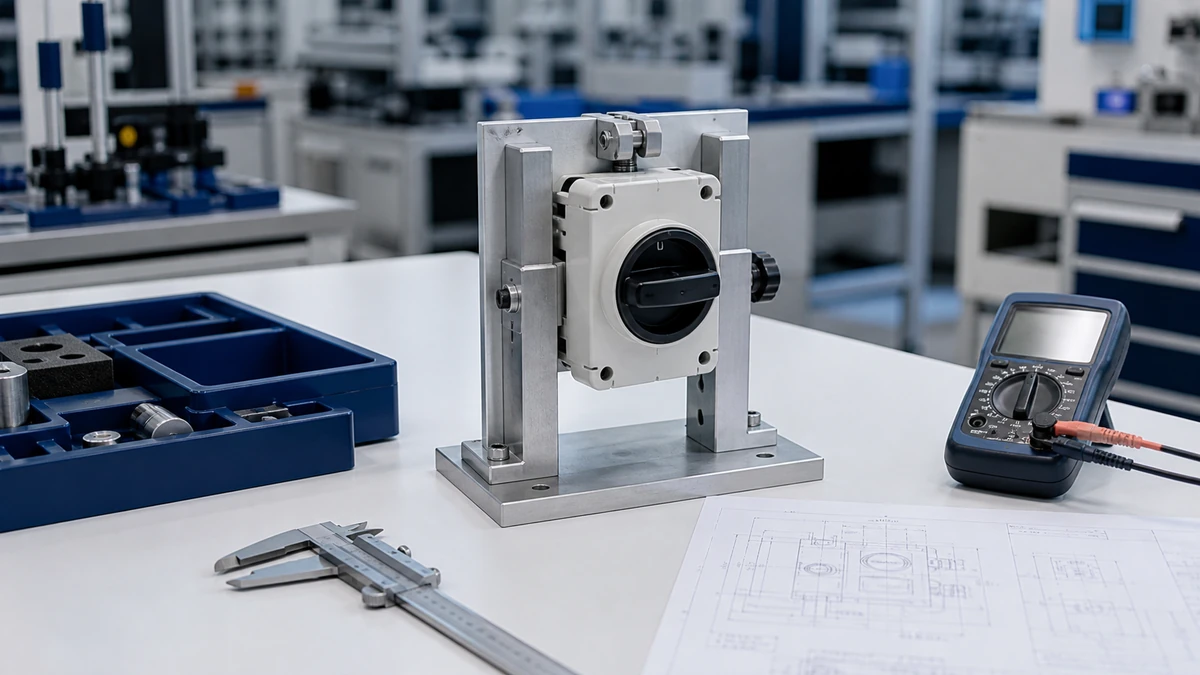
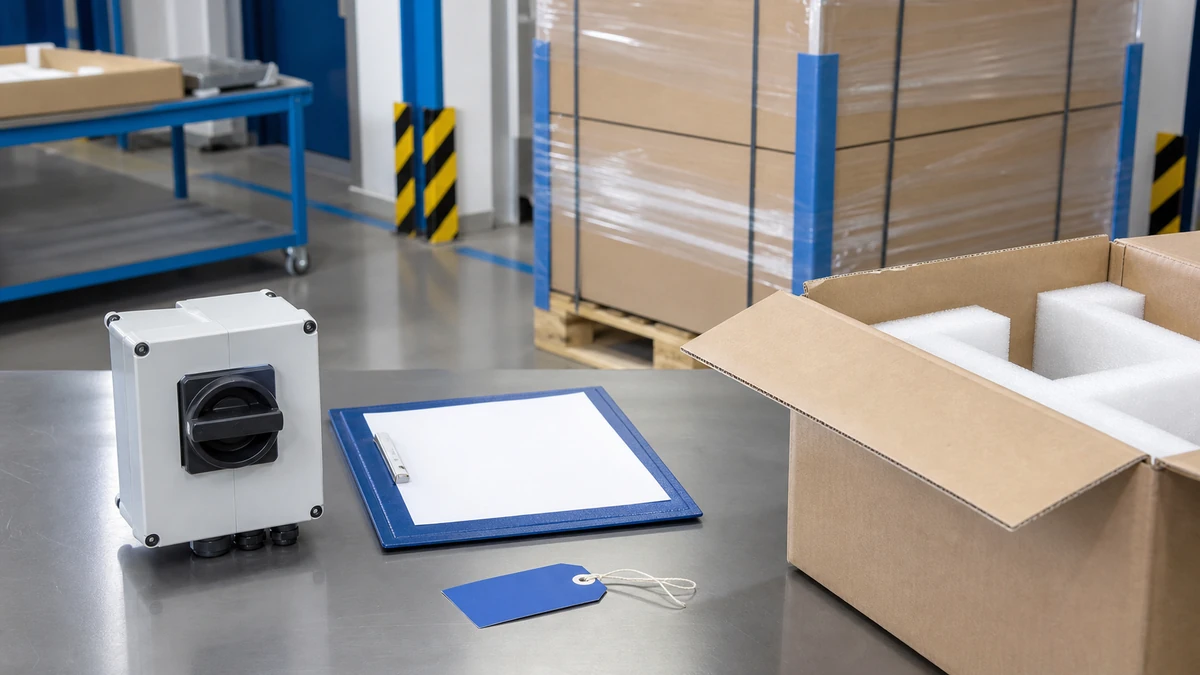
Sample approval, documentation control and protective packing form separate parts of an OEM handover.
Packing identity decisions
Confirm carton description, buyer SKU, quantity per carton, inner packing method, barcode requirements, and outer marks before mass packing. Any carton mark using rating, certification, or model wording should be checked against the approved product documents.
If the buyer needs neutral packing, private-label packing, or distributor-specific marks, that should be stated during quotation. Packing cost, carton configuration, and lead time can vary by exact route and buyer requirement.
Export handover checklist
Before shipment handover, confirm:
Final product route and buyer part number.
Approved artwork revision and marking file.
Packing specification and carton mark.
Commercial invoice identity matching buyer PO.
Packing list details matching shipped cartons.
Requested certificate or datasheet files, where applicable.
Shipping marks and consignee details.
Any buyer-required photos or pre-shipment confirmation, if agreed in the order.
Quotation, MOQ, lead time, and change-risk checks
The quotation should state what is included and what remains conditional, because OEM pricing can change when the model route, artwork, documents, packing, or approval scope changes. MOQ and lead time should be read as exact-quotation outputs, not general supplier promises.
Commercial comparison table
Quotation item
Что проверить
Почему это важно
Exact model route
Matches buyer application and documentation
Prevents price comparison across non-equivalent routes
Private-label scope
Product label, handle mark, manual, datasheet, carton, or all
Branding work affects approval and production setup
Document package
Drawing, datasheet, certificate package if applicable
Export buyer may need model-specific approval files
Sample cost and timing
Sample version and artwork status
Samples sent before artwork approval may not represent production
MOQ
Exact route and packing dependent
Should not be assumed from another project or model
Lead time
Order, artwork, material, and packing dependent
Should be confirmed for the approved route
Упаковка
Neutral, Shieldhz, or private-label packing
Affects carton design and export handling
Change-control rule
Buyer approval required for defined changes
Reduces mismatch between sample and shipment
RFQ red flags to resolve before purchase order
Resolve these points before issuing the PO:
The quote references a family name but not the exact model.
Artwork is approved before route confirmation.
Certificate wording is copied from a different model.
The datasheet, drawing, and label use different model references.
Carton marks include unverified rating or certification text.
MOQ and lead time are treated as universal instead of route-specific.
The buyer has not defined who approves revisions after sample sign-off.
Conclusion
A dc isolator switch OEM program should be managed as a route-confirmation and approval workflow. The buyer is not only purchasing a switch; the buyer is approving an exact model, marking set, document package, sample version, packing identity, and export handover process.
For overseas OEMs, panel builders, PV equipment builders, distributors, and procurement teams, the safest commercial comparison is route-to-route and document-to-document. Confirm the application, destination market, electrical and mechanical inputs, private-label scope, sample approval, and revision-control rules before treating any offer as ready for purchase order release.
Часто задаваемые вопросы
What makes a dc isolator switch OEM quote different from a standard purchase?
An OEM quote includes more than the product price. It should define the exact model route, private-label marking, document package, sample approval, packing identity, and revision-control rules.
Can private-label artwork be approved before the product route is confirmed?
It should not be treated as final before route confirmation. The approved artwork must match the exact model, drawing, datasheet, and any applicable certificate wording.
Are voltage, current, pole arrangement, IP class, and certifications the same across model families?
No. These items are exact-model, drawing, certificate, market, and application dependent, so they must be confirmed for the specific route under quotation.
What documents should an export buyer request for distributor or panel-builder review?
Request the exact-model drawing, datasheet, certificate package where applicable, artwork proof, and packing specification. Each document should match the quoted model and approved sample version.
Does mentioning IEC 60947-3 mean every OEM product route is certified?
No. A standard reference and a product certificate are different things. Certification status must be checked against the exact model, certificate scope, document revision, destination market, and buyer application.
When should the buyer approve mass production?
Approve mass production only after the route, drawing, datasheet, artwork, sample version, packing specification, and export document requirements are aligned. Any later change should follow a defined revision-control process.
Ши, Мукси пишет технические статьи Shieldhz для покупателей промышленных систем управления и электрических компонентов, охватывая поворотные кулачковые переключатели, разъединители, PV DC разъединители, кнопки, индикаторные лампы, водонепроницаемые корпуса и клеммные блоки. Статьи основаны на опыте производства и экспорта компании Zhejiang Shihe Electric Co., Ltd., с практическим акцентом на выборе модели, технических характеристиках, чертежах, сертификации, рейтингах IP и деталях запроса, которые покупатели должны подтвердить перед заказом.