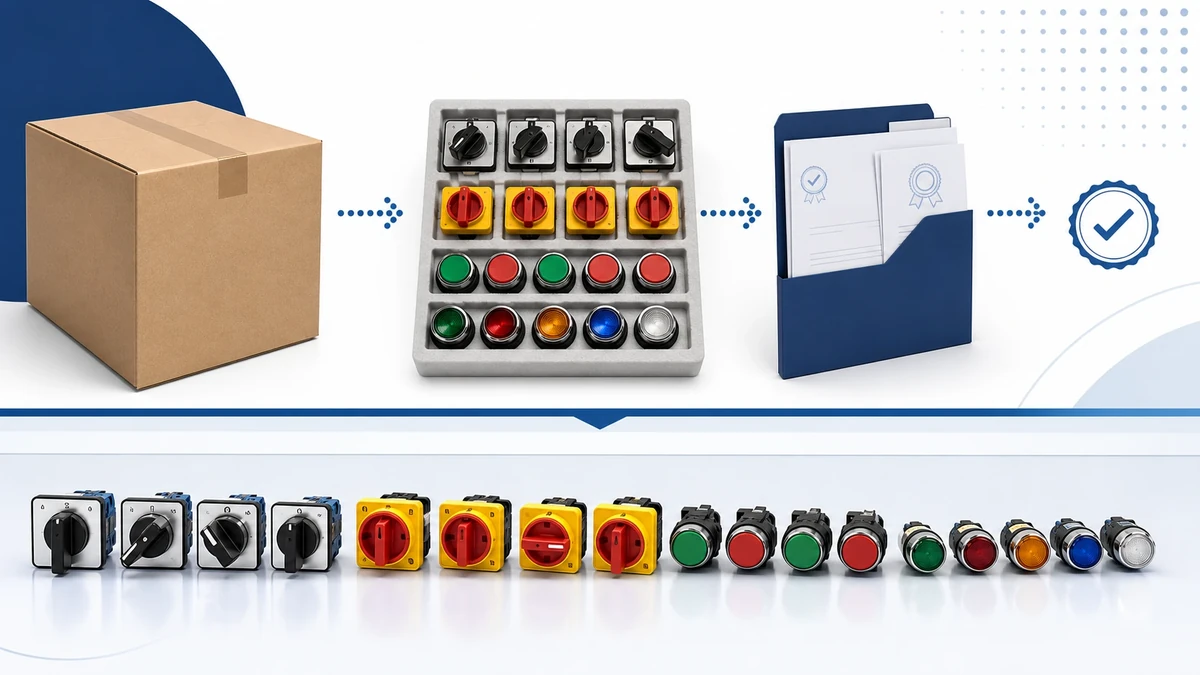
A control panel BOM is a structured engineering document that defines every switching, isolation, and signalling device by rated voltage, current, utilization category, IP rating, and applicable IEC standard — not by part number or frame size alone.
Omitting utilization category and contact program from BOM line items are the two most common specification gaps that cause field rejections, procurement errors, and wiring mistakes during panel build.
AC and DC isolation switches are not interchangeable at equivalent voltage ratings; DC-rated isolators require dedicated arc extinction geometry, and their selection must reference maximum open-circuit voltage rather than operating voltage.
What Is a Control Panel BOM and Why Component Specification Matters
A control panel bill of materials (BOM) is a structured component list that defines every switching, isolation, and signalling device required to build a functional, safe, and code-compliant panel. Correct specification at the BOM stage prevents field substitutions, reduces procurement errors, and ensures each component meets its rated voltage, current, and environmental class before assembly begins.
The BOM as an Engineering Document
In industrial control panel design, the BOM does more than list part numbers. It captures the electrical parameters that govern safe operation: rated operational voltage (Ue), rated current (Ie), utilization category (such as AC-23A for motor switching or DC-21A for resistive DC loads under IEC 60947-3), enclosure ingress protection class per IEC 60529, and applicable certifications. A BOM entry for a rotary cam switch, for example, must confirm pole count, contact program, and whether the device meets the making and breaking capacity required for the connected load — not merely its frame size.
In a typical motor control center, engineers specify isolator switches at the incoming feeder to create a defined de-energised state before any enclosure access, while selector switches and push buttons handle operator commands at the panel face. Each device occupies a distinct function in the switching and signalling hierarchy.
Why Vague Specification Creates Risk
Under-specified BOMs commonly list only a voltage and current rating, omitting utilization category, contact endurance, and IP rating. IEC 60947-3 — the standard governing disconnectors, isolators, and switch-disconnectors — requires that a device be selected against its rated making capacity and mechanical endurance, not solely its continuous current. A 32 A–rated cam switch and a 32 A–rated isolator carry the same headline rating but differ significantly in arc interrupting geometry, contact material, and certified breaking duty. Specifying مفاتيح الكامات الدوارة و مفاتيح عزل التيار المستمر by full IEC parameters at the BOM stage eliminates ambiguity for procurement, quality inspection, and regulatory sign-off. For North American panel work, consult UL’s control-panel component guidance alongside the applicable project requirements.
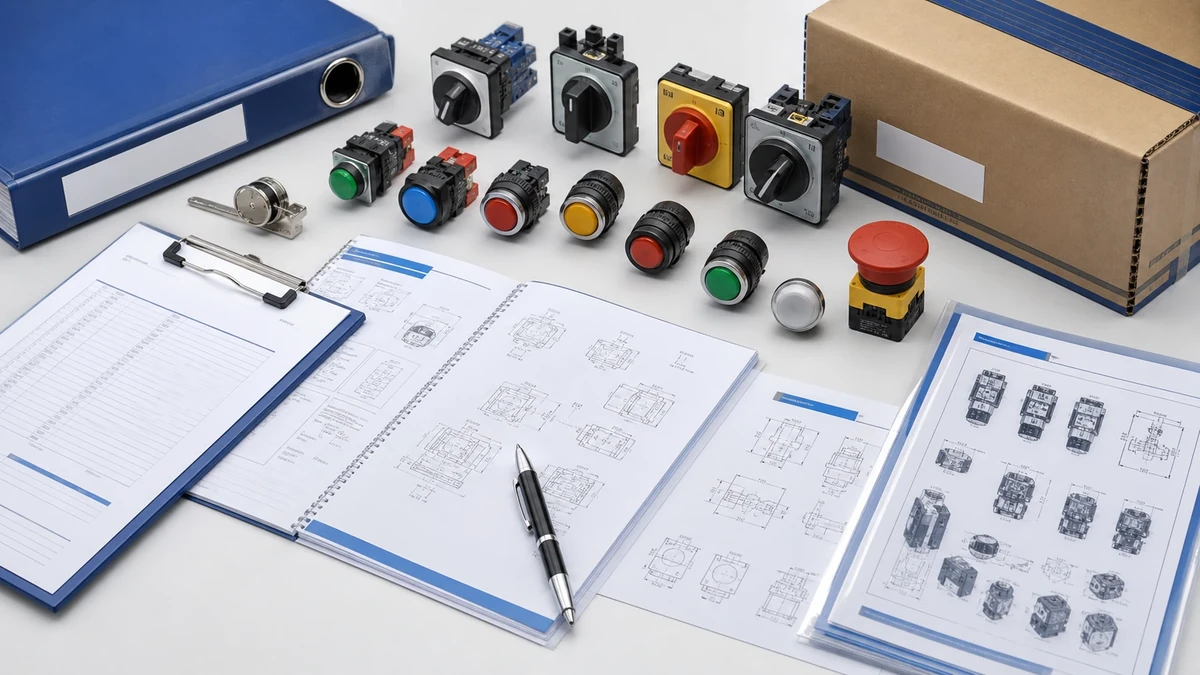
Figure 1. Core concept behind control panel component BOM selection.
How to Specify Switching Devices: Key Parameters and Standards
Getting the parameters right before writing a single line item is what separates a BOM that clears inspection from one that generates a field rejection on commissioning day.
Specifying switching devices for a control panel BOM requires matching each component to its electrical environment, mechanical duty, and applicable IEC performance standard. An undersized or incorrectly categorized device — even one that appears physically correct — can fail under inductive load conditions that a resistive-rated switch cannot safely interrupt.
معلمات التصنيف الكهربائي
The first group of parameters defines what the device must handle under normal and fault-adjacent conditions:
الجهد التشغيلي المقدر (Ue): The voltage at which the device performs its switching duty. Isolators and cam switches are typically available in ratings up to 690V AC or up to 1500V DC for PV applications.
Rated insulation voltage (Ui): The maximum voltage the device can withstand without breakdown, generally ≥ Ue. IEC 60947-3 requires that Ui be the reference for dielectric test levels.
التيار التشغيلي المقدر (Ie): Current at a defined utilization category (e.g., AC-21A for resistive loads, AC-23A for motor loads). A device rated 32A at AC-23A carries a harder switching duty than the same frame at AC-21A — confirm the category before specifying.
Making and breaking capacity: The device’s ability to close into and interrupt fault-level currents without welding or excessive arcing, defined per IEC 60947-3 clauses on conditional short-circuit ratings.
Mechanical and Environmental Parameters
IP rating (IEC 60529): Panel-mounted devices typically require IP40–IP65 at the front face; outdoor or washdown environments may require IP66 or IP67 enclosure-level protection. For installations in wet or corrosive environments, waterproof isolator switches extend that protection to the full assembly.
Mechanical endurance: IEC 60947-3 specifies a minimum of 50,000 no-load operating cycles for switch-disconnectors. Verify the datasheet figure against expected maintenance intervals.
Operating temperature: Typically −25°C to +55°C for industrial-grade switching devices, though confirm against the specific datasheet, as enclosure type affects derating.
Utilization Category and Standard Reference
IEC 60947-3 governs disconnectors, switch-disconnectors, and isolators. IEC 60947-5-1 governs control circuit devices including push buttons and selector switches. Matching the device to the correct standard and utilization category is the specification step most commonly skipped in early-stage BOMs — and the one most likely to generate a field rejection from an inspection authority.
For rotary cam switches serving multi-position selector or motor reversal duties, the contact program (which contacts make or break at each position) must be documented alongside the current and voltage rating. A cam switch BOM entry that lists only frame size and amperage is incomplete.
[HTML-BLOCK-START]
A minimum insulation resistance of ≥ 10 MΩ after damp-heat conditioning (IEC 60068-2-78) is a common acceptance criterion for switching devices destined for humid or tropical panel environments. Confirm this value against the selected device datasheet rather than applying it universally, as enclosure class and contact material affect the result.
[HTML-BLOCK-END]
[Expert Insight] — Switching Device Specification in Practice
– Always cross-reference the utilization category against the actual load type at the time of BOM creation, not during procurement. Changing a category from AC-21A to AC-23A after purchase orders are raised typically means a complete re-order, not a substitution.
– Request the full contact endurance table from the datasheet, not just the headline mechanical cycles figure. Electrical endurance at rated current under AC-23A duty is often 40–60% lower than the no-load mechanical figure.
– For panels destined for export, confirm whether CE marking alone satisfies the destination market or whether additional country-specific certification (UL, CCC, RCM) must appear on the same device — this affects which model variant to specify.
How to Specify Isolation Switches for Safe Circuit Disconnection
With the switching device parameters established, the next layer of the BOM addresses isolation: the confirmed off-state that allows maintenance personnel to work without residual voltage present.
An isolation switch creates a verified off-state in a circuit so maintenance personnel can work safely without residual voltage. Specifying the correct isolator requires matching rated voltage, current, pole count, utilization category, and enclosure protection level to the actual circuit conditions — both AC and DC applications carry distinct requirements that affect device selection.
AC vs. DC Isolation: Why the Distinction Matters
AC current crosses zero 100–120 times per second, which naturally assists arc extinction at disconnection. DC current holds a continuous polarity, making arc extinction significantly harder. A switch rated for 230V AC is not automatically suitable for 230V DC service — DC-rated isolators use dedicated arc chutes, increased contact gap geometry, and pole configurations that extend the arc path to force extinction. IEC 60947-3, which governs disconnectors and switch-disconnectors, distinguishes AC and DC utilization categories precisely for this reason. For photovoltaic and battery systems, DC isolator switches must be rated against maximum open-circuit string voltage, not operating voltage, because open-circuit conditions represent the worst-case disconnection scenario.
Isolation Switch Specification Matrix
المعلمة
AC Isolation
DC Isolation
Voltage reference
Rated operational voltage Ue
Maximum open-circuit voltage Voc
نطاق الجهد النموذجي
حتى 690 فولت تيار متردد
Up to 1500V DC (PV applications)
تكوين العمود
1P, 2P, 3P, or 4P
2P minimum; series-pole configurations for higher DC voltage
فئة الاستخدام
AC-20A, AC-21A, AC-22A, AC-23A
DC-20A, DC-21A, DC-22A, DC-23A
Arc extinction mechanism
Natural zero crossing
Extended contact gap, arc chute, series poles
Enclosure requirement
IP rating per installation environment
IP65 minimum for outdoor PV installations
المعيار المطبق
IEC 60947-3
IEC 60947-3; local PV installation codes
Key Numeric Parameters for Specification
In a typical industrial feeder application, an isolation switch is positioned at the incoming supply so service teams establish a confirmed de-energized state before opening the enclosure. Two numeric parameters anchor every isolator specification:
[HTML-BLOCK-START]
Rated insulation voltage (Ui): must be ≥ the highest voltage present in the circuit, including transient overvoltages. For most industrial AC panels, Ui ≥ 500V is a common baseline; confirm against the actual installation voltage class.
Rated current (Ie): must meet or exceed the maximum load current at the specified utilization category. For resistive loads (AC-21A or DC-21A), the rated current is applied directly; for mixed inductive loads (AC-23A or DC-23A), verify the switch’s making and breaking capacity at that category, which is lower than the resistive rating.
[HTML-BLOCK-END]
For rooftop PV string disconnection, the GF40 PV DC isolator switch and GF51 series are examples of devices built specifically around DC breaking requirements, with pole counts and voltage ratings suited to string-level isolation. Confirm the applicable local installation standard and required certification documentation — IECEx, CE marking, or regional codes — before finalizing the model selection.
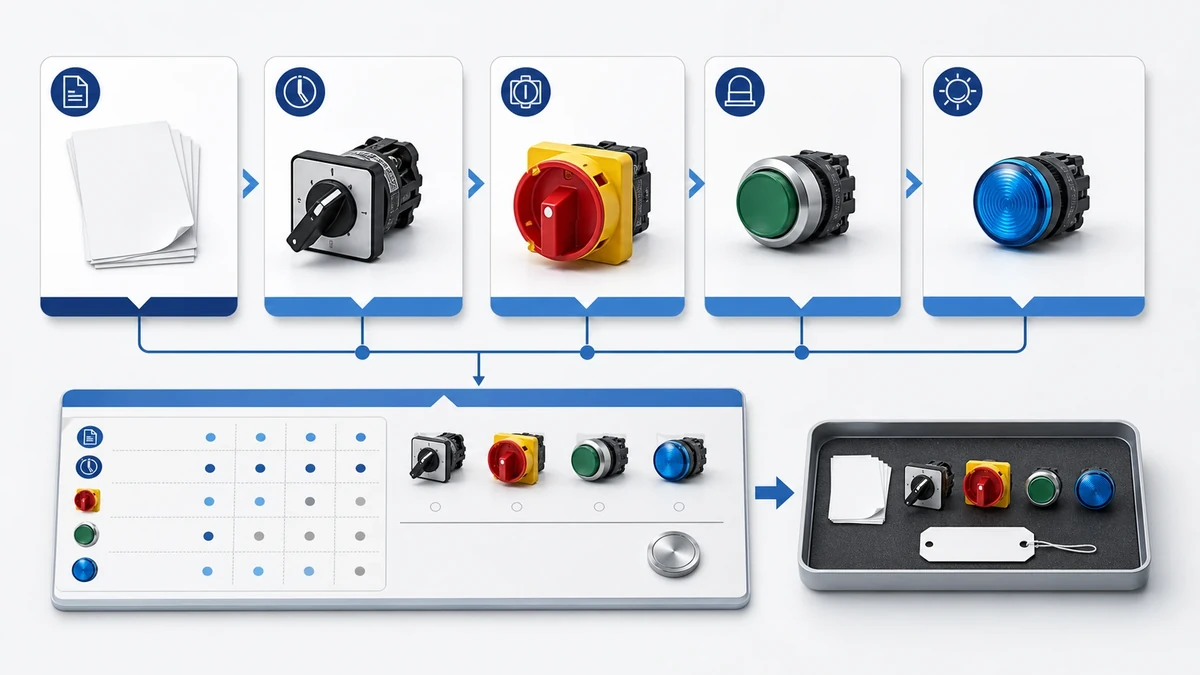
Figure 2. Selection checks should connect function, rating, model route, contact program, mounting, documents, certificate scope, and inquiry inputs.
[Expert Insight] — DC Isolation in PV and Battery Systems
– Never use a device’s AC current rating as a direct substitute for its DC rating. DC breaking duty is rated separately, and the allowable current at a given DC voltage is often 30–50% lower than the AC equivalent on the same frame.
– For battery energy storage systems, the isolator must be rated for bidirectional current flow, not just the discharge direction. Many standard DC isolators are asymmetrically designed and will not safely interrupt regenerative or charging currents.
– Verify the string open-circuit voltage at minimum expected temperature, not at standard test conditions (STC). PV module Voc rises as temperature falls, and cold-climate installations regularly exceed STC Voc by 10–15%, which can push a 1000V DC rated isolator beyond its insulation voltage limit.
How to Specify Signalling Devices: Indicator Lights and Push Buttons
Signalling devices are the operator’s direct interface with the panel’s internal state, and their specification deserves the same parameter discipline applied to isolation and switching components.
Indicator lights and push buttons provide operators with real-time status feedback and manual control inputs at the panel face. Specifying them correctly requires matching voltage class, ingress protection rating, and actuator function to the application before selecting a part number.
LED vs. Filament Indicator Lights
IEC 60947-5-1 governs low-voltage control circuit devices, including panel indicator lights, defining performance requirements for rated insulation voltage, operating voltage range, and environmental endurance. The technology choice between LED and filament types affects service life significantly.
المعلمة
LED Indicator
Filament (Incandescent) Indicator
Typical service life
50,000+ hours
1,000–2,000 hours
Power consumption
0.1–0.5 W (typical)
1–5 W (typical)
Operating voltage range
Wide (12V DC – 240V AC variants)
Narrow (matched to rated voltage)
مقاومة الاهتزاز
High — solid-state construction
Lower — filament fatigue risk
Replacement frequency
منخفض
مرتفع
Color options
Red, green, amber, white, blue
Red, green, amber (filter-dependent)
In an industrial motor control panel, a green LED pilot light on the output contactor circuit provides run-status confirmation, while a red LED signals a fault or tripped overload — both are typically wired at 24V DC control voltage to match the PLC output rail.
Momentary vs. Maintained Push Buttons
IEC 60947-5-1 also classifies push button actuators by operating mode. Momentary types return to rest position on release; maintained (latching) types hold their switched state until deliberately reset.
المعلمة
Momentary Push Button
Maintained Push Button
التطبيق النموذجي
Start, stop, reset commands
Enable/disable, mode selection
Contact return
Spring-return on release
Mechanical latch — manual reset
Contact block rating
Up to 10A at 690V AC (confirm datasheet)
Up to 10A at 690V AC (confirm datasheet)
Operator formats
Flush, extended, mushroom-head
Key-lock, twist-release, pull-release
IEC utilization category
AC-15 / DC-13 (inductive control loads)
AC-15 / DC-13 (inductive control loads)
For stop circuits, a mushroom-head momentary push button with a normally-closed (NC) contact block is the standard configuration, consistent with IEC 60204-1 machine safety requirements for stop actuator color and contact type — confirm the specific applicable clause against the current edition of the standard.
شيلدهز نطاق أزرار الضغط and the AD16 panel indicator light series cover both LED pilot lights and momentary or maintained actuators across common panel voltages. Confirm IP rating, LED supply voltage, and contact program against the panel’s control circuit diagram when specifying.
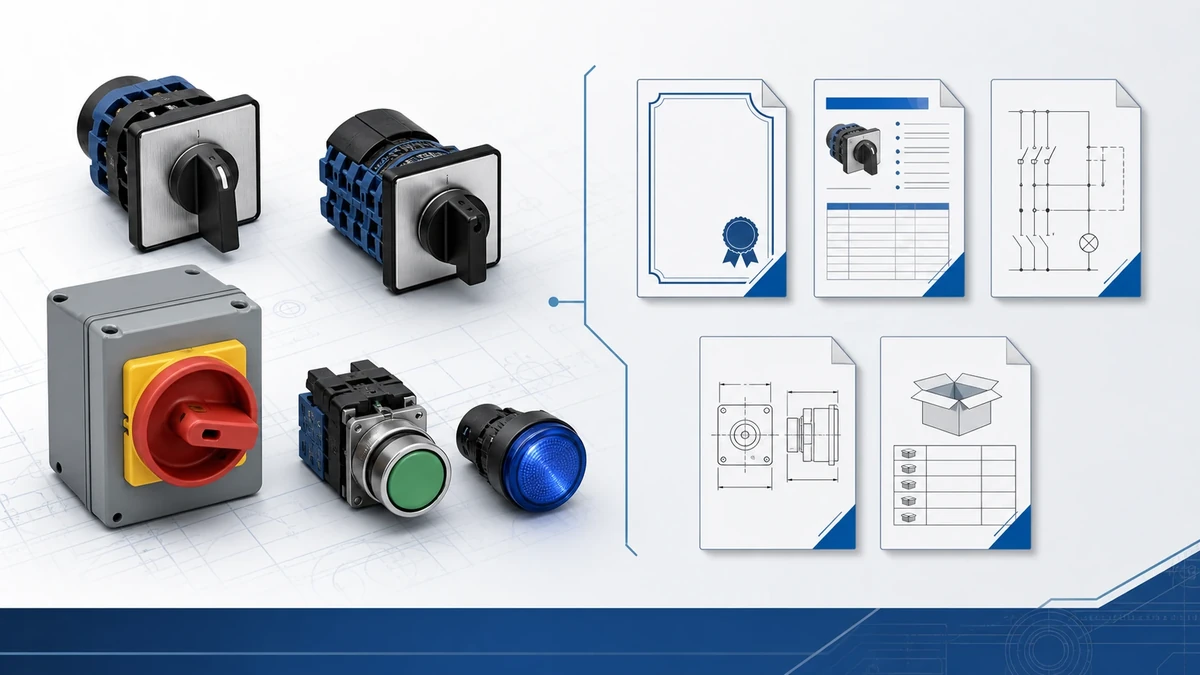
الشكل 3. يجب التحقق من سياق الأسلاك التطبيقية بالمقارنة مع مخطط التلامس الخاص بالشركة المصنعة قبل التنشيط.
BOM Line-Item Structure: Fields, Format, and Common Omissions
Understanding what to specify for individual device types is only useful if the BOM document itself is structured to capture and communicate that information without ambiguity.
A well-structured BOM line item for a control panel component captures enough technical specificity to allow procurement, manufacturing, and maintenance to work from a single source of truth. For switching, isolation, and signalling devices, that typically means 8–12 discrete fields per line — not a part number alone.
Mandatory Fields
These fields must appear on every line item for panel switching and signalling components:
Item number — sequential reference for cross-linking to schematics and wiring diagrams
Manufacturer part number / model code — full alphanumeric string including contact program suffix, pole count, and position count (e.g., LW28-20/X2-3 is meaningless without the position and circuit designator)
Reference designator — panel tag linking the BOM to the schematic (e.g., S3, Q1)
المعيار المطبق — IEC 60947-3 for isolating switches and cam switches; IEC 60947-5-1 for control circuit devices including push buttons and indicator lights
Enclosure / IP rating — especially critical for outdoor or wet-area components; IP65 minimum is common for wash-down environments, IP67 for submersible or direct spray exposure
Optional but Recommended Fields
Mounting cutout dimensions — panel cutout diameter or width in mm (e.g., 22 mm or 30 mm round)
Wiring termination type — screw clamp, cage clamp, or ring terminal
Certification marks required — CE, UL, CCC, or RCM depending on destination market
The two most frequent specification gaps in submitted BOMs are the absence of a utilization category and an unspecified contact program. A rotary cam switch rated at 20A resistive (AC-21A) is not interchangeable with one rated 20A inductive motor load (AC-23A), even if the frame size matches. Similarly, omitting the contact program table forces the manufacturer to interpret intent — a common source of wiring errors during panel build.
For DC isolator switches used in photovoltaic string circuits, the BOM must also include maximum system DC voltage (e.g., 1000V DC or 1500V DC) and pole configuration, since a 2-pole and 4-pole isolator of the same current rating serve fundamentally different string architectures.
Real-World Specification Scenarios: Industrial, Solar PV, and Marine Panels
Abstract parameters are easier to apply when examined against the specific operating conditions that drive each specification decision.
Translating BOM principles into actual component entries becomes clearer when examined through concrete application contexts. The three scenarios below annotate representative BOM line items, showing how switching, isolation, and signalling specifications are derived from real operating conditions.
Scenario A: 45 kW Industrial Motor Control Panel
A motor control panel managing a 45 kW, 400V AC conveyor drive typically requires an isolator-disconnector rated for utilisation category AC-23A (switching motor loads). A suitable BOM entry would specify a rotary cam switch with a minimum thermal current of 63A at 400V AC, IP65 front-face protection for dusty machine halls, and an IEC 60947-3 declaration of conformity. The LW42 series rotary cam switch is a representative route for this frame size. Signalling is handled by 22 mm panel indicator lights rated 230V AC, typically wired to auxiliary contacts on the main contactor.
Scenario B: Rooftop Solar PV String Combiner Box
For a rooftop installation with string open-circuit voltage up to 1000V DC, each string requires a dedicated DC isolator selected for ≥ 1000V DC rated insulation voltage (Ui) and a utilisation category appropriate for DC-resistive switching. IEC 60364-7-712 governs installation requirements — confirm the current applicable edition for the specific PV installation. A BOM entry referencing the GF40 PV DC isolator switch would note pole count (2-pole for single string), IP65 or IP66 enclosure rating, and RoHS compliance status. String current rating is confirmed from the module datasheet, not assumed.
Scenario C: Marine Distribution Panel
Offshore and coastal marine panels face salt-spray ingress and vibration cycles that demand IP67 or higher ratings with UV-stabilised enclosures. A typical BOM entry for the main shore-power isolation point specifies a weatherproof isolator switch with 32A AC rating, corrosion-resistant housing, and a cable entry seal torque confirmed from the manufacturer’s installation drawing. Signalling components — typically IP67-rated metal push buttons for bilge pump activation — must share the same ingress rating as the enclosure, not a lower panel-mount rating.
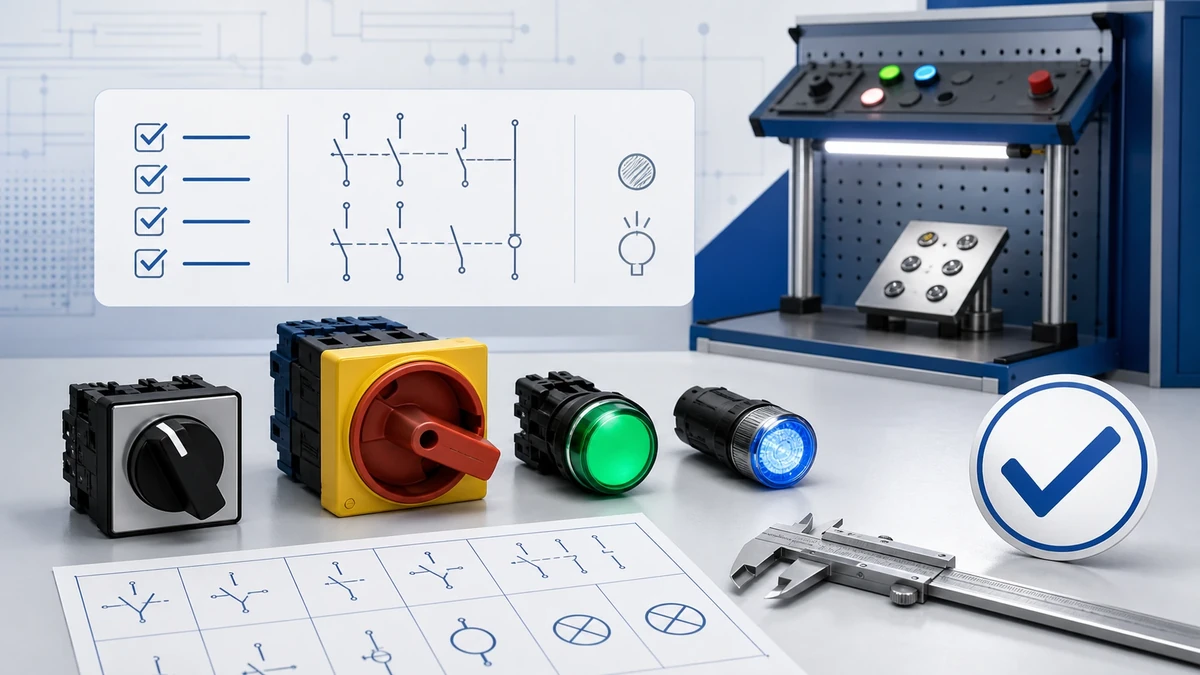
الشكل 4. يجب أن يتضمن الاستفسار الكامل التصنيف وتسلسل التلامس والتركيب والحاوية ومتطلبات المستند.
How Shieldhz Supports BOM Specification for Switching, Isolation, and Signalling Components
With specification requirements defined across device types and application scenarios, the final step is confirming that every line item maps to a buildable, certified component before purchase orders are raised.
Translating a control panel BOM into confirmed, buildable component orders requires more than a catalog reference. Shieldhz — founded in 2014 and operating a 5,000+ m² manufacturing facility in Zhejiang Province — supports procurement teams through a structured specification confirmation process across its verified product families: مفاتيح الكامات الدوارة, DC isolator switches, أزرار الضغط وأضواء المؤشر, و waterproof isolator boxes.
What Shieldhz Confirms Before Quotation
For each line item, Shieldhz reviews the buyer’s circuit function, rated voltage and current (typically 10A–63A AC or up to 1,000V DC for isolator models), pole count, contact program or position sequence, utilization category, panel cutout constraints, IP enclosure requirement, and required certification documentation — CE, RoHS, or market-specific compliance records.
Matching Product Routes to BOM Entries
A motor selector function routes to a rotary cam switch series. A PV string isolation requirement routes to a DC isolator switch, with string open-circuit voltage and pole count verified against the selected model. An operator call-for-attention function routes to a push button or pilot indicator from the SH-B2 or AD16 series. Outdoor or weatherproof installations are assessed against enclosure IP ratings, directing orders to the UKP or SH30 waterproof isolator range.
To begin BOM specification support, submit your component list, circuit diagram, and documentation requirements through the صفحة التواصل مع شيلدهز.
الأسئلة الشائعة
What is the difference between a disconnector and an isolator switch in IEC terminology?
Under IEC 60947-3, a disconnector is a mechanical switching device that opens a circuit when the current is negligible, while an isolator switch (switch-disconnector) is rated to make and break currents under normal load conditions. Both create a verified open-gap state, but only the switch-disconnector can be operated safely under load.
How do I determine the correct utilization category for a cam switch or isolator?
The utilization category is determined by the nature of the connected load: AC-21A applies to resistive or slightly inductive loads such as distribution panels, while AC-23A applies to motor switching where high inrush currents must be interrupted reliably. Match the category to the actual switching duty at the point of disconnection, not to the rated continuous current of the circuit.
Why must a DC isolator switch be rated at maximum open-circuit voltage rather than operating voltage?
In photovoltaic and battery systems, the highest voltage the switch must withstand and interrupt occurs when the load is disconnected and no current is flowing — the open-circuit condition. Operating voltage is lower and does not represent the worst-case insulation stress, so sizing to Voc provides the correct safety margin for the rated insulation voltage (Ui).
What IP rating should control panel push buttons and indicator lights carry in a food processing environment?
Food processing and washdown environments typically require front-face IP65 as a minimum for panel-mounted devices, with IP66 or IP67 preferred where high-pressure cleaning is routine. The device’s IP rating must match or exceed the environmental exposure it faces independent of the enclosure’s overall rating.
Can a single rotary cam switch serve both selector and motor isolation functions in the same panel?
A cam switch can combine selector and isolation duties only if it is rated for the isolation function under IEC 60947-3, carries the required making and breaking capacity for the connected load, and its contact program correctly sequences all required switching states. Using a device that is rated only for control circuit duty in a main isolation position is a code violation.
What information must a BOM entry include for a DC isolator used in a solar PV string combiner box?
A complete PV DC isolator BOM entry must state the maximum system DC voltage (Voc), rated operational current confirmed from the module datasheet, pole count, utilization category (DC-21A or DC-22A depending on load type), IP enclosure rating (IP65 minimum for outdoor installations), and applicable certification documentation required by the installation standard and destination market.
How many operating cycles should a switch-disconnector be rated for in a high-cycle industrial application?
IEC 60947-3 requires a minimum of 50,000 no-load mechanical operating cycles for switch-disconnectors, but the electrical endurance figure at rated current is the more relevant limit for high-cycle duty. Review the full endurance table in the device datasheet and compare it against the expected annual cycle count for the application, applying a service factor appropriate to the maintenance interval.
شي، موكسي
يكتب شي، موكسي مقالات شيلدهز الفنية لمشتري التحكم الصناعي والمكونات الكهربائية، والتي تغطي مفاتيح الكامات الدوارة، ومفاتيح العازل، ومفاتيح فصل التيار المستمر الكهروضوئية، وأزرار الضغط، وأضواء المؤشر، والحاويات المقاومة للماء، والكتل الطرفية. تستند المقالات على خبرة شركة Zhejiang Shihe Electric Co., Ltd. في التصنيع والتصدير، مع التركيز العملي على اختيار الطراز وأوراق البيانات والرسومات والشهادات وتصنيفات IP وتفاصيل الاستفسار التي يجب على المشترين التأكد منها قبل الطلب.