Pump Isolator Switch Box: Local Isolation and Cable-Entry Checks for Water Systems
Use a practical buyer checklist to evaluate pump isolator switch inputs, documentation, approval controls and the exact weatherproof isolator switch box route.
A pump isolator switch box should be selected as a local service-isolation interface for the pump enclosure, with cable-entry, sealing, mounting, and documentation checked before the quotation is fixed.
Confirm the pump isolator switch role, AC/DC duty, voltage, current, and local access requirement before choosing a model route.
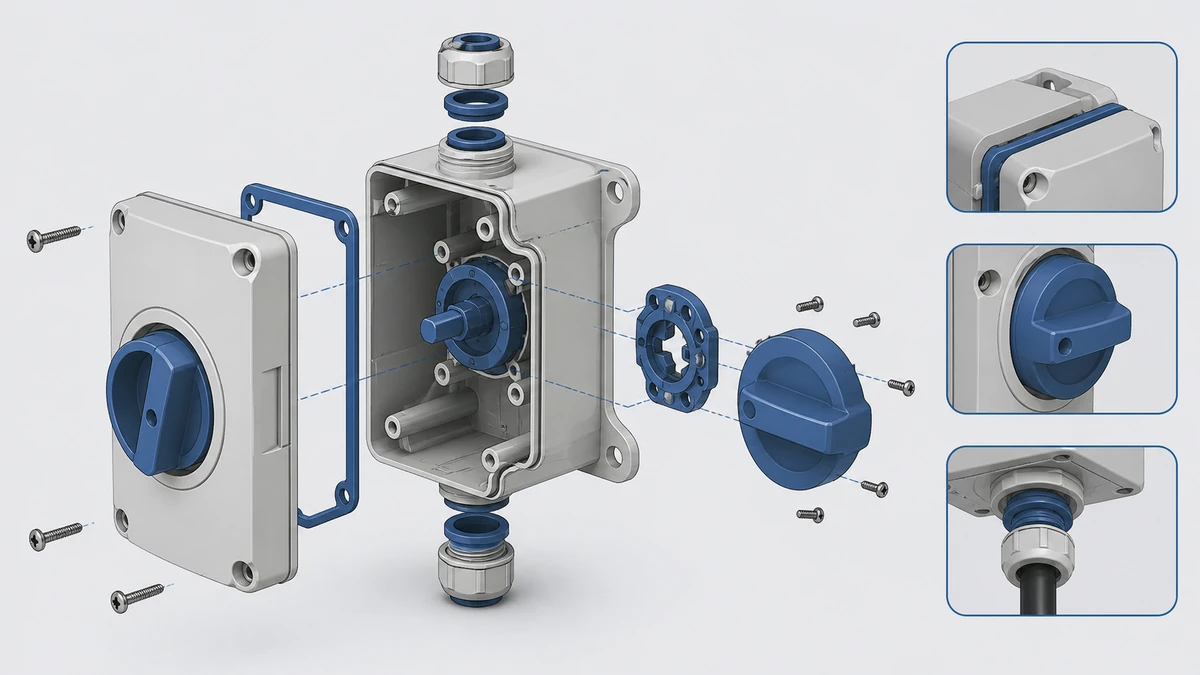
Check cable-entry direction, gland size, gasket path, mounting face, and handle clearance as part of the enclosure decision, not as a late accessory choice.
Request the exact drawing, datasheet, and certificate package for the target model and destination market before procurement release.
Where the pump isolator switch box fits in water-system enclosure decisions
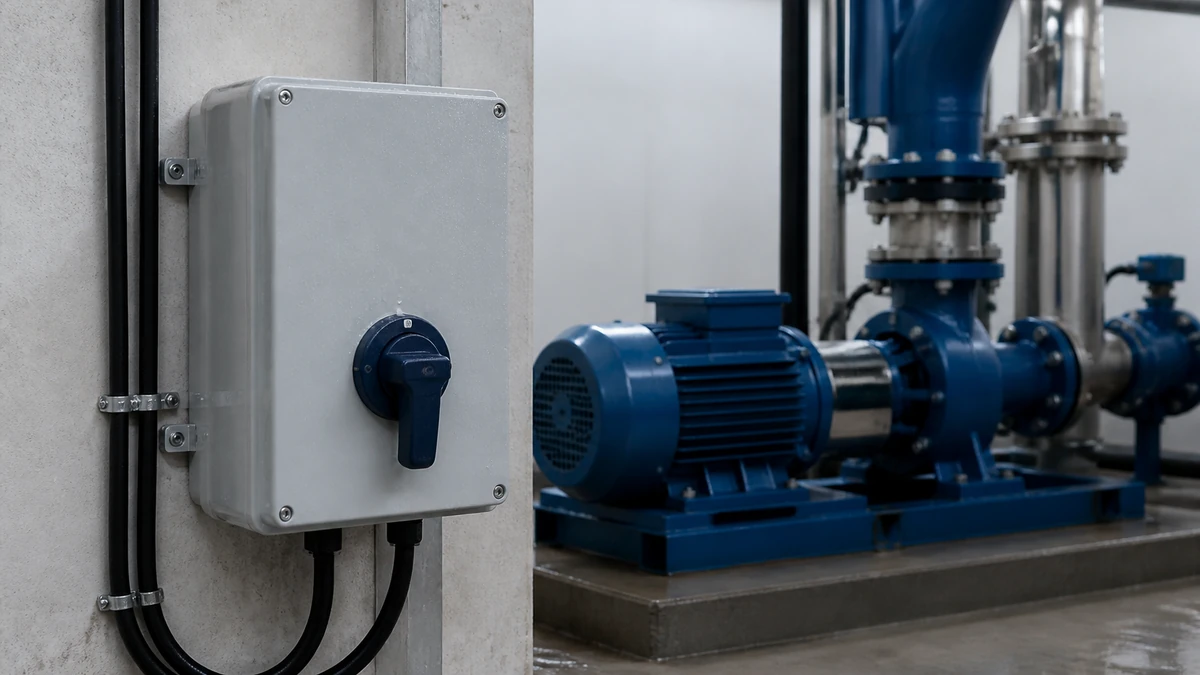
A pump isolator switch box belongs at the local service point where the pump or water-system subassembly needs a visible, accessible isolation interface for maintenance and commissioning.
This article focuses on the enclosure service inputs that affect selection: pump load information, cable routing, sealing path, mounting position, handle access, and documentation. For a product-family starting point, see the waterproof isolator box range. For a general concept overview, use the waterproof isolator box basics.
An exact drawing identifies the interfaces that must be controlled for the approved model route.
The decision is local isolation, not only product appearance
Outdoor-equipment builders, pump-panel teams, HVAC integrators, contractors, and distributors often compare similar-looking boxes. The important commercial question is whether the selected route matches the actual pump enclosure environment and service workflow.
A compact box may be convenient, but entry geometry, gasket compression, handle clearance, and cable bend space can decide whether it is practical. These points should be checked before order confirmation.
Do not treat this as a repeat of SH30 basics
If your team needs the product-level foundation, refer to the SH30 weatherproof isolator box guide. This article instead owns the pre-quotation checks around pump-enclosure service inputs.
The distinction matters for procurement. A basic product page can show a construction route, while a pump package still needs load data, mounting location, entry plan, documentation requirements, and installation assumptions confirmed.
Choose the isolation role before choosing the box route
The first buyer decision is whether the pump isolator switch is being used as a local service isolation interface for one pump, a packaged skid, or an auxiliary water-system section.
A pump isolator switch should not be specified as overcurrent protection. If the system requires protective functions, those are selected and validated separately by the panel or system designer according to the complete electrical design and applicable requirements.
Common local-isolation use cases
Use the role statement to prevent a vague RFQ. “Pump isolation” can mean different physical and documentation needs depending on the equipment boundary.
Buyer situation
What to confirm before quoting
ما أهمية ذلك
Single pump near an outdoor skid
Local mounting face, cable direction, voltage/current, handle access
Keeps the box practical for service near the pump
Pump set with control panel nearby
Whether the local isolator is upstream or local to one pump branch
Avoids selecting an enclosure route that does not match the wiring plan
Aligns installation position with maintenance workflow
Distributor stock inquiry
Target model family, common current range, documentation expectations, market
Prevents buying a generic box that lacks required project paperwork
Buyer action list
State the isolation role in one sentence on the RFQ.
Identify whether the box serves one pump, a packaged subassembly, or a local service point near a panel.
Provide AC or DC duty, voltage, current, phase arrangement where relevant, and frequency where applicable.
Confirm whether the handle must be accessible from a specific service side.
Keep any protective-device selection separate from the isolator switch box specification.
Match the switch route to pump load and duty information
The correct route depends on the exact pump duty information and the documented capability of the selected model, not on the enclosure shape alone.
Pump loads can involve motor starting conditions, wet-location installation assumptions, and service-access expectations. The buyer should provide enough data for Shieldhz to compare the request against current product documentation.
Sample review should connect the exact item to its current drawing and requested evidence package.
Load data to collect before RFQ
A short load checklist improves quotation accuracy and reduces back-and-forth. It also helps distributors avoid offering a box that later fails a drawing review.
Pump-load checklist
Pump quantity served by the local isolator switch box.
AC or DC duty.
Rated voltage and current for the intended equipment.
Phase arrangement where applicable.
Motor or pump nameplate data available to the buyer.
Required handle position and service access direction.
Any buyer-specified documentation, destination-market, or project approval requirement.
When a different route may be needed
A different model route may be required if the buyer’s load, voltage, entry size, or documentation requirement does not match the first product idea. This is normal in commercial pump packages.
Do not lock the part number based only on a photo or previous order. Confirm against the current drawing, datasheet, and certificate set for the exact model under review.
Cable-entry and gasket checks decide whether local isolation remains practical
Cable entry should be treated as a primary selection item because sealing and serviceability depend on the entry route, gland interface, gasket path, and installation practice.
For a focused foundation on entry details, use the weatherproof switch-box cable-entry guide. The pump-specific point is to confirm the entry plan against the installed equipment before freezing the quote.
Cable-entry decision table
Cable-entry question
Practical buyer check
Commercial impact
Bottom, side, or rear entry?
Match cable approach from pump, panel, or conduit route
Affects drilling, gland choice, bend radius, and installed appearance
One cable or multiple cables?
Count supply and outgoing cables required by the design
May change enclosure size or entry layout
Factory entry or installer-prepared entry?
Ask which openings are part of the offered model and which are installation work
Prevents mismatch between drawing and site expectation
Gland size and cable diameter?
Provide cable outside diameter and gland type if already specified
Helps avoid undersized or poorly sealed entries
Gasket path near entry area?
Check that entries do not interfere with cover sealing surfaces
Protects the intended sealing route after installation
Drainage and splash direction?
Review installed orientation and water exposure
Helps align enclosure position with application conditions
Entry-route checklist for pump packages
Mark cable approach direction on a simple sketch or photo.
Confirm whether conduit, cable gland, or buyer-specified fitting is expected.
Check that cable bend space is available after mounting.
Keep drilling or modification assumptions explicit in the RFQ.
Avoid placing entries where they may compromise gasket seating or cover closure.
Confirm whether the installer or supplier is responsible for entry preparation.
Enclosure exposure, IP evidence, and mounting location
The IP requirement should be selected from the real exposure and then verified against the exact product and installation conditions.
IEC identifies IEC 60529 as the IP Code for degrees of protection provided by enclosures in its IEC 60529 listing. A rating still depends on the exact product and installation conditions. For a practical comparison of IP levels, see the IP65, IP66 and IP67 enclosure guide.
Installation conditions change the product-route and document questions a buyer must resolve.
Exposure inputs to define
Water-system equipment can see rain, hose-down practice, condensation, splash, UV exposure, vibration from pump operation, and service handling. These conditions are not identical across irrigation equipment, HVAC plantrooms, packaged pump skids, and outdoor filtration assemblies.
The buyer should define exposure in plain language and, where required, state the requested IP level. Shieldhz can then compare the request against model-specific documentation rather than assuming one enclosure route fits every site.
Mounting location table
Mounting location
Check before selection
Risk if ignored
Pump skid frame
Vibration, cable approach, handle clearance, service side
Handle may be hard to reach or cable bend may be tight
Splash, standing water possibility, impact exposure
Location may be unsuitable for the requested documentation route
HVAC equipment room
Condensation, service aisle, labeling and access
Box may be hidden or difficult to operate
Distributor stock use
Common mounting patterns and documentation package
Stock may not match project-specific drawing needs
Handle access, labeling, and service workflow
The handle position should be checked from the technician’s working position, not only from the front view of the box drawing.
A pump isolator switch box is often chosen for local visibility and service convenience. If the handle is blocked by pipework, a frame member, a cabinet door, or a cable bend, the installation may be awkward even when the electrical data looks acceptable.
Handle and access checklist
Confirm the normal operator standing position.
Check that the handle can be reached after pipes, guards, and cable glands are installed.
Verify cover opening clearance where inspection or service access is expected.
Define labeling text, language, or symbol requirements if the buyer has a project standard.
Confirm whether the handle orientation is fixed by the selected model or installation arrangement.
Keep lockout or service-control expectations explicit and model-dependent.
Labeling and service boundaries
Labeling should identify the equipment served by the local isolator. In pump sets, this is especially important when multiple motors, valves, heaters, or auxiliary devices are nearby.
Any lockable-handle, color, or operator-feature request must be checked against the exact model documentation. Selecting a handle option does not, by itself, validate the complete electrical or machine risk-control design.
How Shieldhz confirms a weatherproof isolator switch box route
Shieldhz confirms a weatherproof isolator switch box route by checking the buyer’s load, isolation role, enclosure exposure, cable-entry plan, mounting needs, and requested documentation against current product information.
This is a pre-quotation confirmation step. It helps align the commercial offer with the buyer’s pump enclosure design before drawings and procurement approvals become harder to change.
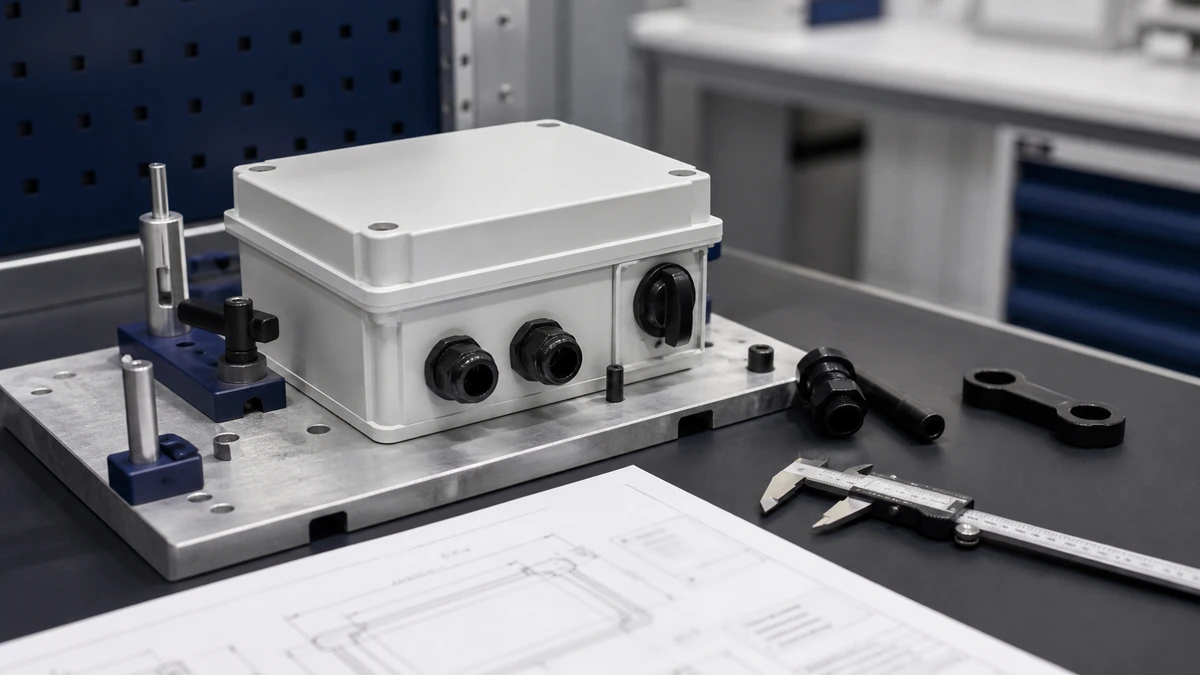
Documentation control, sample acceptance and protective packing are separate handover checks.
Pre-quotation confirmation inputs
Shieldhz typically needs the following inputs to review a pump isolator switch request:
Load and isolation role: what equipment the local isolator serves and where it sits in the buyer’s system.
AC/DC duty: whether the application is AC or DC and any duty information the buyer can provide.
الجهد/التيار: the required electrical values for the intended pump or water-system equipment.
Enclosure exposure: indoor, outdoor, splash, rain, washdown expectation, condensation, or other buyer-defined conditions.
متطلبات IP: the requested IP level, if the project or destination market specifies one.
Cable entry and gasket route: cable direction, gland or conduit expectation, entry count, and any gasket-interference concern.
Mounting and handle access: mounting face, fixing expectation, service side, and handle clearance.
Requested documentation package: drawing, datasheet, and certificate requirements for the exact model and destination market.
Confirmation output
After reviewing the inputs, Shieldhz can propose a model route or identify missing information. The quotation can then reference the required drawing, datasheet, and certificate package where available for that exact product route.
Final suitability is confirmed against current product documentation and the buyer’s application. The buyer remains responsible for checking the complete equipment design, installation method, and destination-market requirements.
Documentation and procurement checks before release
Procurement should release the order only after the part route, drawing revision, datasheet, and requested certificate package match the pump project requirements.
For contractors and distributors, the documentation step is often where a generic enquiry becomes a controlled purchase. A correct-looking enclosure is not enough if the drawing, entry plan, or project paperwork is different from what the buyer must submit.
Documentation decision table
Procurement item
What to request
ما أهمية ذلك
Model identification
Exact model or proposed model route
Prevents quotation ambiguity
الرسم
Current drawing for the product route under review
Confirms size, mounting, entry assumptions, and handle layout
ورقة البيانات
Current datasheet for the selected model
Confirms documented electrical and enclosure information
Certificate package
Requested certificate documents, if required for the destination market
Supports buyer project review where applicable
Entry details
Entry location, gland expectation, or installer-prepared opening note
Avoids site mismatch
Packaging or labeling request
Buyer-specific requirements, if any
Prevents late commercial changes
Purchase-release checklist
Match the quotation model to the drawing and datasheet.
Confirm voltage, current, and duty information are still the same as the engineering request.
Check that cable-entry assumptions are stated.
Confirm the requested IP level is supported by the exact documentation route and installation assumptions.
Verify destination-market document requirements before order release.
Keep any site modification or installer responsibility clearly assigned.
Commercial specification template for pump-package RFQs
A concise RFQ template helps buyers compare offers without reducing the pump isolator switch box to a generic enclosure line item.
The goal is not to overload the supplier with unnecessary paperwork. The goal is to provide enough technical and commercial detail to confirm the correct route quickly.
RFQ fields to include
Use the following structure when sending a pump isolator switch enquiry:
RFQ field
Buyer entry
Project or equipment type
Pump skid, HVAC water loop, filtration unit, irrigation package, or other
Isolation role
Local isolation for which pump or subassembly
AC/DC duty
Buyer to state
الجهد والتيار
Buyer to state
Mounting location
Frame, panel side, wall, machine enclosure, or other
Exposure
Outdoor rain, splash, indoor condensation, hose-down expectation, or other
Prototype, pilot build, project buy, distributor stock, or other
What to avoid in the RFQ
Avoid vague phrases such as “waterproof box for pump” without load and entry details. Also avoid assuming that a previous part number covers a new destination market, new cable size, or different mounting location.
A better RFQ states the engineering role and the commercial documentation requirement together. That lets Shieldhz check the proposed route before the buyer commits the panel layout or pump skid design.
Conclusion
A pump isolator switch box is a local service-isolation decision as much as a product selection. For water systems, the important checks are the load and isolation role, AC/DC duty, voltage and current, enclosure exposure, requested IP level, cable-entry route, gasket path, mounting face, handle access, and documentation package.
The strongest procurement route is to confirm these inputs before quotation release. Final selection should always be checked against the exact model drawing, datasheet, certificate package, installation conditions, and the buyer’s complete application.
الأسئلة الشائعة
What is the main purpose of a pump isolator switch box?
It provides a local isolation interface near the pump or water-system equipment so service teams can identify and operate the intended isolation point. Its exact use must match the buyer’s electrical design and product documentation.
Is a pump isolator switch the same as overcurrent protection?
No. A pump isolator switch should not be specified as overcurrent protection. Protective functions are selected separately as part of the complete electrical design.
What information should I send before asking for a quotation?
Send the isolation role, AC/DC duty, voltage, current, pump or equipment data, mounting location, exposure, requested IP level, cable-entry plan, handle-access needs, and documentation requirements. A sketch or photo of the intended mounting area is often useful.
Why are cable-entry details so important?
Cable entry affects sealing, installation time, cable bend space, and whether the cover and gasket route remain practical after installation. Entry direction and gland expectations should be confirmed before the model route is fixed.
Can one IP rating be assumed for all installations?
No. IP evidence depends on the exact product and installation conditions. The requested IP level should be checked against current documentation and the buyer’s installed environment.
What documents should procurement request before order release?
Request the current drawing, datasheet, and any required certificate package for the exact model route. Also confirm that the quotation, documentation, electrical values, entry assumptions, and destination-market requirements all match.
شي، موكسي
يكتب شي، موكسي مقالات شيلدهز الفنية لمشتري التحكم الصناعي والمكونات الكهربائية، والتي تغطي مفاتيح الكامات الدوارة، ومفاتيح العازل، ومفاتيح فصل التيار المستمر الكهروضوئية، وأزرار الضغط، وأضواء المؤشر، والحاويات المقاومة للماء، والكتل الطرفية. تستند المقالات على خبرة شركة Zhejiang Shihe Electric Co., Ltd. في التصنيع والتصدير، مع التركيز العملي على اختيار الطراز وأوراق البيانات والرسومات والشهادات وتصنيفات IP وتفاصيل الاستفسار التي يجب على المشترين التأكد منها قبل الطلب.