Industrial Control Component OEM vs ODM: Scope, Documentation, and Brand-Control Questions
Use a practical buyer checklist to evaluate industrial control component OEM vs ODM inputs, documentation, approval controls and the exact industrial control component portfolio route.
The practical difference in an industrial control component OEM vs ODM decision is who controls the product route, drawing evidence, markings, approval records, and future change decisions.
Confirm the exact product family, model route, destination market, and buyer application before comparing OEM and ODM offers.
Request current drawings, datasheets, marking artwork, approval evidence, and change-control expectations before treating two quotations as equivalent.
Do not approve a supplier model only from catalog appearance; approve it from documented scope, exact-model evidence, and brand-control obligations.
OEM vs ODM in industrial control components: what is really being compared
OEM and ODM are not just label choices; they allocate control over product definition, documentation, branding, and future change approval.
In a commercial investigation, the buyer should compare the supplier model as an approval route. The same visible component category can involve different drawings, markings, packaging, certificates, and revision controls depending on the exact model and agreed supply scope.
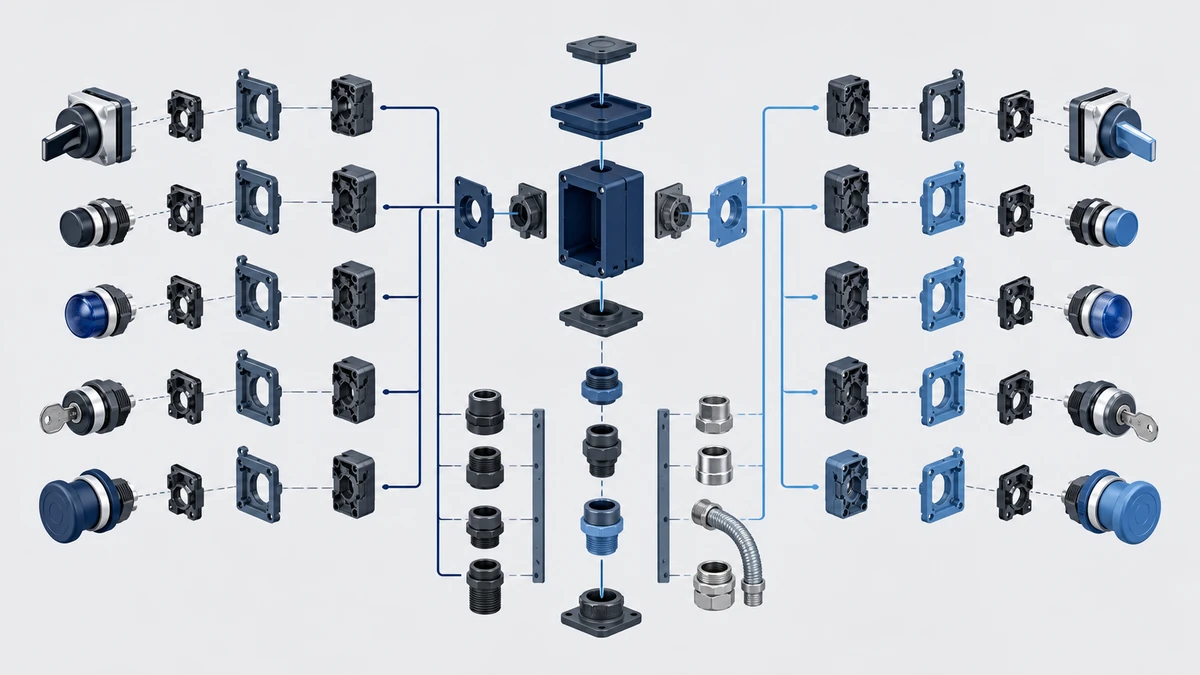
An exact drawing identifies the interfaces that must be controlled for the approved model route.
The buyer decision behind the acronym
An OEM route usually keeps stronger buyer control over product definition, private drawings, branding rules, and engineering approval gates. It can be appropriate where the component must match a buyer-controlled design, panel layout, installation practice, or documented bill of materials.
An ODM route usually starts from a supplier-controlled product platform or catalog route. It can be appropriate where the buyer accepts the supplier’s existing product architecture, subject to exact-model documentation, destination-market requirements, and agreed branding limits.
What should not be assumed
Do not assume that either route automatically changes electrical ratings, ingress protection, endurance, approvals, MOQ, lead time, or application fit. Those points depend on the exact model, drawing, datasheet, certificate, buyer application, and destination market.
A useful starting point is to map the intended product family against the Shieldhz industrial control component range, then narrow the discussion to the exact model route and requested evidence.
Decision point
OEM route tends to suit
ODM route tends to suit
Evidence to request
Product definition
Buyer-defined form, marking, or configuration
Supplier platform accepted with limited changes
Drawing, datasheet, model code
Brand control
Buyer needs private label or controlled artwork
Buyer accepts supplier or agreed neutral presentation
Marking layout, packaging artwork
Approval ownership
Buyer maintains internal approval file
Buyer relies more on supplier documentation package
Certificates, declarations, test or inspection records where applicable
Change control
Buyer must approve changes before release
Supplier controls platform changes under agreed notice terms
Revision history, change-notification terms
Commercial comparison
Not directly comparable without engineering review
Not directly comparable without evidence review
Quotation scope and exceptions
When an OEM route is the stronger commercial choice
Choose an OEM route when the buyer must control the component identity, design evidence, markings, or approval record as part of its own machine, panel, or distribution program.
OEM can be the stronger route when the component is not just purchased as an item, but approved as part of a buyer-controlled product system. The commercial value is control: what is marked, what is documented, what can change, and who must approve that change.
Strong OEM triggers
OEM discussion is usually justified when the buyer has fixed internal drawings, approved-vendor lists, panel cut-outs, harness interfaces, or labeling standards. It is also relevant when procurement wants alternate supply while engineering still needs one controlled product record.
Use this route when branding and documentation must match the buyer’s own downstream responsibilities. That may include private-label markings, packaging identity, traceability expectations, or drawing numbers referenced in customer-facing documentation.
OEM approval checklist
Before asking for an OEM quotation, prepare the approval package clearly:
Target product family and exact intended function.
Buyer drawing, reference model, or required dimensional envelope.
Electrical and mechanical inputs, including installation environment assumptions.
Destination market and required documentation language or marking content.
Branding, packaging, and label-control requirements.
Required approval records and internal review milestones.
Sample approval process and change-control expectations.
An OEM route should not be treated as a shortcut around technical approval. It usually increases the need to document what is buyer-controlled and what remains supplier-controlled.
When an ODM route is the stronger commercial choice
Choose an ODM route when a supplier-controlled product platform can satisfy the buyer’s application review with acceptable documentation, markings, and change-control terms.
ODM can reduce engineering definition work for buyers who do not need a private product architecture. The buyer still needs to confirm exact-model suitability, because supplier-platform acceptance is not the same as blanket approval for every rating, option, or destination market.
Strong ODM triggers
ODM is often suitable when the buyer wants to adopt an existing catalog model, standard operating style, or established mechanical format. It can also suit distributors and panel builders who need documented product selection rather than custom product definition.
This route is strongest when the supplier’s existing drawing, datasheet, and marking approach are acceptable. Any requested change to color, handle, engraving, packaging, or label content should be checked against the supplier’s allowed model route before quotation.
ODM verification checklist
Before approving an ODM offer, verify:
Exact model code and option route, not just the product family.
Current datasheet and drawing revision.
Marking content and whether buyer branding is requested.
Destination-market documentation needed for the buyer’s file.
Application limits stated in the current product documentation.
Whether samples will match the quoted production route.
How future product revisions are communicated.
ODM does not remove the buyer’s engineering responsibility. It narrows the decision to whether an existing product route can be documented and controlled well enough for the buyer’s application.
Scope boundaries by product family and standard reference
Scope should be confirmed by product family, exact model, and intended circuit role before any OEM or ODM route is approved.
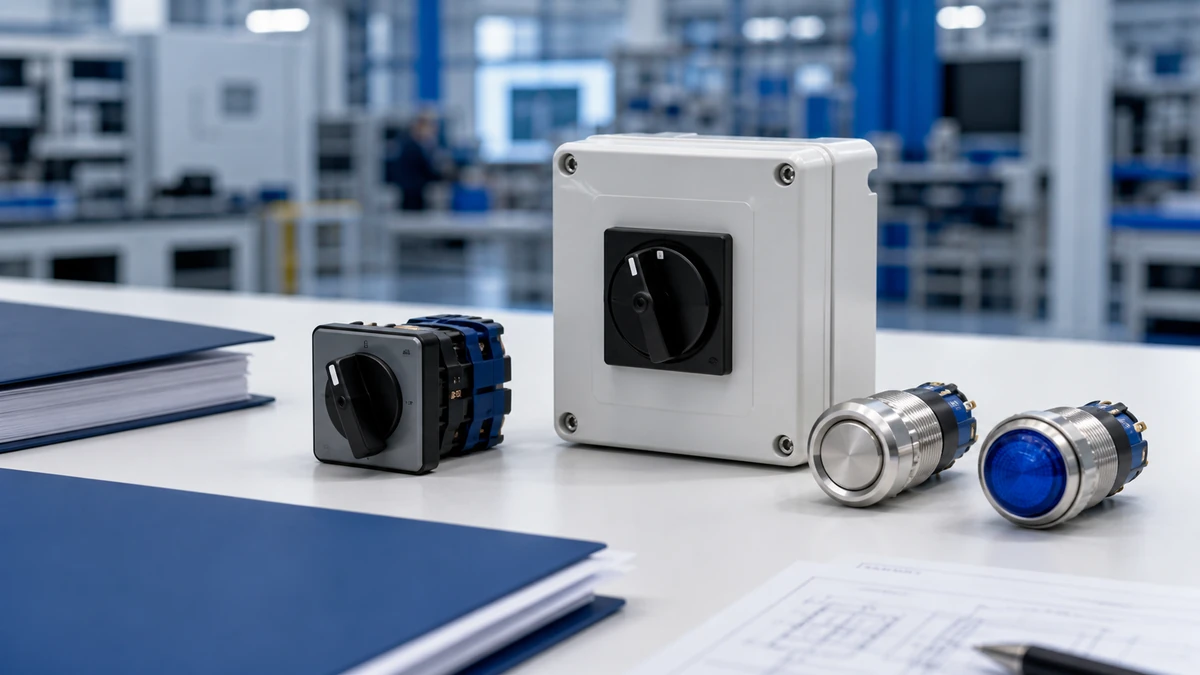
A supplier-model comparison is only useful when the product family is correctly identified. A rotary cam switch, PV DC isolator, push button, indicator, or enclosure-mounted isolator solution should be reviewed against its own documentation and intended use.
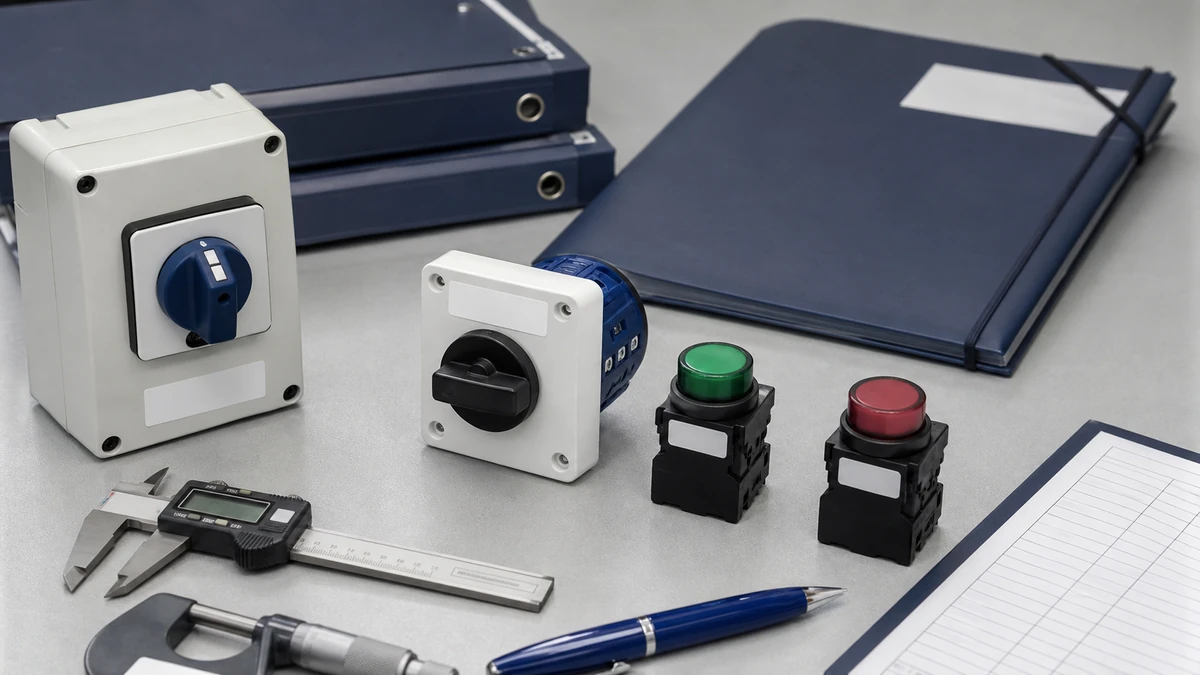
Sample review should connect the exact item to its current drawing and requested evidence package.
Do not treat these categories as interchangeable. Electrical role, installation method, operator access, environment, and documentation needs vary by exact model and buyer application.
IEC scope boundary
إن IEC 60947-3 scope describes this scope as switches, disconnectors, switch-disconnectors and fuse-combination units within stated distribution- and motor-circuit AC/DC limits. Referencing that scope is not the same as claiming that a specific model has a specific certification or is suitable for a specific installation.
Selecting an operator, including an emergency-stop style operator where relevant, does not validate a complete machine safety function. Machine safety validation depends on the complete safety-related control system, risk assessment, architecture, diagnostics, installation, and applicable standards for the buyer’s equipment.
Product discussion
Key boundary question
Documentation to confirm
مفتاح كاميرا دوارة
What switching sequence, poles, positions, and panel interface are required?
Model code, contact diagram, drawing, datasheet
عازل التيار المستمر الكهروضوئي
What DC application assumptions and installation conditions apply?
Exact model datasheet, marking, certificate where applicable
Push button or indicator
What operator type, contact arrangement, color, marking, and panel cut-out are required?
Which markings are buyer-owned and which are supplier-controlled?
Artwork approval, label drawing, revision record
Documentation and approval evidence to request before quotation
Request documentation before price comparison, because a lower quotation is not comparable if the model route, marking, or approval evidence is different.
For industrial control components, commercial review and engineering review should run together. Procurement may compare price, but engineering should first confirm that both offers refer to the same scope of supply and the same evidence level.
Core documentation package
A practical pre-quotation documentation request may include:
Exact model code and option description.
Current datasheet.
Dimensional drawing and panel cut-out information where applicable.
Electrical configuration or contact diagram where applicable.
Marking layout, nameplate content, and packaging artwork if branded supply is requested.
Certificate, declaration, or approval record where applicable to the exact model and market.
Installation or wiring information where provided for the exact model.
Revision status and sample approval record.
The word “applicable” matters. Documentation availability and content depend on the exact product, destination market, buyer application, and agreed route.
Evidence-quality checklist
When reviewing supplier evidence, check whether it is:
Exact-model specific, not only product-family level.
Current revision, not an obsolete file.
Consistent across drawing, datasheet, label, and quotation.
Relevant to the buyer’s destination market.
Clear about options and exclusions.
Matched to the sample that will be evaluated.
Usable in the buyer’s internal approval file.
If two suppliers provide different evidence levels, the offers are not yet commercially equivalent. The buyer may need to assign engineering risk, documentation workload, and approval time as part of the cost comparison.
Brand-control questions that decide the supplier model
Brand control decides whether the buyer is purchasing a supplier-identified component, a private-label component, or a buyer-controlled product record.
In an industrial control component OEM vs ODM decision, branding is not only a logo question. Markings can affect identification, traceability, documentation matching, and downstream customer approval.
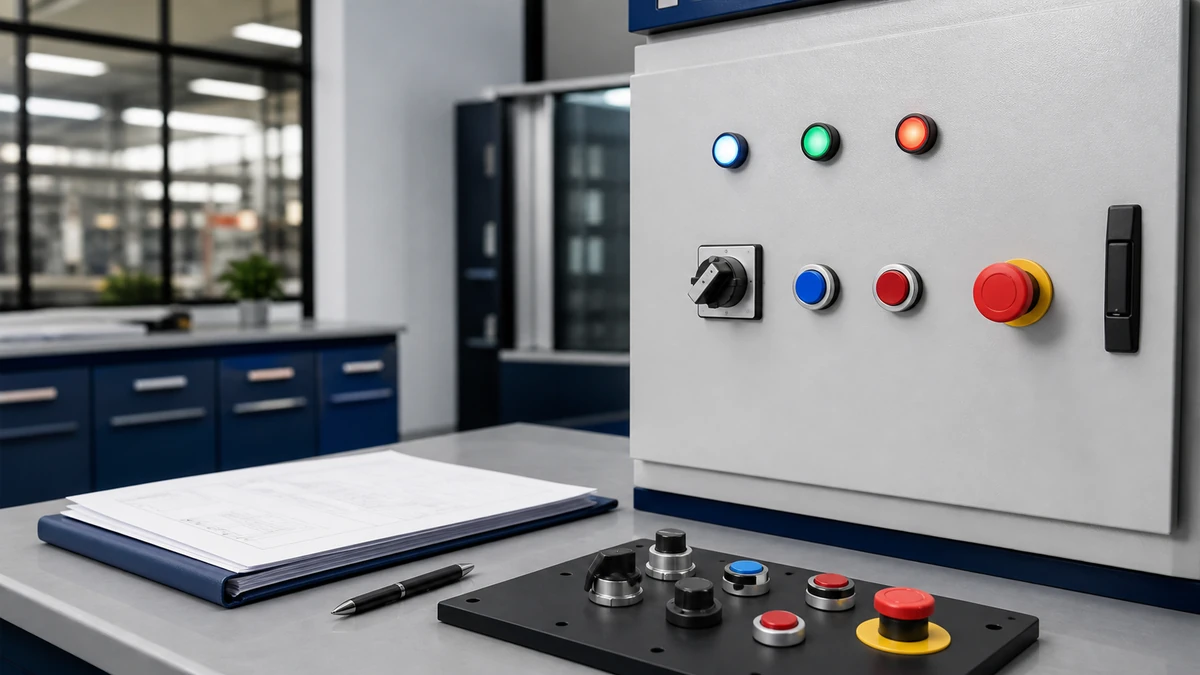
Installation conditions change the product-route and document questions a buyer must resolve.
Marking and packaging control
Clarify which items are fixed by the product route and which can be buyer-defined. This can include product label text, logo placement, rating plate format, packaging label, instruction sheet identity, and carton markings.
Do not assume that all marking requests are possible on every model. Marking content must remain consistent with current product documentation, applicable evidence, and destination-market requirements.
Change-control questions
Brand control also affects future changes. If the buyer’s brand is on the product, the buyer should know how changes to drawings, components, labels, packaging, or documentation will be handled.
Ask these questions before approval:
Who owns the released artwork?
Who approves changes to marking content?
What drawing revision is tied to the approved sample?
What happens if the supplier updates the base product platform?
How are substitutions, discontinued options, or tooling changes communicated?
Which documents must be updated before shipment under the buyer’s brand?
Brand-control issue
Buyer risk if unclear
Practical approval action
Logo and label ownership
Incorrect or inconsistent downstream identification
Approve artwork before sample sign-off
Rating or model marking
Mismatch between product and documentation
Cross-check label against datasheet and quotation
Packaging identity
Wrong brand presentation to customer or distributor
Approve packaging files and carton labels
Revision control
Buyer receives a changed product without internal review
Define change-notification and reapproval triggers
Certificate reference
Buyer cites evidence that does not match the supplied model
Confirm exact model and market relevance
How Shieldhz confirms a industrial control component portfolio route
Shieldhz confirms the route by aligning the buyer’s application, exact product family, model documentation, marking needs, and commercial handover requirements before quotation.
The goal is not to make a generic capacity claim. The goal is to establish whether the requested OEM or ODM route can be reviewed against current product documentation and the buyer’s application.
Documentation control, sample acceptance and protective packing are separate handover checks.
Pre-quotation confirmation inputs
A practical confirmation starts with the buyer’s application and destination market. Shieldhz then needs the product family and exact model route, or enough technical input to narrow the route before documentation is discussed.
The confirmation should include:
Application description and equipment context.
Destination market and any buyer-specified documentation needs.
Product family and intended exact model route.
Electrical inputs such as circuit role, poles, positions, voltage/current assumptions, and load context where applicable.
Mechanical inputs such as mounting, cut-out, enclosure arrangement, operator access, and dimensional limits.
Requested documents, including drawing, datasheet, marking artwork, certificate, declaration, or inspection record where applicable.
Buyer approval records, sample sign-off expectations, and internal qualification steps.
Marking and brand-control requirements.
Sample, revision, and change-control expectations.
Commercial handover requirements, including quotation line scope, packaging, labeling, and document delivery format.
Final suitability is confirmed against current product documentation and the buyer’s application. If the buyer’s application changes, the route should be reviewed again before approval.
Handover from engineering review to quotation
The quotation should reflect the same route that engineering reviewed. If the quote uses a different model code, marking plan, packaging scope, or documentation package, it should not be treated as approved.
A clean handover normally records the exact model route, approved documents, requested branding, sample status, and exceptions. This helps procurement compare offers without separating price from technical scope.
Quotation comparison matrix for procurement and engineering approval
Compare OEM and ODM quotations only after normalizing the product route, documentation package, branding scope, and change-control terms.
A quotation that looks less expensive may carry more buyer-side work if drawings, certificates, artwork, or sample approval steps are incomplete. A quotation that looks more expensive may include documentation or branding work that another quote excludes.
Commercial comparison table
Comparison item
Quote A review question
Quote B review question
Buyer action
Exact model
Is the model code fully stated?
Is the model code fully stated?
Reject vague family-only comparisons
التوثيق
Are current drawings and datasheets included?
Are current drawings and datasheets included?
Normalize the document package
Branding
Is private label included or excluded?
Is private label included or excluded?
Compare artwork and marking scope
Approval evidence
Is evidence exact-model and market-relevant?
Is evidence exact-model and market-relevant?
Request missing evidence before approval
Samples
Will samples match the quoted route?
Will samples match the quoted route?
Tie sample approval to the quote revision
Change control
Are reapproval triggers defined?
Are reapproval triggers defined?
Add change terms before release
Commercial scope
Are packaging, labels, and documents included?
Are packaging, labels, and documents included?
Compare total landed approval workload
Procurement action list
Use this sequence before releasing a purchase order:
Confirm the buyer application and destination market.
Freeze the product family and exact model route for comparison.
Request drawing, datasheet, marking, and approval evidence.
Confirm whether the route is OEM, ODM, or a limited branding variation.
Approve samples only if they match the quoted route.
Record required documents as part of the commercial handover.
Define change-notification and reapproval triggers.
Keep the quotation, documents, and sample approval record together.
The best supplier-model decision is the one that procurement, engineering, and quality can all defend from the same file.
Conclusion
An industrial control component OEM vs ODM decision is mainly a control decision. OEM can suit buyer-controlled product identity, drawings, markings, and approval files. ODM can suit adoption of an existing supplier platform when the exact model, documentation, and change-control route are acceptable.
Do not compare offers only by price or catalog appearance. Compare exact model route, current documentation, destination-market evidence, branding scope, sample approval, and change-control terms. Final approval should always be made against current product documentation and the buyer’s actual application.
الأسئلة الشائعة
Is OEM always better than ODM for industrial control components?
No. OEM is stronger when the buyer needs control over product identity, drawings, branding, or approval records. ODM can be stronger when an existing supplier-controlled model route meets the buyer’s application review and documentation needs.
Can a buyer approve an ODM component only from a catalog page?
A catalog page is usually not enough for a controlled engineering approval. The buyer should confirm the exact model code, current datasheet, drawing, markings, destination-market evidence where applicable, and sample route.
Does private labeling make a product an OEM product?
Not always. Private labeling may be a branding variation on an ODM route, or it may be part of a buyer-controlled OEM route. The distinction depends on who controls the product definition, drawings, markings, approval record, and change process.
What documentation should procurement request before comparing quotes?
Procurement should request the exact model code, datasheet, drawing, marking artwork if relevant, approval evidence where applicable, sample conditions, packaging scope, and change-control terms. Quotes should not be treated as equivalent until these items are aligned.
Does selecting an emergency-stop operator validate machine safety?
No. Selecting an operator does not validate a complete machine safety function. The full safety function depends on the complete system design, risk assessment, installation, diagnostics, validation, and applicable machine-safety requirements.
Who confirms final suitability: the supplier or the buyer?
The supplier can provide product documentation, model-route confirmation, and agreed commercial scope. Final suitability must be confirmed against current product documentation and the buyer’s application, including destination-market and system-level requirements.
شي، موكسي
يكتب شي، موكسي مقالات شيلدهز الفنية لمشتري التحكم الصناعي والمكونات الكهربائية، والتي تغطي مفاتيح الكامات الدوارة، ومفاتيح العازل، ومفاتيح فصل التيار المستمر الكهروضوئية، وأزرار الضغط، وأضواء المؤشر، والحاويات المقاومة للماء، والكتل الطرفية. تستند المقالات على خبرة شركة Zhejiang Shihe Electric Co., Ltd. في التصنيع والتصدير، مع التركيز العملي على اختيار الطراز وأوراق البيانات والرسومات والشهادات وتصنيفات IP وتفاصيل الاستفسار التي يجب على المشترين التأكد منها قبل الطلب.