وثائق قاطع التيار المستمر للطاقة الكهروضوئية: القيم الاسمية والرسومات والشهادات
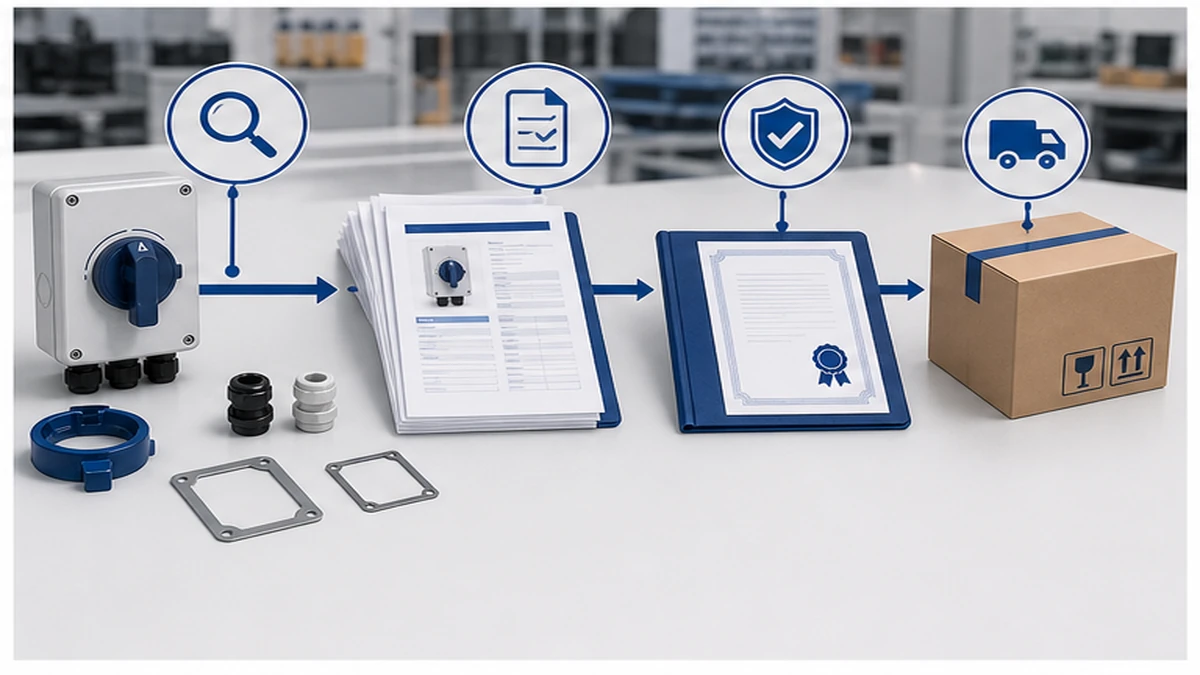
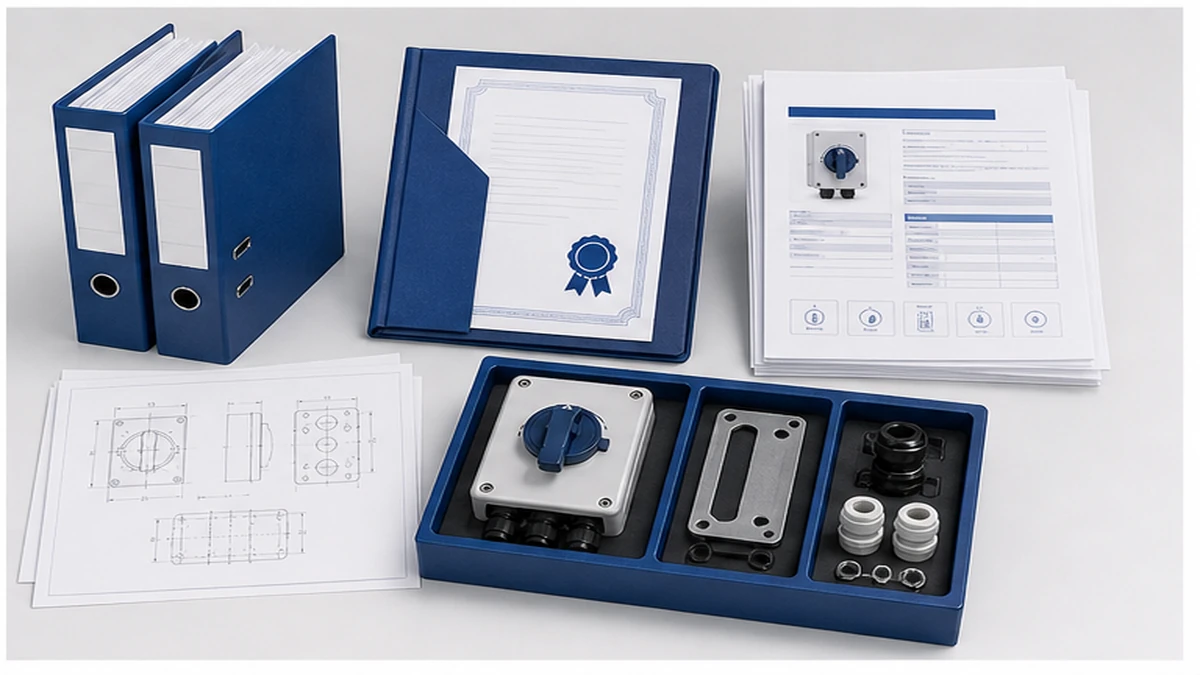
يجب أن تثبت الوثائق الخاصة بفاصل التيار المستمر للأنظمة الكهروضوئية نطاق الطراز الدقيق من خلال أوراق البيانات، والرسومات، ومخططات الأسلاك، والشهادات، والإقرارات.
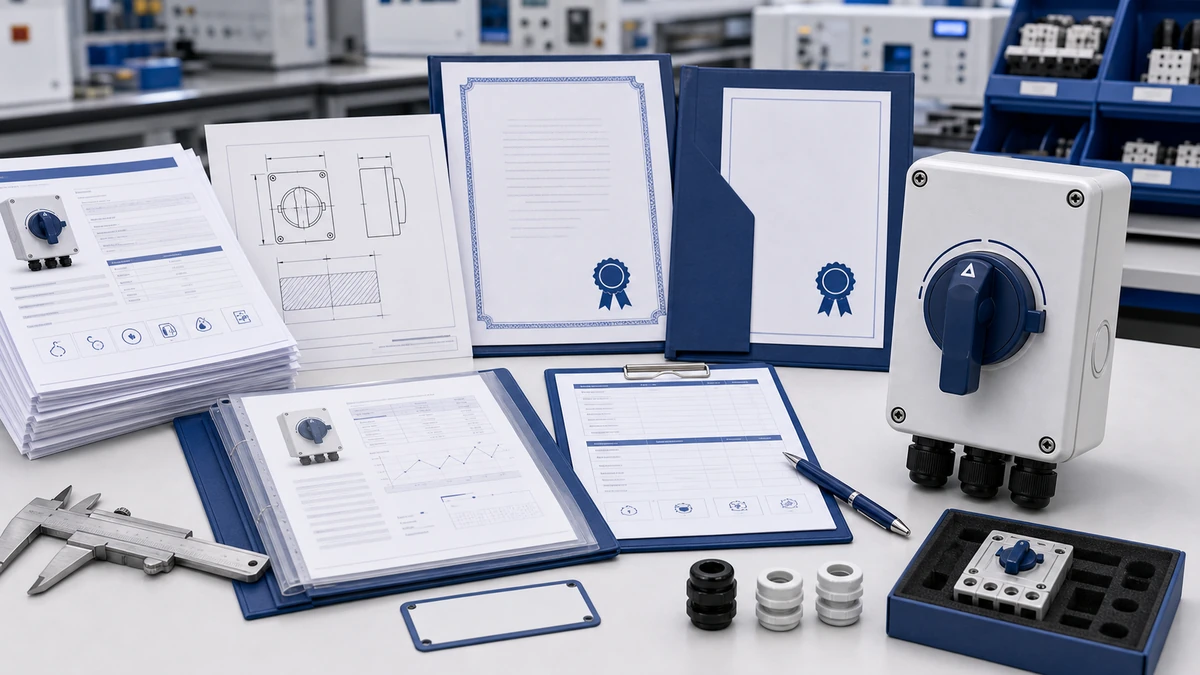
When specifying a PV DC isolator for a solar energy system, the supporting documentation matters as much as the hardware. The minimum document set for a compliant installation includes the electrical ratings datasheet, dimensional drawing, wiring diagram, type-test certificate, and Declaration of Conformity. Together these confirm rated DC voltage, rated current, pole configuration, utilization category, IP enclosure class, and compliance with the current switch-disconnector standard edition — the governing standard for switches, disconnectors, switch-disconnectors, and fuse-combination units for distribution and motor circuits, with rated voltage up to 1000 V AC or 1500 V DC. This guide explains what each document must contain, how to read and authenticate it, and what a complete package looks like in practice.
Document boundary: A Declaration of Conformity is not the same thing as a type-test report, certificate, drawing, or datasheet. Buyers should match each document to the exact model, rating, enclosure route, and certificate scope instead of treating one document as a substitute for the complete technical file.
What Manufacturer Documents Should You Request for a PV DC Isolator?
For any grid-tied PV installation, five documents form the baseline procurement requirement.
Electrical ratings datasheet. Must state rated operational voltage (Ue), rated current in amperes, utilization category, rated insulation voltage (Ui), and rated impulse withstand voltage (Uimp). For string-level isolators on residential systems, ratings commonly fall in the 32 A to 63 A range at 1000 V DC. Utility-scale combiner applications may require 1500 V DC, and not all the switch-disconnector standard certified models extend to that voltage tier — confirm explicitly.
Dimensional drawing. Must include panel cutout dimensions in millimetres, mounting hole pattern, actuator shaft depth, and overall body depth behind the panel face. Installers fitting isolators into enclosures with limited internal clearance require this data before procurement to avoid rework. Confirm the drawing revision matches the production batch, because tooling changes between product generations can alter cutout requirements.
Wiring diagram. Must show pole count, contact sequence, and explicit DC+ / DC- labeling. An unlabeled or generic schematic does not satisfy IEC 60364-7-712 requirements during commissioning sign-off.
IEC type-test certificate. Confirms third-party laboratory testing to the applicable standard. The certificate must name the exact model number, not a product family umbrella, and must be cross-referenceable to the issuing laboratory’s public register.
Declaration of Conformity. Lists the assessed standards, the notified body or testing laboratory, and the specific model covered. A DoC without an underlying test report is a self-issued document and carries limited evidential weight on its own.
How to Read and Verify PV DC Isolator Ratings on a Datasheet
Once you hold the full document set, interpreting each parameter correctly is critical. A value misread at this stage can result in an undersized or non-compliant isolator reaching site.
Maximum DC Voltage (VDC max)
Defines the highest system open-circuit voltage the isolator can safely interrupt. Residential string inverter systems typically operate at 600 V DC or 1000 V DC; utility-scale PV systems frequently require 1500 V DC. Confirm this parameter against the array maximum open-circuit voltage calculated under standard test conditions, not nominal operating voltage.
Rated Current (In)
The continuous current the device can carry without exceeding its thermal limits. Common values are 16 A, 25 A, 32 A, and 63 A, but the datasheet governs — do not assume. Cross-check against the string short-circuit current (Isc), applying a 1.25 safety factor per IEC 60364-7-712 where required by the project’s design standard.
فئة الاستخدام
the switch-disconnector standard defines utilization categories for switch-disconnectors operating in DC circuits. For PV applications, category DC-PV2 covers switching under load, which is the standard duty for string-level and combiner-level isolators in most grid-tied systems. Category DC-PV1 applies to back-of-module locations where switching under load is not the primary duty. Always confirm which category the datasheet references — absence of DC-PV2 coverage is a disqualifier for most rooftop string applications.
جهد العزل المقدر (Ui)
Must equal or exceed the system maximum DC voltage. A device with Ui = 1000 V DC is not suitable for a 1500 V DC string without an explicit certificate covering the higher voltage tier. Note that Ui and the rated operational voltage (Ue) are separate parameters — a datasheet listing only one is incomplete for compliance evaluation.
IP Enclosure Rating
Datasheets reference IEC 60529. Outdoor rooftop locations typically require IP65 minimum; directly exposed combiner box environments often specify IP67. Importantly, the IP rating on a datasheet describes the isolator body. Confirm separately that the same IP class applies to the cable entry points and actuator seal — these are distinct test points on the physical unit. For background on how IP rating grades are defined and tested, see IP rating reference.
تكوين الأعمدة
A 2-pole isolator breaks both the positive and negative conductors simultaneously. IEC 60364-7-712 recommends this configuration for ungrounded PV systems. Confirm the pole count matches the system earthing arrangement before finalizing the order.
Certifications Listed on the Datasheet
Look for TUV, CE, or equivalent marks accompanied by the applicable standard number — not generic logos alone. Verify that the certification body issued the mark against the exact model number, not a broader product family. If a certification mark appears without a certificate number, treat it as unverified until the test report is supplied.
Datasheet review checklist for field engineers:
Cross-check Ui and VDC max separately. Some datasheets list insulation voltage higher than the rated operational voltage, which can mislead buyers into accepting an undersized switch for high-voltage strings.
When a datasheet lists only DC-PV1, ask explicitly whether DC-PV2 under-load switching has been tested and certified.
If a certification mark appears without a traceable certificate number, request the test report before committing to the order.
Confirm IP rating covers the cable entry and actuator seal, not only the switch body.
Dimensional Drawings and Wiring Diagrams: What Buyers Must Check Before Ordering
Dimensional drawings are where specification errors most commonly translate into on-site delays. Missing or ambiguous drawing data is one of the most frequent causes of installation rework, particularly when panel cutout dimensions, busbar clearances, or terminal wiring sequences cannot be confirmed before components arrive.
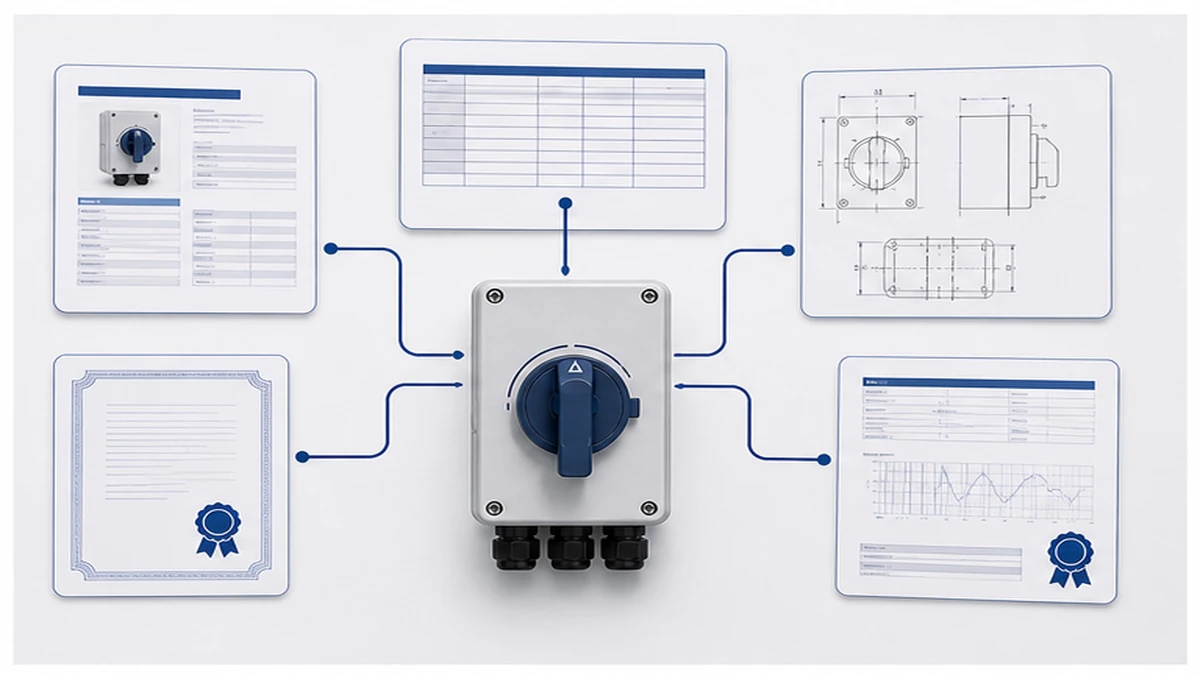
الشكل 2. يجب أن تربط فحوصات الاختيار جهد التيار المستمر، وتيار السلسلة، وعدد الأعمدة، والحاوية، ومدخل الكابل، والوثائق.
The table below identifies the minimum content a dimensional drawing package should contain, alongside the gaps most commonly found in low-quality supplier datasheets.
Drawing Element
Minimum Required Content
Common Gap in Low-Quality Datasheets
Overall dimensions
Length x width x depth in mm with tolerance
Dimensions listed without tolerances or in non-SI units only
حجم فتحة اللوحة
Exact cutout dimensions in mm
Cutout omitted or described only as “standard”
Mounting hole spacing
Center-to-center distance in mm
Missing or inconsistent with physical product
Terminal block layout
Numbered terminal positions, wire entry direction, conductor size range in mm2
Terminals shown without numbering or polarity indication
مخطط الأسلاك
Pole count, contact sequence, DC+ / DC- labeling per IEC 60364-7-712
Generic schematic without DC polarity marking
IP rating reference
IP class per IEC 60529, linked to enclosure drawing
IP rating stated in text only, no enclosure drawing reference
Cable entry specification
Entry diameter in mm and compatible gland or conduit type
Entry points shown without dimensions
If a datasheet omits even one element from the table above — particularly the wiring diagram or cutout size — request a supplemental drawing before confirming the order. Terminal torque values and conductor cross-section range are two additional items that installation teams rely on to meet commissioning documentation requirements; their absence should also prompt a drawing request.
For a practical comparison of complete versus incomplete drawing packages, the full DC isolator switch range page shows how model-level documentation is structured for the GF series, providing a useful audit baseline when reviewing an alternative supplier’s materials.
Which Certificates Are Mandatory for a PV DC Isolator — and How to Authenticate Them
Certificate verification is a procurement prerequisite, not an afterthought. The two primary standards referenced across most market certification frameworks are the switch-disconnector standard for disconnectors and switch-disconnectors, and IEC 60529 for enclosure ingress protection. The full text of المنشور الرسمي الخاص بمفصلات التبديل التابعة للجنة الكهربائية الدولية (IEC) is maintained at the IEC web store for reference. For a concise explanation of the standard’s scope and how it applies to DC switching equipment, see switch-disconnector standard reference.
Mandatory Certificate Types by Destination Market
CE Marking. Required for EU markets. Declares conformity with the Low Voltage Directive 2014/35/EU and the EMC Directive 2014/30/EU. Verify via the EU Declaration of Conformity, which must name the specific model, the assessed directives and standards, and the issuing entity.
TUV or VDE Test Certificate. Common in German and broader European utility-scale projects. Confirms third-party laboratory testing to the switch-disconnector standard. Distinguish this from a self-issued CE declaration — TUV and VDE marks involve independent testing to the standard, not only a manufacturer assertion.
CCC (China Compulsory Certification). Mandatory for products sold within China; administered by CNCA. The certificate scope must cover the exact model and rated voltage.
UKCA Marking. Required for Great Britain markets post-Brexit. Replaces CE for products placed on the GB market and references equivalent UK-adopted standards.
SAA / RCM Marking. Required for Australia and New Zealand. Grid-connected PV installations in those markets must also reference AS/NZS 5033. Confirm SAA certification covers the exact model and DC voltage class specified.
UL 98B. Required for North American DC switch installations up to 1000 V DC. Note that UL 98B scope does not automatically extend to 1500 V DC applications — confirm the certificate explicitly.
Certificate Authentication Checklist
Confirm the certificate names the exact model number — not a product family umbrella.
Verify rated operational voltage and rated current on the certificate match your system design requirements.
Check the certificate issue date and expiry. Most third-party certificates are valid for 3 to 5 years; an expired certificate does not confirm current production compliance.
Cross-reference the certificate number on the issuing body’s public database. TUV Rheinland, Bureau Veritas, and SGS all maintain searchable online registers. This step takes under five minutes and identifies the most common form of document fraud in the supply chain.
Confirm IP rating is declared within the certificate or an accompanying test report, not only in marketing text.
Request the original type-test report, not only the certificate cover page. The test report documents specific test conditions, voltage and current levels tested, and pass/fail results for each applicable clause.
Authentication notes for procurement teams:
When a supplier provides a CE Declaration of Conformity but cannot produce the underlying test report, treat the declaration as unverified. DoCs are self-issued and carry no independent evidential weight without a third-party test record.
A certificate issued for a 1000 V DC model does not automatically extend to a 1500 V DC variant in the same product family, even if model codes appear similar. Require a separate certificate for the higher voltage tier.
For projects targeting multiple export markets, request certificates in the correct language from the outset. Retrofitting translated documentation after shipment can delay grid-connection approval by weeks.
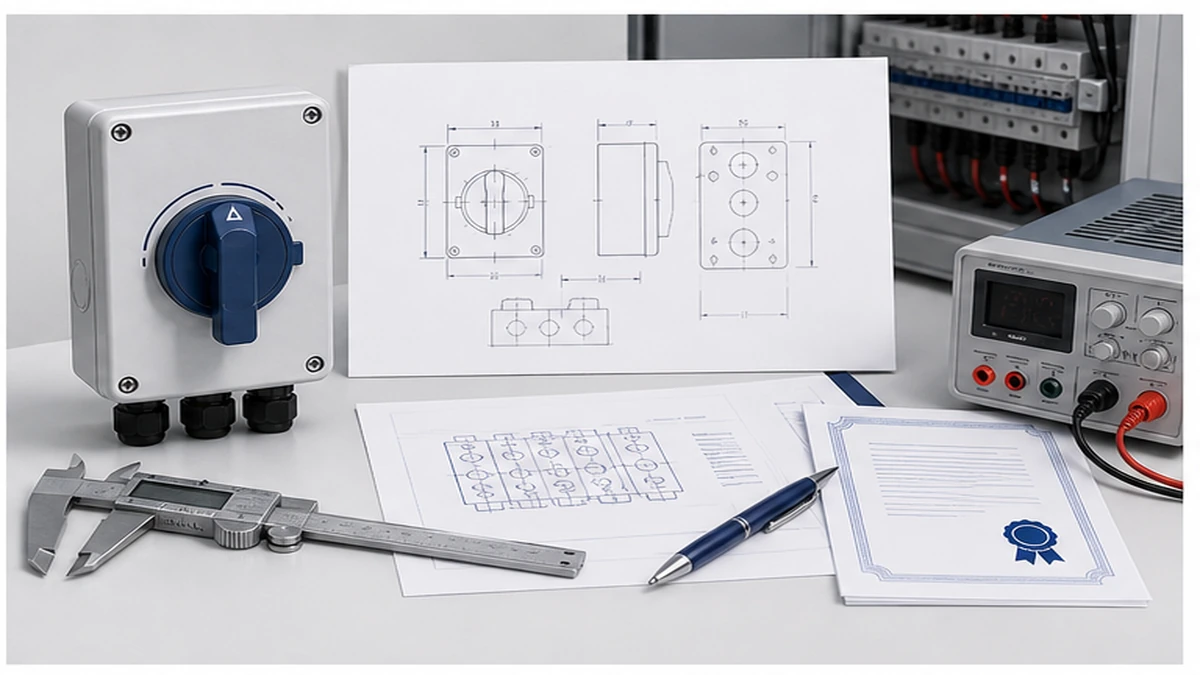
الشكل 3. يجب التحقق من سياق الأسلاك التطبيقية بالمقارنة مع مخطط التلامس الخاص بالشركة المصنعة قبل التنشيط.
Comparing PV DC Isolator Document Packages: Tier-1 Manufacturer vs. Budget Supplier
The documentation package accompanying a PV DC isolator directly determines whether an installation will pass inspection and whether a warranty or liability claim can be substantiated in the field. The table below compares what a complete Tier-1 package contains against common shortfalls from budget suppliers.
Document Category
Tier-1 Manufacturer
Budget Supplier
Ratings datasheet
Full datasheet: rated voltage, rated current, utilization category, breaking capacity, IP rating per IEC 60529
Basic spec sheet; voltage and current values often unverified by third-party test
Certificate scope
the switch-disconnector standard type-test certificate with traceable test report reference and certificate number
Self-declaration or photocopied certificate; no test report available
Drawing quality
Dimensioned outline drawing with tolerances, wiring schematic, panel cutout template, terminal conductor size range
Generic dimensional sketch; no cutout template; conductor size range absent
Traceability
Certificate number links to test laboratory, test date, and confirmed model code; batch code traceable on unit
No batch traceability; certificate cannot be cross-referenced to the specific unit
Compliance standard referenced
the switch-disconnector standard, IEC 60529, and applicable regional standards listed with evidence
Standards often unlisted or listed without test evidence
Language availability
English plus local market language; dual-language certificates common for export
Single language; may not match installation country documentation requirements
In rooftop and ground-mount PV systems, a missing or non-traceable certificate can trigger re-inspection fees and project schedule delays. Budget suppliers frequently omit contact wiring diagrams and terminal conductor specifications — two details that installation teams rely on when completing commissioning sign-off under IEC 60364-7-712. Buyers reviewing candidate models should request the complete document package before purchase and cross-check certificate numbers against the issuing body’s online register to confirm authenticity.
الشكل 4. يجب أن يتضمن الاستفسار الكامل التصنيف وتسلسل التلامس والتركيب والحاوية ومتطلبات المستند.
How Shieldhz Prepares and Delivers the Full Document Package for PV DC Isolators
Shieldhz is the export brand of Zhejiang Shihe Electric Co., Ltd., established in 2014 in Yueqing, Wenzhou, Zhejiang Province. The company operates a 5,000+ m2 manufacturing facility with 100+ employees and 40+ production machines. Certifications held across the product range include ISO 9001, CE, TUV, RoHS, CCC, CB, UKCA, and UL where applicable to specific models and markets.
For PV DC isolator inquiries, Shieldhz follows a defined documentation workflow from the initial inquiry through to delivery.
Step 1 — Inquiry and model confirmation. When a buyer submits an inquiry, Shieldhz’s engineering team requests the operating DC voltage, maximum string current, pole count, enclosure IP requirement, mounting constraints, and target installation market. These inputs determine the appropriate model route — for example, whether the GF40 series, GF41 series, or GF51 series best fits the application — and which certification documentation is required for the destination market.
Step 2 — Drawing and datasheet preparation. Once the model is confirmed, Shieldhz prepares dimensional drawings showing cutout dimensions, mounting hole pattern, and terminal clearance, alongside a per-model datasheet listing rated insulation voltage (Ui), rated operational current (In), utilization category, and IP class, all referenced to the switch-disconnector standard. Buyers can specify at this stage whether single-line diagrams or wiring schematics are needed for permit submission packages.
Step 3 — Certificate package compilation. Shieldhz compiles the applicable test certificates — which may include TUV, CE, SAA, or CCC documentation depending on the confirmed destination market — along with RoHS declarations and the switch-disconnector standard test reports. Each certificate is cross-referenced to the confirmed model number and rated voltage to prevent mismatches during audit. Certificate numbers are provided so buyers can independently verify them against the issuing laboratory’s public register before the order is placed.
Step 4 — Document handover and post-sale support. The complete document package is delivered digitally within an agreed lead time tied to the order confirmation. For project-specific requirements such as custom labeling, additional witness test reports, or translated documentation for a specific regulatory authority, Shieldhz coordinates requirements through the engineering team before production is confirmed — not after shipment.
Buyers can submit an inquiry specifying the following inputs to receive a matched document pack:
Target operating voltage and maximum string current
Pole count and required switching positions
Enclosure IP rating requirement
Applicable certification market and any regional authority requirement
Mounting constraints or known panel cutout dimensions
الأسئلة الشائعة
What is the minimum IP rating a PV DC isolator must have for outdoor rooftop installation?
Most rooftop string applications require at least IP65, which provides protection against dust ingress and low-pressure water jets from any direction. Directly exposed combiner box environments or installations subject to regular washdown often specify IP67. Confirm the actual site exposure conditions and the project’s applicable installation standard before selecting a model, and verify that the IP rating covers the cable entry points and actuator seal as well as the switch body.
Can a 1000 V DC certified isolator be used in a 1500 V DC utility-scale PV system?
No. A device certified only to 1000 V DC cannot be substituted in a 1500 V DC system without a separate type-test certificate explicitly covering the higher voltage tier. Operating an undersized isolator at elevated string voltages creates arc-flash and insulation failure risk, voids the product warranty, and compromises the installation’s compliance status. Require a certificate that names 1500 V DC as the rated operational voltage before specifying the model.
What is the difference between utilization categories DC-PV1 and DC-PV2?
DC-PV1 applies to isolators installed at the back of PV modules where switching under load is not the primary duty. DC-PV2 covers isolators required to make and break current under full load conditions, which is the standard expectation for string-level and combiner-level isolators in most grid-tied systems. If a datasheet lists only DC-PV1, ask the manufacturer explicitly whether DC-PV2 under-load switching has been type-tested and certified before proceeding.
How do I verify that a CE mark on a PV DC isolator is genuine?
Request the EU Declaration of Conformity, which must name the specific model number, the assessed directives, the applicable standards, and the issuing entity. Then cross-reference the listed test certificate number against the issuing laboratory’s public database. TUV Rheinland, Bureau Veritas, and SGS all maintain searchable online registers. A CE mark without a traceable certificate number or without an underlying test report should be treated as unverified for procurement purposes.
Why do some datasheets list rated operational voltage and rated insulation voltage separately?
Rated operational voltage (Ue) is the voltage at which the device performs its specified switching duty. Rated insulation voltage (Ui) is the dielectric withstand level used as the basis for insulation and impulse testing. Ui must equal or exceed Ue, but they are separate parameters tested under different conditions. A datasheet listing only one of these values is incomplete for compliance evaluation — request clarification from the manufacturer if either is absent.
What drawing data should I request if the manufacturer’s public datasheet does not include a panel cutout template?
Request a dimensioned outline drawing that states the exact cutout diameter or rectangular cutout dimensions in millimetres with machining tolerances, the actuator body depth behind the panel face, the terminal block clearance dimensions, and the cable entry diameter with compatible gland or conduit type. These four items are the minimum needed to confirm mechanical fit before an enclosure is drilled or ordered.
Does a Declaration of Conformity replace the the switch-disconnector standard type-test report?
No. A Declaration of Conformity is a manufacturer-issued self-declaration of compliance. For procurement and project audit purposes, the original type-test report from the accredited laboratory is the authoritative document. The test report records specific test conditions, voltage and current levels applied, the clauses evaluated, and pass/fail results against each. Always request the test report in addition to the DoC, particularly for projects where third-party inspection or grid-connection sign-off is required. For an overview of what the switch-disconnector standard covers and how it applies to PV DC isolation duty, see the ما هو مفتاح عزل التيار المستمر الكهروضوئي reference page.
شي، موكسي
يكتب شي، موكسي مقالات شيلدهز الفنية لمشتري التحكم الصناعي والمكونات الكهربائية، والتي تغطي مفاتيح الكامات الدوارة، ومفاتيح العازل، ومفاتيح فصل التيار المستمر الكهروضوئية، وأزرار الضغط، وأضواء المؤشر، والحاويات المقاومة للماء، والكتل الطرفية. تستند المقالات على خبرة شركة Zhejiang Shihe Electric Co., Ltd. في التصنيع والتصدير، مع التركيز العملي على اختيار الطراز وأوراق البيانات والرسومات والشهادات وتصنيفات IP وتفاصيل الاستفسار التي يجب على المشترين التأكد منها قبل الطلب.