Контрольный список для запроса информации о солнечных разъединителях постоянного тока для фотоэлектрических проектов
Предложения по солнечным разъединителям постоянного тока становятся актуальными после указания данных о фотоэлектрической цепочке, требований к корпусу, категории, сертификатов и сведений о монтаже.
A complete solar DC isolator quote must confirm the rated operational voltage, rated current, pole count, IP ingress protection class, applicable certifications, enclosure material, and mounting dimensions. Without these parameters confirmed in writing before order, procurement errors and compliance failures are common on PV projects of every scale. This checklist walks PV installers, panel builders, and OEM buyers through every parameter that must appear on a credible quotation — from electrical ratings and utilization category through certification scope, enclosure selection, and the documentation package that project engineers and financiers require before installation proceeds.
Scope boundary: This quote checklist is a model-confirmation tool, not a replacement for the product page or a generic price list. Final ratings, cable entry, enclosure route, certificate scope, and lead time confirmed after model and documentation review should be confirmed against the current Shieldhz datasheet, drawing, and order documentation.
Electrical Ratings and Utilization Category
Key PV Electrical Parameters to Specify
Before raising a quotation request, confirm the following values from your module datasheets and system design documents.
Voc (open-circuit voltage): The maximum DC voltage the string produces under standard test conditions. Always apply a cold-temperature correction — in many climates the corrected Voc at the lowest expected ambient temperature can exceed the STC value by 10 to 15 percent. The isolator’s rated insulation voltage (Ui) must meet or exceed this corrected figure, not the inverter MPPT operating range.
Vmax (maximum system voltage): Common PV system voltage tiers are 600 V DC, 1,000 V DC, and 1,500 V DC. Confirm which tier your installation standard requires before specifying any isolator.
Isc (short-circuit current): The maximum current a string can produce. The isolator’s rated current must cover this value with appropriate margin per your installation standard.
Iop (operating current): Continuous load current under normal irradiance. Both Isc and Iop must appear on the quotation as the basis for current-rating selection.
System Voltage Tiers and Isolator Rating Reference
System Voltage Tier
Typical Corrected Voc
Minimum Isolator Ui
Typical String Isc
Reference Isolator Current Range
600 V DC
Up to 600 V
600 V DC
8 to 12 A
16 A to 25 A
1,000 V DC
Up to 1,000 V
1,000 V DC
8 to 15 A
16 A to 32 A
1,500 V DC
Up to 1,500 V
1,500 V DC
10 to 18 A
25 A to 40 A
Ratings in this table are reference ranges only. Always confirm the corrected Voc and Isc from your specific module datasheet and applicable local installation standard before finalising any quotation.
Utilization Category: Why It Must Appear on Every Quote
The utilization category under the switch-disconnector standard governs the making and breaking capacity a switch must demonstrate under defined circuit conditions. For PV string isolators, the relevant categories are DC-PV1 for grounded systems and DC-PV2 for ungrounded (floating) string circuits. DC-PV2 requires the device to interrupt both conductors against a higher arc-energy demand; substituting a DC-PV1 or AC-rated device in a DC-PV2 application introduces contact-welding risk under fault conditions. A quote that lists only AC ratings or omits the utilization category entirely is a disqualifying gap.
Figure 1. Core concept behind solar DC isolator quote checklist selection.
Pole Count and Arc Interruption
In an ungrounded DC PV string, a 2-pole isolator interrupts both positive and negative conductors simultaneously. Each pole must be rated to handle the arc energy associated with the voltage across its contact gap. For 1,000 V DC systems the contact geometry must manage the sustained DC arc that forms when the circuit opens — a requirement that distinguishes purpose-built DC isolators from repurposed AC devices. For floating systems, confirm that pole count matches the grounding configuration before ordering: an incorrect pole configuration fails inspection and may not be repairable in the field.
Certification requirements vary significantly by region. CE marking alone without an underlying IEC type-test report is insufficient for many commercial PV projects. Submitting a non-certified isolator to a local distributor, grid operator, or project financier commonly causes delays of weeks to months.
Certification
Управляющий орган
Primary Market
Key DC Isolator Requirement
стандарт на выключатели-разъединители
IEC
Global baseline
Making and breaking capacity at rated DC voltage; disconnection category
CE Marking (LVD + EMC)
European Commission
EU and EEA
Declaration of conformity against the switch-disconnector standard; Ui must cover system voltage
TUV Rheinland or TUV SUD
Independent test houses
EU, global export
Third-party type testing; commonly required by EPCs and project financiers
RCM
EESS and ACMA
Australia, New Zealand
Compliance with AS/NZS 3000 and AS/NZS 4777; RCM mark mandatory for supply
UL 98B
Underwriters Laboratories
USA, Canada
Enclosed switch listing for DC; breaking capacity tested at full DC voltage
ССС
CNCA and CQC
China domestic
Mandatory for grid-connected solar equipment sold in mainland China
Схема CB
IECEE
Multilateral
Facilitates mutual recognition across participating national bodies
The governing standard for switches and disconnectors in this product category is the current switch-disconnector standard edition, which applies to switches, disconnectors, switch-disconnectors, and fuse-combination units for distribution and motor circuits with rated voltage up to 1000 V AC or 1500 V DC. The current edition is published by the IEC at the официальная публикация МЭК по выключателям-разъединителям. For a focused explanation of how the switch-disconnector standard applies to isolator selection, see the switch-disconnector standard reference.
What a Complete Certification Package Looks Like
A credible quotation identifies the certification scope: which standard, which test laboratory, and which exact model number and variant is covered by each certificate. Always request the original certificate document and verify the certificate number against the issuing body’s online registry before order confirmation. For multi-region OEM supply, confirm the selected model carries both IEC third-party test reports and the regional mark required at the point of installation. A certificate issued for one pole count or voltage variant does not automatically extend to a different pole count or voltage tier within the same product series.
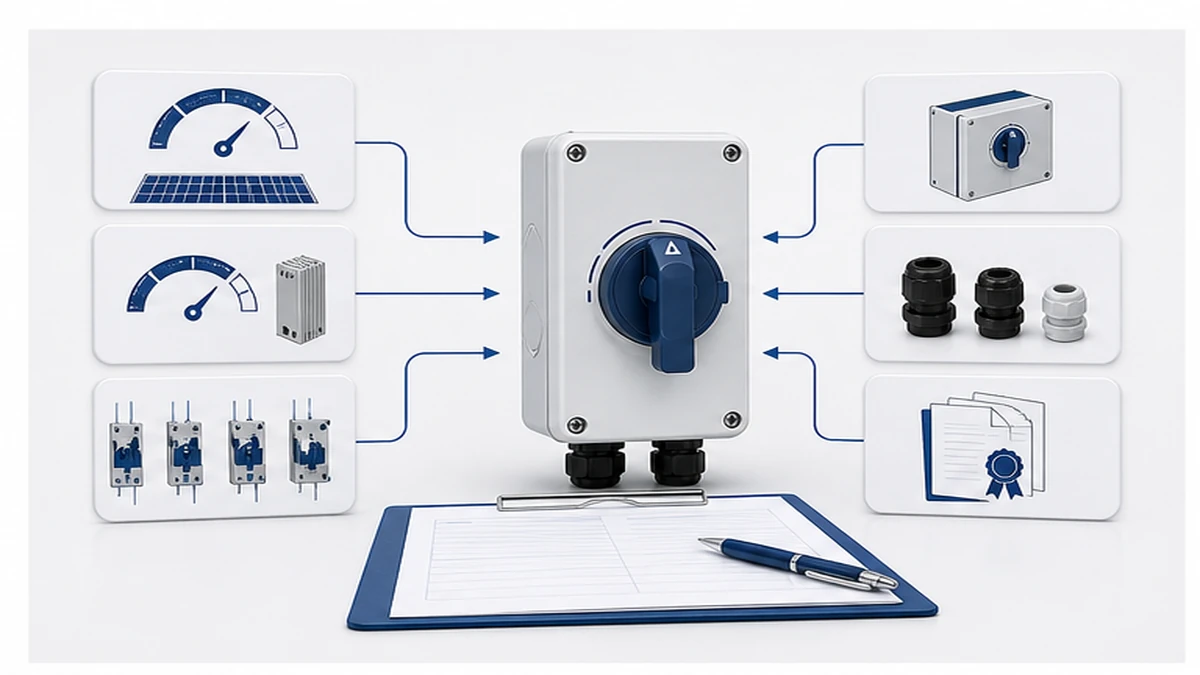
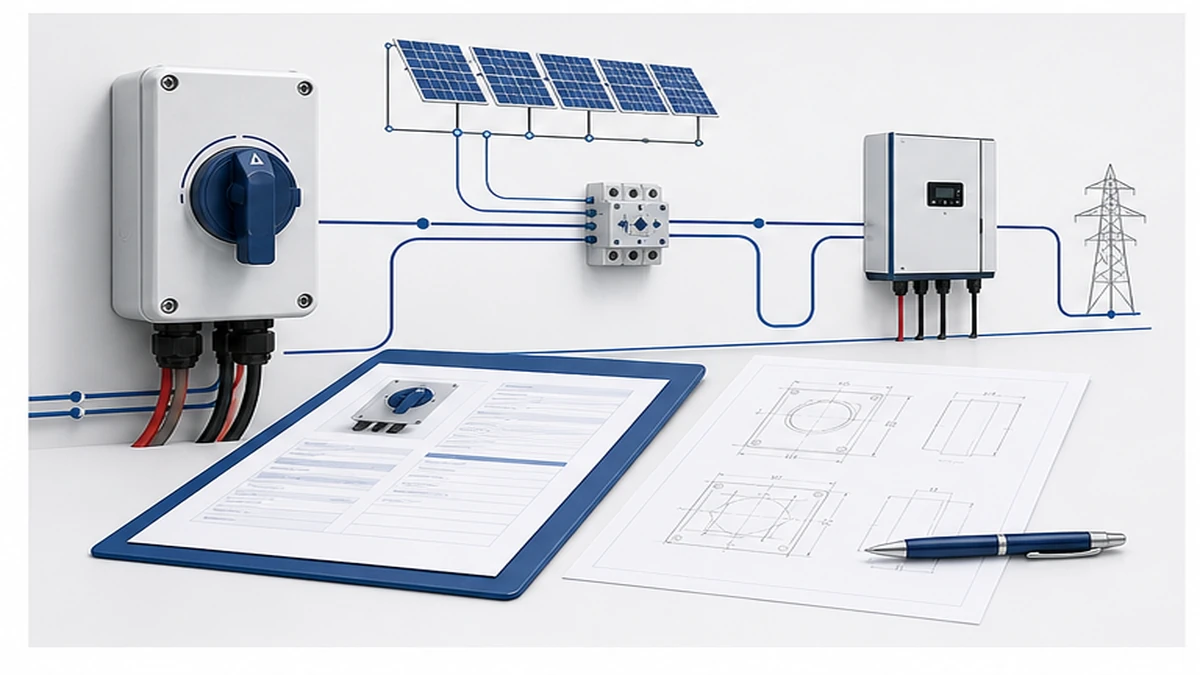
Рисунок 2. При выборе следует проверить постоянное напряжение, ток в сети, количество полюсов, корпус, кабельный ввод и документацию.
Enclosure, Ingress Protection, and Mounting Configuration
IP Rating Selection for PV Environments
IEC 60529 defines ingress protection using two digits: the first governs solid particle exclusion, the second governs liquid ingress. For solar DC isolators the minimum practical starting point for any direct outdoor installation is IP65, which provides complete dust exclusion and protection against low-pressure water jets from any direction. The IP rating differences article provides a reference for understanding how these levels map to installation environments.
Installations in coastal zones, monsoon climates, or ground-mount arrays subject to pressure washing should specify IP66. IP67 certifies temporary immersion to 1 m depth for up to 30 minutes, which is relevant where isolators are mounted near grade level or in regions with flash flooding. For utility-scale tracker systems where the isolator housing sits within 300 mm of the ground plane, IP67 is the more defensible selection.
Specifying only voltage and current while omitting IP rating commonly results in delivery of an IP20 panel-mount unit to a weatherproof application. The IP class must appear explicitly on the quotation, not be inferred from a product image or catalogue description.
Mounting Configuration Checklist
Confirm the following mechanical parameters before approving a quotation.
Surface mounting versus DIN rail: Most field-side DC isolators use direct surface mounting. Confirm back-box depth and screw boss pattern against your junction box or tracker chassis drawing.
Cable entry orientation: Top, bottom, or side conduit entry affects water ingress management at cable glands. Specify the gland thread size required based on conductor cross-section, typically M20 or M25 for string wiring in the range commonly used for residential and commercial PV installations.
Actuator handle clearance: Rotary or paddle handles require a minimum swing radius. Confirm panel cutout dimensions from the manufacturer’s dimensional drawing before fabricating any enclosure or mounting bracket.
Enclosure material and UV resistance: Polycarbonate and GRP compounds used in outdoor enclosures should confirm UV resistance per IEC 60068-2-5 to prevent embrittlement over a service life consistent with PV system design horizons.
Labelling surface area: IEC 62548 and regional installation standards require permanent warning labels at the isolator location. Confirm that the enclosure surface accommodates the required label area before ordering.
OEM and Volume Buyer Considerations
OEM Procurement Checklist
Volume and OEM buyers require additional confirmation beyond the electrical and mechanical parameters that apply to single-project procurement. The following fields must be resolved before a production order is placed.
Field
Key Questions to Confirm with Supplier
Custom Voltage Rating
Does the specific model variant support 1,000 V DC or 1,500 V DC? Confirm Ui and utilization category on the datasheet.
Label and Logo
Is private-label silk-screening or laser engraving available? Confirm minimum artwork file format and any tooling charges.
Packaging
Individual polybag, retail blister, or bulk carton? Specify EAN barcode requirement per unit if applicable.
MOQ
Confirm minimum order quantity for custom-labeled variants versus standard catalog items.
Lead Time
Confirm production lead time confirmed after model and documentation review from artwork approval and deposit confirmation for both standard and custom runs.
Sample Policy
Is a pre-production sample available before production commitment? Confirm sample charge and credit terms against the production order.
OEM buyers commonly require custom voltage ratings aligned to their inverter platform, private-label markings, regional-language warning labels, and packaging configured for kit assembly or retail distribution. Confirming these requirements in writing before issuing a purchase order prevents rework at volume.
Рисунок 3. Перед подачей напряжения необходимо сверить контекст подключения с контактной схемой производителя.
For buyers evaluating specific models, the Разъединительный выключатель постоянного тока GF40 PV, the GF41 solar DC switch, and the GF51 Разъединительный выключатель постоянного тока PV each cover distinct voltage, current, and pole configurations. Review the individual datasheets and confirm the utilization category, rated insulation voltage, and certificate scope against your project specification before adding any model to a bill of materials.
For utility-scale procurement, lead time confirmed after model and documentation review for customized DC isolators should be factored into procurement schedules well before installation mobilization. Requesting a pre-production sample rated to your target voltage and IP class allows incoming inspection to verify compliance before committing to full volume.
Common Quoting Mistakes and How to Avoid Them
Specifying Nominal Voltage Instead of Corrected Voc
Installers frequently request an isolator rated at the inverter MPPT operating voltage rather than the string maximum Voc under cold-temperature conditions. Module Voc increases as temperature falls, and the corrected value at the lowest expected ambient can exceed the STC figure by a meaningful margin. The isolator rated insulation voltage must meet or exceed this corrected maximum. Obtain the temperature coefficient of Voc from the module datasheet and apply the correction for your site’s design minimum temperature before specifying any isolator.
Omitting Utilization Category from the Specification
A quote that states only voltage and current without identifying the utilization category leaves the supplier unable to confirm whether the selected switch frame is appropriate for the circuit type. General-purpose DC switches rated for resistive loads may not provide the arc-interruption performance required for PV string disconnection. Ensure DC-PV1 or DC-PV2 appears explicitly in both the buyer’s specification and the supplier’s quotation response.
Incorrect Pole Count for the Grounding Configuration
A grounded negative configuration may require a 2-pole isolator switching only the positive conductor, while a floating system requires a 4-pole device switching all current-carrying conductors simultaneously. Requesting a DC isolator by voltage and current without pole count forces the supplier to assume, and an incorrect pole configuration fails commissioning inspection. Confirm the array grounding configuration from the system design before raising any procurement request.
Underspecifying the Enclosure IP Rating
Omitting IP rating from a quotation commonly results in delivery of a DIN rail mount device rated for indoor enclosures into an outdoor combiner application. IP65 is the generally accepted minimum for direct outdoor PV exposure. Confirm IP class on the datasheet and on the certificate, not only from a product photograph or catalogue thumbnail.
Requesting Certification Without Confirming Variant Coverage
A certificate covering one model variant within a product family does not automatically extend to different pole counts, voltage tiers, or current ratings within the same series. When reviewing a certification document, verify that the exact model number and variant being ordered — not just the product family name — appears within the scope of the certificate. Cross-check the certificate number against the issuing laboratory’s online registry.
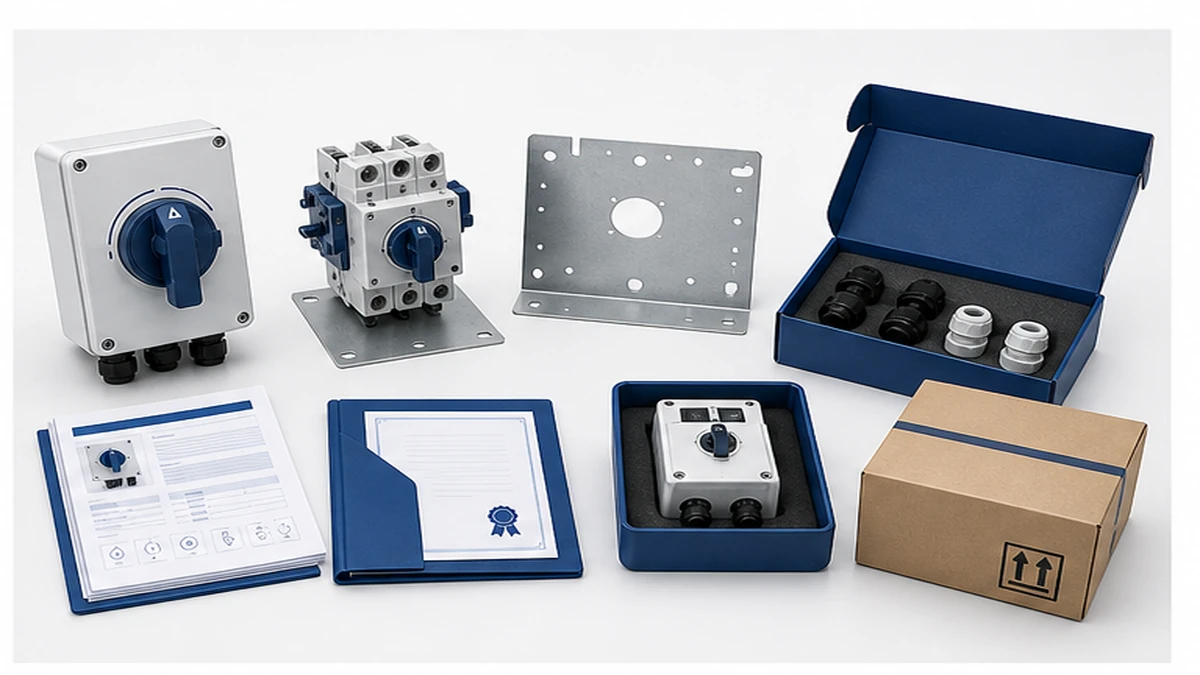
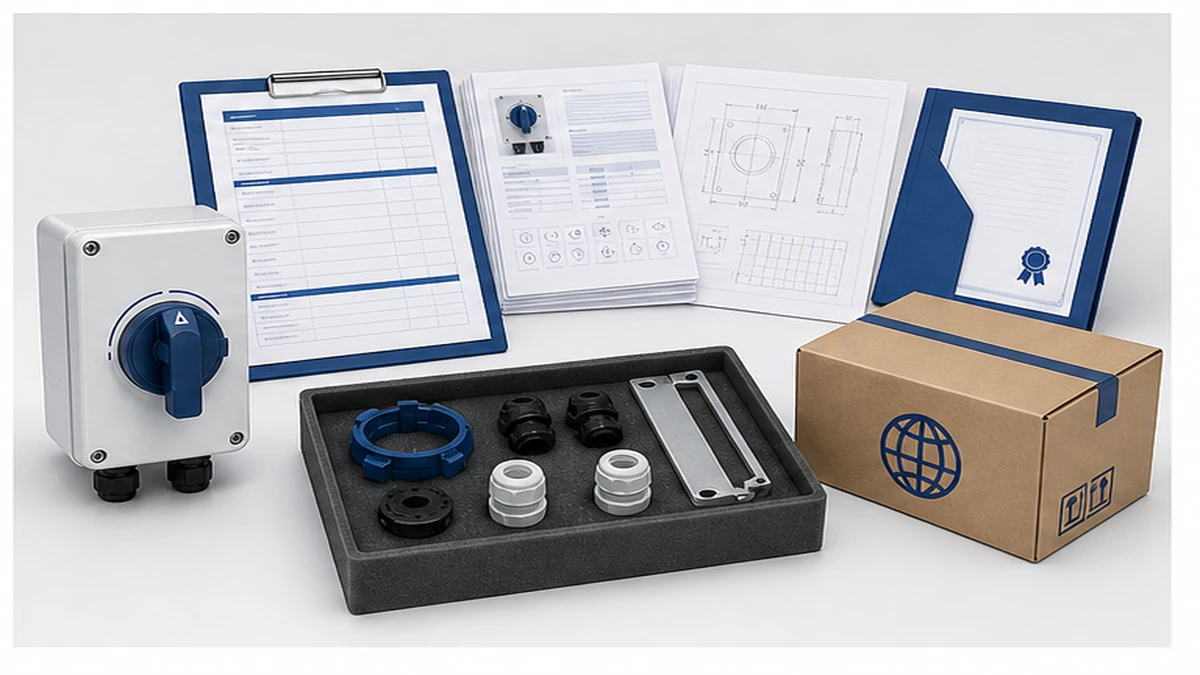
Рисунок 4. Полный запрос должен включать номинал, последовательность контактов, монтаж, корпус и требования к документам.
How Shieldhz Validates Your DC Isolator Specification Before Quoting
Shieldhz is the export brand of Zhejiang Shihe Electric Co., Ltd., founded in 2014 and based in Yueqing, Wenzhou, Zhejiang — a region recognised as China’s primary manufacturing centre for low-voltage electrical components. The facility covers more than 5,000 square metres, employs more than 100 staff, and operates more than 40 production and testing machines. The quality management system holds ISO 9001 certification, and the product portfolio carries CE, TUV, UL, UKCA, CCC, CB, and RoHS documentation across applicable product lines.
The quotation process for DC isolator switches follows a structured technical review rather than a catalogue-lookup model.
Inquiry capture: The review begins when the buyer submits application data covering system voltage, maximum string current, pole count, required utilization category, enclosure IP rating, and the applicable installation standard. Shieldhz also requests the intended market region so the correct certification scope can be identified before any model is proposed.
Electrical route confirmation: The engineering team cross-references submitted voltage and current values against the available switch frames in the DC isolator range. Rated insulation voltage, making and breaking capacity, and utilization category are verified against the contact table for the candidate model before a price is generated. No quotation is issued for a model that does not match the declared application parameters.
Mechanical and enclosure check: Shieldhz confirms panel cutout dimensions, mounting orientation, actuator handle clearance, terminal conductor cross-section range, and enclosure IP classification. For outdoor string combiner applications this step confirms IP65 or IP66 compliance per IEC 60529 against the specific enclosure variant being quoted, not the broader product series.
Documentation and certification alignment: The final step identifies which certificates and test reports the buyer requires — CE, TUV, CQC, CB, or project-specific third-party documentation. Shieldhz confirms certificate availability for the selected model and provides wiring diagrams, dimensional drawings, and the confirmed datasheet as part of the quotation package. OEM buyers requiring private-label markings, regional-language labels, or custom packaging receive a separate OEM scope confirmation before production is scheduled.
To submit a specification and receive a validated quotation, use the Shieldhz inquiry channel.
Часто задаваемые вопросы
What is the minimum IP rating required for an outdoor solar DC isolator?
IP65 is the generally accepted minimum for direct outdoor PV installations, providing complete dust exclusion and protection against low-pressure water jets from any direction. Coastal, monsoon, or near-grade installations should specify IP66 or IP67. Confirm the IP class on both the product datasheet and the test certificate rather than relying on catalogue descriptions alone.
What is the difference between utilization category DC-PV1 and DC-PV2?
DC-PV1 applies to isolators used in grounded PV systems where one conductor is referenced to earth and switching duty is correspondingly lighter. DC-PV2 applies to ungrounded floating string circuits where the isolator must interrupt both conductors against a higher arc-energy demand. Substituting a DC-PV1 device in a DC-PV2 application introduces contact-welding risk under fault conditions. Always confirm the utilization category on the product datasheet before ordering.
Can an AC-rated isolator be used in a solar DC string circuit?
No. AC contact geometry and arc-quenching mechanisms are not designed for the sustained DC arc that forms when interrupting a PV string circuit. Using an AC isolator in a DC application is not compliant with the switch-disconnector standard and creates a fire and contact-welding hazard. Purpose-built DC isolators with a confirmed DC utilization category must be used in all PV string disconnection applications.
How does cold-temperature correction affect which isolator voltage rating I need?
Module Voc increases as cell temperature falls below the STC reference. At the lowest expected ambient temperature for a given site, the corrected string Voc can exceed the STC value by a margin that varies with the module’s temperature coefficient and the site’s climate. The isolator rated insulation voltage must meet or exceed this corrected maximum open-circuit voltage, not the inverter MPPT upper operating voltage. Apply the manufacturer’s Voc temperature coefficient to your site design minimum temperature and use the result as the minimum Ui for isolator selection.
What documents should I request alongside a solar DC isolator quotation?
At minimum, request the full product datasheet, wiring diagram, dimensional and mounting drawing, and the original certificate with its issuing body reference number. For commercial or utility-scale projects, also request the underlying the switch-disconnector standard type-test report so EPC engineers and project financiers can verify making and breaking capacity independently. Confirm that each document references the exact model variant and pole and voltage configuration being ordered.
What is a project-specific lead time confirmed after model and documentation review for custom-labeled DC isolator switches?
Standard catalog items are produced within regular production schedules. Custom-labeled variants that require artwork approval, label tooling, or packaging configuration generally require a longer lead time confirmed after model and documentation review from deposit confirmation. Volume OEM orders should be placed well in advance of installation mobilization to allow for production, logistics, and incoming inspection. Confirm the specific lead time confirmed after model and documentation review in writing as part of the quotation before committing to a project schedule.
Do I need a different isolator model for a 1,500 V DC system compared to a 1,000 V DC system?
Yes. The rated insulation voltage, contact spacing, and arc-interruption design must correspond to the higher voltage tier. A device certified only at 1,000 V DC must not be applied in a 1,500 V DC string circuit, as the arc energy at the higher voltage exceeds what the lower-rated contact geometry is designed to extinguish safely. Confirm that the model number and voltage tier on the certificate match the system voltage tier of your specific installation before ordering.
Ши, Мукси
Ши, Мукси пишет технические статьи Shieldhz для покупателей промышленных систем управления и электрических компонентов, охватывая поворотные кулачковые переключатели, разъединители, PV DC разъединители, кнопки, индикаторные лампы, водонепроницаемые корпуса и клеммные блоки. Статьи основаны на опыте производства и экспорта компании Zhejiang Shihe Electric Co., Ltd., с практическим акцентом на выборе модели, технических характеристиках, чертежах, сертификации, рейтингах IP и деталях запроса, которые покупатели должны подтвердить перед заказом.