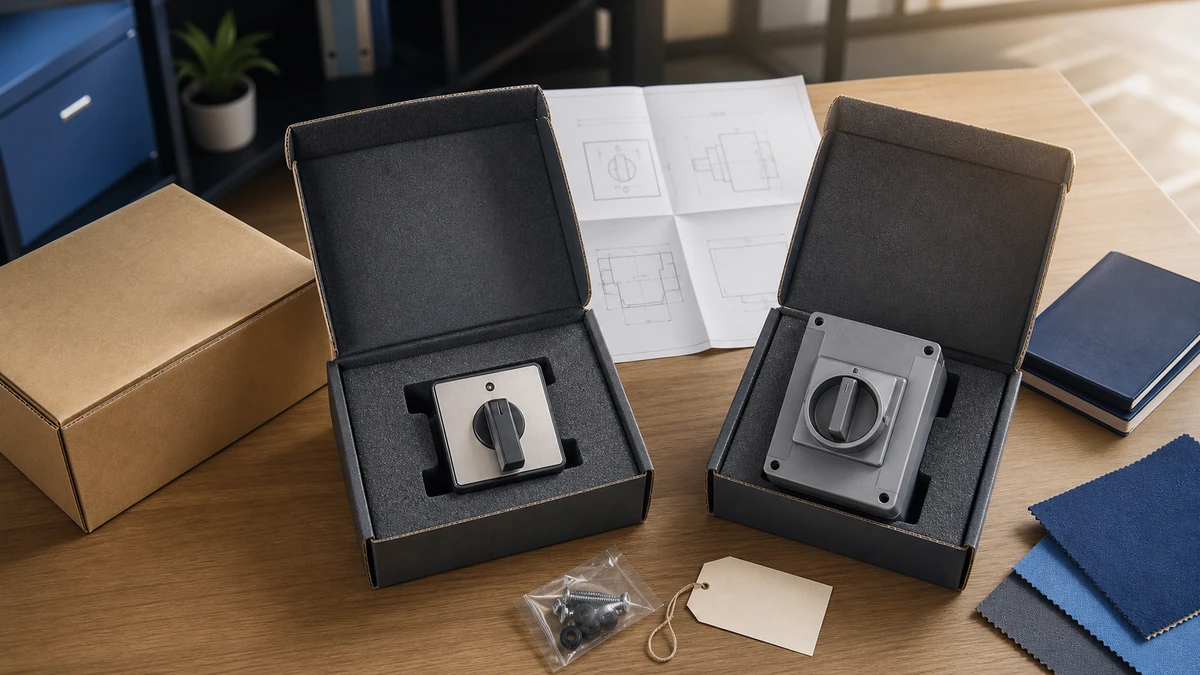
Cam Switch vs Switch Disconnector: Choosing a Panel Control or Local Isolation Route
Use a practical buyer checklist to evaluate cam switch vs switch disconnector inputs, documentation, approval controls and the exact rotary cam switch route.
For cam switch vs switch disconnector decisions, choose by device role first: use a rotary cam switch when the buyer needs a defined manual switching program, and use a switch disconnector route when the buyer needs a local circuit isolation function supported by the exact device documentation and installation design.
Map the required function first: selector, changeover, reversing, star-delta, meter selection, local isolation, or maintenance disconnect route.
Confirm electrical duty from the actual circuit: AC/DC, voltage, current, utilization category, number of poles, and contact sequence.
Request model-specific drawings, datasheets, certificates, and handle/mounting details before locking the panel layout or purchase order.
The core decision is device role, not product shape
Choose by device role first: a cam switch builds a defined control program, while a switch disconnector is selected primarily to open and isolate a circuit in a specified installation context.
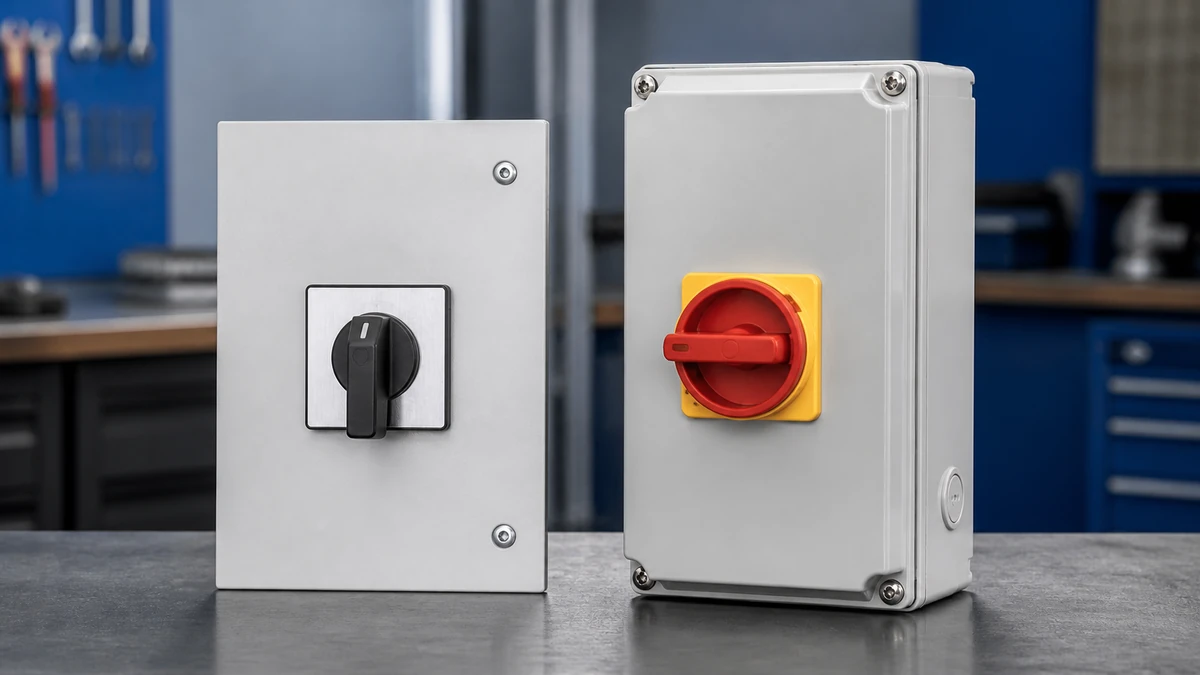
Both products may use rotary handles. Both may appear on an enclosure door. The buying mistake is to treat the handle style as the category. The right question is what the device must do electrically and mechanically in the panel or machine.
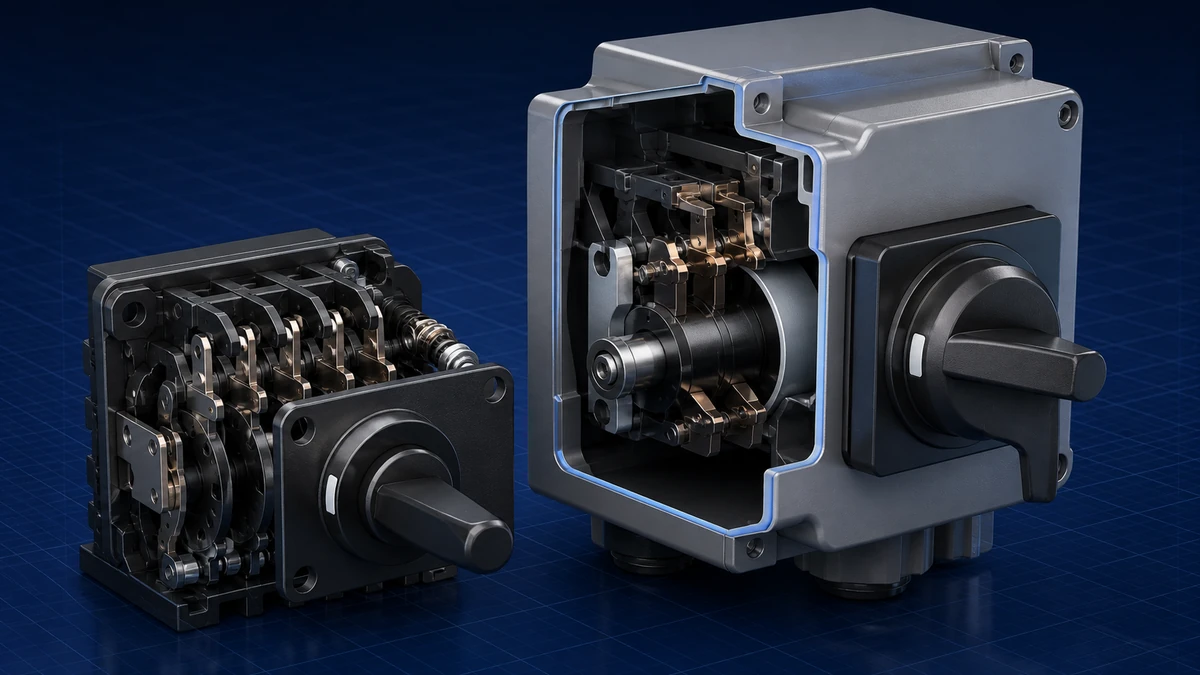
An exact drawing identifies the interfaces that must be controlled for the approved model route.
Is this really an SH30-versus-another-cam-switch question?
Treat as a model-family comparison
Not applicable
Use the dedicated SH30 comparison or current product documentation, not this role decision
Panel control route
A rotary cam switch is normally considered when the buyer needs manual selection between defined electrical states. Examples include ON-OFF, multi-position selector, voltmeter or ammeter selection, forward-reverse control logic, or changeover arrangements, depending on the exact switch program.
This route is attractive for panel builders because one operator can be mapped to a contact sequence. The final choice still depends on the exact model, duty, contact program, installation, and current product documentation.
Local isolation route
A switch disconnector route is normally considered when the buyer needs a local means to disconnect a circuit as part of the installation design. The suitability of a particular device depends on the rated duty, utilization category, enclosure layout, handle arrangement, certificate package, and destination-market requirements.
Do not assume that any rotary handle provides the same isolation function. The documentation and the application decide the acceptable route.
Standards scope helps frame the discussion, but it does not select the model
Use standards language to frame the enquiry, but select the product from the exact datasheet, drawing, certificate, and application requirements.
Сайт IEC 60947-3 scope describes this scope as switches, disconnectors, switch-disconnectors and fuse-combination units within stated distribution- and motor-circuit AC/DC limits. That is a scope boundary, not a blanket approval for every installation or model.
Use the standard to name the device role
When a buyer asks for a switch disconnector, the supplier needs to know whether the request is tied to a standard, a machine specification, a site maintenance requirement, or a panel-builder convention. The naming affects the documentation package and the drawings reviewed before quotation.
When a buyer asks for a cam switch, the supplier needs the function program. A cam switch enquiry without positions, poles, duty, and contact sequence is incomplete.
Evidence boundary for quotation
A quotation should not rely on generic category claims. It should identify the proposed series or model, drawing, electrical ratings under the stated duty, handle and mounting route, and any requested certificate or declaration package available for that model and destination market.
If the buyer has a project compliance matrix, send it before the supplier confirms the route. The model may be suitable for one duty or market requirement and not for another.
Choose a rotary cam switch when the buying need is a manual switching program
Choose a rotary cam switch route when the commercial value is in the contact program: positions, poles, switching sequence, operator type, and panel layout.
Required drawing, datasheet, and certificate package for the destination market.
Any project-specific brand, labeling, packaging, or documentation requirements.
Choose a switch disconnector when the buying need is local circuit isolation
Choose a switch disconnector route when the purchasing requirement is primarily a local disconnect or isolation function rather than a programmed control sequence.
This is common in machinery, sub-panels, local motor panels, and distribution-related assemblies, but the acceptable product depends on the exact circuit, installation, enclosure, duty, and documentation.
Sample review should connect the exact item to its current drawing and requested evidence package.
Best-fit purchase signals
A switch disconnector route should be evaluated when the enquiry is driven by:
A local isolation point near equipment.
A door-coupled operator requested by the panel design.
A lockable handle requirement, if supported by the selected model and handle.
A maintenance procedure that names a disconnecting device.
A site specification that calls for a switch disconnector or equivalent documented route.
Do not substitute a cam switch solely because it has a similar handle. If the requirement is isolation, ask for isolation-related documentation for the exact device proposed.
Switch-disconnector buyer checklist
Send the supplier:
Single-line diagram or circuit position of the device.
AC/DC system details, voltage, current, and utilization category.
Number of poles and any neutral switching requirement.
Load type and operating frequency expected by the application.
Enclosure type, door coupling, shaft length, and handle requirements.
Locking, legend, and color requirements, if specified by the project.
Destination market and documents required for technical file or customer approval.
Interface choices can make a correct device route fail commercially
Select the interface route early because handle position, mounting depth, legend, and door arrangement can decide whether the selected device is practical for the panel.
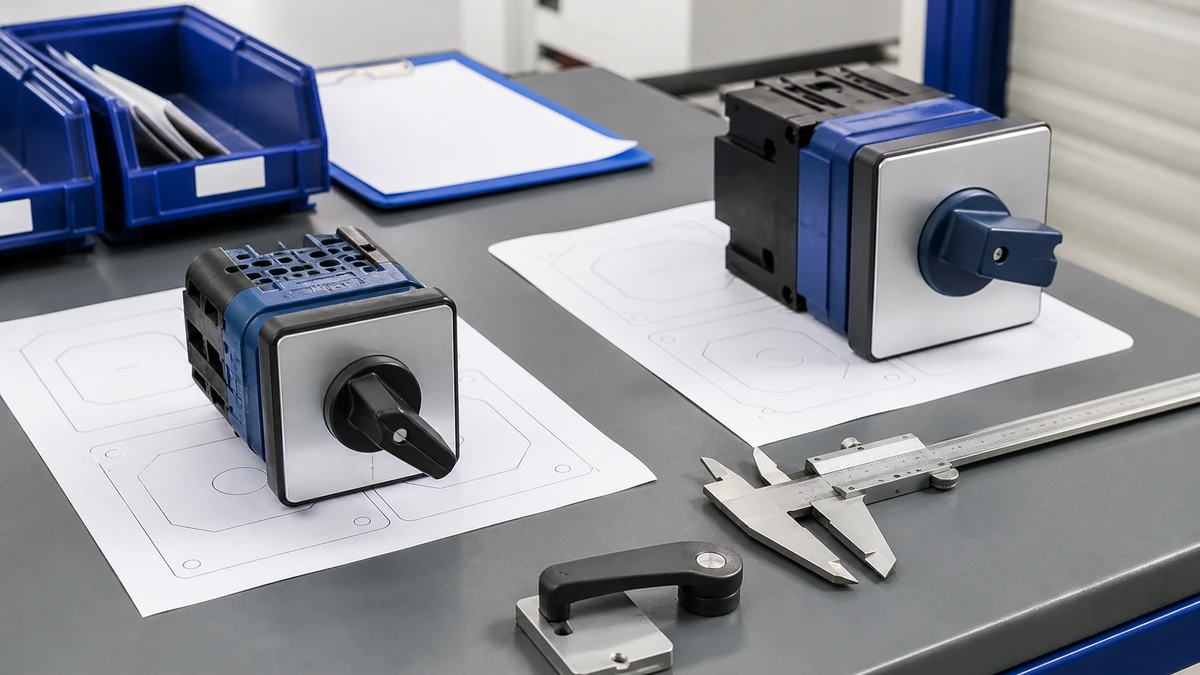
A technically suitable model can still cause redesign if the panel cutout, shaft length, operator style, or internal clearance is wrong. For OEMs and panel builders, this is a commercial risk as much as an engineering issue.
Installation conditions change the product-route and document questions a buyer must resolve.
Door-mounted versus internal mounting
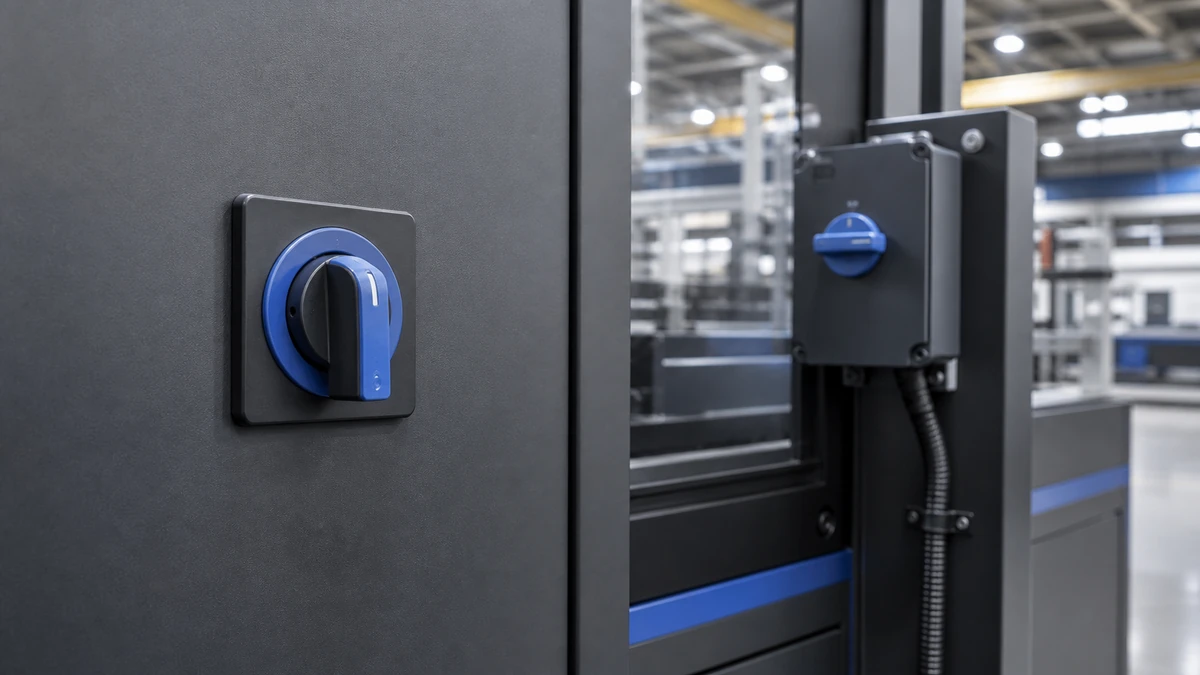
Door-mounted operation is often requested when operators need access without opening the enclosure. The drawing must confirm cutout, shaft, handle, door thickness, and internal clearance for the exact model.
Internal mounting may be preferred where the device is adjusted less often or where the operator arrangement is not on the enclosure door. The layout still needs clearance for wiring, cable bend radius, and service access.
Color, legend, and emergency-stop wording
Handle color and legend text should follow the buyer’s machine or panel specification. A red/yellow operator may be requested for particular functions, but the color choice alone does not establish a complete safety function.
If emergency-stop wording appears in the project, confirm the whole machine safety concept separately. Selecting an operator does not validate the complete machine safety function, control architecture, risk reduction, or compliance file.
Electrical program and load duty decide whether a cam switch route is credible
Confirm the electrical program and load duty before comparing prices, because the same visible operator can represent very different internal contact arrangements and duties.
For cam switches, the contact sequence is often the core specification. For switch disconnectors, the circuit duty and isolation role usually dominate the selection. Either way, the datasheet must match the buyer’s application.
Contact program, positions, and poles
A cam switch enquiry should include positions, poles, and the contact program. If these are missing, the supplier cannot confirm whether a standard function or a custom contact arrangement is needed.
Does each position need a different contact sequence?
Requires a switching program, not only an isolating role
Поворотный кулачковый переключатель
Is the requirement to disconnect a local circuit?
Requires device documentation for that role
Switch disconnector
Is the duty motor-related?
Utilization category and application details become critical
Exact-model review
Is the load AC or DC?
Ratings and switching behavior are duty dependent
Exact-model review
Motor, reversing, and transfer applications
Motor-related manual control requires extra care because current, utilization category, switching frequency, and contact sequence all affect the route. Use the rotary cam switch motor-control guide for motor-control-specific considerations instead of assuming that any cam switch or switch disconnector fits.
For reversing or changeover, provide the intended wiring diagram. The supplier should confirm the proposed contact program against the current product documentation and the buyer’s application.
How Shieldhz confirms a rotary cam switch route
Shieldhz confirms a rotary cam switch route by checking the buyer’s function, duty, contact program, mounting route, environment, and requested documentation before quotation.
This pre-quotation step is intended to avoid buying a similar-looking operator that does not match the electrical program, panel layout, or approval file. Final suitability is confirmed against current product documentation and the buyer’s application.
Documentation control, sample acceptance and protective packing are separate handover checks.
Pre-quotation inputs
Shieldhz typically asks the buyer to confirm:
Switching function: ON-OFF, selector, changeover, reversing, star-delta, instrument selection, or another defined program.
AC/DC duty: whether the circuit is AC, DC, or mixed within the buyer’s design.
Voltage/current and utilization category: the actual operating duty required for the application.
Pole and contact program: number of poles, positions, contact stages, and required sequence.
Panel mounting and handle route: door or base mounting, cutout, handle type, shaft needs, legend, and panel depth.
Environment: enclosure context, ambient assumptions, contamination exposure, and any project-specific environmental requirement.
Requested drawing, datasheet, and certificate package: documents needed for buyer review, customer approval, or destination-market file.
Output package for buyer review
The quotation route should identify the proposed model or series, the relevant drawing, available datasheet information, and requested documentation. If the buyer needs a special contact program, the confirmation should include how that program is represented in the drawing or switching table.
If information is missing, Shieldhz should treat the enquiry as unconfirmed rather than forcing a price-only answer. That protects the buyer’s panel layout, customer approval process, and purchasing schedule.
Procurement should compare documented fit, not only unit price
Compare the two routes by documented fit first, then by price, packaging, and commercial terms.
For distributors and sourcing teams, the lowest visible unit price is not useful if the selected device cannot be approved in the panel, does not match the contact program, or lacks the requested documentation package for the buyer’s market.
What to ask each supplier
Use the same enquiry discipline for both routes:
Exact proposed model or series.
Current datasheet and drawing.
Rated duty under the buyer’s stated voltage, current, and utilization category.
Contact program or circuit function confirmation.
Mounting and handle drawing.
Available certificate or declaration package for the stated destination market.
Packaging, labeling, and project documentation requirements.
Any buyer-specific drawing approval process before mass purchase.
Decision table for sourcing teams
Procurement comparison point
Cam switch route
Switch disconnector route
Commercial risk if skipped
Function confirmation
Contact program must be confirmed
Isolation role and circuit position must be confirmed
Wrong part ordered under a similar description
Drawing review
Cutout, depth, handle, and contacts
Cutout, shaft, handle, and enclosure route
Panel redesign or assembly delay
Документация
Datasheet plus switching diagram
Datasheet plus role-specific documentation
Customer approval delay
Рынок назначения
Certificate needs depend on buyer requirement
Certificate needs depend on buyer requirement
Import, approval, or project-file issue
Price comparison
Compare after function match
Compare after duty and role match
False low-cost shortlist
Conclusion
The practical cam switch vs switch disconnector decision is not about which rotary handle looks right. It is about the device role.
Choose a rotary cam switch when the buyer needs a defined manual switching program with specific positions, poles, and contact stages. Choose a switch disconnector route when the buyer needs a documented local isolation function within the circuit and installation design. In both cases, confirm the exact model, duty, drawing, documentation package, and buyer application before purchase.
Часто задаваемые вопросы
Is a cam switch the same as a switch disconnector?
No. A cam switch is typically selected for a defined manual switching program, while a switch disconnector route is selected for a local disconnect or isolation role. Some visible features may look similar, but the device documentation and application decide the correct route.
Can I use a cam switch for local isolation?
Only if the exact model, ratings, utilization category, installation, and documentation support the buyer’s intended isolation requirement. Do not assume this from the handle shape or the word “rotary.”
When is a cam switch the better buying route?
It is usually the better route when the requirement is contact sequencing: ON-OFF, selector, changeover, reversing, instrument selection, or another defined manual program. The final selection still depends on the exact electrical duty and product documentation.
When is a switch disconnector the better buying route?
It is usually the better route when the requirement is a local circuit isolation function in a panel, machine, or installation. The exact model must be checked against the circuit duty, mounting arrangement, and documentation required by the buyer.
Does a red/yellow handle make the device an emergency stop?
No. A handle color or operator selection does not validate a complete machine safety function. Emergency-stop and safety-related functions require separate risk assessment, control architecture validation, and project documentation.
What information should I send for a quotation?
Send the switching function, AC/DC duty, voltage, current, utilization category, number of poles, contact sequence, mounting style, handle requirements, environment, destination market, and requested drawing, datasheet, and certificate package. This allows the supplier to confirm a documented route instead of guessing from a short product name.
Ши, Мукси
Ши, Мукси пишет технические статьи Shieldhz для покупателей промышленных систем управления и электрических компонентов, охватывая поворотные кулачковые переключатели, разъединители, PV DC разъединители, кнопки, индикаторные лампы, водонепроницаемые корпуса и клеммные блоки. Статьи основаны на опыте производства и экспорта компании Zhejiang Shihe Electric Co., Ltd., с практическим акцентом на выборе модели, технических характеристиках, чертежах, сертификации, рейтингах IP и деталях запроса, которые покупатели должны подтвердить перед заказом.