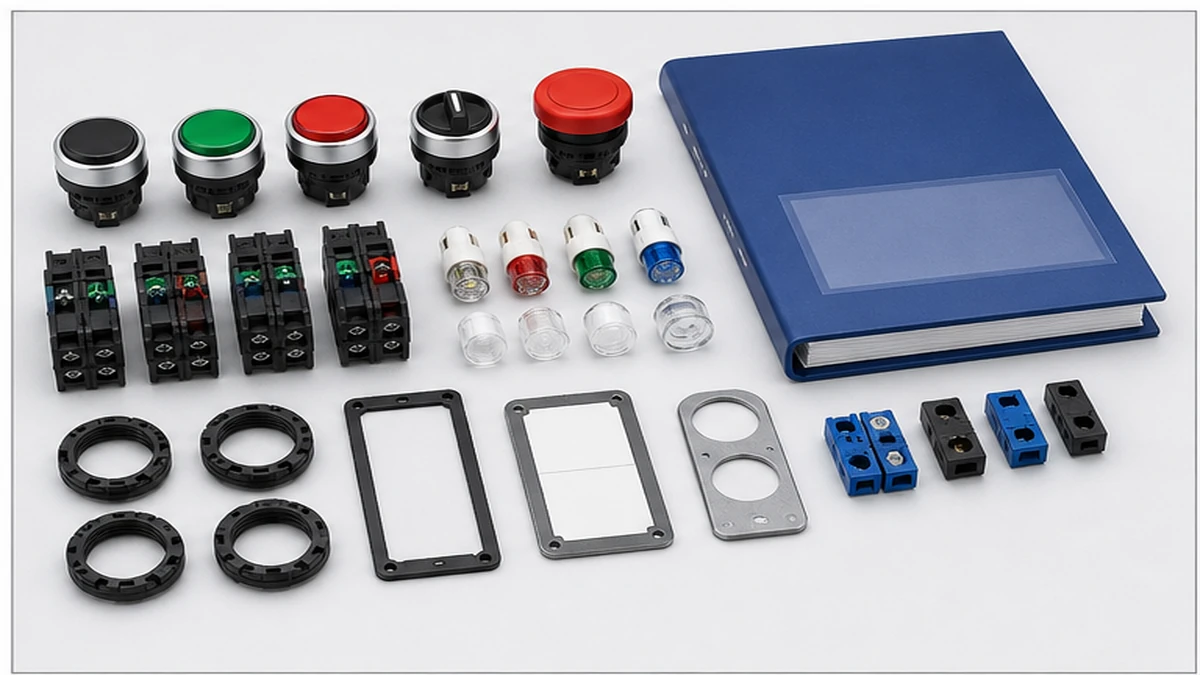
Specifying a push button assembly correctly means aligning three interdependent sub-components: the contact block, the indicator lamp, and the legend plate. Get any one wrong and the result is premature contact erosion, a lamp failure at first power-up, a non-compliant signal color, or an IP-rated seal that leaks at the bezel. This guide walks industrial control panel engineers, panel builders, maintenance teams, and OEM procurement managers through every selection step — contact circuit type, utilization category, lamp voltage and technology, legend plate material and inscription method, series compatibility, and documentation requirements — so every line of the bill of materials is defensible before the order ships.
Граница безопасности: Selection examples are documentation checks, not live-work instructions. Final wiring and commissioning should be handled by qualified electrical personnel using the approved contact table and panel schematic.
What Are Push Button Contact Blocks, Lamps, and Legend Plates
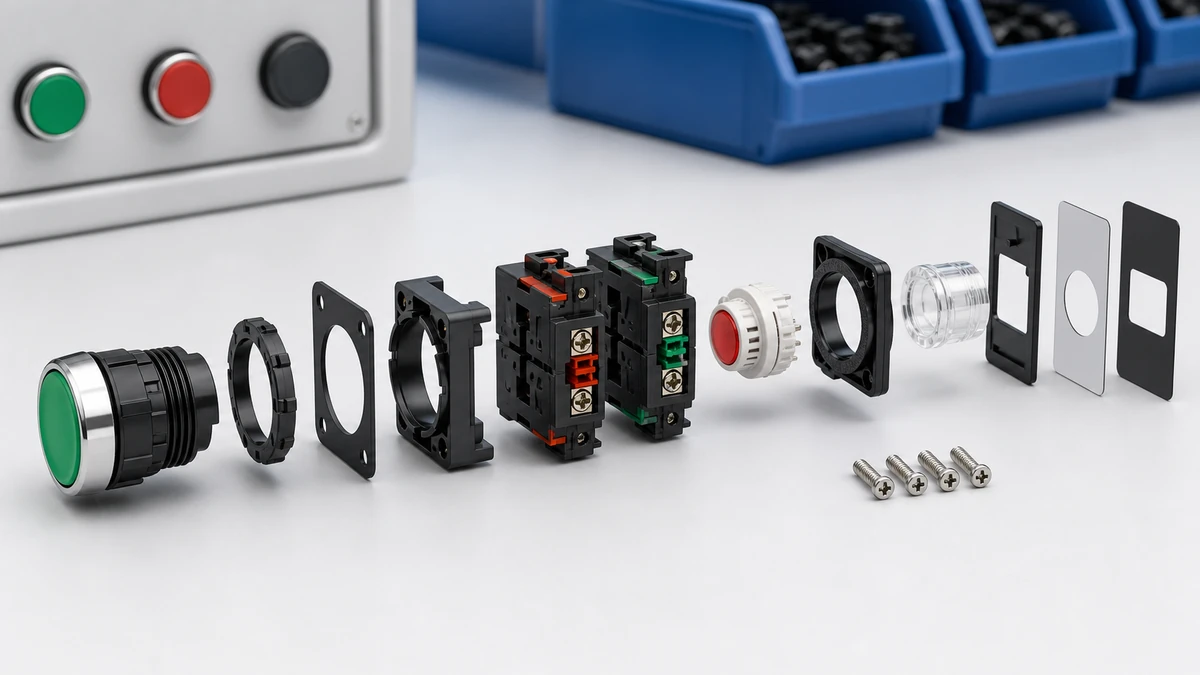
Push button assemblies are built from four mechanical layers stacked on a common mounting body: the operator head at the front, then the legend plate collar, then an optional lamp module, and finally one or more contact blocks at the rear. Each layer is mechanically and electrically interdependent.
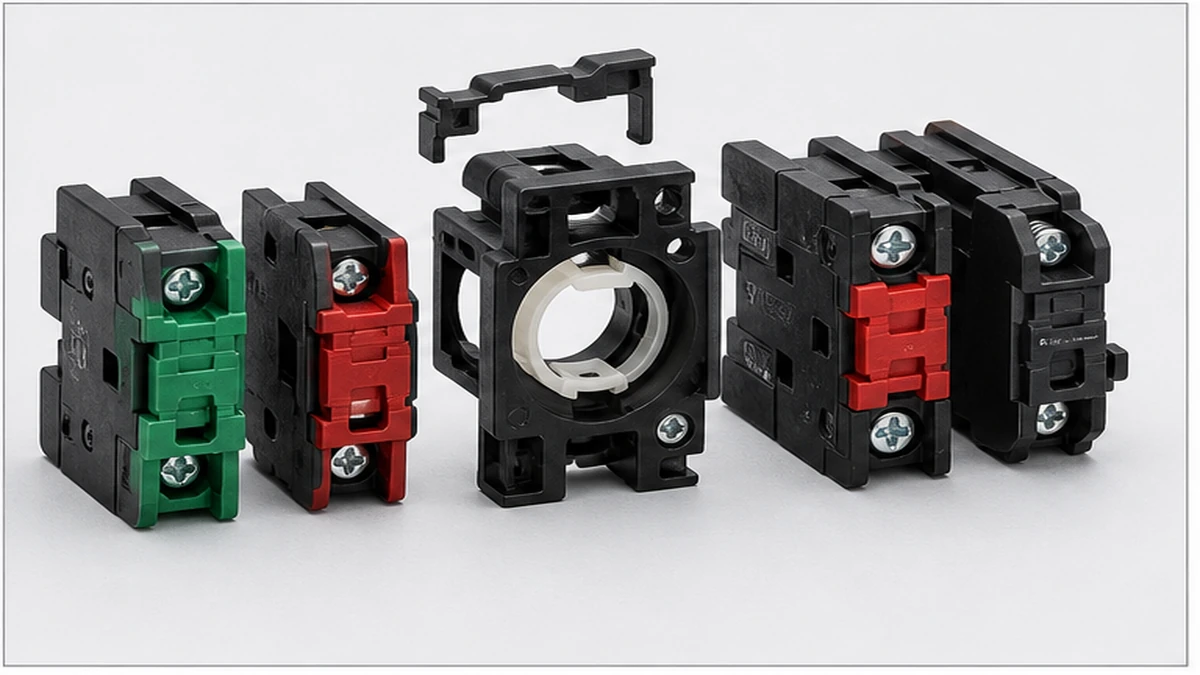
Контактные блоки mount directly behind the actuator head and contain the normally open (NO) or normally closed (NC) contact bridges that make or break a control circuit. They are governed by the applicable control-device standard and rated by switching current, utilization category, and mechanical endurance.
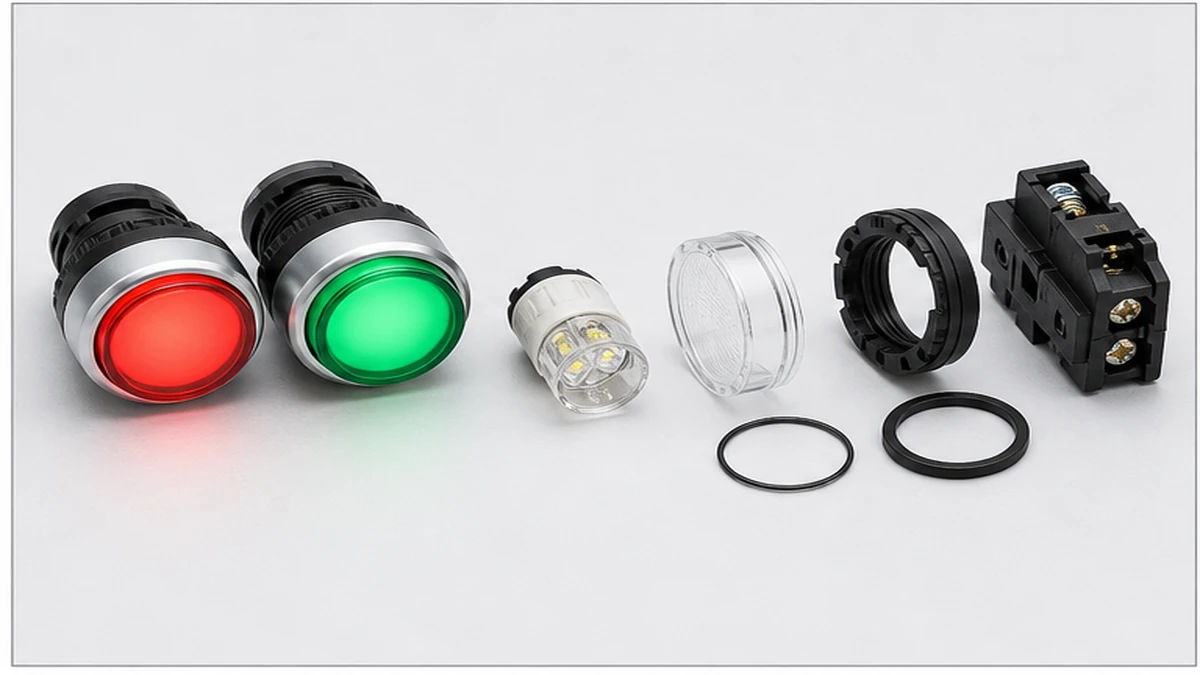
Indicator lamps integrated into the assembly signal circuit state — energized, tripped, or faulted — without requiring a separate panel indicator. Lamp voltage must match the control circuit supply exactly; even a sustained overvoltage of 10 percent above the rated value accelerates LED or incandescent lamp degradation measurably.
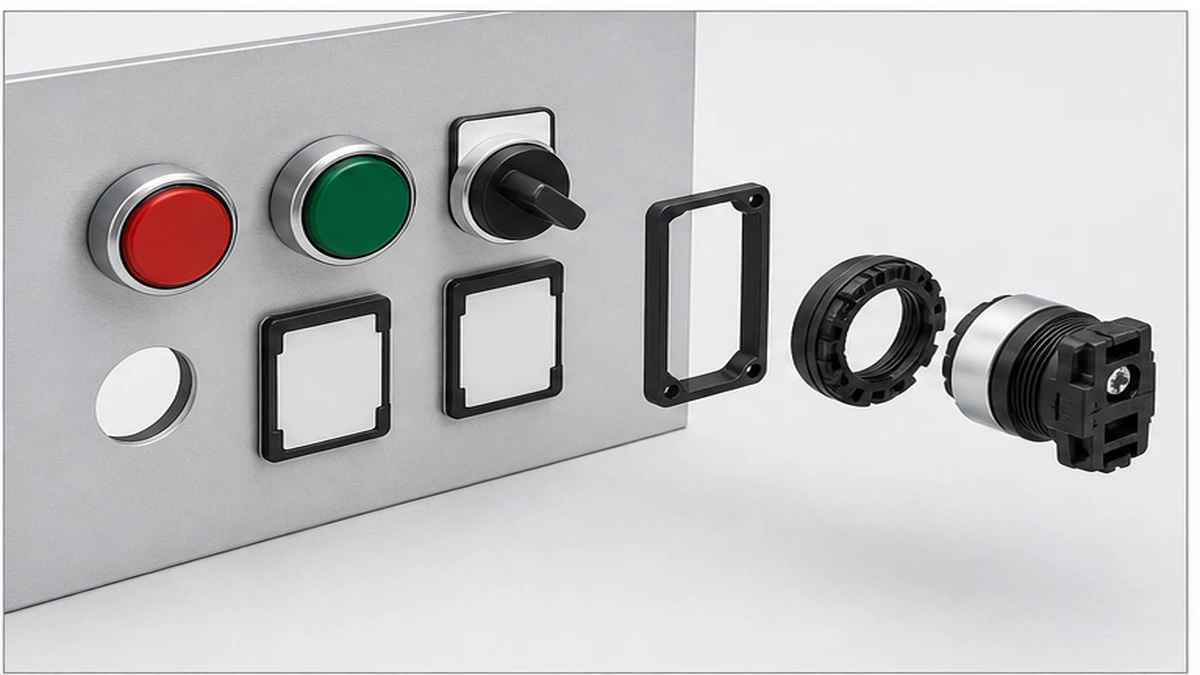
Legend plates frame the actuator and carry engraved or printed text such as START, STOP, or RESET, in materials rated for chemical resistance and UV stability. A mismatched plate leaves gaps around the actuator bezel, directly compromising the IP ingress protection rating of the completed assembly.
All three components must share the same mounting body diameter — commonly 22 mm or 30 mm — and must be sourced from a compatible product family. Mixing contact block, lamp module, and legend plate from incompatible series causes misaligned cutouts, incorrect IP sealing, or contact spring preload mismatches that raise contact resistance above acceptable limits.
Contact Block Specifications: Contacts, Ratings, and Circuit Configuration
Selecting the correct contact block begins with matching three interdependent parameters: contact circuit type, current and voltage rating, and utilization category. Together these determine whether a contact block will survive its actual switching duty across its rated operating life.
Contact Circuit Types: NO, NC, and Changeover
Normally Open (NO): The circuit is open at rest and closes when the actuator is pressed. Used for START commands and momentary signaling.
Normally Closed (NC): The circuit is closed at rest and opens when the actuator is pressed. Used for STOP commands, interlocks, and safety loops.
Changeover (CO): One common terminal switches between NO and NC contacts simultaneously. Used when a single actuator must control two independent signal paths.
A common panel-build practice is to stack one NO and one NC contact block on a single push button body, providing both a start command and an auxiliary stop confirmation from the same actuator without consuming additional panel real estate.
Contact Ratings Reference
The table below summarizes parameter ranges drawn from the applicable control-device standard. Confirm exact values against the specific product datasheet for every line item on your BOM.
Параметр
Indicative Range
Standard Reference
Contact Type
NO, NC, Changeover
the applicable control-device standard
Rated Current (AC)
Datasheet-dependent
the applicable control-device standard
Rated Current (DC)
Datasheet-dependent
the applicable control-device standard
Номинальное напряжение изоляции
Up to 690V AC typical
the applicable control-device standard
Категория использования
AC-12, AC-15, DC-12, DC-13
the applicable control-device standard
Механическая выносливость
Per manufacturer datasheet
the applicable control-device standard
Electrical Endurance
Per manufacturer datasheet
the applicable control-device standard
Utilization Category: The Parameter Buyers Most Often Overlook
Utilization category is the single most consequential contact block parameter and the one that procurement teams most frequently specify incorrectly.
AC-12 covers switching resistive and solid-state loads. The make and break currents are predictable and relatively low in relation to the steady-state value.
AC-15 is required for switching electromagnetic loads — relay coils, contactor coils, and solenoid valves. Inrush current at energization can be several times the steady-state coil current, and the contact block must be rated to interrupt that inductive arc repeatedly without excessive erosion.
Specifying AC-12 contact blocks on an AC-15 inductive circuit accelerates contact erosion and reduces electrical endurance well below the published figure. Always confirm the load type before selecting the utilization category, and document the decision on your specification sheet.
DC-13 is the DC equivalent of AC-15 and applies to switching electromagnetic DC loads. DC arc interruption is harder than AC interruption because there is no natural current zero, so DC-rated contact blocks use specific contact gap geometries to extinguish the arc.
Контактный материал
Silver-alloy contacts — typically silver-nickel (AgNi) or silver-tin-oxide (AgSnO2) — outperform plain silver in oxidizing or sulfurous atmospheres. In panels installed near chemical processing, water treatment dosing points, or battery rooms, specify contact material explicitly on your BOM. The manufacturer’s datasheet will state the alloy designation for each catalog number.
Contact resistance for new contacts is typically specified at a low milliohm value that varies by product family — confirm the threshold from the datasheet rather than assuming a universal figure. During commissioning, measure contact resistance with a low-resistance ohmmeter before energizing the panel; values above the datasheet threshold on brand-new contacts indicate contamination or incorrect block seating.
How to Select Push Button Indicator Lamps: Voltage, Color, and Technology
Selecting the correct indicator lamp block requires matching three interdependent parameters: supply voltage, color designation, and lamp technology. Specifying any one incorrectly leads to premature lamp failure, a non-compliant signal color under IEC 60073, or a maintenance access problem during panel servicing.
Voltage Compatibility
Indicator lamp blocks are rated for specific supply voltages. Common offerings include 24V AC/DC, 110V AC, and 230V AC, but available voltages vary by product family. The lamp block voltage must match the control circuit supply voltage — not the power circuit voltage. In a 400V AC motor control panel, the control transformer secondary is typically 24V DC or 110V AC, and the lamp block must match that secondary voltage.
At 110V and 230V, LED lamp blocks are strongly preferred because they do not require the voltage-dropping resistor network that incandescent designs use, which reduces heat accumulation inside compact panel cutouts and enclosures.
Incandescent vs. LED Lamp Blocks
Параметр
Incandescent
LED
Typical supply voltages
24V, 110V, 230V AC
24V AC/DC, 110V AC, 230V AC
Typical power draw
Выше
Нижний
Typical service life
Shorter — bulb-dependent
Longer — driver-dependent
Lens type
Replaceable bulb plus separate lens
Integral LED lens assembly
Color options
Red, green, yellow, white, blue
Red, green, yellow, white, blue
Heat output
Moderate to high
Низкий
Устойчивость к вибрации
Low — filament sensitive
Высокий
Replacement method
Bulb replaced independently
Full lamp block replacement
In motor control and process automation panels where control voltage is typically 24V DC, LED lamp blocks are the standard selection. Their long service life reduces planned maintenance frequency, and their compatibility with PLC sourcing and sinking outputs makes integration straightforward. Exact service life values vary by manufacturer and operating temperature; confirm from the product datasheet rather than using a generic industry figure.
Color Selection per IEC 60073
IEC 60073 assigns functional meaning to indicator colors:
Красный — fault, emergency, or danger condition
Зеленый — normal or safe operation
Желтый — caution or abnormal condition requiring attention
Голубой — mandatory action
Белый — general information or status where the above categories do not apply
Specifying color outside these conventions in safety-relevant panels creates compliance risk and can cause operator error during incidents. Confirm available color-voltage combinations from the manufacturer’s selection guide before finalizing a BOM.
AC/DC Polarity Consideration for LED Blocks
Many LED lamp block drivers are polarity-sensitive and will fail silently or flicker on an AC supply even though the nominal voltage matches. Always confirm from the datasheet whether a 24V DC lamp block is rated for AC/DC operation before installing it on a 24V AC control circuit.
In high-vibration environments — compressor skids, mobile equipment, or conveyor drives — LED lamp blocks are the only practical choice. Incandescent filaments typically fail within weeks under sustained vibration levels that LED assemblies handle without issue.
When replacing incandescent lamp blocks with LED retrofits in an existing panel, verify the control relay output card’s minimum load current specification. Some older relay output cards require a minimum load current that a low-wattage LED block will not satisfy, requiring a parallel bleeder resistor to maintain reliable switching.
Рисунок 2. При выборе необходимо учитывать размер привода, тип контакта, напряжение лампы, цвет, степень защиты по стандарту IP, размеры выреза в панели и сопроводительную документацию.
Specifying Legend Plates: Inscription, Material, and Mounting
Legend plates communicate function, state, and safety information directly at the operator interface. Selecting the right legend plate requires matching inscription method, material durability, window size, and mounting approach to the panel environment and the expected service life of the installation.
Inscription Methods
Standard pre-printed text — START, STOP, ON, OFF, RESET — is fastest to source and suits fixed-function stations where panel function will not change.
Blank legend plates with label inserts — window aperture dimensions vary by operator series and diameter; confirm the exact aperture size from the product drawing.
ISO-compliant symbols — preferred for multilingual facilities and export panels. Confirm the symbol set against ISO 7000 or IEC 60417 as applicable.
Engraved text — indent depth is a datasheet-dependent value that varies by material and manufacturer. Ink-filled engraving survives repeated chemical cleaning where surface printing degrades within months in wash-down environments.
Laser engraving on metal plates — produces a permanent mark resistant to solvents, steam cleaning, and UV exposure. Appropriate for food-processing, pharmaceutical, and outdoor installations.
Material Selection
Criteria
Plastic (PC or ABS)
Stainless Steel or Aluminium
Chemical resistance
Moderate
Высокий
Impact resistance
Стандарт
Superior
Weight
Light
Heavier
Cost
Нижний
Выше
Typical environment
Standard indoor panels
Outdoor, marine, food processing, wash-down
In outdoor or wash-down enclosures — common in food processing and water treatment — stainless steel legend plates rated to IP65 or higher are the practical baseline. For standard indoor panels without chemical or UV exposure, UV-stabilized polycarbonate is generally sufficient and reduces component cost.
Mounting Method Checklist
Snap-in: Tool-free insertion into the button collar. Suits high-volume production builds and reduces assembly time.
Screw-fixed: M2 or M2.5 fasteners typical. Recommended where vibration exceeds the threshold specified in the product datasheet, or where tamper resistance is required.
Verify plate thickness compatibility with the actuator collar depth. A mismatch in plate thickness — even within a few tenths of a millimeter — can cause the plate to rock, obstruct actuator travel, or break the IP seal at the bezel interface.
Рисунок 3. Перед подачей напряжения необходимо сверить контекст подключения с контактной схемой производителя.
Series Matching: Avoiding the Most Common Specification Error
Mixing components from different product series or mounting sizes is the single most frequent push button specification error encountered in industrial control panel builds. A contact block designed for a 30 mm operator will not seat correctly on a 22 mm head. A lamp module designed for one manufacturer’s series will often fail to achieve the IP-rated seal on a non-matching bezel regardless of nominal cutout diameter.
Why Series Matching Is Non-Negotiable
Push button assemblies are mechanically and electrically interdependent across all four component layers. Each layer engages via proprietary snap-fit geometry, thread pitch, or bayonet locking. the applicable control-device standard requires the assembled unit to meet rated insulation voltage, rated impulse withstand voltage, and degree of protection as a complete assembly — not as a collection of individually rated parts. Mixing series breaks the tested configuration and voids those assembly-level ratings.
Series and Mounting Size Alignment
Component Layer
22 mm Series
30 mm Series
Cross-Series Use
Operator head
22 mm panel cutout
30 mm panel cutout
Not compatible
Контактный блок
Matched to 22 mm head
Matched to 30 mm head
Not interchangeable
Lamp/indicator block
22 mm bayonet or snap fit
30 mm bayonet or snap fit
Not interchangeable
Legend plate
22 mm window frame
30 mm window frame
Not interchangeable
Always verify the manufacturer’s accessory cross-reference table before combining components sourced separately or as spares. The cross-reference table is the authoritative source — catalog number suffix matching is not a reliable substitute.
Voltage and Contact Program Alignment
Lamp block voltage ratings must match the control circuit supply. Contact programs — NO, NC, or NO plus NC — must be confirmed against the contact block’s rated operational current under the correct utilization category. These two alignment checks are distinct: a correctly voltage-rated lamp block can still be incorrectly specified for utilization category, and vice versa.
For applications where the relevant switch standard matters, the applicable control-device standard edition applies to switches, disconnectors, switch-disconnectors, and fuse-combination units for distribution and motor circuits, with rated voltage up to 1000V AC or 1500V DC. Engineers building panels that also incorporate push button switches or changeover devices should review that standard alongside the applicable control-device standard. The push button selection reference provides a reference point for understanding how panel switching components at the main circuit level are specified in parallel with push button control stations.
Specification Walkthrough: Building a Complete Push Button BOM
The example below applies every selection criterion to a concrete procurement scenario: a 400V AC three-phase motor starter requiring a green START and a red STOP button, mounted on a 22 mm cutout panel with 24V DC PLC control voltage.
Step 1 — Select the Operator Body
Choose a 22 mm momentary push button operator with IP65 ingress protection minimum. Select a flush-head profile for STOP to reduce accidental activation risk, and an extended-head profile for START to make the button easier to locate and press during normal operation. Confirm the operator body accepts a rear-mount contact block and an integrated lamp socket.
Step 2 — Specify Contact Blocks
Each push button requires at minimum one NO and one NC contact block. Select AC-15 utilization category per the applicable control-device standard because the load is a contactor coil — an electromagnetic inductive load. The START button takes one NO block; the STOP button takes one NC block. Confirm contact material — AgNi or AgSnO2 — and confirm mechanical and electrical endurance figures from the product datasheet.
Step 3 — Add the Lamp Block
Attach a rear-mount LED lamp block rated for 24V AC/DC to match the PLC output card voltage. Confirm the lamp block is rated for both AC and DC operation if the control circuit supply is AC. Green lamp block for START, red lamp block for STOP, per IEC 60073. Confirm the lamp block fits the same 22 mm operator body series.
Step 4 — Choose Legend Plates
Select snap-fit legend plates with engraved or laser-marked legends: START with white text on a green background, STOP with white text on a red background, sized to the operator front face. Laser-engraved or ink-filled engraved legends resist wash-off during industrial cleaning cycles.
Resulting BOM Summary
Позиция
Component Description
Количество
START
Green flush operator, 1x NO contact block, 24V AC/DC LED lamp block, START legend plate
1 set
STOP
Red flush operator, 1x NC contact block, 24V AC/DC LED lamp block, STOP legend plate
1 set
Spares
Matching LED lamp blocks per site spares policy
Per BOM
Рисунок 4. Полный запрос должен включать номинал, последовательность контактов, монтаж, корпус и требования к документам.
For panels that also include main circuit switching, comparing push button control station specification against main circuit switching standards is useful. The IEC standard that covers switches, disconnectors, and fuse-combination units is official IEC control-device publication, which engineering teams can reference directly at the IEC Webstore to verify scope and application limits. Locally, the SH-B2 push button route summarizes the standard’s scope and what it means for panel-level switch selection.
How Shieldhz Confirms Your Push Button Assembly Specification
Shieldhz is the export brand of Zhejiang Shihe Electric Co., Ltd., founded in 2014 and based in Yueqing, Zhejiang, China — a region recognized globally for low-voltage electrical component manufacturing. The company operates a factory of more than 5,000 square meters, employs over 100 staff, and runs more than 40 production and testing machines. Quality certifications held include ISO 9001, CE, RoHS, TUV, UL, UKCA, CCC, and CB. Every push button assembly order goes through a structured pre-shipment specification review designed to catch the four most common errors — series mismatch, wrong utilization category, incorrect lamp voltage, and missing documentation — before the order enters production.
Series and Mounting Confirmation
The engineering review confirms the correct product series against your declared panel cutout diameter and IP rating requirement. Cutout size — typically 22 mm or 30 mm — is cross-checked against the customer drawing before the order is built. Where the drawing is not available, Shieldhz requests confirmation of the panel cutout and enclosure IP requirement in writing.
Contact Program Review
Each contact block configuration is verified against the customer’s circuit diagram: NO and NC assignment, contact quantity per position, rated operational voltage, and utilization category. Dual-contact or convertible-contact programs are flagged for written customer confirmation before production proceeds. This step prevents the most costly field failure mode — wrong contact polarity at a safety interlock.
Lamp Voltage Check
Lamp modules are matched to the declared control circuit voltage. The engineering team checks whether the customer’s declared voltage is AC or DC, confirms that the selected lamp block driver is compatible with the supply type, and flags any polarity-sensitive LED blocks ordered against AC control circuits.
Legend Plate Inscription Approval
Custom legend plate text, symbol, or color coding is returned to the customer as a proof for sign-off before engraving or printing begins. This step eliminates rework delays on orders with custom inscriptions and ensures that symbol sets match the customer’s applicable standard — IEC 60417 or ISO 7000.
Пакет документации
A completed Shieldhz order includes the product datasheet, a wiring diagram for the assembled configuration, a dimensional drawing confirming cutout and mounting dimensions, and the compliance certificates relevant to the customer’s target market. Customers specifying for export to the EU, UK, North America, or Australia should state the required certificate set at inquiry stage so documentation can be confirmed before order acknowledgment.
To begin your specification review, contact Shieldhz with your panel cutout diameter, control voltage, load type and utilization category, required IP rating, legend inscription requirements, and target market certification requirements.
Часто задаваемые вопросы
What is the difference between AC-12 and AC-15 utilization categories for contact blocks?
AC-12 covers switching resistive and solid-state loads where make and break currents are predictable and close to the steady-state value. AC-15 is required for switching electromagnetic loads such as relay coils and contactor coils, which generate inrush currents that demand higher contact breaking capacity. Using AC-12 contact blocks on inductive circuits causes accelerated contact erosion and reduces service life below the rated electrical endurance figure stated in the datasheet.
Can I mix contact blocks and lamp modules from different manufacturers on the same push button body?
Physical fitment may appear acceptable, but mixing components from different manufacturers or from different series within the same manufacturer’s range typically breaks the tested IP-rated assembly. This voids the rated insulation voltage and rated impulse withstand voltage established for the assembly under the applicable control-device standard. Always use series-matched accessories confirmed by the manufacturer’s cross-reference table, and document that the combination is manufacturer-approved on your BOM.
How do I choose between a 22 mm and 30 mm push button mounting size?
The choice is driven by available panel space and operator ergonomics. The 22 mm diameter is the industry standard for dense control panels with multiple stations. The 30 mm diameter suits applications where gloved-hand operation is expected, where the actuator face must be visible at a distance, or where a larger contact block stack is required. Both sizes require all four component layers to be matched within the same series — the diameter decision locks in the entire accessory family.
What LED lamp block voltage should I specify for a PLC-controlled panel?
Most PLC discrete output cards operate at 24V DC, making a 24V AC/DC LED lamp block the correct selection for the majority of modern control panels. Confirm whether the output card sources or sinks current before specifying the lamp block’s internal driver polarity. Also confirm from the datasheet that the lamp block is genuinely rated for both AC and DC operation if there is any possibility the supply will be 24V AC rather than 24V DC.
How long do LED indicator lamp blocks typically last in industrial panel service?
Rated service life for LED lamp blocks varies by manufacturer and product family — confirm the figure from the specific product datasheet rather than using a generic industry value. Actual life is reduced by sustained overvoltage and by elevated ambient temperature inside sealed enclosures. Panels with high internal heat load from other components should have thermal calculations performed to confirm the lamp block operating temperature stays within the rated range.
When should I specify metal legend plates instead of polycarbonate?
Stainless steel or aluminium legend plates are the practical baseline for outdoor installations, wash-down environments, and food-processing or water-treatment applications where repeated chemical cleaning or UV exposure would degrade printed plastic plates within months. UV-stabilized polycarbonate remains appropriate for standard indoor panels without chemical exposure or sustained UV loading.
What documentation should I expect to receive with a push button assembly order?
A complete order from a specification-grade supplier should include the product datasheet for each component, a wiring diagram for the assembled configuration, a dimensional drawing confirming panel cutout and mounting dimensions, and the compliance certificates applicable to your target market. Request the documentation list at inquiry stage rather than after order placement, so any missing certifications can be addressed before the order is acknowledged and production is scheduled.
Ши, Мукси
Ши, Мукси пишет технические статьи Shieldhz для покупателей промышленных систем управления и электрических компонентов, охватывая поворотные кулачковые переключатели, разъединители, PV DC разъединители, кнопки, индикаторные лампы, водонепроницаемые корпуса и клеммные блоки. Статьи основаны на опыте производства и экспорта компании Zhejiang Shihe Electric Co., Ltd., с практическим акцентом на выборе модели, технических характеристиках, чертежах, сертификации, рейтингах IP и деталях запроса, которые покупатели должны подтвердить перед заказом.