Rotary Cam Switch Replacement: How to Match Function Code, Contact Table, and Mounting
Use a practical buyer checklist to evaluate rotary cam switch replacement inputs, documentation, approval controls and the exact rotary cam switch route.
A rotary cam switch replacement is only comparable after you verify the original switching function, contact table, electrical duty, and mounting interface. Do not treat a similar knob legend, current marking, or body size as proof of substitution.
Ask for the original contact chart, wiring record, or drawing before approving a replacement route.
Match AC/DC duty, voltage, current, utilization category, pole count, contact sequence, and mounting details against current product documentation.
If the original data is missing, treat the job as an engineered retrofit, not a like-for-like substitution.
Start with the original contact chart, not only the knob marking
Use the original contact chart as the controlling evidence for a rotary cam switch replacement. The front legend may say “0-1,” “I-0-II,” “FWD-OFF-REV,” or “Ammeter Selector,” but the replacement decision depends on which contacts close in each handle position.
An exact drawing identifies the interfaces that must be controlled for the approved model route.
The contact chart is the map between handle positions and contact closure. Without it, a supplier can suggest a function family, but should not claim interchangeability.
Why the knob legend is not enough
Two cam switches can share the same handle marking and still have different internal contact programs. The difference may be in pole count, contact timing, overlapping contacts, break-before-make behavior, or unused stages reserved for auxiliary signals.
A function code is useful when it maps to a documented contact table. For broader function categories, use the rotary cam switch functions guide as a reference, then verify the exact program against the original unit or the machine drawing.
What to capture from the existing switch
Collect practical evidence before removing the old switch, especially if the machine drawing is incomplete.
Replacement evidence checklist:
Photo of the front legend and handle positions.
Photo of the side label, rating label, and any model or function code.
Original contact table or wiring schematic, if available.
Wire-by-wire record for each contact pair before disconnection.
Number of positions and switching angle between positions.
Number of poles, contact blocks, and stages.
Mounting hole, shaft length, panel thickness, and handle style.
Application role: selector, changeover, meter selection, motor control, or another defined function.
If the contact chart cannot be recovered, the safest commercial wording is “engineered replacement route subject to verification,” not “direct replacement.”
Classify the replacement route before comparing part numbers
Choose the route first: like-for-like replacement when the original contact chart is known, or engineered retrofit when it is not. This prevents sourcing teams from comparing model numbers before engineering has verified function.
Route decision table
Buyer situation
Practical route
What must be verified before quotation
Original contact chart and model data are available
Like-for-like comparison
Contact sequence, electrical duty, mounting, handle, and documentation
Model number is available but no contact chart
Conditional comparison
Manufacturer code meaning, contact program, and present wiring
Only photos and wire positions are available
Engineered retrofit
Reconstructed contact table and application review
Original switch is obsolete or unidentifiable
Engineered retrofit
Required switching logic, panel interface, and current product fit
Machine design is being changed
New selection
Updated circuit requirement, duty, and drawings
When a like-for-like route is reasonable
A like-for-like route is reasonable when the original contact program, electrical duty, and mechanical interface are documented. The replacement still needs confirmation against the current datasheet, drawing, and any certificate package requested for the destination market.
Сайт rotary cam switch selection guide is useful for structuring this comparison, but the original contact table remains the key retrofit evidence.
When an engineered route is required
An engineered route is required when the original contact table is missing, the circuit has been modified, or the old switch is no longer traceable. In this case, the buyer should define what each contact must do in each position, then confirm whether a current cam program can match that requirement.
Engineered replacement is not a shortcut. It is a controlled way to rebuild the switch logic before purchasing parts.
Match electrical duty to the exact circuit, not to a catalog headline
Compare electrical duty by circuit role, AC/DC type, voltage, current, and utilization category for the exact model under review. A printed current value alone does not confirm suitability.
For the standards boundary, the IEC 60947-3 scope describes this scope as switches, disconnectors, switch-disconnectors and fuse-combination units within stated distribution- and motor-circuit AC/DC limits. Actual use still depends on the exact switch documentation and buyer application.
AC/DC and utilization category checks
AC and DC switching duties are not interchangeable by assumption. Motor, resistive, mixed, and control-circuit duties may require different confirmation, even when the same physical switch family is being considered.
Electrical verification table:
Check item
Почему это важно
Evidence to request
AC or DC circuit
Switching behavior and rating basis differ
Circuit drawing and datasheet
Номинальное напряжение
Must match the actual circuit voltage
Datasheet for the exact model
Номинальный ток
Must match the load and duty condition
Datasheet and application data
Категория использования
Defines the type of load duty under the stated standard
Product documentation
Frequency, if applicable
Can affect application review
Circuit specification
Number of energized poles
Affects contact program and current path
Contact table and schematic
Avoid rating shortcuts
Do not approve a rotary cam switch replacement because the visible current marking is equal or higher. The replacement must be reviewed against voltage, AC/DC duty, utilization category, contact arrangement, ambient conditions where relevant, and the exact product documentation.
If a buyer requires a drawing, datasheet, or certificate package, state that requirement at RFQ stage. Availability and wording of documentation can depend on the exact model and destination market.
Verify positions, poles, contact stages, and detent behavior
Confirm the mechanical sequence and contact program together. A rotary cam switch replacement must match what the handle does and what every contact does at each position.
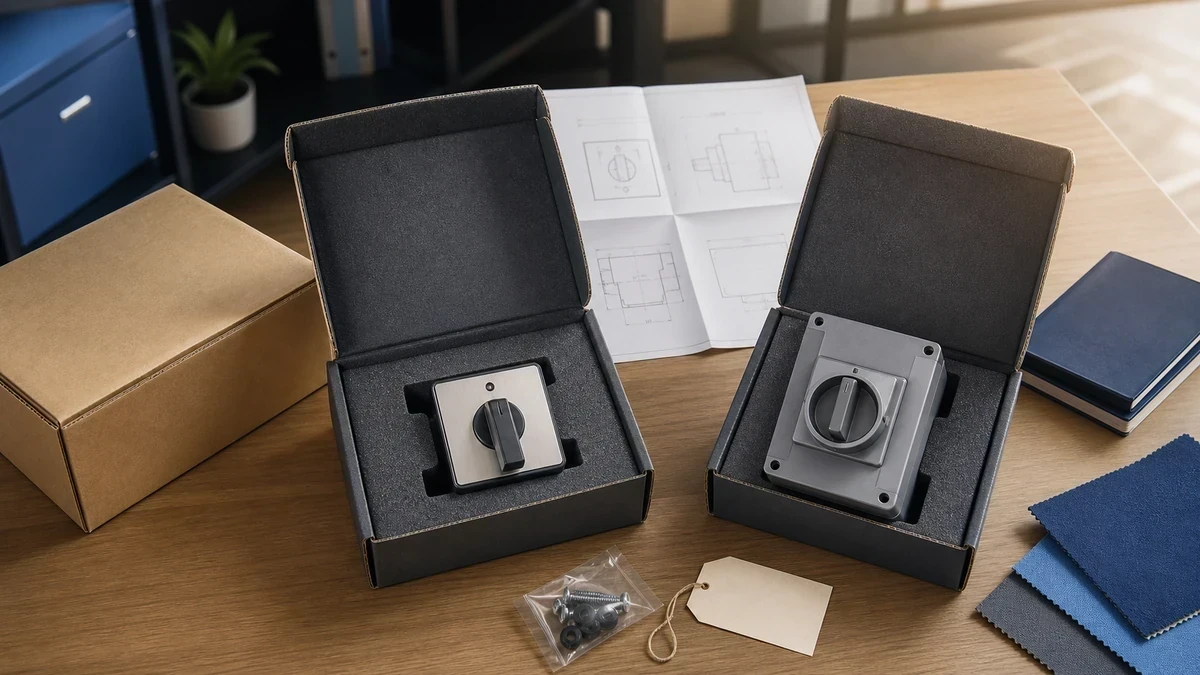
Sample review should connect the exact item to its current drawing and requested evidence package.
Сайт positions, poles and contact stages guide explains the core terms. For replacement work, the key point is practical: every position column and every contact row must be checked.
Positions and handle angle
Record the number of positions and the angle between positions. Common-looking handles can have different indexing, and panel legends may not reveal the internal cam sequence.
Position verification checklist:
Number of positions, including OFF or neutral positions.
Maintained or spring-return action, if used.
Switching angle between positions.
Stop arrangement and handle travel direction.
Whether the handle can pass through intermediate positions.
Required legend marking and orientation.
Poles and contact stages
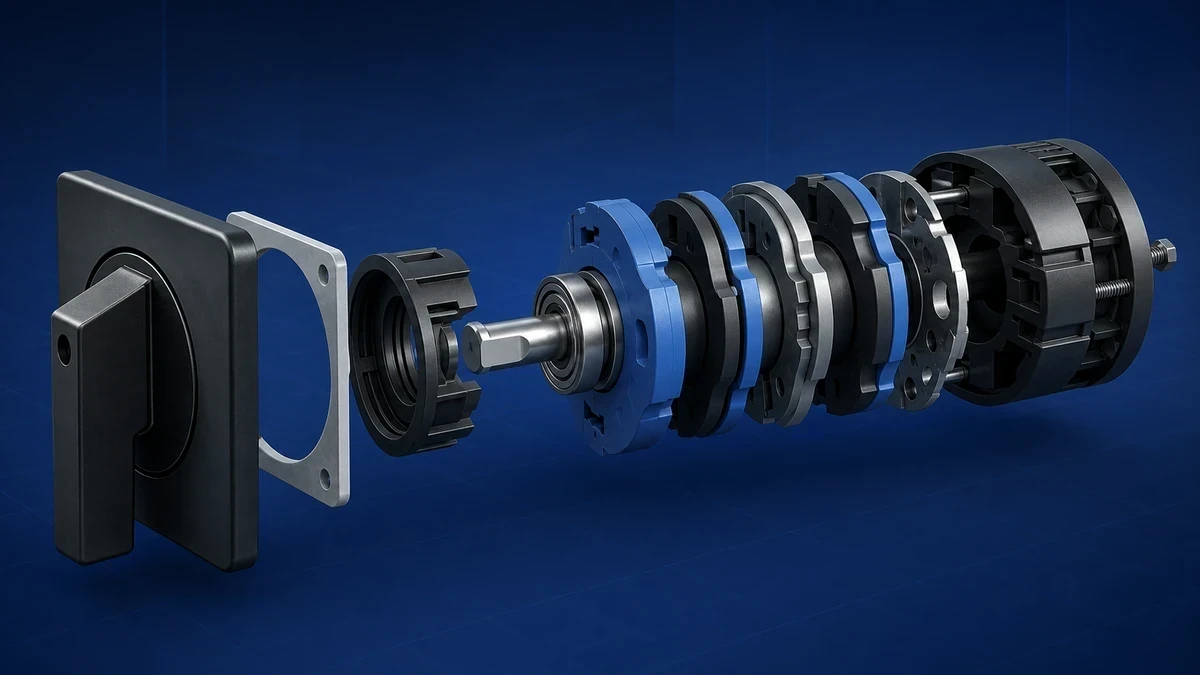
Pole count describes how many separate circuits are switched. Contact stages describe the stacked contact elements used to create the program.
A replacement may need the same number of active poles and the same contact timing, not merely the same number of contact blocks. If any contact closes early, opens late, or overlaps another contact, that timing must be visible in the contact table.
Confirm mounting route before choosing the handle and shaft
Confirm the panel interface before finalizing the switch body. A correct contact program can still fail the retrofit if the shaft, mounting style, handle, or panel depth does not fit the enclosure design.
Installation conditions change the product-route and document questions a buyer must resolve.
Panel and shaft measurements
Measure the actual installation, not only the removed part. Panel cutout, fixing pattern, panel thickness, and available rear depth affect the route.
Mounting comparison table:
Mounting item
Buyer should provide
Why it affects replacement
Panel cutout or fixing hole pattern
Dimensioned photo or drawing
Determines whether the switch can be installed without panel changes
Толщина панели
Measured value
Affects shaft and mounting accessory selection
Rear clearance
Depth available behind the panel
Affects body length and stage count
Shaft length
Measurement from mounting face
Affects handle fit and front-panel operation
Тип рукоятки
Photo and marking requirement
Affects operator interface and legend match
Front marking
Required text or symbol layout
Affects user-facing identification
Handle and legend route
The handle is part of the operator interface, but it is not proof of the internal switching logic. Confirm handle color, shape, legend plate, and position text separately from the contact chart.
If the panel marking is customer-specific, provide the required legend at RFQ stage. Custom marking, accessory choice, and front appearance are exact-order and drawing dependent.
Treat motor-control replacements as sequence checks, not nameplate matches
For motor-control duties, verify the full contact sequence before discussing part equivalence. Forward/reverse, pole-change, star-delta, and multi-step functions depend on exact contact timing and circuit design.
Сайт rotary cam switch motor-control guide is a useful foundation. For replacement approval, compare the actual contact table and the machine circuit.
Forward-off-reverse and reversing functions
A reversing switch route must confirm which contacts close in forward, which close in reverse, and what happens in the OFF position. Any electrical interlocking created by the cam sequence must be verified on the drawing.
Motor-control replacement decision table:
Motor-control pattern
Replacement risk
Verification needed
Forward-off-reverse
Wrong phase sequence or unintended contact overlap
Original contact chart and motor circuit drawing
Star-delta
Incorrect transition or contact timing
Full sequence table and application review
Two-speed or pole-change
Wrong winding connection
Motor data and switch contact program
Multi-step control
Incorrect step order
Position-by-position contact table
Local selector function
Wrong enabled circuit
Control schematic and legend confirmation
Transition and overlap details
Some motor-control programs depend on whether contacts open before others close. This cannot be inferred from the front handle text.
Action list for motor-control replacement:
Confirm the motor-control function name.
Obtain the original switch contact chart.
Check motor voltage, current, and duty information.
Confirm AC/DC control circuits, if separate control contacts are used.
Review contact timing in every handle position.
Match the route against the exact current product documentation.
Selecting a rotary operator or switch component does not validate a complete machine safety function. Machine safety validation, where relevant, must be handled at the system level by the buyer’s competent team.
How Shieldhz confirms a rotary cam switch route
Shieldhz confirms a replacement route by matching the requested function, electrical duty, contact program, mounting interface, environment, and documentation package before quotation. Final suitability is confirmed against current product documentation and the buyer’s application.
Available configuration discussions can start from the диапазон поворотных кулачковых переключателей, but retrofit approval still depends on the buyer’s evidence and the exact model route.
Pre-quotation confirmation inputs
Shieldhz asks for practical inputs that allow the model route to be checked before a commercial quote is treated as final.
Pre-quotation checklist:
Switching function: ON/OFF, changeover, selector, meter selection, motor-control pattern, or defined custom sequence.
AC/DC duty: circuit type and load role.
Voltage/current and utilization category: based on the buyer’s circuit and required standard basis.
Pole and contact program: original contact chart or reconstructed position-by-position table.
Panel mounting and handle route: cutout, fixing, panel thickness, shaft, handle, and legend.
Environment: enclosure context, ambient conditions, and any exact IP or material requirements stated by the buyer.
Requested documentation: drawing, datasheet, and certificate package required for purchasing or destination-market review.
Quotation output and suitability boundary
The quotation route should identify the proposed function, model basis, and documentation available for review. If the replacement is not like-for-like because the original contact chart is missing, that limitation should be visible in the quotation conversation.
The buyer remains responsible for confirming the replacement in the actual panel or machine application. Shieldhz can support the model-route check, but no substitution claim should be made without the original contact chart or an agreed engineered contact table.
Build the RFQ package so sourcing, engineering, and quality review the same evidence
Send one evidence package that connects the commercial request to the engineering verification. This reduces the risk of a buyer, distributor, and supplier discussing similar-looking switches with different contact programs.
Documentation control, sample acceptance and protective packing are separate handover checks.
RFQ package checklist
A strong RFQ package does not need to be long. It needs the right evidence.
Include:
Quantity and required commercial purchasing details.
Old switch photos: front, side label, rear contact stack, and wiring before removal.
Original contact chart, schematic, or machine drawing.
Function name and handle legend.
Electrical data: AC/DC, voltage, current, utilization category, and circuit role.
Pole count, contact sequence, and number of positions.
Mounting dimensions, shaft length, panel thickness, and rear clearance.
Required drawing, datasheet, and certificate package.
Destination market, if documentation requirements depend on it.
Any buyer-specific review format or drawing approval process.
Red flags that require engineering confirmation
Some replacement requests should be paused before quotation is finalized. These cases need engineering review because a simple part-number comparison can hide functional differences.
Red flags:
The old switch has no readable model label.
The original contact chart is missing.
The panel legend does not match the machine drawing.
More wires are present than the visible function suggests.
The switch controls a motor sequence or multi-step circuit.
The buyer requests a different handle layout or position count.
The required documentation package is not yet defined.
The circuit has been modified since the original machine build.
Conclusion
A rotary cam switch replacement is an engineering verification task before it is a purchasing task. The original contact chart, contact timing, electrical duty, and mounting interface decide whether a replacement route is valid.
For commercial sourcing, the safest process is clear: collect the original evidence, classify the route as like-for-like or engineered, confirm the exact model documentation, and avoid substitution claims without the contact chart. This gives panel builders, OEMs, distributors, and sourcing teams a practical basis for quotation and review.
Часто задаваемые вопросы
Can I replace a rotary cam switch using only the front handle marking?
No. The front marking shows the operator position text, but it does not prove the internal contact sequence. Use the original contact chart, wiring record, or a reconstructed contact table before approving the replacement.
What if the original brand or model is obsolete?
Treat the job as an engineered retrofit unless the original contact chart is available. Provide photos, wiring records, mounting dimensions, and the required switching sequence so a current model route can be checked.
Is the same current rating enough for replacement?
No. Current must be reviewed with voltage, AC/DC duty, utilization category, contact program, and exact product documentation. A visible ampere marking alone is not enough evidence.
What documents should I request before purchasing?
Request the model drawing, datasheet, and any certificate package needed for your purchasing or destination-market review. Availability and scope of documentation depend on the exact model and order requirement.
How should I handle a motor reversing or star-delta replacement?
Start with the original contact chart and motor circuit drawing. Confirm every handle position, contact closure, transition, and duty condition before selecting a replacement route.
Does selecting an operator validate an emergency-stop or machine safety function?
No. Selecting an operator or switch component does not validate a complete machine safety function. Safety validation is a system-level task that depends on the full machine design, risk assessment, circuit architecture, and applicable requirements.
Ши, Мукси
Ши, Мукси пишет технические статьи Shieldhz для покупателей промышленных систем управления и электрических компонентов, охватывая поворотные кулачковые переключатели, разъединители, PV DC разъединители, кнопки, индикаторные лампы, водонепроницаемые корпуса и клеммные блоки. Статьи основаны на опыте производства и экспорта компании Zhejiang Shihe Electric Co., Ltd., с практическим акцентом на выборе модели, технических характеристиках, чертежах, сертификации, рейтингах IP и деталях запроса, которые покупатели должны подтвердить перед заказом.