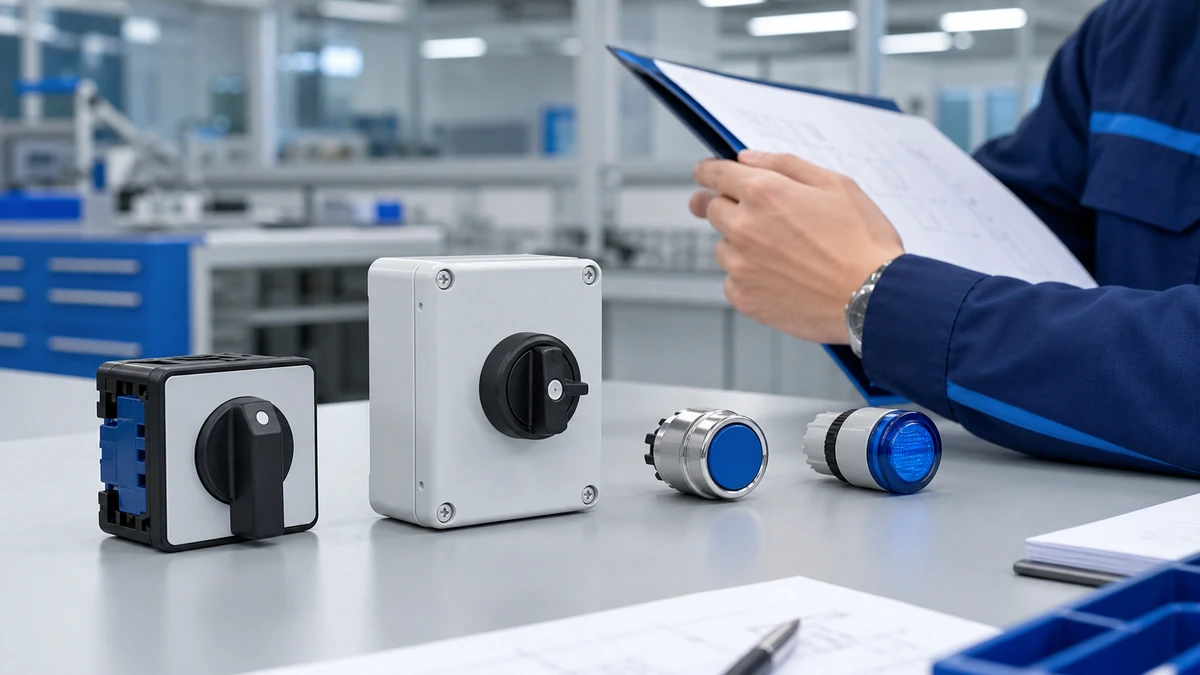
Industrial Control Component Manufacturer in China: Factory, OEM, and Export Buyer Checklist
Use a practical buyer checklist to evaluate industrial control component manufacturer china inputs, documentation, approval controls and the exact industrial control component portfolio route.
For industrial OEMs, panel builders, engineering distributors, and procurement teams, the right China sourcing decision is not “which catalog looks broadest.” It is whether the manufacturer can map your application to an exact product family, model route, documentation set, and export handover before you commit.
Confirm the product function first: switching sequence, DC isolation, operator input, indication, or enclosed local isolation.
Treat ratings, approvals, enclosure claims, lead time, MOQ, labeling, and destination-market compliance as quotation- and document-dependent.
What an industrial control component manufacturer in China should prove before quotation
A manufacturer should prove that it can connect your required control function to a defined product route, documentation package, and commercial handover. This is more useful than broad catalog claims because industrial control components are selected by exact model, wiring arrangement, panel environment, operator interface, and destination-market expectations.
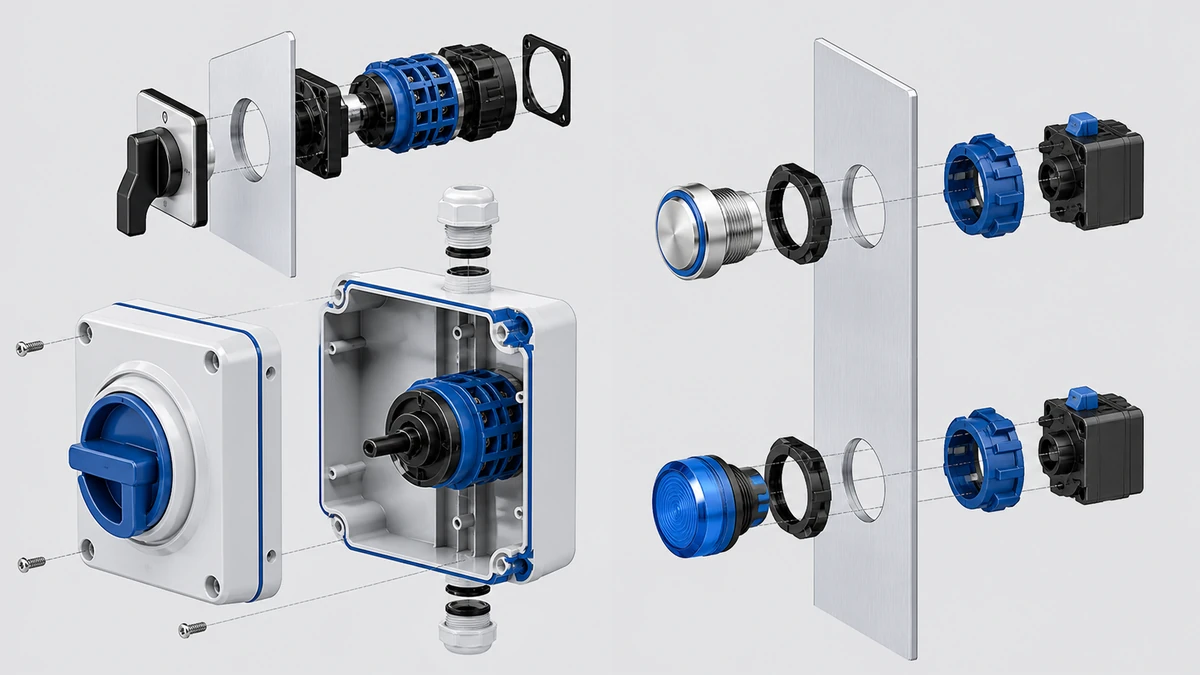
An exact drawing identifies the interfaces that must be controlled for the approved model route.
A buyer comparing an industrial control component manufacturer china option should ask for evidence in the same structure used internally for engineering approval. Start with the product family, then move to model, rating basis, drawing, marking, packaging, sample approval, and order terms.
Manufacturer scope versus trading scope
A factory-route discussion should clarify which product families are made, assembled, customized, branded, or supplied through another route. The buyer does not need a ranking of suppliers; the buyer needs traceability for the quoted item.
Use o Shieldhz industrial control component range as the starting portfolio reference, then confirm the exact model path in the quotation. The catalog page is a starting point, not a substitute for model-level verification.
Evidence buyers should request early
A practical evidence pack should be requested before technical and commercial approval. The content can vary by model and destination, but the request should be specific.
Checklist for first manufacturer screening:
Product family and exact model or proposed model route
Drawing or dimension sheet for panel layout review
Electrical rating information from the current product document
Mechanical mounting details and actuator/interface options where applicable
Marking and label expectations, including brand route if OEM is requested
Available documentation relevant to the destination market
Sample policy, approval method, and change-control expectations
Packing, carton labeling, and export document requirements
Product-family fit: match the component route to the panel function
Select by function first: switching sequence, DC isolation, operator input, indication, or enclosed local isolation. A component should not be chosen only because it appears visually similar to an existing part.
Rotary cam switches for control and selection functions
A rotary cam switch route is typically reviewed when the buyer needs defined switching positions, contact sequence logic, handle style, panel mounting, and marking requirements. The exact selection depends on the current model documentation, requested electrical use, number of positions, contact arrangement, and panel design.
Review the Faixa do interruptor de came rotativo when your application needs a model route for selector, changeover, control, or similar switching functions. The final route should be confirmed against the circuit drawing and the manufacturer’s current data for the exact model.
PV DC isolator switches for photovoltaic DC isolation routes
A PV DC isolator switch route is reviewed when the buyer’s application involves DC isolation in a photovoltaic system architecture. The model choice depends on DC voltage, current, pole configuration, installation environment, enclosure route, and destination-market documentation requirements.
Review the Faixa de chave do isolador PV DC as a product-family starting point. Do not assume that one DC isolator model fits every photovoltaic application; verify the exact model, wiring configuration, rating basis, and documentation route.
Push buttons and indicators for operator interface routes
Push buttons, selector operators, indicator lights, and emergency-stop operators are selected as human-machine interface components. The selection depends on panel cutout, operator style, color, marking, contact arrangement, illumination route, and current product documentation.
Review the push button and indicator light range when the project needs operator input or visual indication components. If an emergency-stop operator is requested, selecting the operator does not validate a complete machine safety function; the safety function must be designed, assessed, and validated at machine or system level by the responsible parties.
Waterproof isolator boxes for enclosed local isolation routes
An enclosed isolator route is reviewed when the buyer needs a local isolation assembly in an enclosure format. The exact enclosure rating, switch model, cable entry method, labeling, and installation suitability must be confirmed against the product documentation and buyer application.
Review the waterproof isolator box range when the requirement is an enclosed local isolation route. Any enclosure or environmental claim should be checked for the exact model and installation conditions.
Buyer function
Possible product-family route
Key verification before quotation
Multi-position control or changeover
Interruptor de came rotativo
Position sequence, contact arrangement, rating basis, handle, panel mounting
PV DC local isolation
Chave isoladora PV DC
DC voltage/current route, pole configuration, wiring diagram, enclosure option
Operator input or indication
Push buttons and indicator lights
Cutout, operator type, contact blocks, lamp voltage, marking, color
How Shieldhz confirms a industrial control component portfolio route
Shieldhz confirms the route by narrowing the request from application intent to an exact model, drawing, documentation pack, and quotation record. Final suitability is confirmed against current product documentation and the buyer’s application.
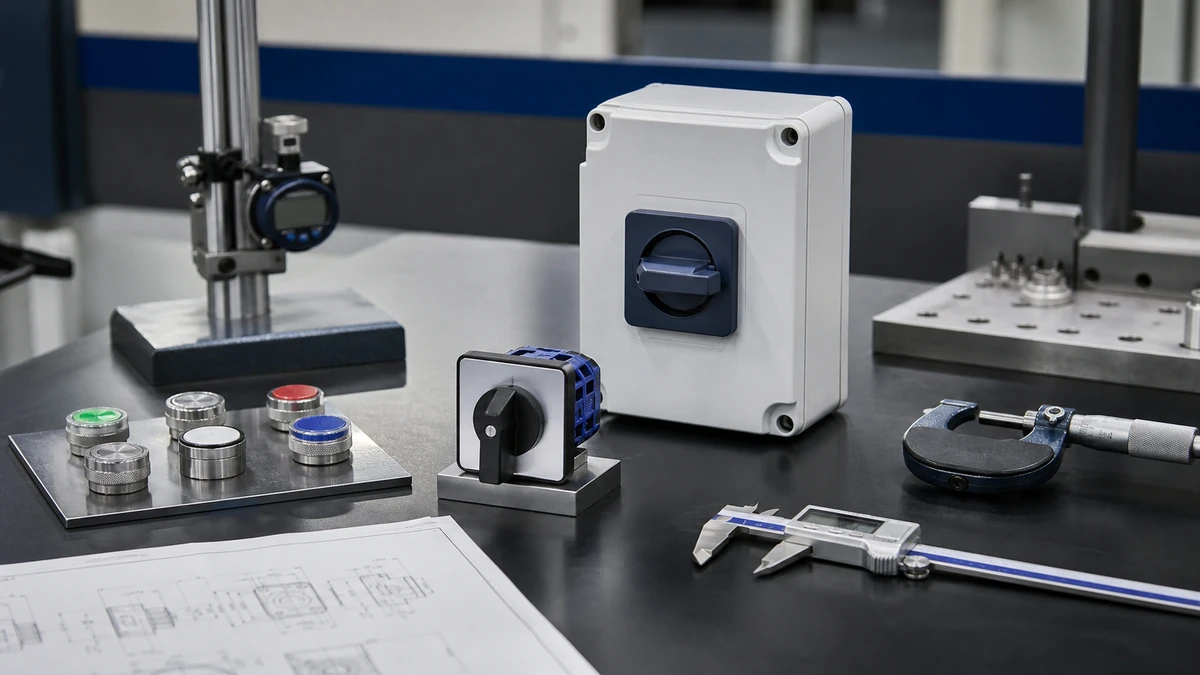
Sample review should connect the exact item to its current drawing and requested evidence package.
This pre-quotation confirmation prevents the common sourcing problem where a buyer approves a catalog family but later discovers that the exact model, marking, enclosure, or document route does not match the project. The process should be handled before purchase order release.
Pre-quotation confirmation inputs
Shieldhz should receive the application context first, not only a photo or short part name. The same product family can lead to different model routes depending on electrical, mechanical, marking, and destination-market inputs.
Practical pre-quotation input checklist:
Application: panel type, machine or equipment context, operating role, and user-interface need
Destination market: country or region where the equipment or panel is intended to be used
Product family and exact model route: existing part number, drawing, sample, or requested alternative
Electrical inputs: voltage, current, AC/DC route, frequency where relevant, load type, poles, and contact arrangement
Mechanical inputs: cutout, mounting method, handle/operator style, enclosure route, dimensions, and cable entry needs where applicable
Requested documentation: datasheet, drawing, declaration, certificate copy if applicable, marking detail, packing information, or other buyer-required files
Marking: product label, panel label, model marking, private label, or packaging label requirements
Sample and change control: sample quantity, approval method, revision freeze, and notification expectations
Commercial handover: quantity, target delivery window, Incoterms if used, packaging, export documents, and payment terms
Approval records and change-control route
The buyer should define what counts as approval. For some teams it is a signed drawing; for others it may be a sample approval record, internal part-number release, or distributor master data entry.
Any change to model route, marking, construction option, documentation status, or packaging requirement should be controlled through written confirmation. For recurring orders, the buyer should decide which changes require re-approval before shipment.
Factory and OEM evaluation without relying on slogans
Evaluate the factory by evidence that can be checked on the exact product family, not by broad claims. A useful supplier conversation separates manufacturing capability, customization route, private-label requirements, documentation availability, and commercial terms.
Factory questions that create usable answers
Ask questions that produce documents, drawings, records, or quotation conditions. Avoid relying on general statements such as “standard model” unless the exact document and revision are identified.
Factory evaluation checklist:
Which product family and exact model is being quoted?
Is the item standard, customized, branded, or buyer-specific?
Which drawing or datasheet revision applies?
What markings will appear on the product and package?
What documentation can be supplied for the exact model?
What sample approval method is expected?
What production or packaging changes require buyer confirmation?
Which export documents are included in the quotation route?
OEM and private-label decision points
OEM supply should be treated as a controlled marking and documentation route. The buyer should confirm whether the requested brand, model code, label layout, packaging artwork, and instruction sheet are available for the exact order conditions.
OEM decision
O que confirmar
Por que é importante
Brand marking
Product body, label, package, or document marking route
Prevents mismatch between approved sample and delivered goods
Model code
Factory model, buyer part number, or dual-reference method
Supports purchasing, inventory, and field replacement
Packaging
Neutral, factory-branded, or buyer-branded packaging
Affects distribution and customs documentation consistency
Documentação
Datasheet, drawing, declaration, certificate copy if applicable
Helps engineering and compliance teams review the exact item
Change control
Which changes require buyer approval
Reduces risk in repeat orders
Documentation and compliance checks for export buyers
Export buyers should treat documentation as model-, destination-, and panel-route-dependent until verified. A certificate, declaration, datasheet, or marking statement should be checked for the exact model and the current edition or revision that the buyer’s project requires.
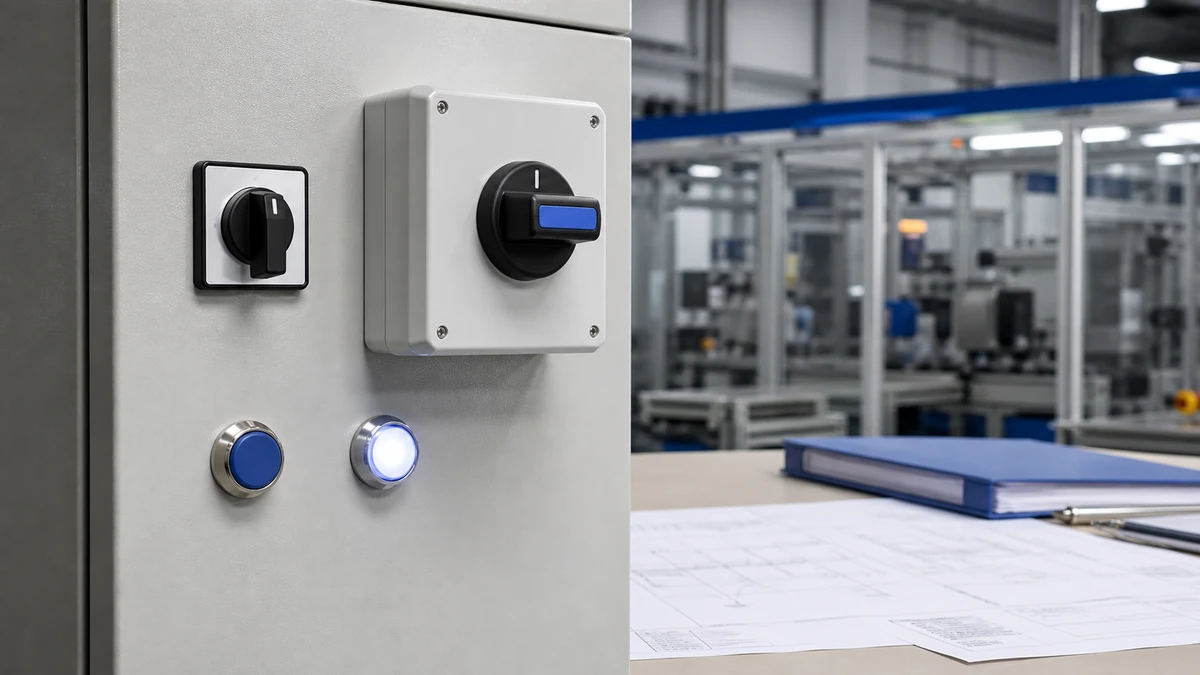
Installation conditions change the product-route and document questions a buyer must resolve.
Documentation review is not only a compliance formality. It affects panel approval, distributor onboarding, customs files, customer documentation, and replacement-part control.
Destination-market route and panel-route review
For U.S.-bound industrial control panels, buyers may need to review UL 508A component guidance. UL explains that its Supplement SA addresses component requirements used in industrial control panels; buyers must verify the applicable edition and exact panel route.
For any destination market, do not assume that a component document automatically covers the finished panel, machine, or installation. The responsible panel builder, machine builder, importer, or certification body should confirm the applicable route.
Document-control checklist
A useful document request is specific and version-aware. Ask for documents before final supplier approval, not after the goods arrive.
Documentation checklist:
Exact model number and product family
Datasheet revision or issue date
Dimension drawing or mounting drawing
Wiring or contact arrangement information where applicable
Marking drawing or label sample if required
Certificate copy or declaration if applicable to the exact model
Language requirements for instructions or labels if relevant
Destination-market or customer-specific documentation notes
Buyer part-number cross-reference if used
Engineering review: ratings, mounting, environment, and user operation
Engineering review should convert the buyer’s load, environment, mounting, and user-interface requirements into exact-model checks. The goal is to prevent a visually similar component from being accepted before the electrical and mechanical route is verified.
Electrical and control-function inputs
The buyer should provide the electrical role of the component, not only a desired current or voltage number. AC/DC route, load type, switching duty, contact arrangement, number of poles, and operating sequence can all affect model selection.
If lamp voltage, contact configuration, DC isolation route, or switching sequence is relevant, request the exact drawing or datasheet used for quotation. Do not treat a switch, isolator, or operator as overcurrent protection.
Mechanical and environmental inputs
Mechanical fit can be as important as electrical selection. Panel cutout, mounting depth, handle clearance, actuator size, enclosure route, cable entry, label space, and operating access should be checked against the drawing.
Environmental information should be stated clearly by the buyer. Temperature range, indoor or outdoor exposure, moisture, dust, washdown expectations, UV exposure, vibration, and installation method should be reviewed against the exact model documentation rather than assumed from the product family name.
Indoor/outdoor context, moisture, dust, temperature
Exact enclosure or product documentation route
Marcação
Label text, symbols, language, color
Marking method and sample approval path
Quality control and change control questions for procurement
Procurement should lock samples, approvals, and change rules before recurring orders. This is especially important when the same part number may involve buyer-specific marking, packaging, or documentation expectations.
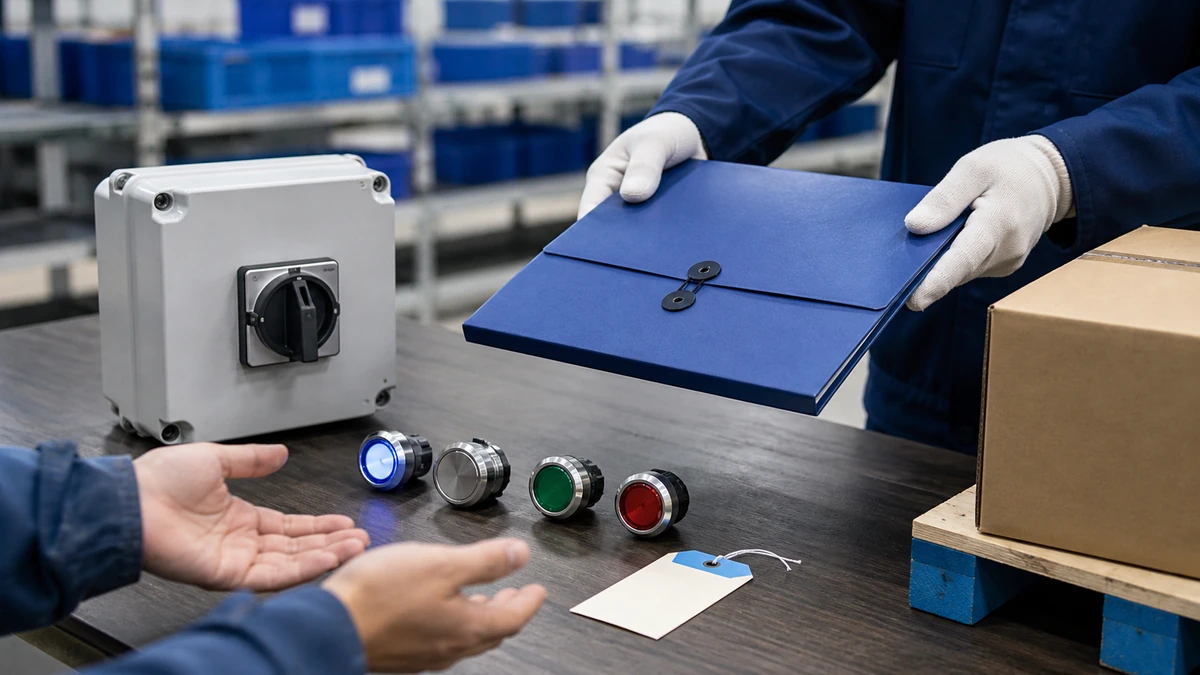
Documentation control, sample acceptance and protective packing are separate handover checks.
Do not rely only on a first shipment to define the standard. The approved standard should be captured in documents, sample records, drawings, or written quotation notes.
Sample approval before bulk order
Samples are most useful when the buyer defines what is being approved. A sample can approve appearance, dimensions, marking, packaging, fit, or documentation route, but only if those items are recorded.
Sample approval action list:
Record the exact model, quotation reference, and revision or drawing date.
Photograph product marking, packaging, and any buyer-specific labels.
Confirm mechanical fit in the intended panel or enclosure route.
Check the datasheet or drawing against the sample.
List open questions before releasing the bulk order.
Define whether future changes require written buyer approval.
Incoming inspection and recurring-order control
Incoming inspection should compare delivered goods against the approved route. This may include model marking, quantity, packaging, dimensions, operator type, color, label, and document package.
For repeat orders, procurement should request written notice for changes that affect fit, marking, construction option, packaging, or documentation. The exact change-control requirement should be included in the purchase agreement or quotation notes where possible.
Commercial checklist for China sourcing, OEM supply, and export handover
A useful RFQ makes the export transaction measurable: exact items, documentation, labeling, packaging, and handover terms. Commercial clarity reduces the risk of technically acceptable goods being delayed by missing labels, unclear shipping requirements, or mismatched documents.
RFQ information that helps the factory quote correctly
A strong RFQ should combine technical and commercial inputs. If some details are not known, state them as open items instead of allowing assumptions to drive the quote.
RFQ checklist:
Buyer company, role, and destination market
Product family and existing part number if available
Required quantity for sample and bulk order
Exact electrical and mechanical application inputs
Drawing, photo, or current sample if replacement matching is requested
Documentation required for engineering, compliance, or resale
OEM marking, label, packaging, or buyer part-number needs
Inspection, approval, and change-control expectations
Requested delivery window, shipment method, and trade terms
Any customer-specific document or packaging requirement
Quotation comparison table
Compare quotations by what is included, not only by unit price. A lower price may not include the same documentation, marking, packaging, or approval route.
Quotation item
What to compare
Buyer decision
Exact model
Same model route or proposed alternative
Approve only after engineering review
Documentação
Datasheet, drawing, certificate copy if applicable, label files
Confirm before purchase order
OEM route
Product marking, package marking, buyer code
Decide whether sample approval is required
Commercial terms
Quantity, price basis, shipment term, payment term
Check against procurement policy
Lead time
Stated for sample or bulk order under quoted conditions
Treat as quotation-dependent
MOQ
Applied to model, color, marking, or packaging route
Confirm before artwork or sample release
Packaging
Export carton, inner packing, label, pallet if required
Align with warehouse and distributor needs
Conclusion
Choosing an industrial control component manufacturer in China is a structured evaluation, not a catalog shortcut. The buyer should confirm product-family fit, exact model route, documentation status, markings, samples, change control, and export handover before approving the supplier.
Shieldhz can be evaluated through the same practical route: define the application, confirm the product family, verify the exact model and documents, approve samples where needed, and lock the commercial handover. Final suitability remains dependent on current product documentation and the buyer’s actual application.
Perguntas frequentes
What should I ask first when sourcing industrial control components from China?
Start with the function and application. State whether the component is for switching sequence, DC isolation, operator input, indication, or enclosed local isolation, then request an exact model route with drawing and documentation.
Can I approve a component based only on a catalog page?
A catalog page is useful for product-family screening, but it should not be the only approval basis. Final approval should use the exact model, current datasheet or drawing, required markings, and destination-market documentation where applicable.
Does selecting an emergency-stop operator validate the full machine safety function?
No. Selecting an emergency-stop operator is only one component decision. The complete machine safety function must be designed, risk-assessed, integrated, and validated by the responsible machine or system parties.
Are ratings, enclosure claims, or certifications the same across a whole product family?
No assumption should be made across a whole family. Ratings, enclosure information, certificates, markings, and application suitability must be verified for the exact model, current document revision, and intended application.
What makes an OEM request different from a standard product request?
An OEM request usually adds marking, label, packaging, buyer part-number, artwork, or documentation requirements. These should be confirmed in the quotation and, where necessary, approved through samples or written records.
How should procurement compare two China manufacturer quotations?
Compare the exact model, documentation included, OEM route, sample approval terms, change-control expectations, packaging, shipment terms, MOQ, and quoted lead time. Unit price is only one part of the sourcing decision.
Shi, Muxi
Shi, Muxi escreve artigos técnicos da Shieldhz para compradores de controle industrial e componentes elétricos, abrangendo chaves de came rotativas, chaves isoladoras, seccionadores PV DC, botões de pressão, luzes indicadoras, gabinetes à prova d'água e blocos de terminais. Os artigos são baseados na experiência de fabricação e exportação da Zhejiang Shihe Electric Co., Ltd., com ênfase prática na seleção de modelos, planilhas de dados, desenhos, certificações, classificações de IP e detalhes de consulta que os compradores devem confirmar antes de fazer o pedido.