Spring-Return vs Maintained Selector Switches: Operator-State and Contact-Program Decisions
Use a practical buyer checklist to evaluate spring return vs maintained selector switch inputs, documentation, approval controls and the exact push button, selector switch or emergency-stop operator route.
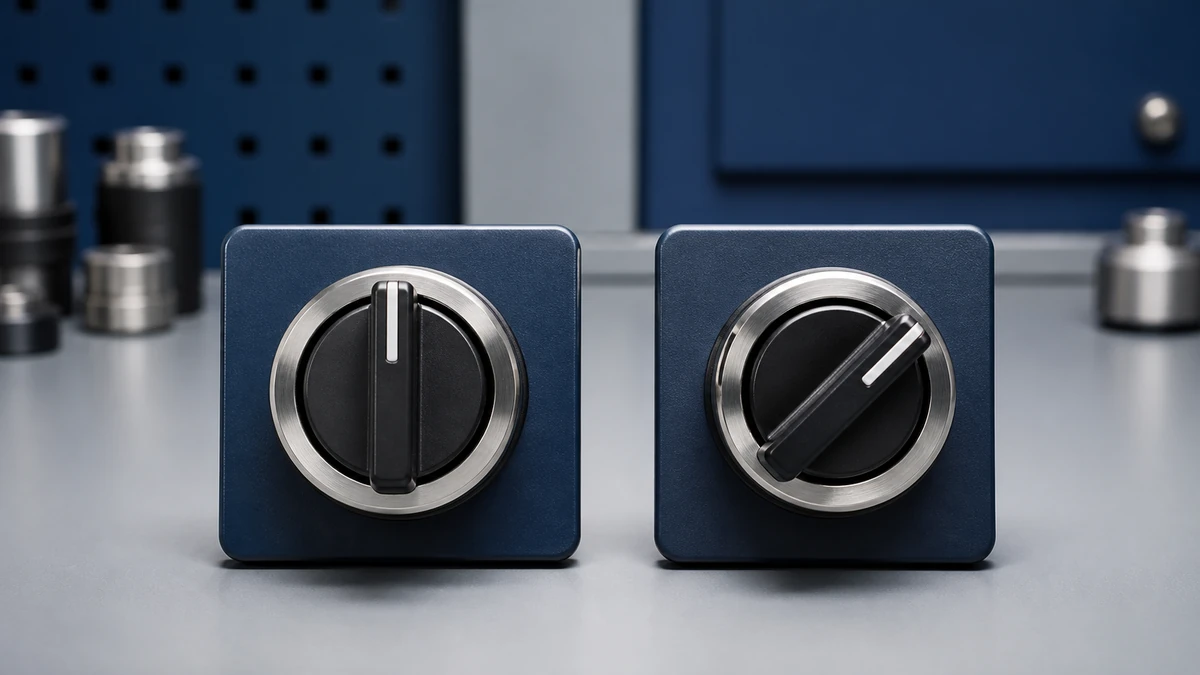
The spring return vs maintained selector switch decision is mainly about what should happen after the operator releases the handle: choose spring-return when the command should return automatically, and choose maintained when the selected state should remain until deliberately changed.
Confirm the required operator state first, then confirm whether the selector is 2-position, 3-position or another exact model route.
Match the contact program to the control circuit: NO, NC, or mixed contacts must support the intended logic.
Treat ratings, environmental details, certificates and markings as exact-model and destination-market dependent, not as assumptions from the operator style alone.
Decide the operator state you want after the hand leaves
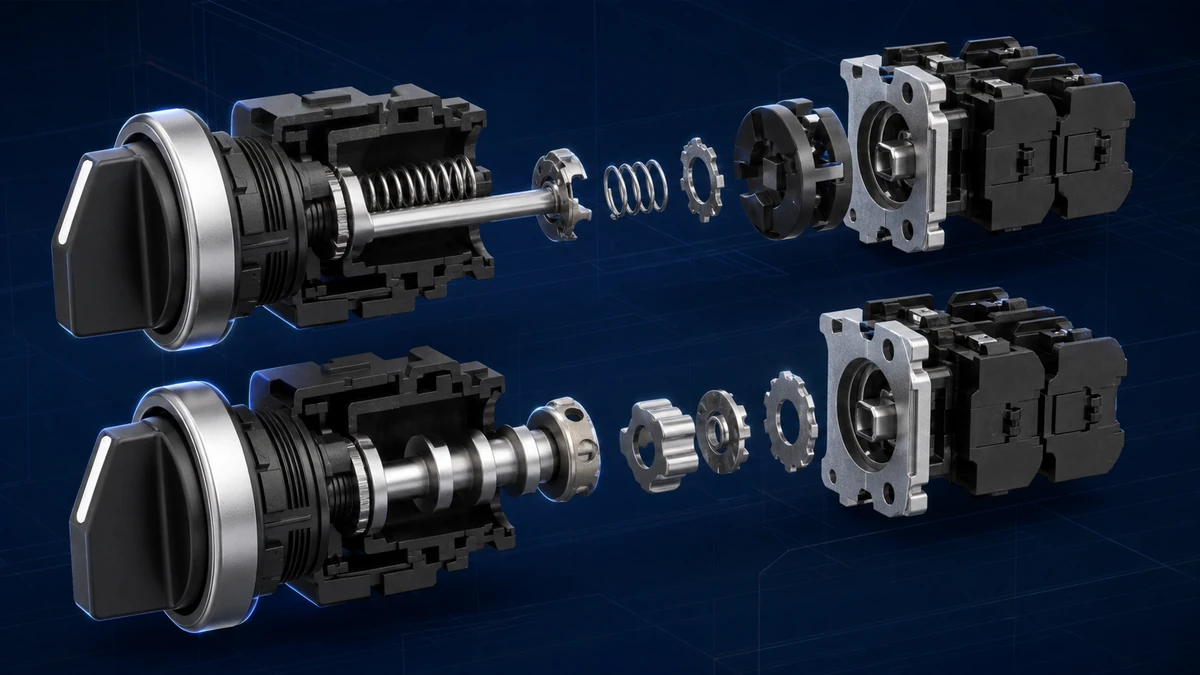
Choose the return action by deciding what state must remain after the operator releases the handle. A spring-return selector automatically leaves the actuated position and returns to its rest position; a maintained selector stays in the selected position until the operator moves it again.
An exact drawing identifies the interfaces that must be controlled for the approved model route.
When the selected state should disappear
Use spring-return when the machine command should exist only while the operator is actively requesting it. Typical buying discussions include jog, inch, reset, acknowledge, test or manual advance functions, subject to the machine logic and the risk assessment behind that logic.
This does not mean the switch alone makes the function suitable. The control system must interpret the contact change correctly, and the final device must be checked against its datasheet, drawing and applicable documentation.
When the selected state should remain
Use maintained action when the selection is intended to persist. Common examples include mode selection, manual/auto selection, local/remote selection, pump 1/pump 2 selection, or a maintained enable path in a defined control scheme.
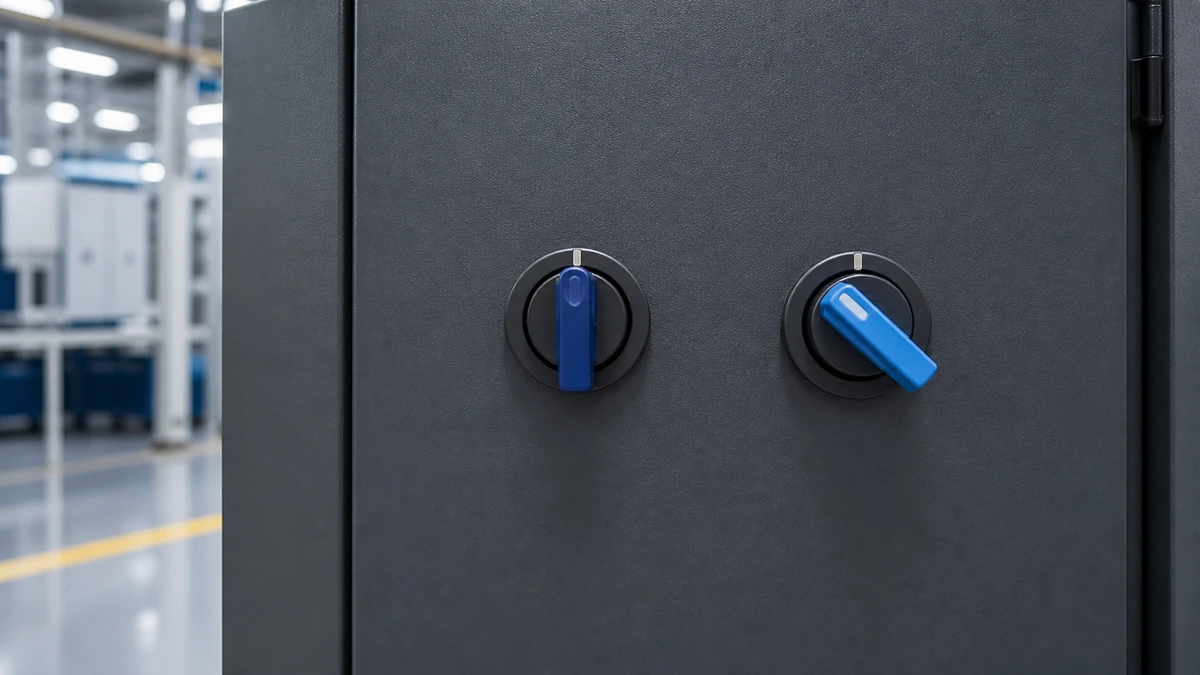
A maintained selector is useful when the visible handle position should communicate the selected state to an operator or maintenance person. The buyer should still verify whether the control system also stores, supervises or overrides that state.
Buyer decision
Seletor de retorno por mola
Maintained selector
State after release
Returns to rest position
Stays where selected
Operator intent
Momentary command
Persistent selection
Visual indication
Handle returns, so status may need separate indication
Handle position can show selected state
Typical purchasing risk
Ordering maintained when the command should be momentary
Ordering spring-return when the operator expects a retained mode
Separate return action from position count before specifying a selector
Specify return action separately from position count because they answer different questions. Position count defines how many mechanical positions the selector has; return action defines whether one or more positions return automatically.
Two-position selection is not automatically maintained
A 2-position selector can be maintained or spring-return depending on the exact model. For example, one version may stay in ON or OFF, while another may return from START to RUN or from TEST to NORMAL.
For foundational operator terminology before part-number selection, use the Noções básicas sobre interruptores de botão article instead of treating every selector as the same device family.
Three-position selection needs a center and side-position decision
A 3-position selector may be maintained in all positions, spring-return from one side, spring-return from both sides, or use another exact contact/operator arrangement. The buyer should define the center position, the left and right functions, and which positions should return.
For layout context where selectors appear near other panel operators, see the emergency-stop and selector layout guide. Selecting an operator or placing it on a panel does not validate a complete machine safety function.
Specification item
Do not assume
Confirm instead
Number of positions
That 2-position means maintained
Exact position count and return behavior
Center position
That center is OFF
Function assigned to center position
Side positions
That both sides behave the same
Whether left, right or both sides spring-return
Operator marking
That handle position is self-explanatory
Legend plate, marking and drawing requirement
Match contact program to the machine logic, not only the knob action
Choose the contact arrangement after the return action is clear, because the knob motion and the electrical contact program are related but not identical. A spring-return operator can be built with different NO, NC or mixed contact arrangements depending on the model route.
Sample review should connect the exact item to its current drawing and requested evidence package.
Decide which circuit changes in each position
The buyer should define what each position must do electrically. For example, one position may close a start input, another may open a stop-permissive input, and a center position may leave both circuits unchanged.
Do not order only by saying “spring return” or “maintained.” Provide the required contact state in each position so the supplier can confirm the correct contact block arrangement against current documentation.
Use NO and NC deliberately
NO and NC contact selection should follow the control circuit design. If the control logic expects a closed signal in normal condition, an NC contact may be required; if it expects a signal only when actuated, an NO contact may be suitable.
For a focused explanation of contact terminology, use the NO and NC contact guide. Final contact suitability still depends on the selected device, control voltage/current and the buyer’s application.
Required control behavior
Likely contact discussion
Return-action implication
Signal only while held
NO contact often reviewed
Spring-return often considered
Signal removed while held
NC contact often reviewed
Spring-return or maintained, depending on logic
Persistent mode signal
NO, NC or mixed contacts reviewed
Maintained often considered
Two circuits change together
Multiple contacts reviewed
Exact contact block stack and drawing required
Choose spring-return when a deliberate held command is the intended operation
Choose spring-return when the machine should receive the command only during a deliberate operator action. This is often the cleaner purchasing route for functions where latching the selector position would create confusion or require extra reset logic.
Good-fit discussions for spring-return
Spring-return is often reviewed for jog, inch, test, reset, acknowledge, manual advance and start-return functions. The exact suitability depends on the machine function, the control circuit and the operator interface design.
A buyer should define whether the operator must hold the selector continuously, whether the command should pulse briefly, and whether the control system latches any result after the selector returns.
Spring-return quotation checklist
Use this checklist before requesting a quote:
Define the rest position and the actuated position.
Confirm whether return is from one side or both sides.
State the required contact condition in rest and actuated positions.
Provide control voltage and current values for the circuit.
Confirm whether a separate indicator, label or legend is required.
Ask for the exact drawing and datasheet for the proposed model.
Choose maintained when operators need a persistent visible selection
Choose maintained action when the selected condition should remain mechanically visible and intentionally changeable. This is usually the stronger route for mode, source, duty or preference selections where the handle position is part of the operator interface.
Good-fit discussions for maintained selection
Maintained selectors are commonly reviewed for auto/manual, local/remote, forward/reverse, pump selection, fan selection and duty/standby selection. The exact operator and contact program should follow the control logic rather than a generic panel habit.
If the control system also stores the selection, confirm how the mechanical selector and the controller state interact after power loss, maintenance activity or manual override.
Maintained selector buying risks
The main buying risk is ordering a maintained selector for a function that should not stay active. Another risk is ordering a maintained operator with the wrong contact sequence, especially on 3-position selections.
Maintained-use question
Por que é importante
Should the handle position show the active mode?
Supports operator recognition, if the control system agrees
Can the selection remain after the operator leaves?
Confirms that maintained action is acceptable
What happens after power is restored?
Avoids conflict between mechanical position and control logic
Does each position need a different legend?
Affects marking and accessory selection
Specify legend, mounting and operator style as part of the return-action decision
Specify the physical operator details with the return action because the purchased assembly must fit the panel and communicate the function. A correct spring-return or maintained choice can still fail the buying requirement if the marking, cutout, mounting or accessory route is wrong.
Installation conditions change the product-route and document questions a buyer must resolve.
Marking and legend requirements
Return action affects how the legend should be written. A spring-return selector may need wording such as RESET, TEST or JOG, while a maintained selector may need position labels such as AUTO/MANUAL or LOCAL/REMOTE.
For contact blocks, lamp modules and legend-related selection topics, use the contact block and legend plate guide. The final marking should match the buyer’s drawing, machine language requirements and destination-market expectations.
Operator family and panel fit
Confirm panel cutout, mounting method, handle type, color, bezel style and any illumination requirement before locking the model. These details are not proven by the phrase “spring return” or “maintained.”
If procurement is consolidating control-panel operators, review the broader push button and indicator light range and then request the exact selector switch route needed for the application.
Practical ordering list:
Panel cutout size and mounting arrangement.
Operator head style and handle orientation.
Maintained or spring-return action, including return direction.
Contact block quantity and contact type.
Legend plate or marking text.
Drawing, datasheet and certificate requirements for the destination market.
Check documentation boundaries before converting a preference into a part number
Confirm documentation before converting the preferred return action into a part number. Ratings, environmental claims, certificates, endurance data, materials and marking options are exact-model and documentation dependent.
Standards and catalogue evidence are not product proof by themselves
O IEC 60947-5-1 listing describes the control-circuit-device subject area and notes that a more recent edition exists. Treat that catalogue page as a subject-area reference, not as a universal product-certification claim for any specific selector switch.
For a commercial purchase, ask for the current datasheet, drawing and applicable certificate package for the exact model under review. The destination market and buyer application determine which documents must be checked.
Variables that must be verified by exact model
Do not assume that one maintained or spring-return selector has the same values as another. Even within a similar operator style, control ratings, environmental suitability, materials, accessories and certificates can vary.
Buyer verification checklist:
Exact model number and configuration.
Control voltage and current for each circuit.
Required contact arrangement and contact state table.
Panel cutout, panel thickness range and mounting details.
Environmental exposure and cleaning conditions.
Destination-market documentation needs.
Drawing revision and datasheet revision used for approval.
How Shieldhz confirms a push button, selector switch or emergency-stop operator route
Shieldhz confirms the route by checking the buyer’s machine function, operator requirement and documentation package before quotation. Final suitability is confirmed against current product documentation and the buyer’s application.
Documentation control, sample acceptance and protective packing are separate handover checks.
Pre-quotation confirmation inputs
Provide the functional requirement first, not only a photo or a short label. The same panel position may require a different operator route if the function changes from maintained mode selection to spring-return reset.
Shieldhz typically asks for:
Machine function and destination market.
Operator action: spring-return, maintained, latching, key-operated or another required action.
Control voltage and current.
Contact arrangement, including NO, NC and contact state by position.
Panel cutout, mounting method and panel conditions.
Environment, including exposure, cleaning and enclosure context where relevant.
Marking, legend, language and color requirements.
Existing part number, drawing or panel layout if available.
Documentation package before purchasing
The quotation route should identify the exact drawing, datasheet and certificate package needed for the selected model. If the buyer requires a specific document set for internal approval, that requirement should be stated before final model confirmation.
For emergency-stop operators, selecting the operator is only one part of the machine design process. It does not validate the complete machine safety function, which must be assessed with the full control architecture, risk assessment and applicable requirements.
Conclusion
The spring return vs maintained selector switch decision should be made from the required operator state after release. Spring-return fits commands that should return automatically; maintained action fits selections that should remain visible and deliberate.
After that decision, specify position count, contact program, panel fit, legend, voltage/current and documentation needs. The safest commercial route is to quote from the exact machine function and approve the final model against the current drawing, datasheet, certificate package and buyer application.
Perguntas frequentes
Is a spring-return selector the same as a momentary selector?
In practical buying language, spring-return usually means the selector returns automatically after the operator releases it, so the command is momentary at the operator level. The exact contact behavior still depends on the selected model and contact arrangement.
When should I choose a maintained selector switch?
Choose maintained action when the selected state should remain until someone deliberately changes it. Typical discussions include mode selection, source selection, local/remote selection and duty selection, subject to the machine logic.
Can a spring-return selector use both NO and NC contacts?
Yes, depending on the exact product route and contact block arrangement. Provide the required contact state in each selector position so the supplier can confirm the correct configuration.
Is return action the same as 2-position or 3-position selection?
No. Position count defines how many mechanical positions the selector has, while return action defines whether the handle returns automatically from one or more positions.
Does selecting an emergency-stop operator validate the safety function?
No. Selecting an emergency-stop operator does not validate the complete machine safety function. The full safety function depends on the risk assessment, control architecture, installation and applicable requirements.
What information should I send for a selector switch quotation?
Send the machine function, destination market, operator action, position count, control voltage/current, contact arrangement, panel cutout, mounting details, environment and marking requirements. Also state which drawings, datasheets and certificates are required for approval.
Shi, Muxi
Shi, Muxi escreve artigos técnicos da Shieldhz para compradores de controle industrial e componentes elétricos, abrangendo chaves de came rotativas, chaves isoladoras, seccionadores PV DC, botões de pressão, luzes indicadoras, gabinetes à prova d'água e blocos de terminais. Os artigos são baseados na experiência de fabricação e exportação da Zhejiang Shihe Electric Co., Ltd., com ênfase prática na seleção de modelos, planilhas de dados, desenhos, certificações, classificações de IP e detalhes de consulta que os compradores devem confirmar antes de fazer o pedido.