Outdoor Isolator Box for HVAC Condensing Units: Service Isolation Inputs for Panel Builders
Use a practical buyer checklist to evaluate air conditioner isolator switch box inputs, documentation, approval controls and the exact weatherproof isolator switch box route.
An air conditioner isolator switch box for outdoor HVAC condensing units should be specified as a documented service-isolation input, not as a generic outdoor box. The buying decision should connect the isolation role, load data, enclosure exposure, cable-entry route, mounting arrangement and documentation package before quotation.
Confirm the exact isolation role, AC/DC duty, voltage, current and destination-market documentation needs before selecting a model route.
Treat IP rating, certificates, drawings and enclosure details as exact-product and installation-condition dependent.
Ask suppliers for the current drawing, datasheet and certificate package instead of relying on catalogue wording alone.
Decide the service-isolation role before choosing the box
The first buyer decision is what the outdoor isolator box is expected to isolate for service access on the HVAC package. For panel builders and contractors, the isolator is normally specified as an accessible local switching point for maintenance or service coordination, while the complete electrical design remains part of the buyer’s system responsibility.
This article focuses on B2B service-isolation inputs for outdoor equipment builders, HVAC and pump-panel teams, distributors and procurement teams. For broad introductory definitions, use the waterproof isolator box basics as the foundation rather than treating this article as consumer installation guidance.
Service isolation is a system input
The isolator box should be described by its function in the equipment package. Typical commercial descriptions include “local service isolation for outdoor condensing unit,” “external isolator for HVAC skid,” or “weatherproof isolator switch box for pump-panel service access.”
That wording is useful because it separates the local switching role from the rest of the electrical protection and control design. It also helps the supplier identify whether the enclosure, handle, switch rating and documentation route are relevant to the buyer’s intended use.
Inputs panel builders should freeze early
Before procurement asks for a price, engineering should freeze the basic service-isolation inputs. Changes to cable entry, current rating, pole configuration or enclosure route after quotation can affect drawings, model selection and document review.
Buyer action list:
Define the equipment: HVAC condensing unit, outdoor pump panel, chiller auxiliary package or other outdoor load.
State the service-isolation role and whether the unit is intended for local maintenance access.
Provide voltage, current, phase, frequency and AC/DC duty.
Identify destination market and requested document package.
Confirm enclosure exposure, mounting surface, handle access and cable-entry direction.
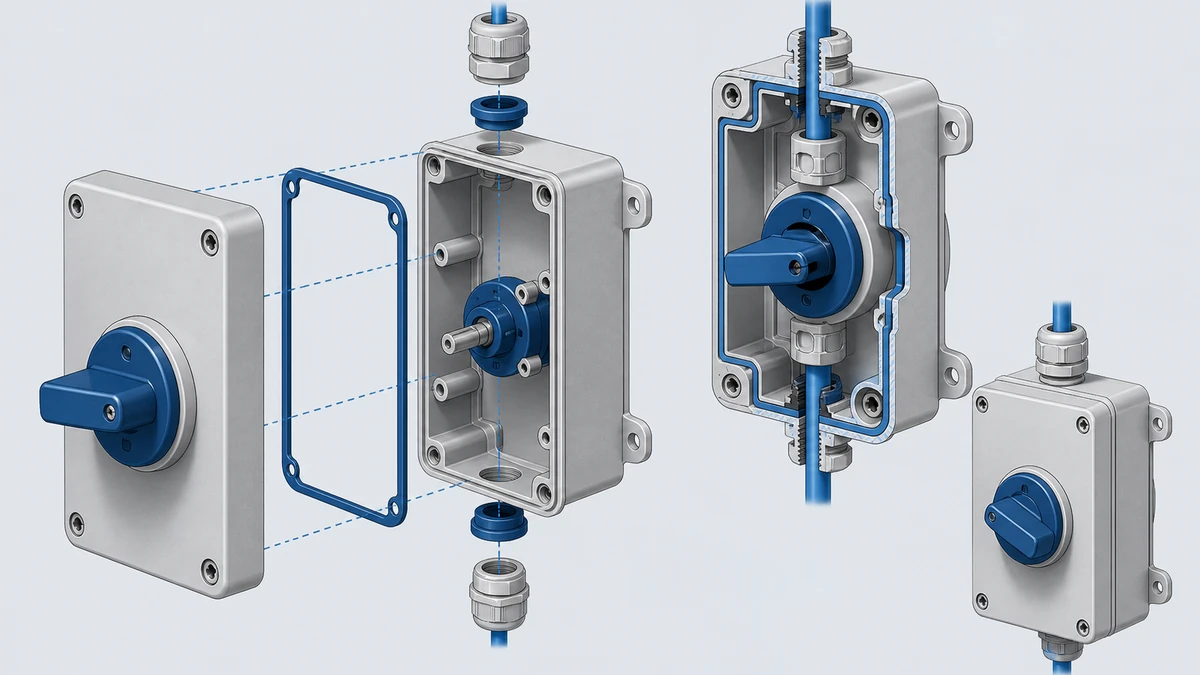
An exact drawing identifies the interfaces that must be controlled for the approved model route.
Select by load type, voltage, current and duty information
The model route should start with electrical duty data because enclosure style alone does not confirm application suitability. An outdoor enclosure may look appropriate, but the switch selection still depends on the exact model documentation and the buyer’s electrical conditions.
For HVAC condensing units, the inquiry should distinguish between the condensing-unit supply, auxiliary loads, pump circuits or mixed equipment assemblies. The supplier then has a clearer path to check the current product datasheet and available documentation.
AC HVAC loads
For air-conditioning and refrigeration equipment, buyers commonly provide AC supply data, rated current and phase information. If motor-related loading, compressor contactor coordination or site-specific service practices affect the isolation requirement, those details should be included in the technical inquiry.
Do not reduce the request to “outdoor HVAC isolator” only. That phrase may describe the market use, but it does not replace the electrical duty information needed for model confirmation.
DC or mixed equipment duties
Some outdoor equipment packages may include DC auxiliaries, control supplies or pump-related assemblies. If the isolator is expected to switch or isolate a DC circuit, the AC information is not enough.
Duty-related details are exact-model dependent. A buyer should ask for the current datasheet that covers the intended AC or DC use rather than assuming that one enclosure family covers every duty condition.
Buyer input
Por que é importante
What to send before quotation
Isolation role
Determines whether the request is for local service isolation or another switching function
One-line description of the equipment and service role
AC/DC duty
Affects model confirmation and datasheet review
AC or DC, phase, frequency if applicable
Tensão e corrente
Core selection input for the switch route
Rated operating voltage and current required by the buyer
Load type
Helps avoid vague “outdoor box” selection
HVAC condensing unit, pump, fan, auxiliary or mixed assembly
Documentation need
Changes the quotation and review path
Drawing, datasheet, certificate request and destination market
Treat enclosure exposure and IP evidence as purchasing inputs
Outdoor exposure should be specified as a documented enclosure requirement, not as a marketing phrase such as “weatherproof” by itself. The required IP class, installation orientation, cable-entry route and site exposure should be reviewed against the exact product documentation.
IEC identifies IEC 60529 as the IP Code for degrees of protection provided by enclosures; see the IEC 60529 listing. A rating still depends on the exact product and installation conditions, so the buyer should confirm the applicable rating on the current datasheet, drawing or certificate for the selected model.
IP rating is not a standalone guarantee
An IP code describes a degree of enclosure protection under defined conditions. It does not remove the need to check cable glands, entries, mounting, gasket compression, cover fit, handle interface and installation orientation.
For a practical comparison of enclosure codes, use the IP65, IP66 and IP67 enclosure guide alongside the exact Shieldhz product documents requested for the quotation. Treat that guide as a framework, not as a substitute for model-specific evidence.
Exposure map for outdoor HVAC procurement
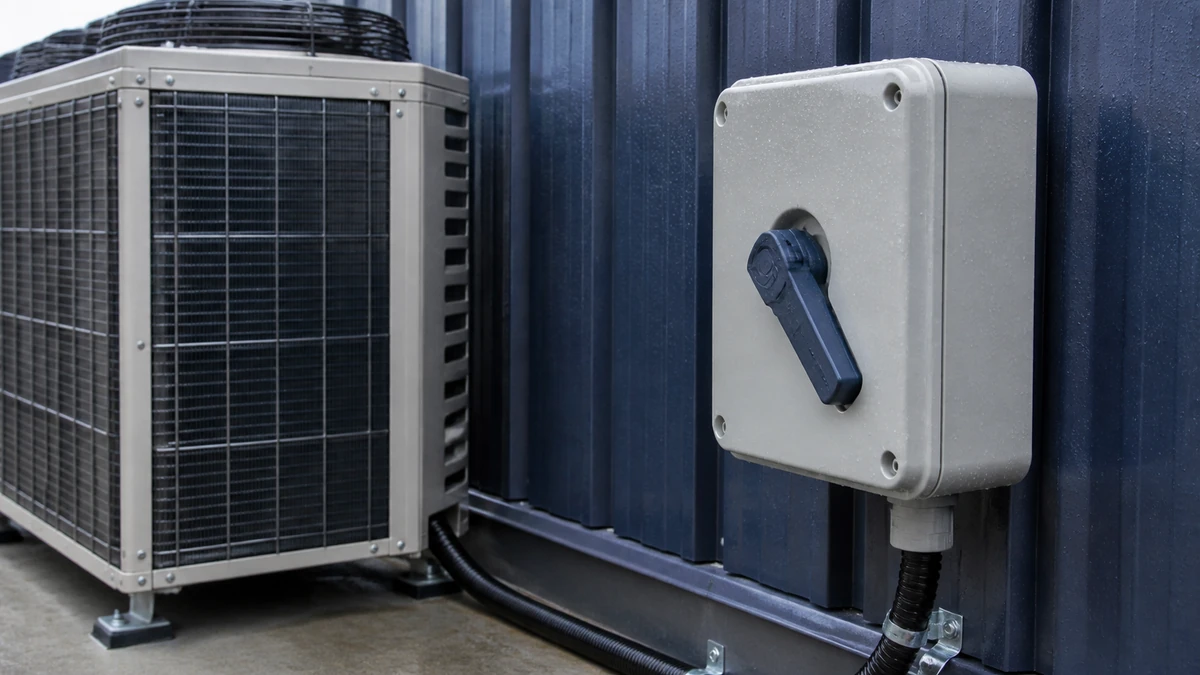
A condensing unit may be installed on a wall bracket, rooftop platform, plant-room exterior, yard plinth or packaged skid. Each location can create a different exposure profile for rain direction, washdown, dust, UV, mechanical access and cable bend space.
Exposure checklist:
Outdoor location: rooftop, wall, yard, skid, pump station or equipment frame.
Water exposure: rain, splash, hose cleaning or other buyer-defined condition.
Dust or debris: industrial yard, plant exterior, coastal or construction-adjacent environment.
Mounting orientation: vertical surface, bracket, backplate or machine frame.
Cable-entry direction: bottom, side or buyer-defined route.
Service access: handle clearance, lock provision if required by the buyer, and visible position for technicians.
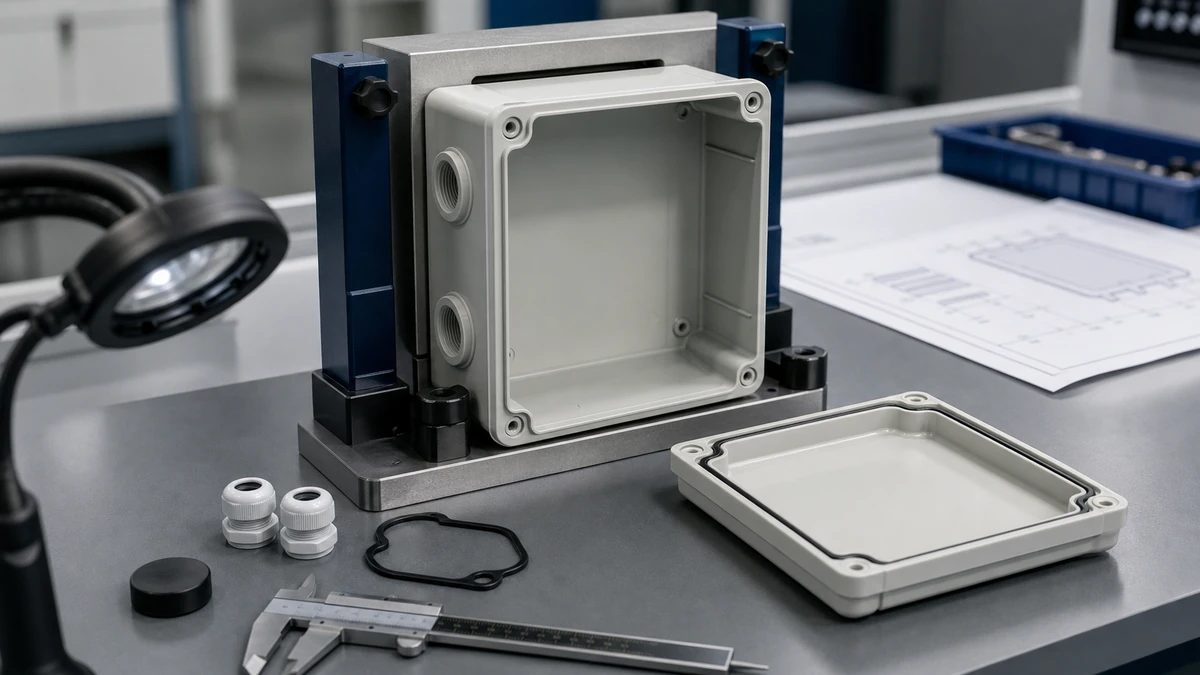
Sample review should connect the exact item to its current drawing and requested evidence package.
Confirm cable entry, gasket path, mounting and handle access
The enclosure route should be checked around cable entry and handle access because these details can decide whether a weatherproof isolator switch box is commercially practical for the buyer’s build. Even when the electrical rating route is clear, poor cable-entry planning can cause drawing changes or site rework.
O weatherproof switch-box cable-entry guide provides a focused foundation for entry, gasket and handle considerations. Use it with the selected product drawing because available entry positions and sealing details vary by exact model.
Cable-entry decision points
Cable entry should be described before the quotation if the buyer needs a known gland position or conduit approach. Bottom entry may be preferred in many outdoor layouts, but the correct route depends on the enclosure, cable size, gland type, mounting position and buyer specification.
If the distributor or panel builder needs pre-defined entry holes, those should be discussed as a project input. Do not assume a catalogue image confirms the cable route for every order.
Gasket and handle access checklist
The gasket and handle interface should be reviewed as part of the enclosure route. A selected handle style or enclosure size can affect service access, labelling space and the practical mounting envelope.
Practical checklist:
Confirm whether the enclosure door or cover needs clear opening space.
Check that handle access is not blocked by pipework, louvers, conduit or condenser guards.
Confirm cable bend radius and gland clearance against the drawing.
Review gasket interface and cover orientation in the current product document.
Identify label area, lock requirement if specified, and operator visibility.
Confirm whether the buyer requires a drawing showing mounting holes and external dimensions.
Choose a model-family route that matches the buyer’s documentation need
A model-family route should be shortlisted by application, enclosure requirement and documentation package before asking for a final price. This avoids the common problem of quoting a generic outdoor isolator when the buyer actually needs a documented HVAC service-isolation input.
For a product-level starting point, review the waterproof isolator box range and then request the exact model documents relevant to the intended equipment. Range information helps shortlist options, while the final route depends on the current product datasheet and buyer application.
Range-level shortlist
A range-level shortlist is useful when the buyer is still comparing enclosure sizes, handle positions or current levels. It is not the final engineering approval.
Procurement should ask engineering to mark which inputs are fixed and which are open. That distinction helps the supplier avoid over-specifying or under-defining the quotation.
Decision status
Buyer situation
Quotation approach
Fixed electrical duty
Voltage, current and AC/DC duty are known
Request model-specific datasheet and drawing
Fixed enclosure route
IP requirement, entry direction and mounting envelope are known
Request drawing review before price finalization
Destination market known
Certificate or declaration package is required
State exact document requirement in the inquiry
Application still developing
Equipment layout or current level may change
Ask for a shortlist route, not a final model commitment
Distributor stock comparison
Buyer needs commercial options for resale
Compare documented model families and package requirements
SH30-style route
When buyers are considering the SH30 family, the SH30 weatherproof isolator box guide can support the early discussion. The exact suitability still depends on the selected model, current documentation and the buyer’s voltage, current, duty and enclosure requirements.
This is especially important for distributors. A model that is suitable for one contractor’s HVAC package may not automatically match another buyer’s destination-market paperwork or installation environment.
How Shieldhz confirms a weatherproof isolator switch box route
Shieldhz confirms a weatherproof isolator switch box route by checking the buyer’s application inputs against current product documentation before treating the selection as final. The pre-quotation process is designed to reduce mismatch between service-isolation intent, enclosure exposure and the document package required by the buyer.
Final suitability is confirmed against current product documentation and the buyer’s application. A catalogue family, product image or previous quotation should not be treated as a substitute for that confirmation.
Pre-quotation confirmation inputs
For an air conditioner isolator switch box or related outdoor equipment isolator, the buyer should send a concise technical request. The more complete the input, the easier it is to confirm a practical model route.
Shieldhz confirmation checklist:
Load and isolation role: HVAC condensing unit, pump panel, auxiliary equipment or other outdoor load.
AC/DC duty: AC or DC use, phase and frequency where applicable.
Voltage/current: required operating voltage and current for the buyer’s design.
Enclosure exposure: outdoor location, rain or splash exposure, dust, cleaning method and mounting orientation.
IP requirement: buyer-requested IP class and destination-market documentation expectation.
Cable entry and gasket route: preferred entry direction, gland or conduit approach, and sealing considerations.
Mounting and handle access: mounting surface, clearance, operator visibility and lock requirement if specified.
Requested package: drawing, datasheet and certificate package needed for review.
What Shieldhz returns for review
The response should route the buyer toward the current model information rather than only a price line. Depending on the request, that may include a drawing, datasheet, certificate-related document or clarification questions.
If the buyer changes cable-entry direction, current requirement, IP expectation or destination-market paperwork after review, the route may need to be checked again. That protects both the panel builder’s documentation process and the distributor’s quotation accuracy.
Installation conditions change the product-route and document questions a buyer must resolve.
Build the documentation package before distributor release
The documentation package should be agreed before release to purchasing because outdoor HVAC equipment often passes through multiple commercial hands. A panel builder, contractor, distributor and end customer may each review a different part of the same isolator-box package.
The goal is not to collect documents after an order problem appears. The goal is to request the documents that the buyer actually needs for design review, resale support or project file control.
Drawing package
The drawing should answer dimensional and mounting questions. Buyers commonly need overall size, mounting hole position, handle projection, cable-entry area and enclosure orientation.
If the drawing is used in a panel or equipment layout, the buyer should verify revision status. A screenshot or catalogue image is not a controlled layout document unless the supplier confirms it as current for the selected model.
Datasheet and certificate review
The datasheet should be checked for the selected model, not only the family name. Ratings, IP information, materials, options and operating conditions can be model-dependent.
Certificate or declaration requirements should be stated by destination market and buyer application. Procurement should avoid assuming that every model, configuration or market route has the same document set.
Documento
Buyer question it answers
Commercial note
Product drawing
Will it fit the enclosure layout, mounting surface and cable route?
Confirm revision and exact model
Folha de dados
Does the selected model match voltage, current, duty and enclosure expectations?
Review against buyer application
Certificate or declaration
Does the buyer need specific evidence for a market or project file?
Availability depends on exact product and requirement
Quotation note
What has been assumed for entry, rating and documentation?
Keep assumptions visible before order
Packaging or label request
Does distribution need model identification or project marking?
Confirm if required before release
Specify for procurement without creating rework
The purchasing specification should be short, technical and evidence-based. A clear inquiry reduces quotation loops and avoids relying on ambiguous terms such as “outdoor switch box” without electrical or documentation context.
A good procurement line connects the commercial need to engineering inputs: service-isolation role, duty data, enclosure expectation, cable route, mounting access and required documents.
Inquiry template
Use this as a concise B2B inquiry structure, then attach drawings or project notes if available.
Procurement action list:
Product request: air conditioner isolator switch box for outdoor HVAC condensing unit service isolation.
Electrical data: AC/DC duty, voltage, current, phase and frequency if applicable.
Enclosure requirement: requested IP class, exposure conditions and mounting orientation.
Cable route: preferred entry direction, gland or conduit notes and gasket concerns.
Access requirement: handle location, visibility, lock requirement if specified and service clearance.
Documentation: current drawing, datasheet and certificate package required for review.
Commercial route: quantity, destination market, packaging or distributor labelling needs if relevant.
Red flags before quotation
Some inquiry gaps should be resolved before price comparison. They can affect the selected model, documentation route or buyer approval process.
Red-flag checklist:
“Weatherproof” requested with no IP requirement or exposure description.
Current or voltage missing from the inquiry.
AC duty assumed when the buyer has a DC or mixed-duty requirement.
Cable entry required on a specific face but not stated in the drawing request.
Destination-market certificate request raised only after price approval.
Handle clearance not checked against the equipment frame or condenser location.
Buyer asks for an emergency-stop style operator without defining the complete machine safety function.
Selecting an operator or handle style does not validate a complete machine safety function. If an emergency-stop function is part of the buyer’s equipment, it must be assessed as part of the complete machine safety design and documentation, not as a standalone enclosure choice.
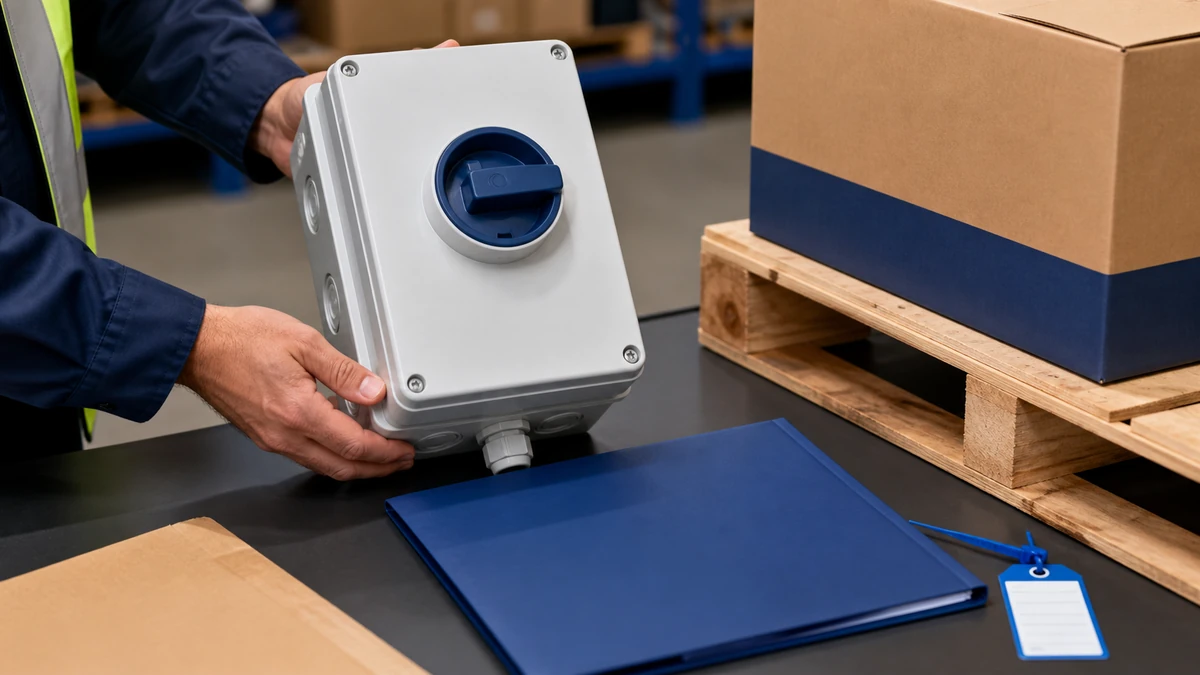
Documentation control, sample acceptance and protective packing are separate handover checks.
Conclusion
An outdoor isolator box for HVAC condensing units should be purchased through a documented service-isolation route. The correct commercial decision is not only the enclosure appearance; it is the match between electrical duty, enclosure exposure, IP requirement, cable-entry path, mounting access and the document package.
For panel builders, contractors, distributors and procurement teams, the most efficient route is to define the application inputs before quotation. Final suitability should then be confirmed against the current Shieldhz product documentation and the buyer’s exact application.
Perguntas frequentes
What is the main purpose of an air conditioner isolator switch box?
In this B2B context, it provides a local service-isolation switching point for an outdoor HVAC condensing unit or similar equipment package. The exact role should be defined by the buyer’s electrical design and project documentation.
Is “weatherproof” enough information for quotation?
No. “Weatherproof” is a useful commercial description, but the supplier still needs the requested IP class, exposure conditions, cable-entry route, mounting orientation and documentation requirement. The final rating evidence depends on the exact product and installation conditions.
Can one isolator box model be used for every HVAC condensing unit?
No universal fit should be assumed. Suitability depends on the selected model, voltage, current, AC/DC duty, enclosure requirement, cable entry, destination-market documents and the buyer’s application.
What documents should a panel builder request before approval?
A panel builder should normally request the current drawing, datasheet and any certificate or declaration package required for the project or destination market. The exact document set should be confirmed for the selected model and configuration.
Why does cable entry matter for an outdoor isolator box?
Cable entry affects enclosure layout, sealing route, mounting clearance and service access. If entry direction or gland arrangement is important, it should be stated before quotation and checked against the product drawing.
Does choosing an emergency-stop style operator validate a machine safety function?
No. Selecting an operator, handle or enclosure style does not validate a complete machine safety function. Any emergency-stop function must be assessed within the buyer’s complete machine design, risk assessment and documentation process.
Shi, Muxi
Shi, Muxi escreve artigos técnicos da Shieldhz para compradores de controle industrial e componentes elétricos, abrangendo chaves de came rotativas, chaves isoladoras, seccionadores PV DC, botões de pressão, luzes indicadoras, gabinetes à prova d'água e blocos de terminais. Os artigos são baseados na experiência de fabricação e exportação da Zhejiang Shihe Electric Co., Ltd., com ênfase prática na seleção de modelos, planilhas de dados, desenhos, certificações, classificações de IP e detalhes de consulta que os compradores devem confirmar antes de fazer o pedido.