IP65 vs IP66 Waterproof Isolator Boxes for Outdoor Equipment
Use a practical buyer checklist to evaluate IP65 vs IP66 isolator box inputs, documentation, approval controls and the exact weatherproof isolator switch box route.
For an outdoor isolator assembly, the IP65 vs IP66 isolator box decision is mainly about the expected water exposure, cable-entry route, gasketed enclosure design, and the exact model documentation—not the IP number alone.
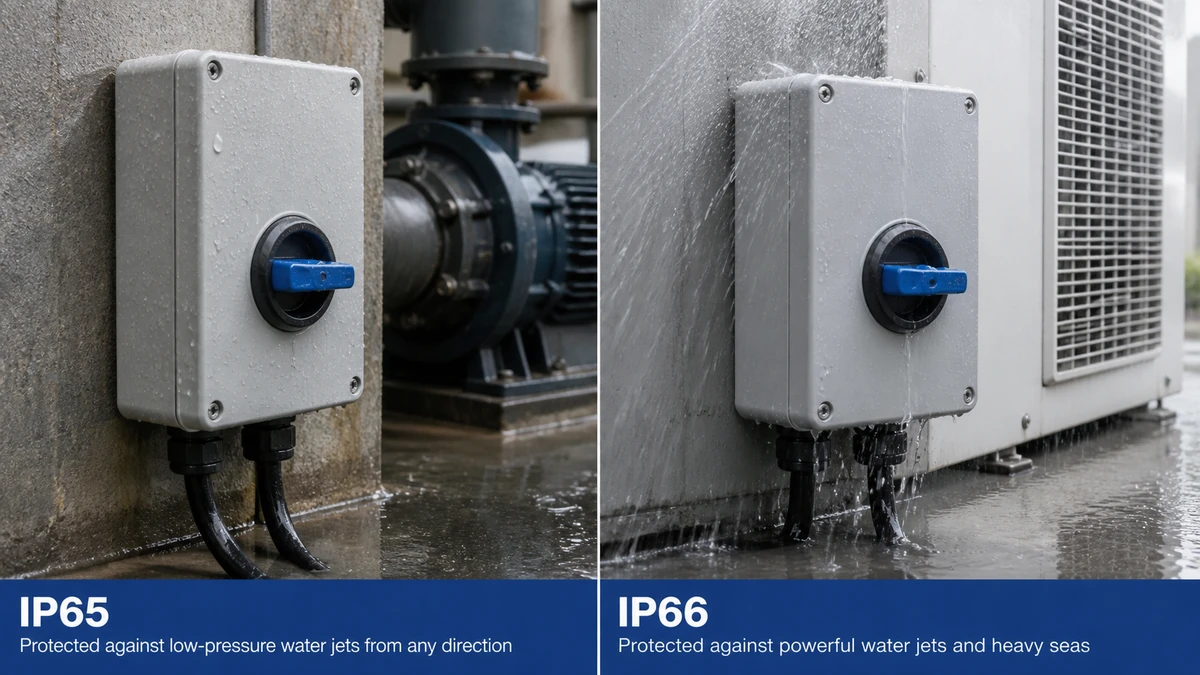
Choose an IP65 route when the equipment sees outdoor weather and low-pressure water exposure, and the selected model documentation supports that use.
Consider an IP66 route when the box may face stronger water jets, exposed washdown, or wind-driven rain, subject to the exact enclosure, operator, gasket, and cable-entry configuration.
Before ordering, confirm voltage, current, AC/DC duty, isolation role, mounting, cable entries, drawings, datasheets, and any destination-market certificate requirements.
Where IP65 vs IP66 changes the isolator-box decision
The practical difference is that IP66 usually raises the water-exposure requirement for the complete isolator-box assembly, while IP65 may be sufficient for many outdoor equipment panels with less severe water impact.
IEC identifies IEC 60529 listing as the IP Code for degrees of protection provided by enclosures; a rating still depends on the exact product and installation conditions. For broader IP background, use the IP65, IP66 and IP67 enclosure guide and keep this article focused on isolator assemblies.
An exact drawing identifies the interfaces that must be controlled for the approved model route.
The IP number applies to the assembled enclosure route
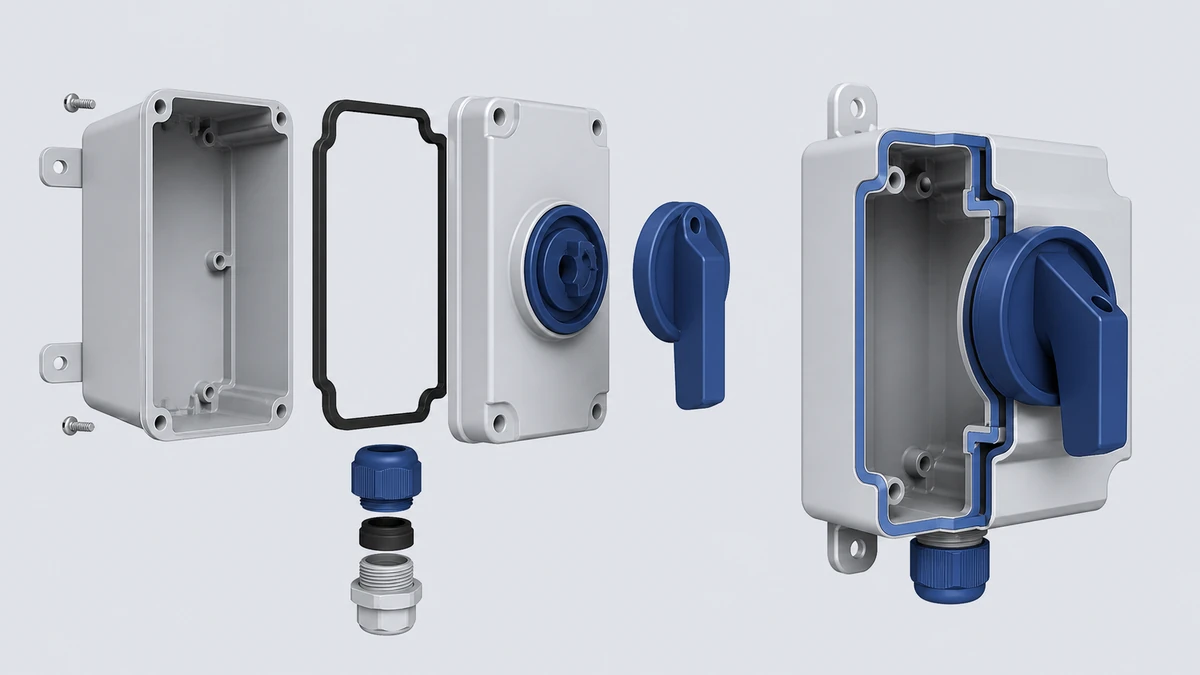
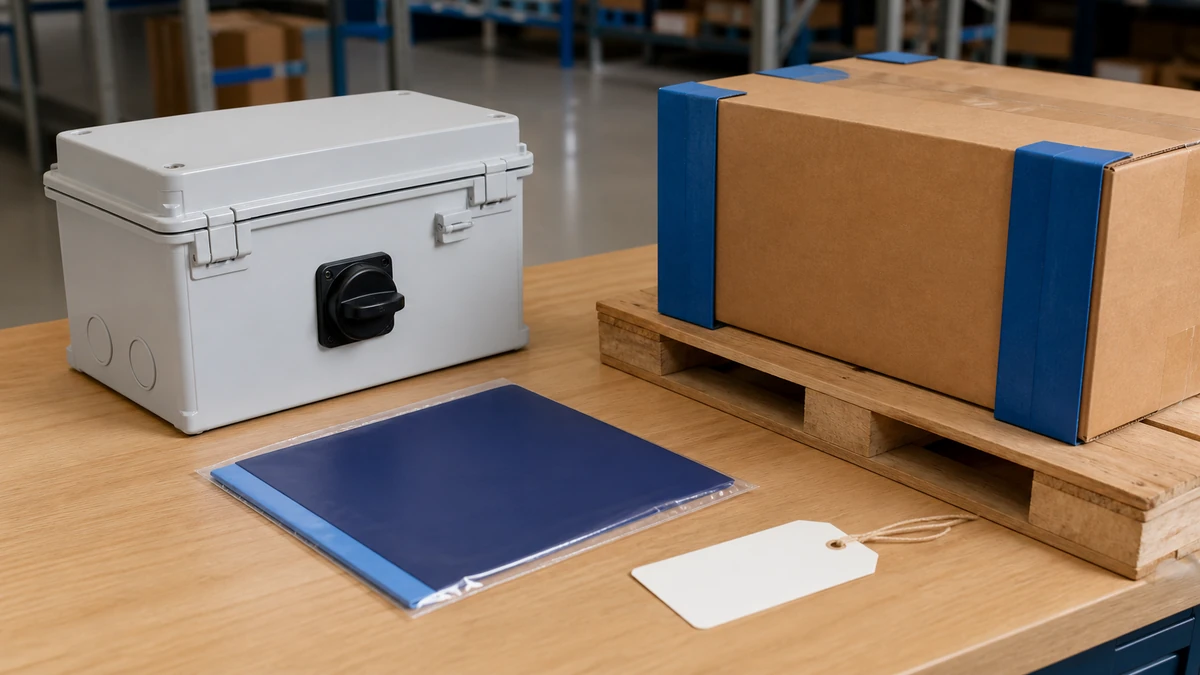
For a weatherproof isolator switch box, the buyer is not only comparing an empty enclosure. The relevant route includes the box body, lid or cover, gasket, handle/operator interface, cable entries, mounting method, and the documented configuration for the selected model.
A change in any of those items can affect the final installed result. That is why the RFQ should identify the exact assembly requirement instead of asking only for “IP65” or “IP66.”
Decision table: IP65 vs IP66 isolator box route
Buyer question
IP65 route may fit when
IP66 route may be preferred when
Water exposure
Outdoor rain, splashing, or lower-pressure cleaning is expected
Stronger jets, more exposed washdown, or severe wind-driven rain may occur
Equipment location
Protected outdoor faces, side-mounted control points, or sheltered frames
Open skids, pump sets, rooftop units, yards, or exposed machine sides
Cable-entry sensitivity
Entry points can be kept protected and correctly sealed
Entry points may be more exposed and need closer review
Commercial priority
Balanced outdoor protection and cost target
Higher water-exposure requirement is worth confirming in the model route
Documentation need
Drawing and datasheet show IP65 configuration
Drawing, datasheet, and certificate package are checked for IP66 configuration
When an IP65 isolator box is the practical route
An IP65 isolator box is often the practical commercial route when the equipment needs outdoor weather resistance but is not expected to face stronger water jets or harsh washdown, subject to the exact model and installation.
For a basic functional overview of this product type, refer to the waterproof isolator box basics. In a buying decision, the key is whether the selected isolator assembly matches the real exposure and the buyer’s documentation needs.
Good-fit exposure patterns
IP65 may be a reasonable route for outdoor HVAC auxiliary equipment, pump-panel auxiliaries, lighting-related outdoor control points, or equipment frames where the box is exposed to rain and splashing. It can also suit covered outdoor locations where direct washdown is not part of the buyer’s operating procedure.
The decision should still be checked against the current datasheet and drawing. The enclosure orientation, cable glands or fittings, and site installation quality matter.
Buyer action checklist for IP65
Before choosing the IP65 route, confirm:
The equipment location is outdoor but not subject to strong water jets in normal use.
The isolator’s electrical role is defined as isolation or switching within the documented duty of the selected model.
AC or DC duty is clearly stated.
Rated voltage and current are included in the RFQ.
Cable-entry size, direction, and sealing method are known.
The drawing shows the intended handle orientation and mounting position.
Any certificate request is tied to the exact destination market and model.
When an IP66 isolator box is the practical route
An IP66 isolator box is the stronger candidate when the isolator assembly may face more severe water impact than a normal outdoor rain case, provided the exact assembly route is documented for that requirement.
O SH30 weatherproof isolator box guide can help buyers review a specific weatherproof isolator-box style. The commercial decision should still be made model by model.
Sample review should connect the exact item to its current drawing and requested evidence package.
Exposed equipment and washdown branches
IP66 is commonly investigated for pump skids, outdoor machinery, exposed HVAC equipment, agricultural equipment, water-treatment equipment, and similar assemblies where cleaning or water impact is part of the buyer’s concern. It may also be requested where the equipment owner has a standard specification that calls for IP66.
That does not mean every installation needs IP66. If the box sits under a canopy or inside a secondary guarded area, an IP65 route may still meet the buyer’s application and documentation requirements.
Trade-offs to confirm before selecting IP66
An IP66 request can affect enclosure selection, gasket route, cable-entry arrangement, operator interface, and commercial availability. These details should be confirmed against current product documentation rather than assumed from a family name.
Decision point
Why it matters for IP66
Handle/operator interface
The front interface is part of the water-exposure route and should match the documented configuration
Cable-entry direction
Top, side, and bottom entries can create different sealing risks in the installed equipment
Gasket compression
The lid or cover route must be installed as intended for the selected model
Mounting surface
Distortion or uneven mounting can affect sealing behavior
Certificate package
Required documents vary by exact model, destination market, and buyer requirement
Assembly details that can decide the real installed result
The installed result is often decided by the enclosure interface details, not only by the stated IP65 or IP66 target.
A weatherproof isolator assembly has multiple potential exposure points. Buyers should review the complete route before approving a drawing or substitution.
Installation conditions change the product-route and document questions a buyer must resolve.
Gasket, lid, and cover interface
The gasket path is one of the first items to check. The buyer should confirm whether the lid or cover is shown in the intended orientation and whether the installation method could distort the sealing surface.
If the enclosure is opened frequently for maintenance, the buyer should also consider how maintenance procedures will preserve the gasket condition. This is application-dependent and should be reflected in the buyer’s operating requirements.
Cable-entry and fitting route
Cable entry is a common place where an otherwise suitable enclosure route can be weakened by the wrong fitting, hole location, or installation practice. For a deeper entry-focused review, use the weatherproof switch-box cable-entry guide.
Practical checks include:
Entry direction: bottom entry is often easier to manage in wet outdoor equipment, but the final route depends on the enclosure design and installation.
Hole quantity: avoid extra penetrations unless they are required and properly sealed.
Fitting compatibility: match cable diameter, fitting type, and enclosure wall thickness.
Drainage and cable bend: avoid routing that channels water toward the interface.
Documentation: show the entry layout on the drawing before purchase approval.
Handle access and mounting position
The handle must remain accessible for the intended isolation task. The buyer should check operator clearance, lockable-position requirements if specified, labeling space, and whether the box can be operated safely within the equipment layout.
Mounting should also be reviewed mechanically. Uneven brackets, thin panels, or high vibration can change how the enclosure sits after installation.
How to specify the IP65 vs IP66 isolator box in an RFQ
The fastest RFQ route is to state the electrical duty, exposure requirement, cable-entry plan, mounting method, and documentation package in one request.
A vague inquiry such as “quote IP66 isolator” leaves too much open. A clear RFQ lets the supplier confirm the exact model route and avoid quoting an assembly that does not match the buyer’s final application.
Minimum data to send
Include the following in the first RFQ:
Required IP route: IP65 or IP66, and why it is being requested.
Application: HVAC, pump, skid, outdoor machine, lighting-related equipment, or other use.
Electrical role: isolation or switching role within the selected model’s documented duty.
AC/DC duty: specify AC, DC, frequency if relevant, and usage category if required by the buyer.
Voltage and current: include operating values and any project standard.
Cable entries: number, size, direction, and fitting expectation.
Mounting: wall, machine frame, panel, skid, or bracket.
Handle access: front access, side access, labeling needs, and lockable-position requirement if specified.
Destination market: state if any certificate or documentation package is required.
RFQ decision table
RFQ field
Why procurement should include it
IP65 or IP66 target
Sets the enclosure water-exposure route to be checked
Load and isolation role
Helps match the isolator assembly to the intended electrical function
AC/DC, voltage, current
Prevents quoting a model outside the requested duty
Cable-entry layout
Allows drawing review before holes and fittings are fixed
Mounting and handle access
Confirms practical installation and operation layout
Drawing, datasheet, certificate request
Aligns the quotation with buyer approval requirements
How Shieldhz confirms a weatherproof isolator switch box route
Shieldhz confirms the route by matching the isolator assembly to the buyer’s stated electrical role, exposure, entry method, mounting conditions, and requested documentation.
This is a pre-quotation confirmation process. Final suitability is confirmed against current product documentation and the buyer’s application.
Pre-quotation confirmation inputs
For a practical confirmation, provide:
Load and isolation role: what the isolator assembly is intended to isolate or switch.
AC/DC duty: whether the application is AC or DC, with any usage details required by the buyer.
Voltage and current: operating values and required rating target.
IP requirement: IP65 or IP66, including whether it is a buyer standard or application-driven.
Cable entry and gasket route: entry quantity, size, direction, fitting type, and gasketed interface expectation.
Mounting and handle access: mounting surface, orientation, operator clearance, labeling, and lockable-position requirement if specified.
Requested package: drawing, datasheet, and certificate package required for quotation or approval.
Confirmation output for the buyer
The output should identify the proposed model route, key configuration assumptions, and documents available for review. If the request needs a different configuration, the route should be adjusted before commercial approval.
The buyer can also review the waterproof isolator box range to prepare a model-family discussion. The final selection should still be tied to the current drawing, datasheet, and buyer application.
Procurement and distribution decisions: stock family, documentation, and substitutions
Procurement should treat IP65 and IP66 isolator boxes as documented assembly routes, not interchangeable labels.
A distributor or purchasing team may see similar enclosure sizes and handle styles across model families. Substitution should not be approved unless the replacement matches the electrical duty, IP requirement, cable-entry route, mounting, and documentation requirement.
Documentation control, sample acceptance and protective packing are separate handover checks.
Substitution control checklist
Before accepting an alternate model, verify:
Same or approved IP route for the buyer’s installed condition.
Electrical duty matches the buyer’s AC/DC, voltage, and current requirement.
Same intended isolation or switching role.
Cable-entry positions can be made without compromising the documented route.
Handle position, labeling, and access remain acceptable.
Drawing dimensions match the equipment cutout or mounting bracket.
Requested datasheet and certificate package are available for the exact model and destination market.
Commercial comparison table
Commercial factor
What to compare
Model availability
Exact model, color, handle type, entry arrangement, and configuration
Documentação
Current drawing, datasheet, and any requested certificate package
Installation labor
Hole making, fitting selection, mounting bracket work, and labeling
Approval risk
Whether the buyer can approve the substitute without redesign
Lifecycle sourcing
Whether future orders can reference the same model and configuration
Common mistakes to avoid when comparing IP65 and IP66 isolator assemblies
Most selection errors come from treating the IP rating as a standalone product promise instead of checking the full installed assembly.
The IP65 vs IP66 isolator box decision should be made with the electrical role, environment, enclosure route, and documentation package together.
Mistake 1: treating the isolator as something it is not
An isolator or switch operator should be selected for its documented switching or isolation role. It should not be specified as overcurrent protection.
If the assembly includes an emergency-stop operator or emergency-style interface, selecting that operator does not validate a complete machine safety function. The full safety function depends on the machine design, control architecture, risk assessment, and applicable standards for the buyer’s project.
Mistake 2: ignoring the installed cable and mounting route
A box may be quoted for a target IP route, but the final installation can introduce extra penetrations, unsupported cables, poor fittings, or distorted mounting. These items should be reviewed before the purchase order is released.
Practical prevention list:
Freeze the cable-entry drawing before production or installation.
Avoid top entries unless the design and fittings are clearly suitable for the exposure.
Confirm gasketed interfaces are not blocked, cut, painted over, or distorted.
Check handle clearance on the actual equipment layout.
Keep the approved drawing and datasheet with the procurement record.
Reconfirm documentation if the model, entry pattern, or destination market changes.
Conclusion
For outdoor equipment builders, the IP65 vs IP66 isolator box decision is a practical engineering and procurement choice. IP65 may suit many outdoor rain and splash applications, while IP66 is worth investigating for stronger water exposure, washdown concern, or buyer specifications.
The correct route depends on the exact model, electrical duty, enclosure exposure, cable-entry method, gasket route, mounting position, handle access, and requested documentation. Confirm those details before quotation so the selected isolator assembly matches the buyer’s application and approval process.
Perguntas frequentes
Is IP66 always better than IP65 for an outdoor isolator box?
Not always. IP66 may be preferred for stronger water exposure, but IP65 may be practical for many outdoor installations where the exposure is less severe and the selected model documentation supports the use.
Can I replace an IP66 isolator box with an IP65 model?
Only if the buyer’s application, exposure, documentation requirement, and approval process allow it. Treat the replacement as a technical substitution, not a simple downgrade.
Does the IP rating cover the cable entries?
The installed cable-entry route must be considered as part of the final assembly condition. The fitting type, hole position, cable diameter, and installation quality can affect the final result.
What should I send to get a correct quotation?
Send the required IP route, application, AC/DC duty, voltage, current, isolation role, cable-entry plan, mounting method, handle access requirement, destination market, and requested drawing, datasheet, and certificate package.
Is a weatherproof isolator box the same as a safety function?
No. A weatherproof isolator box can be part of an equipment interface, but selecting an operator or isolator does not validate a complete machine safety function. That depends on the full machine design and project-specific safety assessment.
Who confirms final suitability?
Final suitability should be confirmed by checking current product documentation against the buyer’s application, installation conditions, and destination-market requirements. The quotation route should make those assumptions clear before order approval.
Shi, Muxi
Shi, Muxi escreve artigos técnicos da Shieldhz para compradores de controle industrial e componentes elétricos, abrangendo chaves de came rotativas, chaves isoladoras, seccionadores PV DC, botões de pressão, luzes indicadoras, gabinetes à prova d'água e blocos de terminais. Os artigos são baseados na experiência de fabricação e exportação da Zhejiang Shihe Electric Co., Ltd., com ênfase prática na seleção de modelos, planilhas de dados, desenhos, certificações, classificações de IP e detalhes de consulta que os compradores devem confirmar antes de fazer o pedido.