UV Exposure and Outdoor Isolator Enclosures: Material and Installation Evidence to Request
Use a practical buyer checklist to evaluate uv resistant isolator enclosure inputs, documentation, approval controls and the exact weatherproof isolator switch box route.
A uv resistant isolator enclosure should be purchased on material and installation evidence, not on an IP rating alone. IP evidence addresses ingress conditions for an exact enclosure arrangement; UV evidence addresses how exposed materials age under sunlight and outdoor heat.
Ask for exact-model material information, drawing, datasheet, and any available certificate or test reference before comparing prices.
Separate UV exposure questions from IP rating questions in your RFQ so suppliers do not answer one with the other.
Confirm cable entries, gasket route, mounting orientation, and handle access because installation details can affect outdoor performance.
UV resistance is a material-ageing question, not an IP rating
UV resistance concerns how the enclosure body, cover, handle interface, gasketed areas, labels, and exposed accessories may age under sunlight. An IP rating concerns ingress of solids and water under defined conditions for a particular product arrangement.
An exact drawing identifies the interfaces that must be controlled for the approved model route.
What UV evidence answers
UV evidence helps buyers judge whether an enclosure material route is credible for outdoor exposure. It may include material grade information, supplier datasheet references, UV-stabilised material declarations, outdoor-use statements, or test references where available for the exact product or material.
For procurement, the useful question is not “Is it outdoor?” in isolation. The better question is: “What material and documentation support this exact outdoor enclosure route for the stated exposure?”
What IP evidence does not answer
An IP rating does not, by itself, confirm sunlight ageing, colour stability, embrittlement resistance, gasket ageing, or long-term appearance. A high IP requirement may be important for rain or washdown exposure, but it is not a substitute for UV and material evidence.
This is the key buying distinction: UV ageing and ingress resistance should be checked as separate evidence lines.
Which enclosure material route should buyers compare?
The material route should be compared against the actual outdoor exposure, installation location, documentation requirement, and procurement risk tolerance. Plastic, metal, and hybrid enclosure routes can all be commercially relevant depending on the exact model, environment, and buyer specification.
Material evidence to compare
For polymer enclosures, ask whether the enclosure body material is intended for outdoor exposure and whether UV-stabilised material information is available. For metal enclosures, ask about coating system, corrosion environment assumptions, and whether exposed polymer parts such as handles, seals, or cable accessories have their own outdoor-use evidence.
Do not evaluate the body alone. An outdoor isolator enclosure is only as credible as the exposed interfaces that must remain aligned, sealed, and operable in the buyer’s application.
Material decision table
Buyer question
Evidence to request
Por que é importante
Is the enclosure body suitable for sunlight exposure?
Material description, grade reference, UV-stabilised statement, or datasheet where available
Helps separate outdoor material claims from generic enclosure descriptions
Are exposed accessories also considered?
Handle, cover, gasket, and cable-entry material information where applicable
Outdoor ageing can occur at interfaces, not only on the enclosure body
Is coating part of the outdoor route?
Coating description and finish information for the exact model where applicable
Coating performance depends on material, surface treatment, and exposure
Is the colour or appearance critical?
Colour reference and any available ageing statement
Appearance change may matter for OEM equipment and visible installations
Is a certificate required for procurement?
Exact certificate, declaration, or test report scope if available
Documentation scope may differ by model, destination market, and configuration
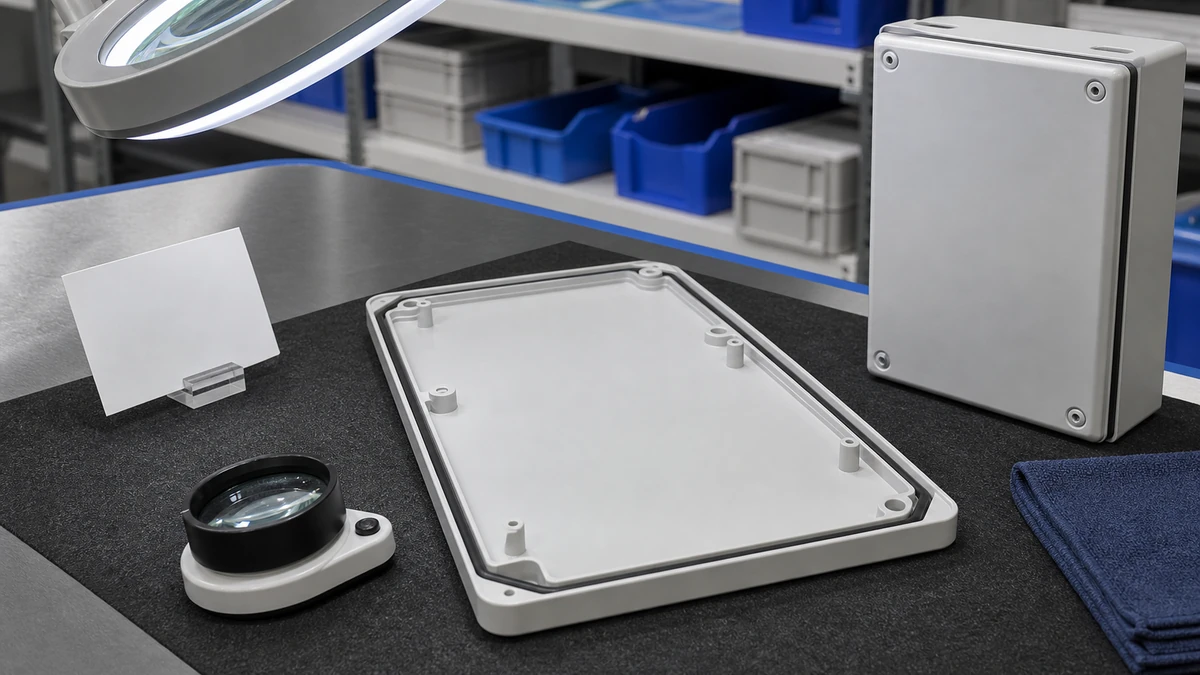
Sample review should connect the exact item to its current drawing and requested evidence package.
Installation exposure changes the UV decision
The same enclosure material route can face different ageing conditions depending on orientation, shade, mounting surface, heat, moisture, and surrounding equipment. Buyers should describe the installation, not only the product size and current rating.
Mounting orientation and shade
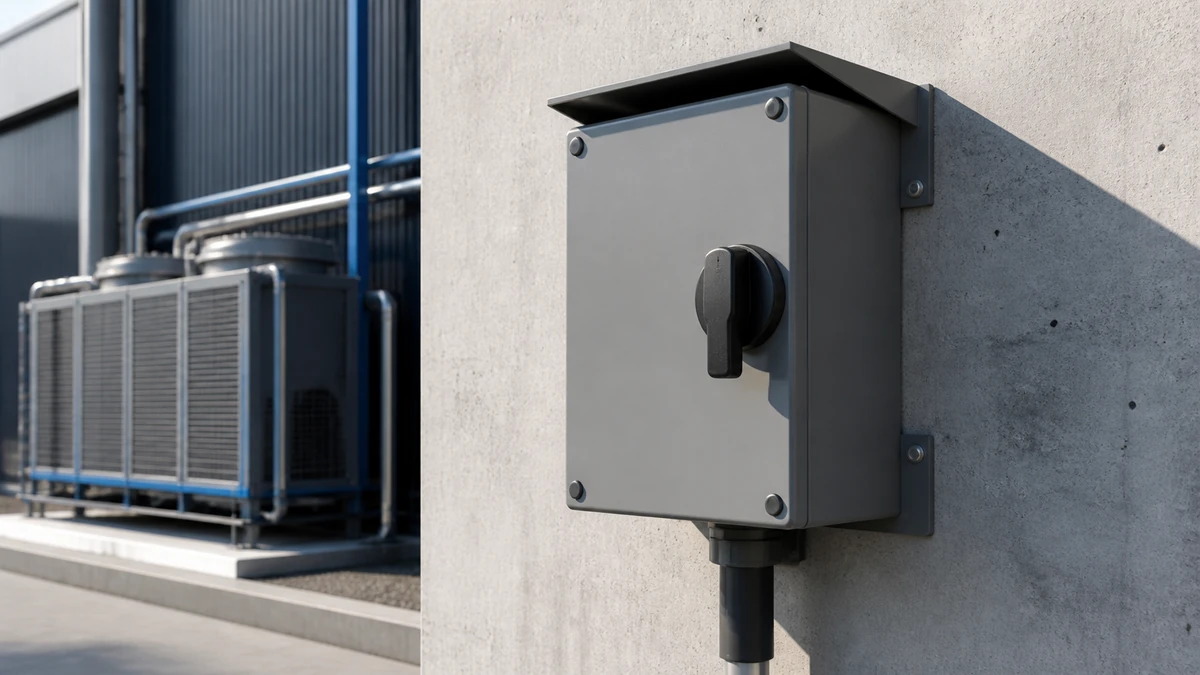
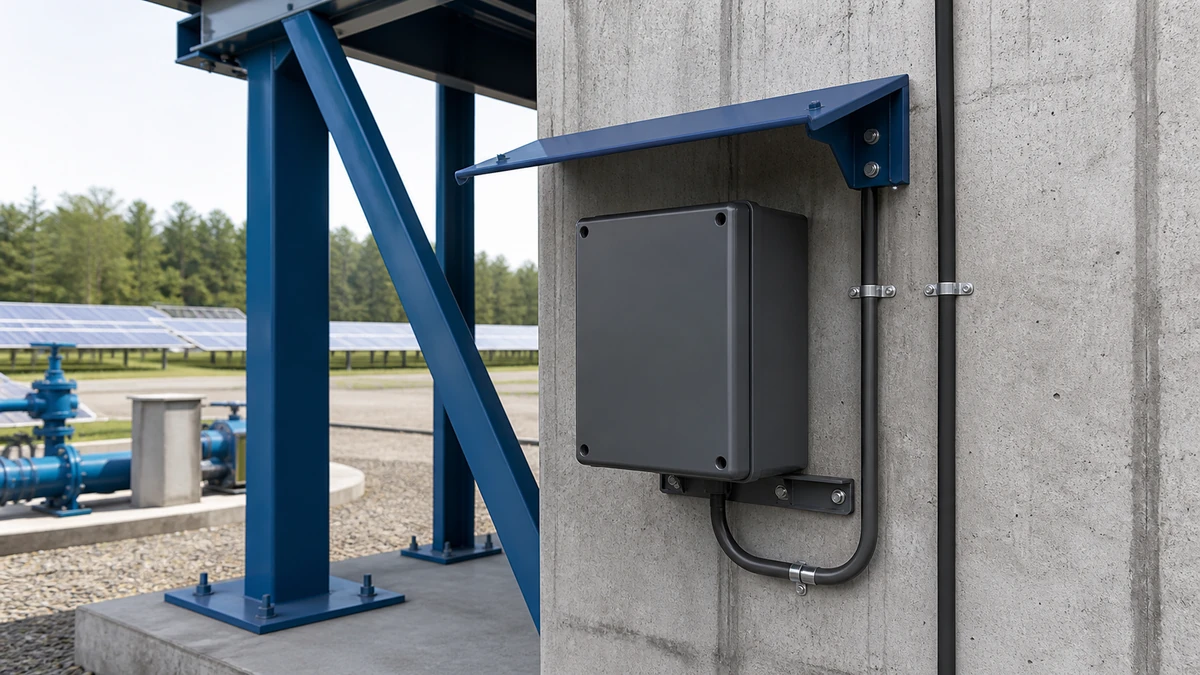
A vertical wall-mounted enclosure under a canopy faces different exposure from a roof-mounted unit with full sun. Direct afternoon sun, reflective surfaces, and high-altitude exposure can increase the importance of UV evidence.
A useful RFQ should state whether the enclosure is in full sun, partial shade, under a louver, inside a plant area, or mounted on equipment with hot surfaces nearby.
Heat, moisture, and contaminants
UV ageing is often evaluated together with heat and moisture because outdoor exposure rarely occurs as sunlight alone. Pump panels, HVAC equipment, agricultural machinery, coastal sites, and industrial yards may add humidity, chemical vapour, dust, salt, oil mist, or cleaning practices.
Practical site-exposure checklist:
[ ] Full sun, partial shade, or covered installation identified
[ ] Approximate ambient temperature range stated
[ ] Rain, splash, washdown, or condensation exposure described
[ ] Coastal, chemical, agricultural, or industrial contaminants noted
[ ] Mounting surface and enclosure orientation confirmed
[ ] Any appearance, colour, or label durability requirement stated
IP evidence should be requested alongside, not instead of, UV evidence
IP evidence is still commercially important, but it should be treated as a separate confirmation line for the exact product and installation arrangement. A UV-resistant material route does not automatically confirm the buyer’s required IP rating, and an IP rating does not automatically confirm UV ageing resistance.
Exact-product IP evidence
IEC identifies IEC 60529 as the IP Code for degrees of protection provided by enclosures; see the IEC 60529 listing. A rating still depends on the exact product and installation conditions.
When comparing quotations, ask whether the stated IP rating applies to the exact enclosure model, cover arrangement, handle interface, gasket route, and cable-entry method. For broader context on IP terminology, refer to the IP65, IP66 and IP67 enclosure guide.
IP versus long-term outdoor exposure
IP evidence can help assess resistance to dust and water ingress under stated conditions. It does not answer whether sunlight will age the enclosure material, whether a surface will chalk, or whether exposed polymers will retain their required mechanical properties over time.
For a commercial comparison, keep two columns in the buyer file: one for ingress evidence and one for UV/material evidence.
Cable entries, gaskets, and handle access are part of the outdoor decision
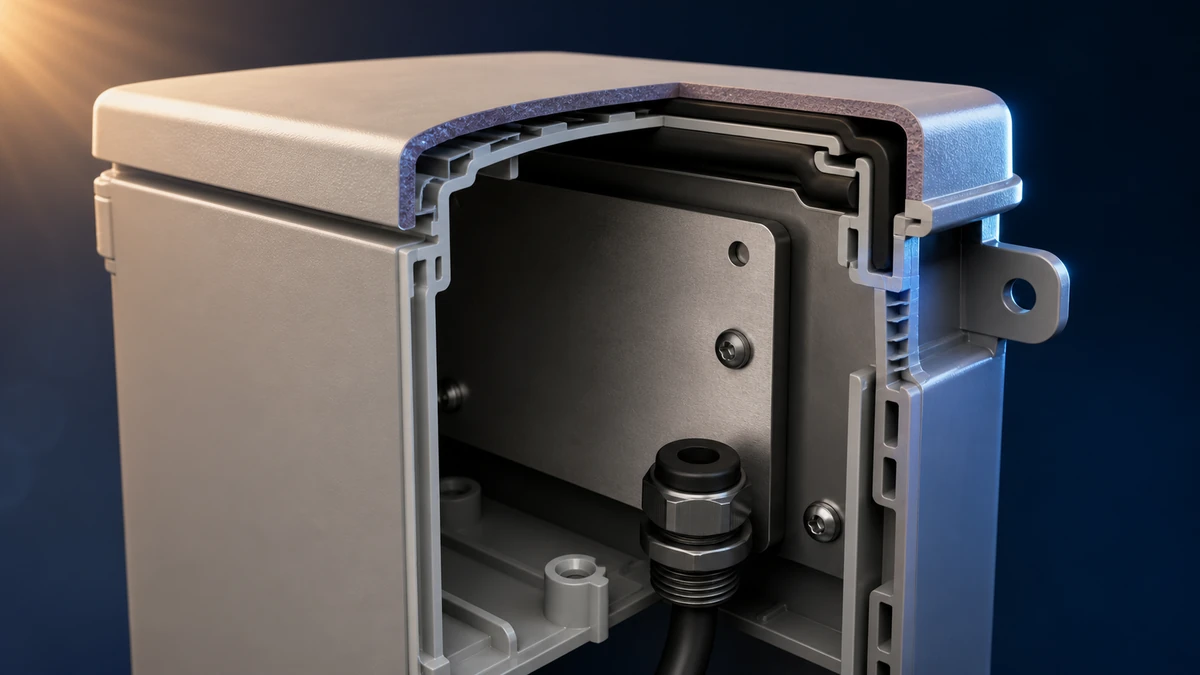
Outdoor enclosure performance depends on the complete installed route, including cable entries, gasket seating, mounting holes, cover closure, and handle access. A strong enclosure body specification can be weakened by an unsuitable entry method or poor installation geometry.
Installation conditions change the product-route and document questions a buyer must resolve.
Cable-entry evidence
Cable glands, knockouts, conduit hubs, and drilled openings can affect the final ingress route. Buyers should confirm which entry method is intended and whether the supplier’s drawing or installation guidance supports it.
O weatherproof switch-box cable-entry guide gives a focused foundation for entry, gasket, and handle considerations. Use that detail as a separate check from the UV material question.
Gasket and handle-interface evidence
The gasket route should be reviewed for seating, compression path, replacement expectation, and installation sensitivity. Handle access should be checked against enclosure orientation, operator clearance, and the buyer’s maintenance practice.
Outdoor buyer action list:
Confirm whether cable entry is bottom, side, rear, or mixed.
Ask which openings are factory-provided and which are buyer-made.
Confirm gasket path and cover-fastening arrangement from the drawing.
Check handle clearance against mounting location and nearby equipment.
Record any site practice that may disturb the cover, gasket, or entries.
How Shieldhz confirms a weatherproof isolator switch box route
Shieldhz confirms the route by matching the buyer’s load and isolation role, AC/DC duty, voltage/current, enclosure exposure, IP requirement, cable-entry plan, mounting condition, and documentation request to the current product information before quotation. Final suitability is confirmed against current product documentation and the buyer’s application.
Pre-quotation confirmation inputs
For model-route confirmation, provide the load and isolation role, AC or DC duty, voltage and current, number of poles if specified, and whether the enclosure is used on equipment, a building surface, or a control panel area. State whether the installation is full sun, partially covered, exposed to rain, subject to washdown, or located in a high-contaminant environment.
Also confirm the IP requirement, cable entry and gasket route, mounting orientation, handle access, and any destination-market documentation requirement. If the buyer is still defining the enclosure style, the waterproof isolator box range can be used as a starting point for model discussion.
Documentation package to request
A practical documentation request includes the current drawing, datasheet, material information where available, and certificate or declaration package if required for the destination market or procurement file. Buyers who need a foundation-level explanation can review the waterproof isolator box basics, while buyers considering a specific SH30 route can use the SH30 weatherproof isolator box guide for product-family context.
Pre-quotation checklist:
[ ] Load and isolation role stated
[ ] AC/DC duty confirmed
[ ] Voltage and current provided
[ ] Outdoor exposure described
[ ] IP requirement identified
[ ] Cable entry position and method planned
[ ] Gasket and cover route reviewed
[ ] Mounting orientation and handle access checked
[ ] Drawing, datasheet, and certificate package requested
Procurement teams should compare evidence scope before comparing unit price
The lowest quoted price is not automatically the lowest-risk route if the material, IP, cable-entry, and documentation scope are unclear. Procurement should compare what each quotation actually includes before approving a uv resistant isolator enclosure route.
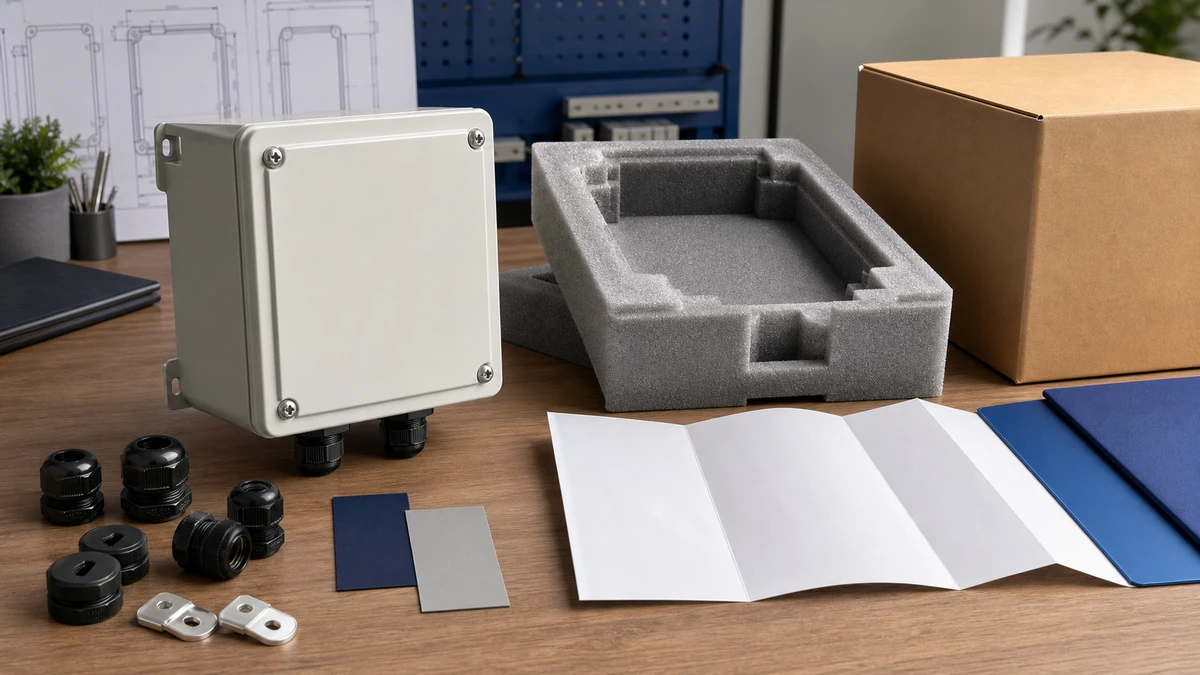
Documentation control, sample acceptance and protective packing are separate handover checks.
RFQ wording that reduces ambiguity
Ask suppliers to identify the exact model, enclosure material, outdoor-use evidence, stated IP rating basis, cable-entry assumptions, and available documentation. Avoid accepting broad phrases such as “weatherproof” or “UV proof” without a supporting document or exact product reference.
Useful RFQ wording:
“Please confirm the exact enclosure model and material route proposed for outdoor UV exposure.”
“Please provide the current drawing and datasheet for the quoted configuration.”
“Please state the IP rating claimed for the exact product arrangement and any installation assumptions.”
“Please identify the cable-entry method assumed in the quotation.”
“Please confirm whether any certificate, declaration, or test reference is available for this exact model or material route.”
Evidence comparison table
Comparison point
Supplier A
Supplier B
Buyer decision note
Exact model identified
Yes / No
Yes / No
Do not compare as equal if model scope is unclear
Enclosure material stated
Yes / No
Yes / No
Material route affects UV review
UV or outdoor-use evidence supplied
Yes / No
Yes / No
Evidence may be material-level or product-level
IP rating basis stated
Yes / No
Yes / No
Confirm exact model and installation conditions
Cable-entry assumption shown
Yes / No
Yes / No
Entries can change installed performance
Drawing supplied
Yes / No
Yes / No
Needed for mounting, entries, and handle clearance
Datasheet supplied
Yes / No
Yes / No
Needed for electrical and enclosure parameters
Certificate/declaration scope clear
Yes / No
Yes / No
Scope may depend on model and destination market
Contractors and OEM builders should decide from the installation back to the enclosure
The practical decision should begin with the installed environment, then move to material, IP, entry route, and documentation. This prevents a common error: selecting an enclosure from a catalogue phrase and discovering later that the installation needs more specific evidence.
Outdoor-equipment builder decision path
OEM builders should decide whether the enclosure is part of a visible product, a serviceable panel, a pump skid, an HVAC unit, or a distributed field-control location. Appearance, access frequency, mounting repeatability, and documentation consistency may influence the preferred route.
Decision path:
Define the equipment location and exposure.
Confirm the isolation role and electrical duty.
Select the enclosure family and size only after the entry route is known.
Request the drawing before freezing mounting holes or cut-outs.
Confirm the documentation package before purchase approval.
Contractor and distributor decision path
Contractors and distributors often need a fast, documentable substitution or model confirmation. In that case, the key is to match the buyer’s specified duty, IP requirement, enclosure material expectation, and entry plan without assuming that one outdoor box is equivalent to another.
Buyer situation
Main decision risk
Evidence to request first
HVAC outdoor equipment
Sun, rain, access clearance, and repeat installation
Drawing, datasheet, material information, IP evidence
Pump-panel area
Splash, condensation, cable routing, and service access
Entry plan, gasket route, IP evidence, model drawing
Current certificate/declaration package and datasheet
When to ask for a different model route or more documentation
Ask for a different model route or more documentation when the exposure, installation, or buyer file cannot be supported by the current quotation evidence. This is a procurement control point, not a criticism of any one material or enclosure style.
Escalation triggers
Escalate the request if the installation is in full sun, near reflective metal or roofing, exposed to washdown, placed in a corrosive or chemical environment, or subject to strict destination-market documentation. Also escalate if the supplier cannot identify the exact model, material route, drawing, or IP basis.
More evidence may also be needed when the enclosure will be installed in repeated OEM production. Repeatability increases the value of clear drawings, consistent entries, and stable documentation.
What to ask next
Do not ask only for a “better enclosure.” Ask for the reasoned route: different material, different enclosure family, revised entry method, changed mounting position, or a clearer documentation package.
Escalation checklist:
[ ] Exposure is stronger than initially described
[ ] IP requirement changed after site review
[ ] Cable entries differ from the quoted assumption
[ ] Mounting or handle access conflicts with equipment layout
[ ] Destination-market documentation requirement is unresolved
[ ] Drawing or datasheet scope does not match the quotation
[ ] UV/material evidence is too general for the buyer’s application
Conclusion
A uv resistant isolator enclosure decision should own two evidence lines: material ageing under outdoor UV exposure and ingress performance under the required IP route. Treating IP as proof of UV resistance creates a documentation gap that can affect OEM builds, contractor substitutions, and procurement comparisons.
The practical approach is simple: define the installed exposure, confirm the electrical duty and isolation role, verify cable entry and gasket details, then request the exact drawing, datasheet, material information, and certificate package required for the buyer’s file. Final selection should always be checked against current product documentation and the specific application conditions.
Perguntas frequentes
Is an IP65, IP66, or IP67 rating the same as UV resistance?
No. An IP rating addresses ingress of solids and water for a defined enclosure condition, while UV resistance concerns material ageing under sunlight. Buyers should request both IP evidence and UV/material evidence where outdoor exposure is relevant.
What should I ask for when buying a uv resistant isolator enclosure?
Ask for the exact model, enclosure material information, current drawing, datasheet, stated IP basis, cable-entry assumptions, and any available certificate or declaration package. Also describe the installation exposure so the supplier can check the route against the intended use.
Does outdoor installation always require the same enclosure material?
No. The appropriate material route depends on exposure, mounting, documentation needs, destination market, and buyer application. Compare the exact model documentation rather than assuming that one outdoor enclosure material is always correct.
Why do cable entries matter if the enclosure body is suitable for outdoor use?
Cable entries create openings and sealing interfaces. The final installed route can depend on gland type, entry position, gasket seating, drilling practice, and conduit arrangement, so entry assumptions should be confirmed before purchase.
Can I use a supplier’s general catalogue statement as proof of UV suitability?
A general statement may be useful background, but procurement decisions should request exact-model or material-level evidence where available. The stronger buyer file connects the claim to the quoted enclosure route and installation conditions.
Who should confirm final suitability for an outdoor isolator enclosure?
Final suitability should be confirmed by reviewing current product documentation against the buyer’s actual application, installation method, and destination-market requirements. The supplier can support model-route confirmation, but the buyer’s project conditions and documentation requirements remain central to the decision.
Shi, Muxi
Shi, Muxi escreve artigos técnicos da Shieldhz para compradores de controle industrial e componentes elétricos, abrangendo chaves de came rotativas, chaves isoladoras, seccionadores PV DC, botões de pressão, luzes indicadoras, gabinetes à prova d'água e blocos de terminais. Os artigos são baseados na experiência de fabricação e exportação da Zhejiang Shihe Electric Co., Ltd., com ênfase prática na seleção de modelos, planilhas de dados, desenhos, certificações, classificações de IP e detalhes de consulta que os compradores devem confirmar antes de fazer o pedido.