Selecting a disconnect switch manufacturer requires more than a price comparison. The supplier must demonstrate that a specific model carries the ratings, certifications, and documentation your application demands before a purchase order is placed.
Four buyer-action bullets:
Confirm the exact model’s rated voltage, current, and pole count against your AC or DC application before requesting a quote.
Request the current datasheet, dimensional drawing, and applicable test certificates for that model—not a generic catalogue page.
Verify the manufacturer’s change-control process so a mid-production revision does not invalidate your panel approval.
Align incoming inspection criteria with the rated markings and physical characteristics documented in the approved drawing package.
What separates a qualified disconnect switch manufacturer from a catalogue supplier
A qualified manufacturer controls the design, tooling, and test records for the products it sells. A catalogue supplier may repackage or rebrand components without holding the underlying technical file.
The distinction matters because panel builders and OEMs carry approval responsibility. If a certification was issued to a different legal entity or an earlier product revision, your panel approval may rest on documentation that does not match the hardware in the box.
Design and tooling ownership
Ask directly: does the manufacturer own the tooling and hold the original type-test records? A supplier that can produce a complete technical file—including the test report, the bill of materials at the time of testing, and the current production drawing—demonstrates genuine ownership.
If the answer is vague or the test report references a third-party brand, treat that as a risk flag and request clarification before proceeding.
Production traceability
Traceability connects a shipped batch to a specific production run, tooling state, and inspection record. Manufacturers with ISO 9001-aligned quality systems can typically provide batch or date-code traceability. Suppliers without production control cannot.
For safety-critical isolation applications, traceability is not a procurement luxury. It is the mechanism that allows a field failure to be investigated and contained.
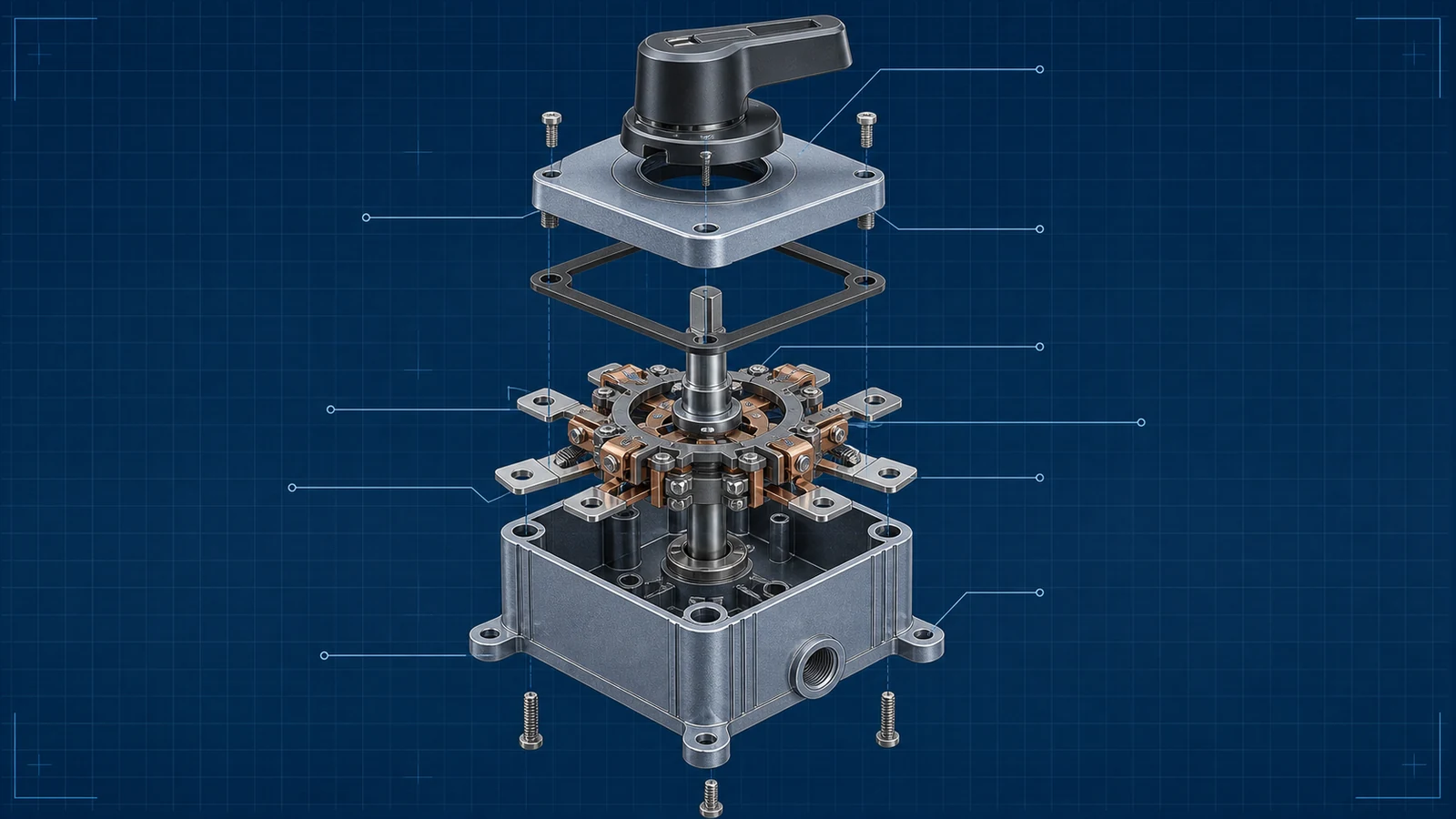
An exploded technical view highlights the mechanical route that a supplier must document and control.
AC versus DC disconnect switch requirements: how they differ for buyers
AC and DC isolation are governed by different arc-interruption physics. A switch rated for AC at a given voltage is not automatically suitable for the same voltage in DC service. Buyers who conflate the two risk selecting a device that cannot safely interrupt the circuit it is installed in.
AC disconnect switch considerations
AC switches interrupt current at a natural zero crossing, which limits arc energy. Ratings for AC switches typically reference voltage classes such as 400 V AC or 690 V AC, with utilisation categories defined under standards such as IEC 60947-3 scope, which covers switches, disconnectors, switch-disconnectors, and fuse-combination units for its stated distribution and motor-circuit scope and limits. Whether a specific product is certified to that standard is a document question, not an assumption.
Panel builders specifying AC disconnect switches for motor feeders or distribution boards should confirm the utilisation category (AC-20, AC-21, AC-22, AC-23) on the device’s nameplate and in the test certificate, as each category defines a different switching duty.
DC disconnect switch considerations
DC circuits sustain an arc after contact separation because there is no natural zero crossing. DC-rated switches require contact geometry, arc-chute design, and materials engineered specifically for that duty. Voltage and current ratings for DC service are model-specific and must be read from the current datasheet, not inferred from an AC rating.
Photovoltaic string and array isolation is a common DC application. The Shieldhz Диапазон переключателей разъединителя постоянного тока PV addresses this duty class. Buyers should confirm the specific model’s DC voltage and current ratings, pole configuration, and applicable certifications against their system design before ordering.
Параметр
AC Disconnect Switch
DC Disconnect Switch
Arc interruption mechanism
Natural current zero crossing
Engineered arc-chute, contact geometry
Voltage rating basis
AC RMS, utilisation category
DC rated voltage, model-specific
Standard reference (example)
IEC 60947-3 (scope-limited)
IEC 60947-3 DC clauses, IEC 62109, others
PV string/array isolation
Not applicable
Applicable—confirm model rating
Certification transferability
Not transferable across models
Not transferable across models
Rating evidence: what documentation a buyer must request
Ratings printed on a nameplate are claims. Documentation is evidence. Buyers who accept a nameplate without a supporting test record have no independent basis to verify the claim.
Minimum document package for a disconnect switch
A complete pre-order document package for a disconnect switch should include:
Document checklist:
[ ] Current product datasheet with rated voltage, current, poles, and utilisation category
[ ] Dimensional drawing with mounting hole pattern, cable entry clearances, and overall envelope
[ ] Type-test certificate from an accredited third-party laboratory, referencing the specific model number
[ ] Certificate validity date and issuing body name
[ ] Wiring diagram or terminal identification drawing
[ ] Applicable safety data or material declaration if required by your end-market
A test certificate is valid for the model, configuration, and ratings tested. It does not automatically extend to a higher voltage, a different pole count, or a physically modified variant. Confirm that the certificate model number matches the part number you are ordering.
Check the issuing laboratory’s accreditation status independently. An accreditation body’s online register allows you to verify that the laboratory held valid scope at the time of testing.
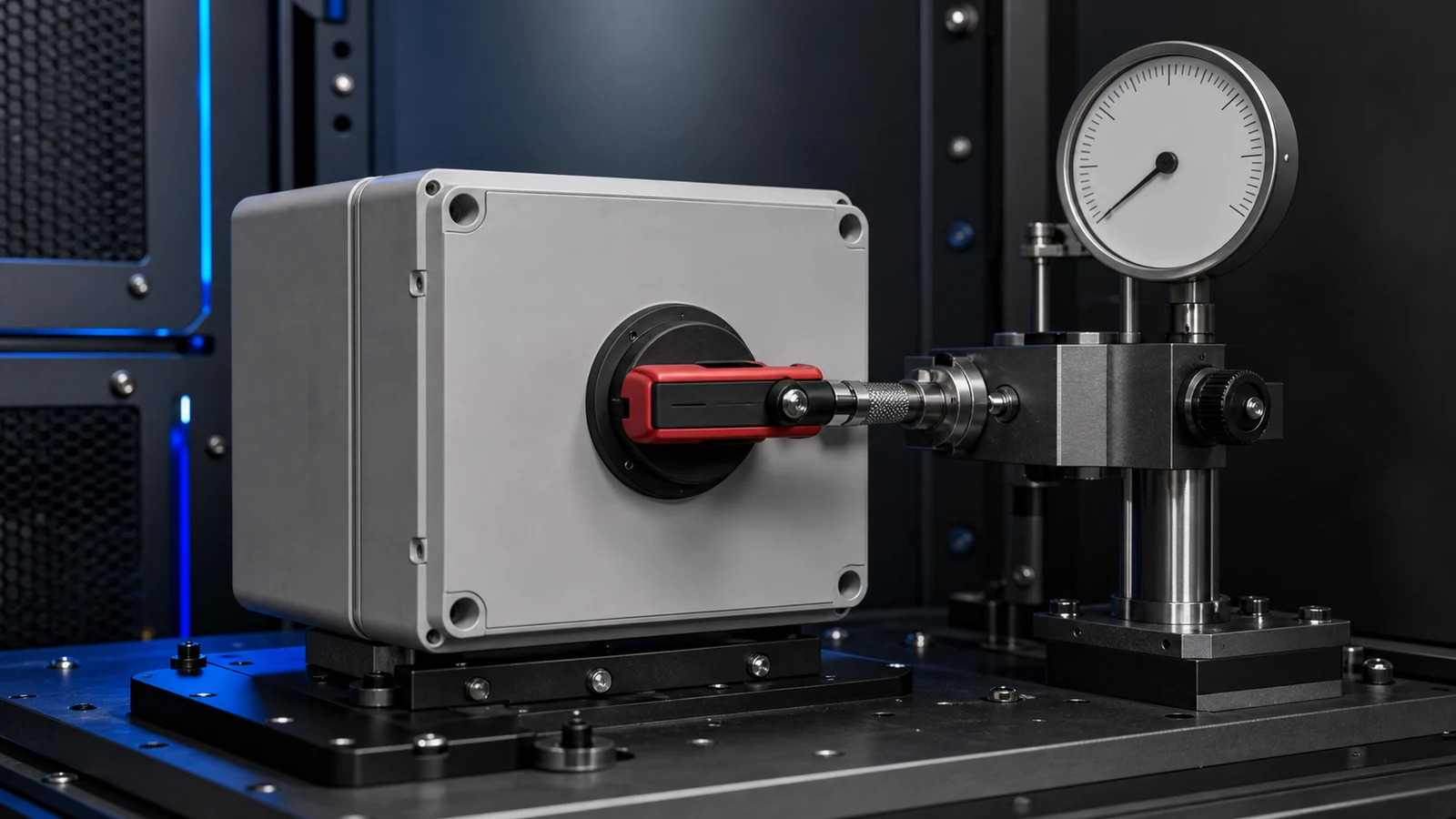
A controlled test fixture illustrates the need to verify a specific model and test route.
Evaluating a manufacturer’s product range for application fit
A manufacturer’s range breadth indicates whether it can support your current requirement and accommodate future variants without a supplier change. Narrow ranges force re-qualification when your application evolves.
Buyers should not assume that ratings are interchangeable across these routes. Each model page carries its own specification. Confirm the correct route against your voltage, current, pole, and enclosure requirements before requesting a drawing package.
Range gaps and custom requests
If a standard model does not match your requirement, establish early whether the manufacturer can support a variant and on what timeline. Custom or modified variants typically require a new or updated test certificate. Confirm this before committing to a design that depends on a non-standard configuration.
Evaluation Criterion
What to Ask the Manufacturer
Risk if Skipped
Model-to-application match
Does this exact model cover my voltage, current, and poles?
Undersized or uncertified device in service
Certificate scope
Does the certificate cover this model number and rating?
Invalid approval basis
Enclosure/IP class
Is the IP rating tested or declared?
Ingress failure in field environment
Конфигурация полюсов
Is the pole count I need a standard variant?
Custom lead time or unavailable
DC versus AC rating
Is the DC rating explicitly stated on the datasheet?
AC-only device installed in DC circuit
Change control
How are production changes communicated to buyers?
Silent revision invalidates panel approval
Manufacturing verification: factory audit and sample inspection
Visiting a manufacturer or commissioning a third-party audit provides evidence that production capability matches the claims in the technical file. Sample inspection before a first production order provides a physical check against the approved drawing.
Pre-production sample review
Request a pre-production sample (golden sample or first-article) and inspect it against the approved dimensional drawing and datasheet. The inspection should confirm:
Pre-production sample checklist:
[ ] Nameplate markings match the ordered model number and rated values
[ ] Physical dimensions fall within the tolerances on the approved drawing
[ ] Terminal labelling matches the wiring diagram
[ ] Actuator operation (handle or rotary mechanism) is smooth and positive at both ON and OFF positions
[ ] Enclosure surface finish and IP-relevant sealing features are present as specified
[ ] Any certification marks on the device match the certificate on file
Retain the approved sample as a reference for incoming inspection of production batches.
Factory audit scope
A factory audit for a disconnect switch supplier should cover process control, incoming material inspection, in-process testing, and final test records. Ask specifically whether the manufacturer performs a dielectric withstand test and a contact resistance check on production units, and request the acceptance criteria used.
Outdoor application conditions influence the enclosure and product-route confirmation.
Change control and supply continuity
A manufacturer that changes a component, tooling, or process without notifying buyers can silently invalidate a panel approval. Change control is a contractual and quality requirement, not a courtesy.
What constitutes a relevant change
Changes that can affect certification validity or application suitability include:
Contact material or geometry modification
Arc-chute design or material change
Housing material substitution
Terminal configuration or torque specification revision
Supplier change for a safety-critical sub-component
Ask the manufacturer to define its change-notification threshold in writing. A responsible manufacturer will have a documented change-control procedure that specifies when buyers are notified and when re-testing is required.
Supply continuity planning
Confirm the manufacturer’s policy on product discontinuation notice periods. For panel builders with long production runs or service obligations, a minimum 12-month discontinuation notice is a reasonable contractual expectation. Establish whether the manufacturer holds safety stock or can commit to a last-time-buy arrangement.
How Shieldhz confirms a disconnect switch sourcing route
Shieldhz confirms a sourcing route through a structured pre-quotation handover. Buyers provide application inputs; Shieldhz maps those inputs to the current product documentation and confirms suitability before a quotation is issued.
Pre-quotation inputs required from the buyer
To confirm the correct model route, Shieldhz requires the following application inputs:
Buyer application input checklist:
[ ] AC or DC service (specify system voltage and whether it is nominal or maximum)
[ ] Rated current and any inrush or fault-current context relevant to the switching duty
[ ] Number of poles required
[ ] Enclosure or IP class requirement and installation environment (indoor, outdoor, UV exposure, condensation risk)
[ ] Mounting configuration and available panel cutout or DIN rail space
[ ] Cable entry direction and conductor size range
[ ] Target market and any specific certification requirement (e.g., IEC, UL, AS/NZS)
Confirmation against current documentation
Final suitability is confirmed against the current product documentation and the buyer’s stated application. Shieldhz does not issue a quotation based on assumed compatibility. If the buyer’s inputs fall outside the rated parameters of a standard model, that is communicated explicitly so the buyer can adjust the specification or seek an alternative route.
This process reduces the risk of a misapplication reaching production. It also ensures that the drawing and certificate package provided with the quotation corresponds to the exact model being quoted.
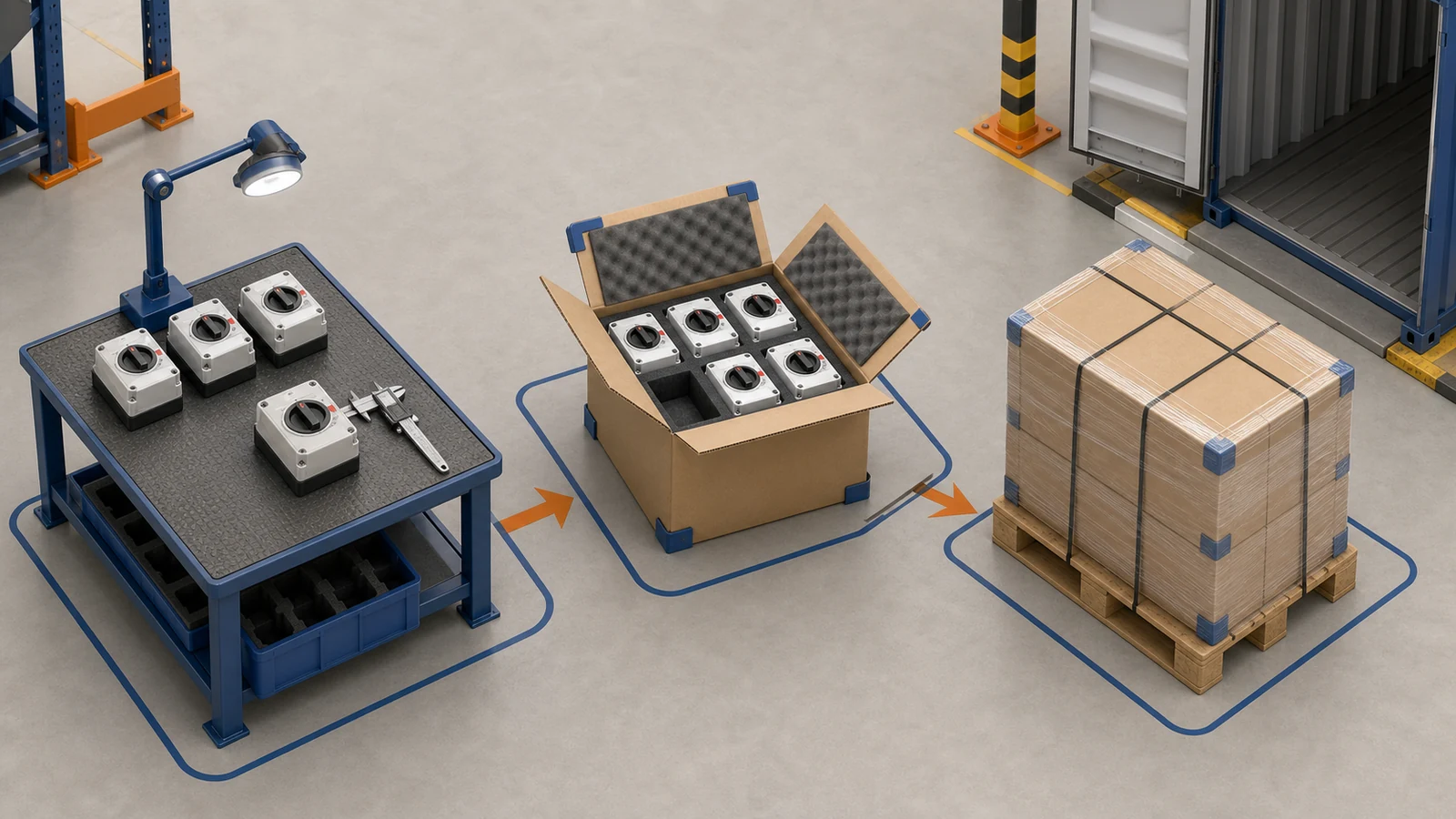
Inspection, protective packing, and dispatch are separate steps in a controlled supply handover.
Commercial handover: from approved sample to production order
The commercial handover phase bridges technical approval and production supply. Errors at this stage—wrong part number on the purchase order, undocumented packaging requirement, missed lead-time assumption—create delays that affect panel build schedules.
Purchase order accuracy
A purchase order for a disconnect switch should reference:
Exact manufacturer part number as it appears on the approved datasheet
Quantity and unit of measure
Required delivery date and any phased delivery schedule
Packaging requirement (bulk, individual box, ESD if applicable)
Reference to the approved drawing revision number
Any agreed incoming inspection or certificate-of-conformance requirement
Verbal agreements about specifications do not survive a supplier transition or a personnel change. Put the technical reference in the purchase order.
Incoming inspection alignment
Incoming inspection criteria should be set before the first production delivery, not after a discrepancy is found. Define the inspection attributes, sample size, and acceptance criteria in writing. Reference the approved golden sample and the dimensional drawing as the inspection standard.
For disconnect switches, practical incoming inspection attributes include nameplate verification, dimensional spot-check, actuator function check, and visual inspection of sealing features where IP class is specified.
Conclusion
Selecting a disconnect switch manufacturer is a technical and commercial decision with direct consequences for panel approval, field reliability, and supply continuity. The evaluation criteria are consistent: design ownership, rating evidence, documentation completeness, change-control discipline, and a structured pre-quotation handover.
Buyers who apply these criteria before placing a purchase order reduce the probability of a misapplication, a documentation gap, or a silent production change reaching their product. The process takes more time upfront and saves significantly more time downstream.
For DC isolation requirements, particularly in photovoltaic applications, confirm the model route, ratings, and certificate scope against the specific model documentation rather than a general product category claim.
Часто задаваемые вопросы
What is the difference between a disconnect switch and a circuit breaker?
A disconnect switch provides isolation—it opens a circuit to allow safe maintenance or de-energisation. It is not designed to interrupt fault currents or provide overcurrent protection. A circuit breaker is an overcurrent-protection device that trips under fault conditions. These are distinct functions, and a disconnect switch should not be substituted for a circuit breaker in a protection role.
Can an AC-rated disconnect switch be used in a DC application?
Not without explicit DC rating confirmation on the datasheet and test certificate. AC and DC arc interruption are physically different. A switch rated only for AC service may fail to interrupt a DC circuit safely at the same voltage. Always confirm the DC rating from the current model documentation before specifying a device for DC service.
How do I verify that a certificate is valid for the model I am ordering?
Check that the model number on the certificate matches the part number on your purchase order exactly. Confirm the issuing laboratory’s accreditation status through the relevant accreditation body’s online register. Check the certificate issue and expiry dates. If the certificate references a product family rather than a specific model, ask the manufacturer to confirm in writing that your model number is covered within that family’s test scope.
What should I do if a manufacturer cannot provide a dimensional drawing?
Treat the absence of a dimensional drawing as a qualification risk. A manufacturer that controls its own tooling and design holds dimensional drawings as a standard part of its technical file. If a drawing is unavailable, you cannot verify fit, mounting, or cable entry clearances before production. Request the drawing as a condition of proceeding, or evaluate an alternative supplier.
How many poles do I need for my disconnect switch application?
Pole count depends on your circuit configuration. A single-phase AC circuit typically requires a 2-pole switch. A three-phase AC circuit typically requires a 3-pole or 4-pole switch depending on whether the neutral is switched. DC string isolation in a PV system depends on whether the system is grounded and how many conductors must be isolated. Confirm the pole requirement with your system designer and verify that the selected model is available in that configuration as a standard variant.
What is a utilisation category and why does it matter for AC disconnect switches?
A utilisation category defines the switching duty a device is designed and tested for—specifically, the relationship between the current switched and the rated current, and whether the load is resistive, inductive, or motor-related. Selecting a device with a utilisation category that does not match the actual switching duty can result in accelerated contact wear or failure to interrupt. Confirm the utilisation category on the datasheet and test certificate against your application’s switching duty before specifying the device.
Ши, Мукси
Ши, Мукси пишет технические статьи Shieldhz для покупателей промышленных систем управления и электрических компонентов, охватывая поворотные кулачковые переключатели, разъединители, PV DC разъединители, кнопки, индикаторные лампы, водонепроницаемые корпуса и клеммные блоки. Статьи основаны на опыте производства и экспорта компании Zhejiang Shihe Electric Co., Ltd., с практическим акцентом на выборе модели, технических характеристиках, чертежах, сертификации, рейтингах IP и деталях запроса, которые покупатели должны подтвердить перед заказом.