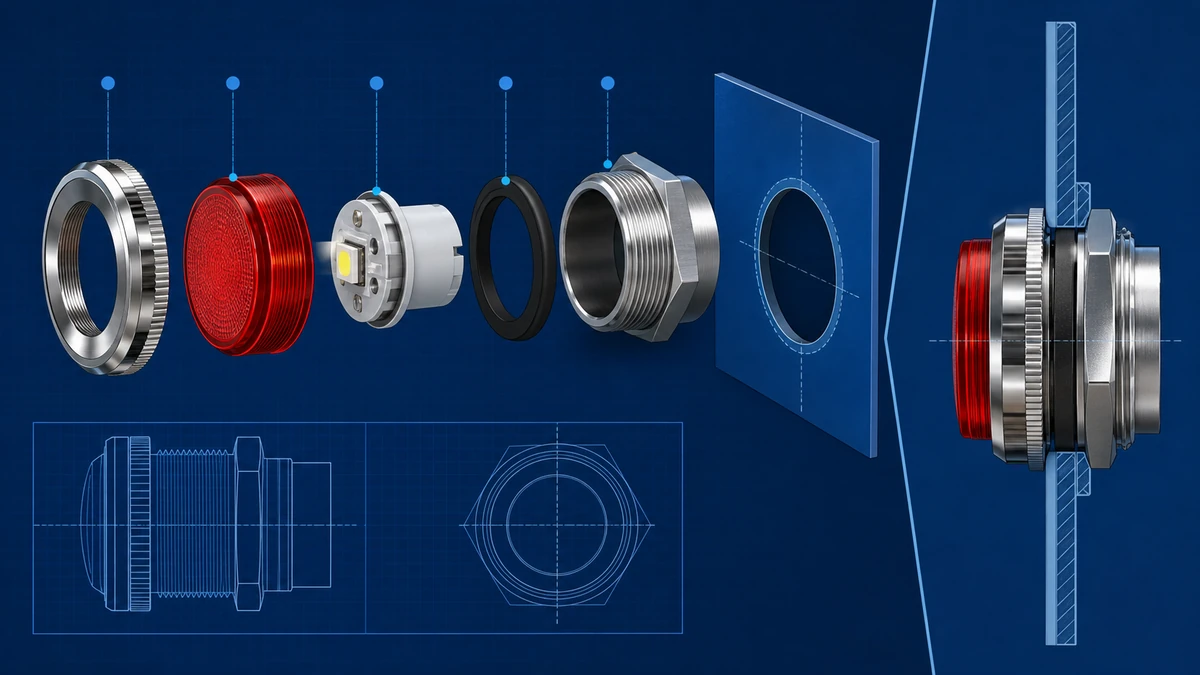
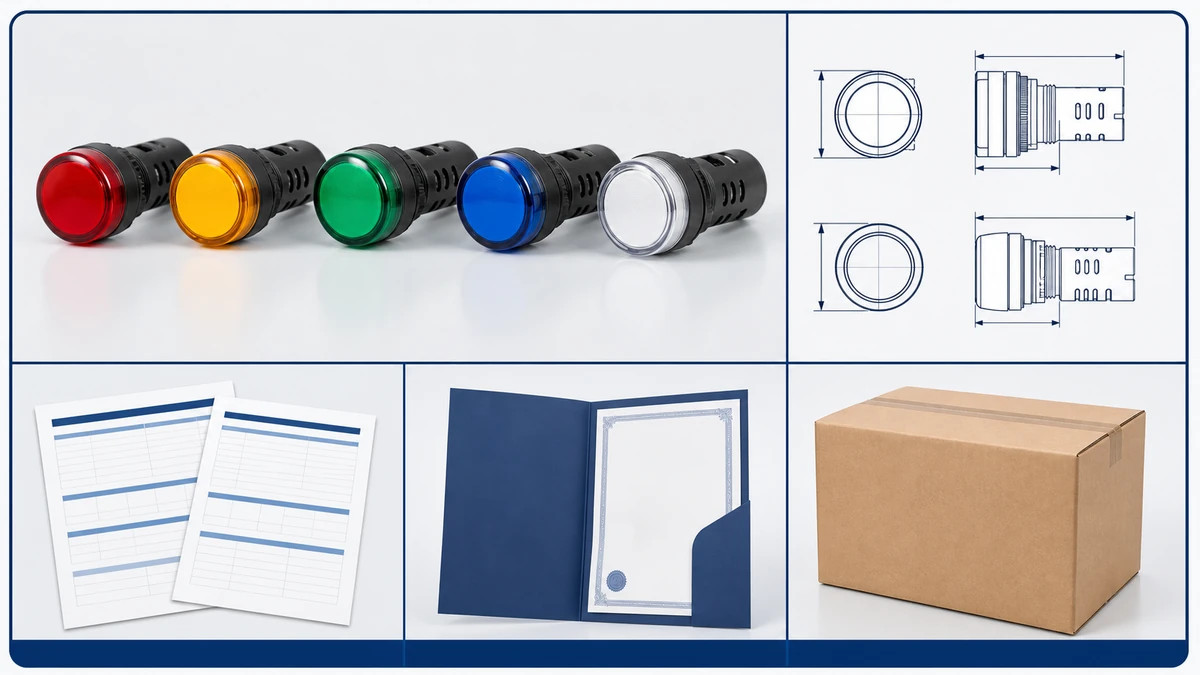
Use the component drawing and wiring information for final selection.
An LED pilot light and a panel indicator light perform the same core function: signaling circuit status on a control panel. They differ in construction rating, operating voltage, luminous intensity, and typical mounting location. LED pilot lights are generally rated for front-of-panel operator use at 24V DC to 240V AC with IP65 or better sealing. Indicator lights more commonly serve logic-level signaling inside control cabinets at lower voltages and lower IP ratings. Because many catalogs use both terms interchangeably, the reliable approach at the specification stage is to confirm IEC 60947-5-1 compliance, rated voltage, IP rating, and lens color coding against the actual datasheet rather than relying on the product name alone.
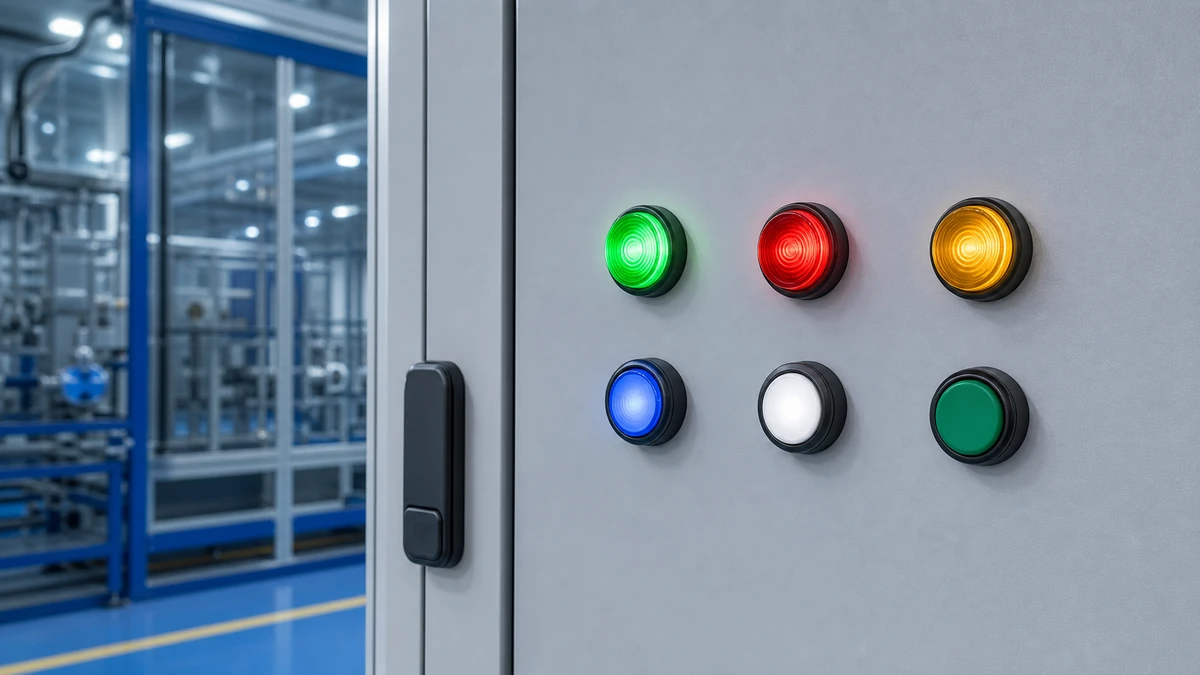
LED Pilot Light vs Indicator Light: Panel Signal Device Selection: engineering anatomy reference for technical selection.
What LED Pilot Lights and Indicator Lights Actually Do
Both devices mount on a panel surface to communicate on, off, fault, or alarm states to an operator or maintenance technician. The distinction between the two terms is partly functional and partly contextual.
An LED pilot light is a panel-mounted signaling device that confirms the energized or de-energized state of a circuit, machine, or process. It uses an LED lamp element housed in a bezel-mounted lens assembly. Pilot lights rated for direct connection to 24V DC or AC mains circuits include an integrated current-limiting resistor or LED driver within the body. Luminous intensity varies by lens color and LED drive current; refer to the product datasheet for specific values.
A panel indicator light, in broader catalog usage, refers to any visual signal lamp mounted on a panel to communicate operating state. The term encompasses both LED and legacy incandescent or neon types. When the application is a dry indoor control cabinet with logic-level PLC outputs, a compact indicator light at 24V DC with IP40 or IP54 protection is often the appropriate and lower-cost selection. When the application is an outdoor machine front plate or a wash-down environment, the requirements shift toward the sealing and brightness levels associated with pilot lights.
Procurement teams and panel builders benefit from treating the terms as describing a spectrum rather than two entirely separate product categories. The actionable question at the specification stage is whether the device in the datasheet matches the operating voltage, panel cutout, IP rating, and lens color requirements of the specific installation.
Standards Classification for Panel Signal Devices
Standards classification is the foundation that separates a defensible panel specification from one that generates rework at the inspection stage.
IEC 60947-5-1 and IEC 60073
Both LED pilot lights and indicator lights fall under IEC 60947-5-1, which governs low-voltage switchgear and controlgear for control circuit devices and switching elements. The standard addresses rated insulation voltage, operating voltage range, and lamp replacement provisions for signaling devices.
Color coding for both device types is governed by IEC 60073, which defines normative color assignments for actuators and indicators at human-machine interfaces. The assignments are: green for safe or running state, red for danger or stop, amber for caution, blue for mandatory action, and white for general status. In safety-relevant installations, IEC 60073 compliance is a normative requirement, not a recommendation. A device can pass electrical ratings and fail a safety audit on color coding alone.
For panels destined for North American markets, UL 508 recognition applies to industrial control panel components. CE marking addresses European market requirements but does not substitute for UL component recognition in a UL 508 listed panel. When ordering for a UL 508 submission, request the UL file number and confirm the rated voltage, current, and enclosure type on the listing record.
IEC 60529 Ingress Protection
Enclosure IP rating is determined by IEC 60529. Pilot lights on outdoor or wash-down panels typically require IP65 or IP67. Standard indicator lights in dry indoor control cabinets may be specified at IP40 to IP54. When verifying IP rating, confirm gasket material compatibility with the installation environment in addition to the stated IP class. Nitrile seals, for example, can degrade in environments with petroleum-based coolants even when the housing carries an IP67 rating. Water can also track along wiring into rear terminal cavities that are not independently sealed.
IEC 60947-3 Context for Associated Switching Hardware
When LED pilot lights and indicator lights are specified alongside isolation and switching hardware in the same panel, the relevant switching standard is IEC 60947-3:2020+AMD1:2025, which applies to switches, disconnectors, switch-disconnectors, and fuse-combination units for distribution and motor circuits, with rated voltage up to 1000 V AC or 1500 V DC. The full standard text is available through the Веб-магазин IEC. For an overview of how this standard applies to rotary switching hardware, see the Shieldhz guide to IEC 60947-3 and rotary cam switch selection.
Classification Summary Table
Параметр
LED Pilot Light
LED Indicator Light
Руководящий стандарт
IEC 60947-5-1, IEC 60073
IEC 60947-5-1, IEC 60073
Typical operating voltage
24V DC / 110 to 240V AC
3V to 24V DC (logic-level typical)
IP rating range
IP65 to IP67 typical
IP40 to IP54 typical
Panel mounting cutout
22 mm or 30 mm round
8 mm to 22 mm depending on series
Color coding compliance
IEC 60073 normative
IEC 60073 normative
Primary mounting location
Operator panel, machine front plate
Control cabinet interior
UL recognition
UL 508 component recognition where applicable
UL component recognition (low-voltage)
Сравнение технических характеристик
Placing device specifications side by side makes practical differences immediately actionable at the component selection stage.
Specification
LED Pilot Light
LED Indicator Light
Основная функция
Equipment on/off, power status
Process state, fault, or alarm
Typical supply voltage
24V DC / 110 to 240V AC
24V DC / 48 to 240V AC
Luminous intensity
Refer to datasheet by lens color
Refer to datasheet by lens color
Lens diameter
16 mm, 22 mm, 30 mm
22 mm, 30 mm
Lens colors available
Red, green, amber, white, blue
Red, green, amber, white, blue
IP rating (typical)
IP40 to IP65; IP67 where sealed
IP65 to IP67 for panel-front types
Рабочая температура
Refer to product datasheet
Refer to product datasheet
LED service life
Refer to product datasheet
Refer to product datasheet
Mounting cutout
16 mm or 22 mm round typical
22 mm or 30 mm round typical
IEC standard reference
IEC 60947-5-1
IEC 60947-5-1
Типичное применение
Control panel power indication
Process alarm, fault signaling
Note that service life figures, power consumption values, and operating temperature ranges vary between models and manufacturers. Use the datasheet for the specific series and voltage variant when writing a panel specification, rather than applying a general figure as a universal claim.
In a motor control center, a green LED pilot light at 22 mm cutout is typically wired to confirm mains supply is present, while a red indicator light at higher luminous intensity signals a tripped fault condition visible from across a production floor. The AD16 panel indicator light series covers both roles within a single product family, with configurable voltage input and lens color for both functions.
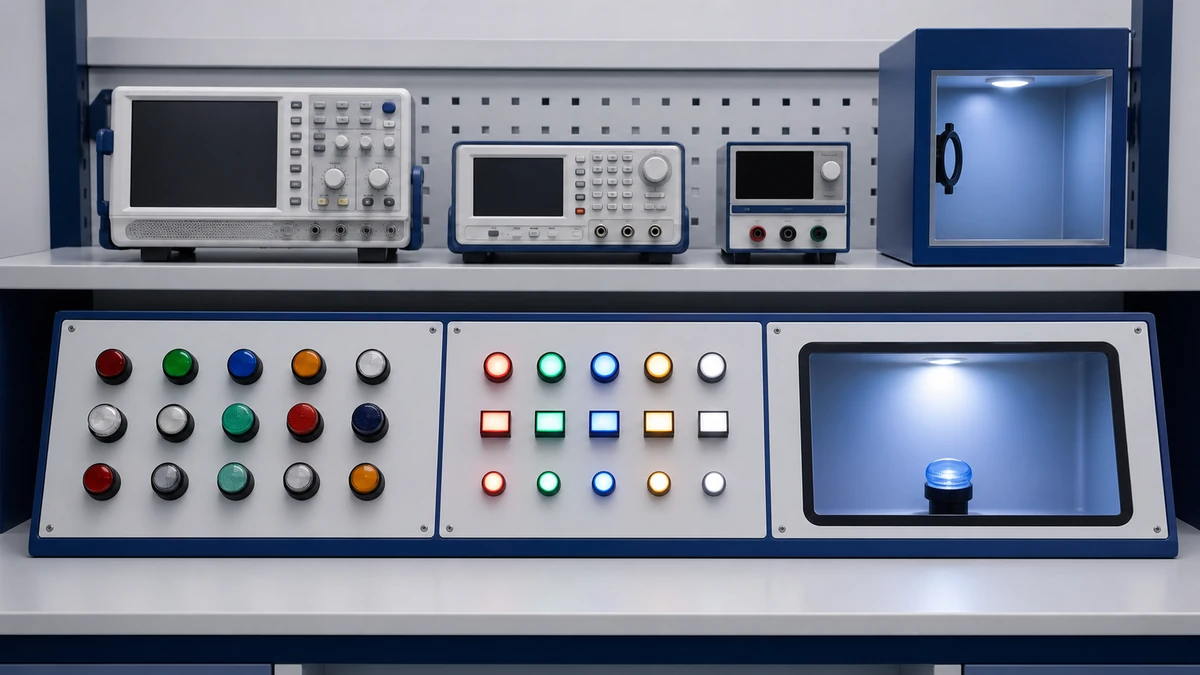
LED Pilot Light vs Indicator Light: Panel Signal Device Selection: test and measurement reference for technical selection.
Panel Selection Criteria: Five Parameters That Determine the Right Device
Specifications on paper only become useful when matched against the concrete variables of a real panel build. The five criteria below structure the selection decision for panel designers, panel builders, and procurement engineers.
1. Operating Voltage and Circuit Type
Confirm whether the panel bus is 24V DC, 110V AC, or 230V AC. Universal-voltage LED pilot light models accept a wide input range, while neon indicator lights are typically rated for 110V AC or 230V AC only. On panels with mixed 24V DC and 230V AC circuits, use clearly differentiated body colors or label sleeves for pilot lights at different voltages. Identical bezel styles at different voltage levels create maintenance hazards when lamps are replaced in the field.
2. Mounting Cutout and Panel Real Estate
Pilot light and indicator light cutout dimensions are series- and drawing-dependent. Some panel designs use 22 mm, 30 mm, or compact openings, but the buyer should confirm the exact hole size against the manufacturer drawing before ordering and verify thread engagement depth against panel thickness.
3. Ambient Visibility and Luminous Intensity
In high-ambient-light environments such as outdoor switchgear or lit machine floors, LEDs with higher luminous intensity maintain readability at viewing distances beyond 3 m. Neon indicators can appear washed out under direct sunlight at high lux levels. Refer to the datasheet luminous intensity value, stated in millicandela, for the specific lens color being specified.
4. Enclosure Ingress Protection
Outdoor or wash-down applications require IP65 or IP67 per IEC 60529. Verify gasket material compatibility with the enclosure environment in addition to the stated IP class. Confirm that the rear terminal area is also adequately protected, since water can track along cables into unsealed cavities even when the front face carries an IP67 rating.
5. Expected Service Life and Maintenance Interval
LED devices rated at 50,000 or more hours of continuous operation reduce replacement frequency significantly in 24/7 process control panels compared to neon bulbs. When specifying for a continuous-duty process line, evaluate service life rating before evaluating price. A lamp replacement on a running conveyor typically costs many times the component value in labor and downtime.
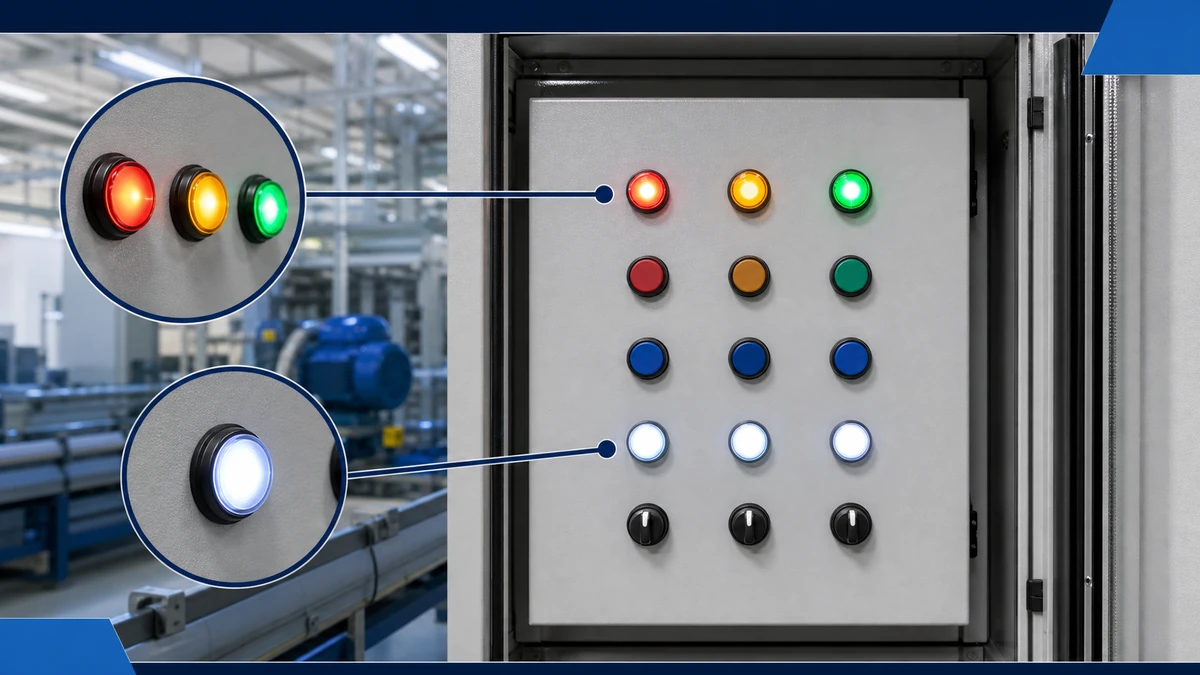
LED Pilot Light vs Indicator Light: Panel Signal Device Selection: application context reference for technical selection.
Application Scenarios: Matching Device to Installation
Conveyor Control Panel: High-Cycle Status Signaling
In a conveyor line control cabinet, operators need continuous run, fault, and stop status at a glance from several meters away. A panel indicator light rated at 24V DC with a 22 mm cutout fits the standard DIN-rail enclosure layout and aligns with the PLC output card voltage. Because the panel interior remains relatively clean and dry, an IP40 or IP54 front-face rating is usually sufficient. For companion rotary isolation hardware in the same panel, the Серия поворотных кулачковых переключателей LW28 provides a confirmed product route for panel-mount disconnection within the same enclosure family.
Outdoor Water Treatment Pump Station: Weatherproof Priority
A water treatment facility running outdoor pump stations requires a fundamentally different selection profile. An LED pilot light housed in an IP67-rated assembly resists condensation, chemical mist, and pressure washing cycles. Operating voltage at these sites is commonly 230V AC, which matches the motor control circuit directly and eliminates a separate signal transformer. For companion switching and isolation hardware in outdoor pump panels, the Серия поворотных кулачковых переключателей LW42 is rated for the heavier-duty switching cycles typical of pump station applications.
Machine Tool Cabinet: Space Constraints and Color Coding
In a CNC machine tool cabinet where panel real estate behind the front plate is limited, a low-profile LED pilot light with a flush-mount lens prevents interference with internal wiring runs. Color coding follows IEC 60073 – red for fault, green for run, amber for standby – a convention that applies equally to pilot lights and indicator lights. For the isolation switching function in the same cabinet, the Серия поворотных кулачковых переключателей SH30 covers the compact form factor requirements typical of machine tool enclosures.
Packaging Line with Mixed Voltages: Documentation Priority
On a packaging line panel combining 24V DC control circuits and 230V AC motor circuits, the documentation burden is as important as the hardware selection. Each pilot light and indicator light should have a corresponding entry in the panel BOM showing rated voltage, IP rating, IEC 60073 lens color assignment, and certificate file number. Ordering from a supplier that provides a complete documentation package — dimensional drawing, wiring diagram, datasheet, and certificate copies — reduces the time required to prepare the panel submission file.
How Shieldhz Configures and Verifies LED Pilot Light Orders for Panel Builders
When panel builders source LED pilot lights or indicator lights at volume, configuration errors — wrong voltage rating, mismatched mounting cutout, or absent certification documentation — create costly rework at the build or inspection stage. Shieldhz, the export brand of Zhejiang Shihe Electric Co., Ltd., structures its order intake process around buyer-specific inputs to eliminate these gaps before production begins.
Shieldhz operates from a 5,000-plus square meter factory in Yueqing, Zhejiang, with more than 100 employees and 40-plus production machines. The company holds ISO 9001 quality management certification and manufactures products carrying CE, RoHS, TUV, UL, UKCA, CCC, and CB certifications where applicable by product series and destination market.
Operating voltage and current type: AC or DC supply, rated voltage (12V DC, 24V DC, 110V AC, 230V AC, or universal range), and tolerance band from the panel design
Mounting cutout diameter: standard bodies are available in 16 mm, 22 mm, and 30 mm; panel thickness must be confirmed to verify adequate thread engagement depth
Lens color and light source: LED color selected from red, green, amber, blue, and white, cross-referenced against the IEC 60073 color-coding assignment for the intended signal function
IP rating requirement: panel environment determines whether IP40, IP54, IP65, or IP67 ingress protection per IEC 60529 applies; gasket material can be confirmed for specific chemical environments on request
Certification package: CE marking and RoHS compliance are standard; UL component recognition, UKCA, CCC, or CB certificates are confirmed by product series and destination market at inquiry stage
Engineering Verification Before Drawing Release
After receiving buyer inputs, Shieldhz cross-checks the requested voltage range against the internal resistor and LED driver circuit for the specific body size before releasing a drawing package. This step prevents mismatches between the buyer-specified voltage rail and the component’s actual rated range, which is a common source of field failures when pilot lights are ordered by physical appearance rather than electrical specification.
Documentation Outputs Provided
The configuration verification package issued to buyers includes a dimensional drawing with cutout tolerance and bezel projection height, a wiring diagram showing terminal polarity for DC types and neutral connection for AC types, a datasheet with rated voltage, power consumption, and LED rated lifetime, and certificate copies relevant to the destination market. Buyers submitting panels for third-party listing under UL 508 or equivalent programs can request the certificate file number for direct verification with the certification body rather than relying on a logo scan alone.
LED Pilot Light vs Indicator Light: Panel Signal Device Selection: supply handover reference for technical selection.
Часто задаваемые вопросы
What is the main difference between an LED pilot light and an indicator light?
The core difference lies in rated operating voltage, typical mounting location, and enclosure protection level. LED pilot lights are generally designed for front-of-panel operator visibility at 24V DC to 240V AC with IP65 or better sealing. Indicator lights more commonly signal logic-level states inside control cabinets at lower voltages and lower IP ratings. Because many manufacturers and catalogs use both terms interchangeably, confirming IEC 60947-5-1 compliance, rated voltage, IP rating, and lens color coding on the actual datasheet is more reliable than relying on the product name.
Can I use the same 22 mm cutout for both pilot lights and indicator lights?
Many LED pilot lights and indicator lights share the 22 mm round cutout diameter, but body depth, thread length, and bezel projection height vary by manufacturer and series. Always verify the dimensional drawing against your specific panel thickness before ordering to confirm adequate thread engagement and to ensure the bezel does not interfere with internal wiring or adjacent components.
Which IEC standard governs the color coding of pilot lights and indicator lights?
IEC 60073 defines the normative color assignments for actuators and indicators at human-machine interfaces. The assignments are: green for safe or running state, red for danger or stop, amber for caution, blue for mandatory action, and white for general status. In safety-relevant installations, compliance with IEC 60073 is a normative requirement. A panel can pass electrical ratings and fail a safety audit on color coding alone if devices have been specified or installed with non-compliant color assignments.
What IP rating do I need for an outdoor pump station panel?
Outdoor enclosures exposed to rain, condensation, or pressure washing require a minimum of IP65, with IP67 preferred where the panel face may be subject to direct water jets or short-term immersion risk as defined under IEC 60529. Confirm that both the pilot light lens assembly on the panel front and the rear terminal area meet this rating. Water can track along cables into inadequately sealed cavities even when the front face of the device carries the required IP rating.
How long do LED pilot lights last compared to neon indicator lamps?
LED pilot lights are typically rated at 50,000 or more hours of continuous operation; refer to the product datasheet for the specific rated value. Neon lamps are generally rated between 10,000 and 25,000 hours depending on the type. In a 24/7 process control application, this difference translates to years of additional service before replacement is required. When specifying for continuous-duty panels, evaluate service life rating as a primary filter before evaluating unit price, since the labor and downtime cost of a lamp replacement on a running line typically exceeds the component cost by a significant margin.
Do LED pilot lights require a separate resistor or driver circuit?
Most panel-mount LED pilot lights sold for 24V DC or AC mains voltages include an integrated current-limiting resistor or LED driver circuit within the lamp body, allowing direct connection to the control circuit without external components. For logic-level voltages below 12V DC, verify the datasheet to confirm whether the internal resistor value is appropriate for the intended supply voltage or whether an external series resistor is required.
What documentation should I request when ordering pilot lights for a UL 508 listed panel?
For panels submitted under UL 508, request the UL component recognition file number for each pilot light, along with the rated voltage, current, and enclosure type from the component listing record. CE declarations and RoHS certificates address European market requirements but do not substitute for UL component recognition in a North American panel listing submission. Verifying the file number directly with UL rather than relying on a logo scan confirms that the recognition is current and that the specific model variant is covered.
Selecting the Right Panel Signal Device: Next Steps
Confirming voltage range, IP rating, lens color, and mounting cutout diameter before committing to a build quantity eliminates the most common sources of rework in pilot light and indicator light procurement. For panels that also incorporate rotary isolation or changeover switching, understanding how the switching hardware is classified under IEC 60947-3 is a useful parallel step; the Shieldhz guide to rotary cam switch types and applications covers the selection framework for that product category.
Сайт AD16 panel indicator light series covers common operating voltages and is available in standard 22 mm cutout format with multiple lens colors for IEC 60073 compliant status differentiation. When submitting an inquiry, include operating voltage and frequency, required IP ingress protection rating, lens color code referenced to IEC 60073, panel cutout size, panel thickness, and any applicable certification requirements such as CE, UL, or RoHS for the destination market.
Shieldhz reviews these inputs against the available configuration, wiring diagram, and certificate package before confirming a buildable model and releasing the documentation set to the buyer.
Ши, Мукси
Ши, Мукси пишет технические статьи Shieldhz для покупателей промышленных систем управления и электрических компонентов, охватывая поворотные кулачковые переключатели, разъединители, PV DC разъединители, кнопки, индикаторные лампы, водонепроницаемые корпуса и клеммные блоки. Статьи основаны на опыте производства и экспорта компании Zhejiang Shihe Electric Co., Ltd., с практическим акцентом на выборе модели, технических характеристиках, чертежах, сертификации, рейтингах IP и деталях запроса, которые покупатели должны подтвердить перед заказом.