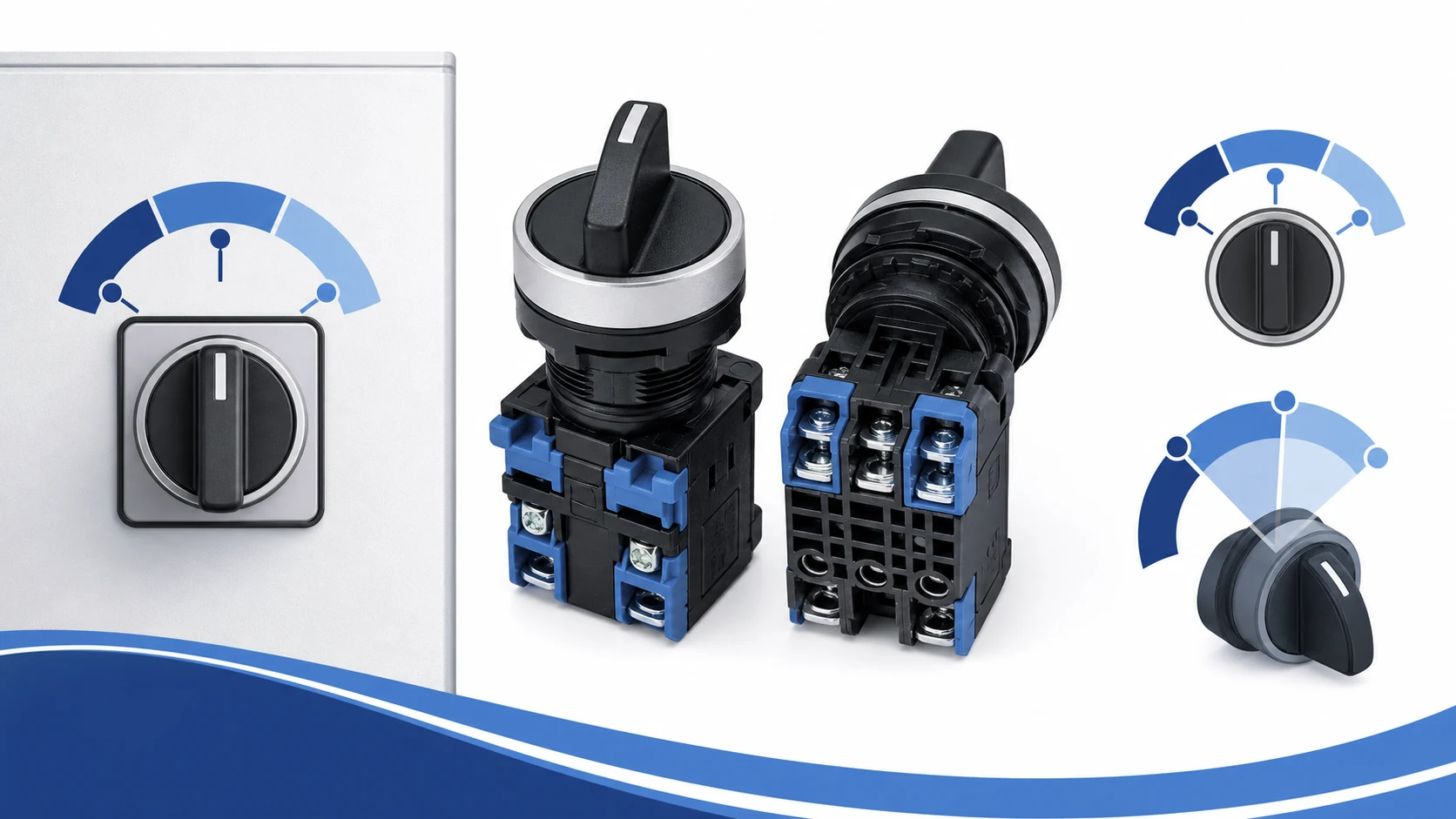
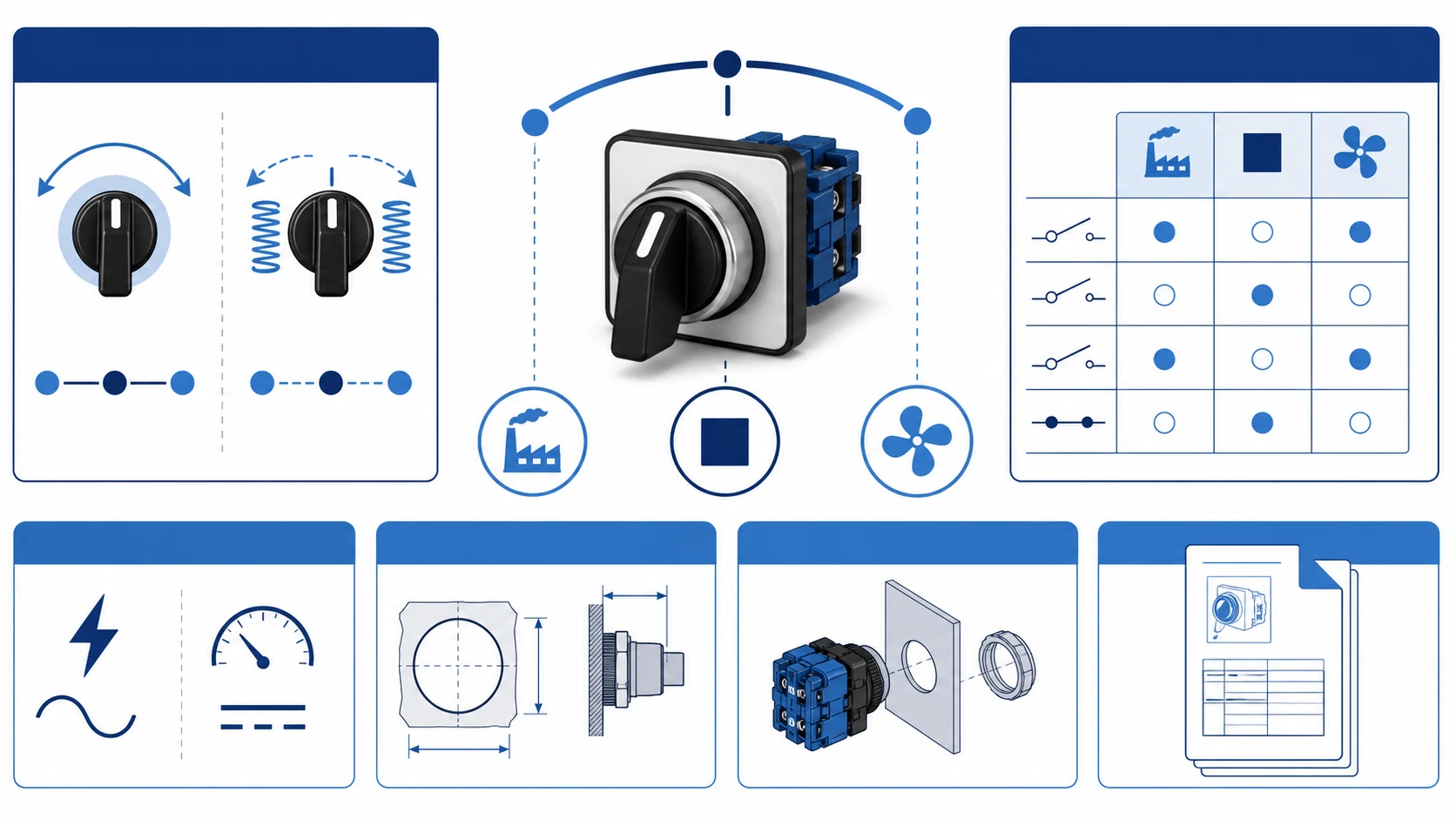
A three-position selector switch normally looks like a panel-mounted rotary operator with three marked handle locations: left, centre, and right. What matters is not only the front handle. A correct identification checks the legend plate, the maintained or spring-return action, the contact blocks behind the panel, the mounting cutout, and the drawing for the exact model. Two units can look alike from the front yet operate differently in the circuit.
Recognise the three visible operating positions
From an operator’s viewpoint, the clearest clue is a handle or knob that can be placed in three defined locations. The legends may read HAND-OFF-AUTO, LOCAL-OFF-REMOTE, FORWARD-OFF-REVERSE, TEST-NORMAL-RESET, or another project-specific sequence. The centre location is often marked OFF or 0, but that is not guaranteed. The legend must be checked against the panel drawing and the switch data, especially on replacement work.
Look for clear detents at each location. A maintained three-position selector stays where the operator leaves it. A spring-return version may return from one or both end positions after release. That difference is visible only when the operator is moved and must be confirmed by the product code or drawing. Do not classify a selector from a product photograph alone: bezel shape, handle colour, and mounting ring do not define the contact sequence.
The front operator communicates the position sequence, but the drawing confirms the actual function.
Read the bezel, legend plate, and handle orientation
The bezel or legend plate tells an operator what each stop is intended to mean. On a well-documented panel, the marks follow the same left-to-right or clockwise order as the electrical drawing. Before commissioning, compare three things: the label on the door, the physical handle position, and the circuit state shown in the approved schematic. A mismatch can create an operational hazard even if the selector itself is mechanically sound.
Common operator formats include a short rotary handle, a key-operated selector, a lever-style handle, and illuminated or modular 22 mm arrangements. Key-operated versions can limit who changes a mode, but the key feature does not change the need to verify the position sequence. A metal selector and a plastic modular selector can also use different mounting hardware and environmental sealing arrangements. Select the front format after the operating function is settled.
For a panel door, check that the operator remains readable at the normal viewing angle and that the legend is not hidden by the handle. In outdoor, washdown, or dusty environments, the door, gasket, and enclosure design contribute to the installed protection level. Do not describe a complete assembly as having a particular IP rating unless the exact operator, enclosure, and mounting arrangement are documented for that condition.
Look behind the panel: the contact blocks reveal the electrical identity
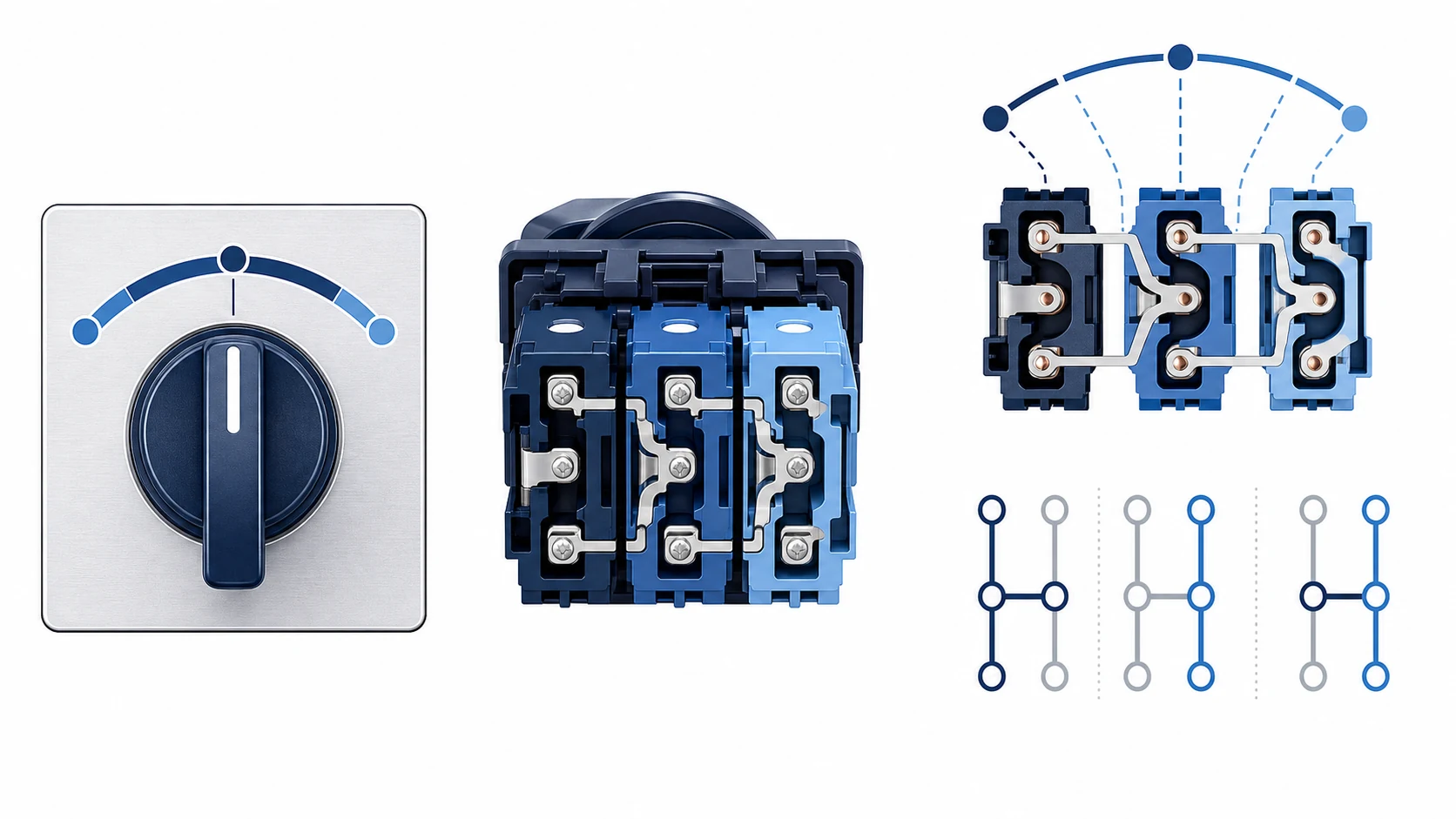
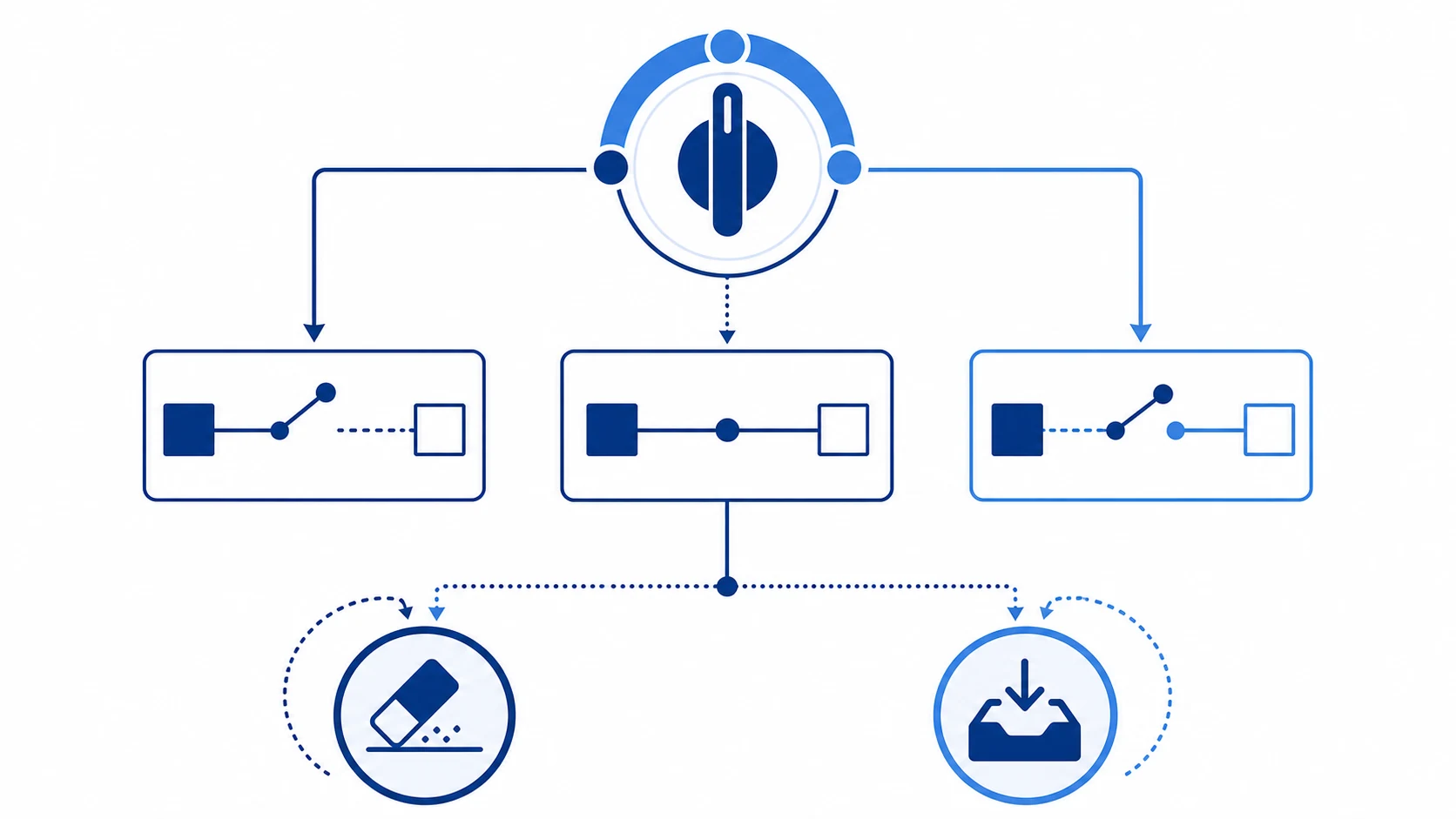
A three-position selector consists of more than the front operator. Behind the panel there may be one or more contact blocks, a lamp module, a fixing collar, and wiring terminals. The contact blocks determine which circuits close or open at the left, centre, and right positions. A drawing may show a different state for every position. That is why an apparent replacement with the same front appearance can alter the machine behaviour.
During inspection, identify the model and contact-block markings, then compare them with the switching table. Trace the terminal numbers to the schematic rather than relying on wire colour. For a control circuit, the required paths may include a PLC input, a relay coil permissive, an indicator lamp, and an interlock. The number of positions does not automatically tell you how many contacts are installed.
Inspect the contact-block markings and switching table as well as the front operator.
A useful first reference is the Shieldhz explanation of NO and NC contacts. It does not replace the model-specific table. A contact that is normally open in one position can be closed in another, and a spring-return operator may only produce a command while it is held. The product datasheet and circuit drawing are the final references.
Common three-position appearances in control panels
HAND-OFF-AUTO
This arrangement is common where an operator needs to choose a manual command, a deliberately inactive state, or an automatic sequence. The centre OFF position should be identifiable without ambiguity. The design team must still define how overload protection, safety devices, PLC logic, and contactors behave in each state.
FORWARD-OFF-REVERSE
A directional legend usually shows an end position at either side with a neutral centre. The selector is an operator input, not the whole reversing circuit. Appropriate electrical and mechanical interlocking is still required in the motor-control design. The drawing must show the intended contact states and prevent conflicting directional commands.
LOCAL-OFF-REMOTE
This layout separates the source of command. It is useful only when the system documentation clearly states which controls are active in each position. A panel builder should verify that the legend language matches the site convention and that a remote command cannot start equipment when the intended local isolation state is selected.
Inspect the visible positions, legend order, action, and contact blocks before accepting a replacement.
Use a short field inspection before replacement or commissioning
Photograph the front legend and note the handle position order.
Record the model marking, contact blocks, terminal references, and mounting cutout.
Compare all three handle positions with the approved schematic and switching table.
Check whether the handle is maintained or spring return from either end position.
Verify the enclosure condition, operator clearance, and any required lock/key arrangement.
Document the confirmed configuration in the panel record before ordering a replacement.
This inspection prevents a frequent error: ordering a physically similar two-position or three-position operator with the wrong centre state. It also helps when an old panel has incomplete drawings. In that case, record the observed function first and seek qualified engineering review before modifying a control or safety-related circuit.
How Shieldhz helps identify the correct operator configuration
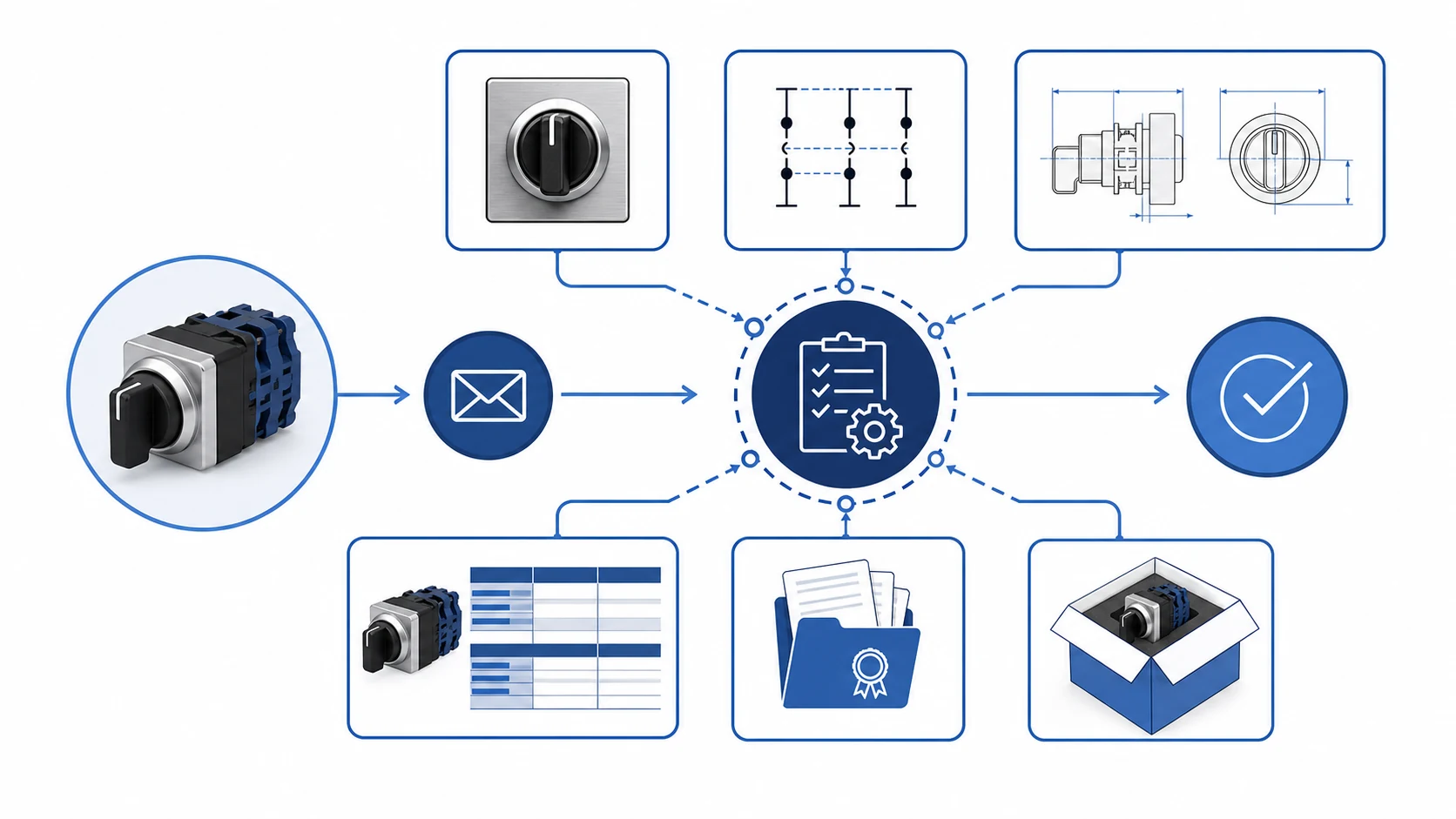
For a three-position selector enquiry, provide a front photo, the required legend, the number of positions, whether the handle must return, the panel cutout, control voltage, contact requirement, and the available schematic. Shieldhz can use those inputs to route the request to the appropriate selector-switch format and confirm the model drawing, contact combination, mounting dimensions, and available documents. This is particularly useful when the requirement is a replacement rather than a new panel build.
A photo plus the legend, action, contacts, and cutout gives a clearer starting point for model confirmation.
Do not confuse a selector switch with every rotary panel device
Some panel-mounted rotary devices are cam switches, instrument selectors, isolator handles, potentiometers, or key switches rather than a three-position control selector. The legend, terminal layout, and circuit role separate them. A voltmeter selector may step through phase combinations. A load isolator may provide a clearly marked OFF function for maintenance. A mode selector may send only low-energy control signals. Treating all of these as interchangeable because they have a rotary handle can lead to an incorrect replacement.
When the application is uncertain, begin with the panel drawing and identify what the terminals connect to. A device used for a control relay or PLC input needs a different review from one used in a power path. If the panel includes a поворотный кулачковый переключатель or a load-isolation function, keep that device’s current, duty, and enclosure requirements separate from the selector-operator identification task. Clear identification makes both troubleshooting and procurement faster.
Frequently asked questions
Does every three-position selector have centre OFF?
No. Centre behaviour is defined by the selected operator and contact programme. Read the legend, switching table, and drawing for the exact model.
How can I tell whether a selector is maintained or spring return?
Operate it only where safe, then confirm the observed action against the model description and drawing. The return action can differ at the two end positions.
Can I replace a three-position selector from a photograph?
A photograph is helpful but insufficient. Include the legend, contact blocks, terminal references, cutout, required circuit behaviour, and the existing drawing if available.
Why do two three-position selectors look the same but work differently?
The front operator can be combined with different contact blocks and programmes. The electrical state at each position is therefore model-specific.
What markings should be checked during commissioning?
Check the legend order, handle detents, terminal references, contact states, panel drawing, and any required identification labels.
Which standard documents are relevant?
Use the applicable project and product documents. IEC control-device requirements, including IEC 60947-5-1, are a useful reference point, but the exact product documentation controls the supplied configuration.
Identify the selector before ordering a replacement
Send the visible legend, position sequence, front and rear photos, cutout, contact requirements, and schematic to Shieldhz. That information supports a model, drawing, and documentation check before a replacement is selected.
Ши, Мукси
Ши, Мукси пишет технические статьи Shieldhz для покупателей промышленных систем управления и электрических компонентов, охватывая поворотные кулачковые переключатели, разъединители, PV DC разъединители, кнопки, индикаторные лампы, водонепроницаемые корпуса и клеммные блоки. Статьи основаны на опыте производства и экспорта компании Zhejiang Shihe Electric Co., Ltd., с практическим акцентом на выборе модели, технических характеристиках, чертежах, сертификации, рейтингах IP и деталях запроса, которые покупатели должны подтвердить перед заказом.