PV DC Isolator for Battery Energy Storage: When PV Ratings Cannot Be Assumed
Use a practical buyer checklist to evaluate dc isolator for battery energy storage inputs, documentation, approval controls and the exact PV DC isolator switch route.
A PV-rated DC isolator cannot automatically be treated as a dc isolator for battery energy storage. Battery systems can present different current direction, duty, enclosure, wiring and documentation requirements, so the buying decision should be confirmed against the exact model datasheet, drawing and certificate package.
Confirm the maximum DC voltage, current, pole arrangement and intended switching duty before selecting a route.
Ask for current model documentation instead of relying on a general PV family description.
Treat PV-to-BESS use as an engineering confirmation, not a catalogue assumption.
Why PV ratings cannot automatically be used for battery energy storage
A PV DC rating is a starting point, not a BESS approval. The same switch family may be relevant to both discussions, but final suitability depends on the exact model, wiring arrangement, ratings and buyer application.
PV strings and battery energy storage systems both operate on DC, but their source behavior is not identical. A product route that is suitable for a PV string application under one set of documented conditions may still need separate confirmation for a battery cabinet, PCS interface, combiner, service disconnect location or OEM enclosure.
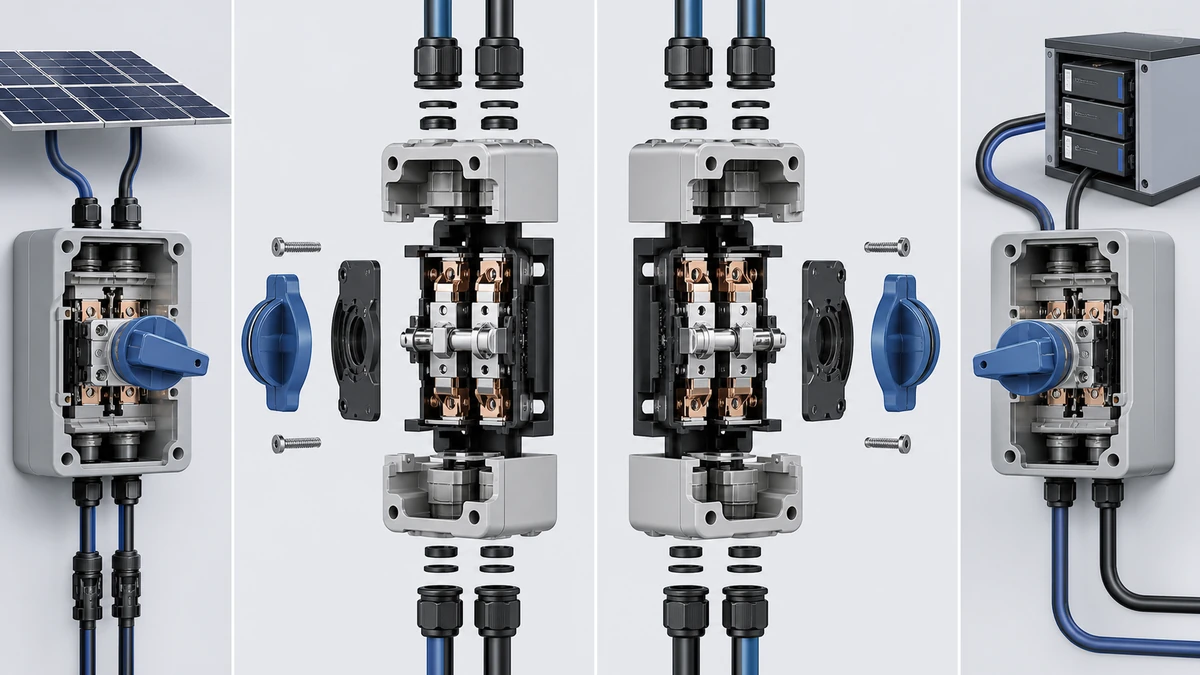
An exact drawing identifies the interfaces that must be controlled for the approved model route.
PV string duty is not the same as battery duty
PV string current is linked to irradiance and array configuration. Battery current can be charge or discharge current, may be bidirectional in the system, and may be defined by inverter, PCS, battery rack or DC bus design.
This does not mean a PV DC isolator switch is excluded from BESS use. It means the buyer should avoid assuming the PV label covers every BESS duty point without model-level confirmation.
The buyer decision is documentation-led
For commercial investigation, start with the نطاق مفاتيح العازل الكهروضوئي للتيار المستمر and then narrow the discussion by electrical data, mechanical format and documentation needs. The purchase decision should move from “PV-rated family” to “confirmed model route for this BESS application.”
Buyer action checklist:
Identify whether the device is used for PV input, battery rack, DC bus, service isolation or OEM panel integration.
Define the maximum operating DC voltage and current at the installation point.
Confirm whether switching under load is required and under what documented condition.
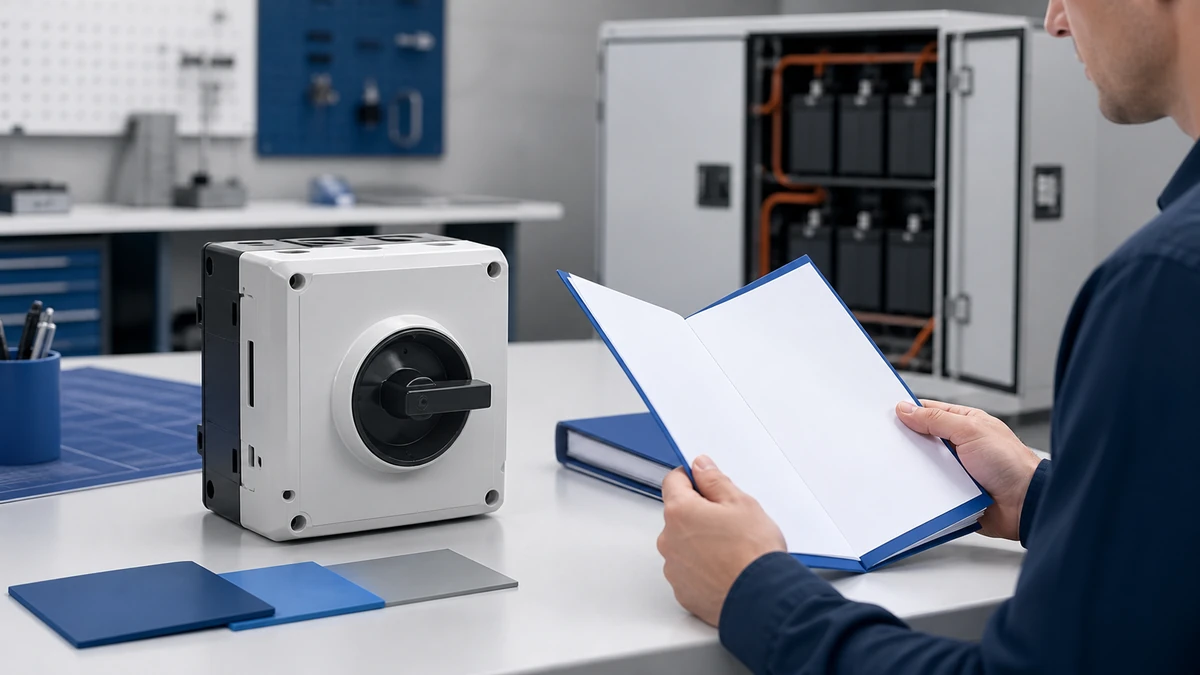
Request the exact datasheet, drawing and certificate package before release to purchasing.
Where a dc isolator for battery energy storage sits in the buying decision
A dc isolator for battery energy storage should be selected as a switching and isolation component within a defined DC circuit position. It should not be selected by name alone, and it should not be treated as a substitute for separate protective-device design.
The commercial question is usually not “Is this a PV switch?” but “Can this exact PV DC isolator switch route be documented for this BESS location?” That question needs engineering, procurement and destination-market inputs.
Typical BESS locations to define before quotation
The location affects the rating discussion. A battery rack interface, a DC combiner, an inverter input and an external enclosure can require different wiring arrangements, operator access and documentation review.
BESS location under discussion
Buyer question to answer
Why it matters for the isolator route
Battery rack or cabinet interface
What is the maximum DC voltage and current at this point?
Establishes the minimum electrical data needed for model screening.
DC combiner or distribution enclosure
How many poles and strings are routed through the device?
Impacts wiring arrangement, pole use and drawing confirmation.
PCS or inverter-side DC input
Is current direction or operational sequence defined by the system design?
Helps confirm whether the documented duty matches the intended use.
Outdoor or exposed enclosure
What enclosure, ingress, UV, temperature or cable-entry requirements apply?
Mechanical and environmental details are model- and enclosure-dependent.
OEM control or service panel
What marking, operator and mounting style are required?
Affects bill of material, drawing and approval review.
Engineering and procurement should align early
Engineering normally defines the electrical and mechanical conditions. Procurement should translate those conditions into an RFQ that asks for exact model confirmation rather than only a price for a generic PV isolator.
A useful RFQ states the application, the intended circuit position, the destination market and the documentation required for internal approval. This reduces the risk of comparing offers that are not based on the same duty.
Which electrical ratings need confirmation before a model route is selected
The route should not be selected until maximum DC voltage, maximum current, pole arrangement and documented switching duty are confirmed. These items determine whether a PV DC isolator route can be reviewed for the BESS application.
A datasheet can contain several values depending on pole configuration, wiring method and product variant. Buyers should avoid pulling one headline rating into a specification without confirming the conditions attached to that value.
Voltage, current and pole arrangement
Battery energy storage circuits may have different system voltages and current profiles from PV string circuits. The buyer should provide maximum DC voltage, normal current, expected operating sequence and whether poles are used in series, parallel or a specified configuration.
Decision table for electrical screening:
Item to confirm
What to send to Shieldhz or your distributor
What not to assume
الجهد الكهربائي المستمر الأقصى
Highest system or circuit voltage at the isolator position
That a PV voltage value applies to every pole arrangement
Maximum current
Continuous operating current and switching current condition
That PV string current equals BESS charge/discharge current
Pole use
Single-pole, multi-pole, series or other required arrangement
That all wiring diagrams support the same rating
Switching condition
Whether load switching is required and under what procedure
That isolation-only placement equals load-breaking duty
Ambient and enclosure
Temperature range, ventilation, enclosure and installation constraints
That an open-air datasheet value applies inside every cabinet
IEC scope is a useful boundary, not a complete selection
إن IEC 60947-3 scope is relevant because IEC describes this scope as switches, disconnectors, switch-disconnectors and fuse-combination units within stated distribution- and motor-circuit AC/DC limits. That scope statement helps define the type of low-voltage switching equipment being discussed.
However, a standard scope reference does not confirm a specific model for a specific BESS duty. Buyers still need the current product documentation, rating table, wiring diagram and any destination-market approval or marking evidence requested for the project.
Electrical confirmation checklist:
Maximum DC voltage at the isolator terminals in the buyer’s circuit.
Maximum normal current and intended switching current condition.
Number of poles and required wiring arrangement.
Required utilization category or documented switching duty, if specified by the project.
Destination-market approval, marking or certificate request.
Any internal customer specification that must be matched to the model documentation.
How battery behavior changes the isolator selection questions
Battery behavior changes the selection questions because current can be defined by charge, discharge, PCS operation and battery system architecture. The isolator route must be checked against the real duty at the intended point, not only against a PV application label.
A PV source is usually discussed as array strings or combiner inputs. A BESS circuit may be discussed as battery racks, strings, DC bus sections, PCS input or auxiliary isolation points. Each position can change the model review.
Sample review should connect the exact item to its current drawing and requested evidence package.
Bidirectional current needs explicit review
Many BESS systems are designed for energy flow in both directions. If the isolator position can see charge and discharge current, the buyer should state this clearly in the RFQ and include the relevant operating current values.
The question is not only whether the device can be wired into the circuit. The question is whether the exact model documentation supports the proposed duty, pole arrangement and current direction assumptions for that installation.
System-level coordination remains separate
A DC isolator switch route should be reviewed for switching and isolation duties according to its documentation. Short-circuit studies, protective-device coordination and battery system fault analysis remain separate parts of the system design.
This distinction matters in purchasing language. Specifications should not describe the isolator as performing functions that belong to other devices or to the complete system safety design.
Choosing between Shieldhz PV DC isolator routes for investigation
A Shieldhz PV route can be investigated for BESS use only after the buyer defines the electrical duty and installation conditions. The route selection should be treated as a model-screening step, not a final approval by product-family name.
Shieldhz product pages help buyers begin the conversation. The final decision still depends on the active datasheet, drawing, wiring diagram, certificate package and destination-market requirements for the selected model.
GF40 route: compact PV DC isolator discussion
إن GF40 PV DC isolator switch route may be a starting point when the buyer needs to investigate a PV DC isolator switch format against a defined BESS duty. The review should focus on the model variant, pole arrangement, mounting and documentation package.
Do not specify GF40 only because it appears in a PV category. Specify the duty and ask for confirmation against current documentation.
GF51 route: alternative model-route review
إن GF51 PV DC isolator switch route can be reviewed when the buyer’s electrical and mechanical requirements point toward that product route. Suitability depends on the exact model, wiring method and project requirements.
Procurement teams should compare GF51 against other routes using the same input data. A fair comparison needs the same voltage, current, pole and enclosure assumptions.
GF41 route: solar DC switch route for defined requirements
إن GF41 solar DC switch route can also be part of the model-route discussion where the buyer’s application data supports review. The term “solar” should not be used as proof of BESS suitability.
Route comparison table:
Buyer condition
Practical route action
Documentation to request
Known voltage and current, but not final enclosure
Ask for preliminary model screening
Datasheet and outline drawing
Fixed panel cutout or mounting concept
Ask for route matching to the mechanical requirement
Drawing, handle/operator details and mounting information
Destination market has marking requirements
State the market and required marking in the RFQ
Current certificate or approval evidence, if available for the model
BESS duty differs from standard PV string use
Ask for application confirmation before quotation lock
Rating table, wiring diagram and written model confirmation
Procurement needs comparable pricing
Send the same technical inputs for each route
Quotation tied to exact model and documentation revision
How Shieldhz confirms a PV DC isolator switch route
Shieldhz confirms a PV DC isolator switch route by matching buyer inputs to current product documentation before quotation or model release. Final suitability is confirmed against current product documentation and the buyer’s application.
This confirmation is practical and document-based. It avoids treating PV ratings as universal and gives OEMs, panel builders and distributors a clearer route from inquiry to purchasable part number.
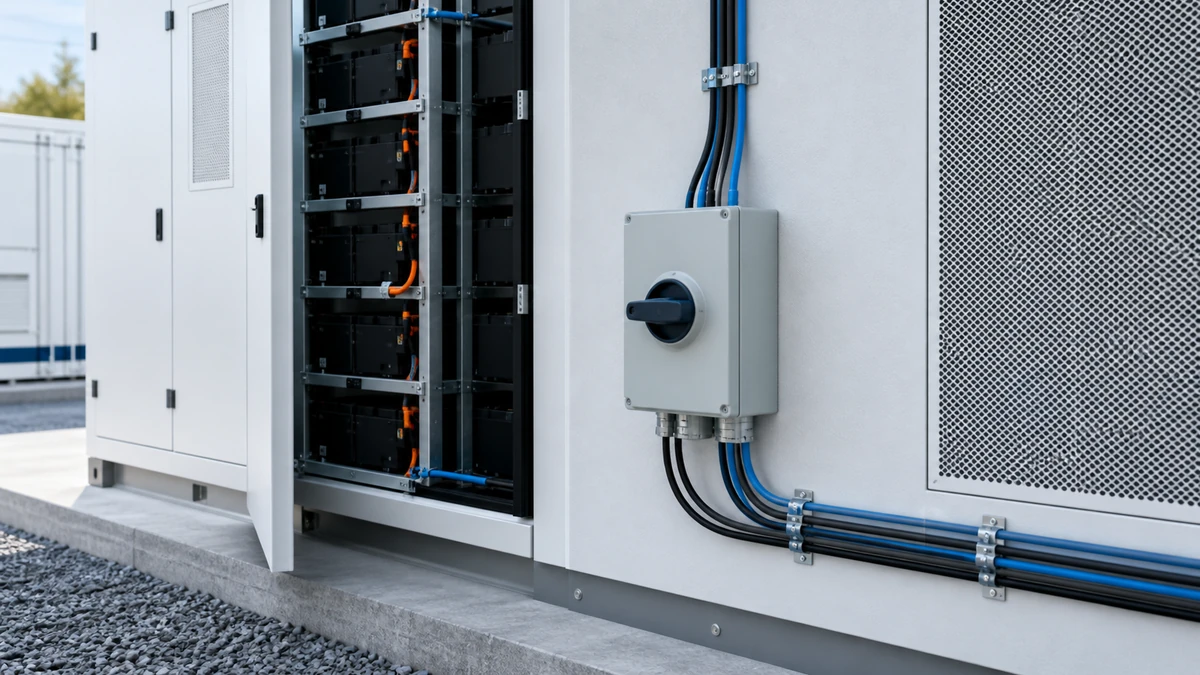
Installation conditions change the product-route and document questions a buyer must resolve.
Pre-quotation inputs Shieldhz needs
Send the application and destination market first. Then provide the maximum DC voltage and current, the string or pole arrangement, enclosure and environment, mounting and cable entry requirements, requested drawing, datasheet and certificate package, and any approval or marking requirement.
Pre-quotation checklist:
Application: PV input, battery rack, DC bus, PCS interface, enclosure or other defined location.
Destination market: country or region where the equipment will be installed or sold.
Electrical data: maximum DC voltage, maximum current and switching condition.
Arrangement: number of poles, string routing and wiring diagram assumptions.
Mechanical data: enclosure type, mounting style, operator position and cable entry.
Documentation request: datasheet, drawing, certificate package and any buyer approval form.
Marking or approval request: state the required marking rather than assuming availability.
Confirmation output for the buyer
The output should identify the proposed route, the exact model or model options, and the documentation basis for review. If the buyer’s requirement cannot be confirmed from current documentation, the route should remain open rather than be treated as approved.
For teams building a document pack, the PV DC isolator documentation checklist gives a focused way to request and review datasheets, drawings and supporting files without turning the RFQ into a generic catalogue exchange.
Enclosure, mounting and operator details that affect quotation accuracy
Enclosure, mounting and operator details can change the quotation and the model route. These items should be stated early because the same electrical discussion may lead to different mechanical configurations.
BESS equipment builders often work inside constrained cabinets or outdoor enclosures. The isolator’s physical form, handle access, cable entry and environmental exposure should be matched to the buyer’s design drawings.
Enclosure and environment
State whether the device is intended for an internal panel, external enclosure, battery cabinet, combiner box or other assembly. Environmental requirements such as temperature range, moisture exposure, UV exposure, dust exposure or indoor/outdoor placement should be treated as model- and enclosure-dependent.
Do not assume an ingress or environmental rating from a product family name. Ask for the current datasheet or drawing that applies to the exact enclosure or switch configuration being quoted.
Mounting and cable entry
Mounting style, shaft length, handle position, panel thickness and cable entry direction can affect part selection. These details also affect drawing approval and assembly planning for OEMs and panel builders.
Mechanical action list:
Send the panel or enclosure drawing if available.
Identify front-panel, base-mounted or enclosed arrangement requirements.
State cable entry direction and space constraints.
Confirm handle access, labeling and operator orientation.
Request an outline drawing before freezing the cabinet design.
Operator color and emergency-stop wording
Some buyers request specific operator colors or emergency-stop style visual elements. Selecting an operator or color arrangement does not validate a complete machine safety function.
If a project has emergency-stop or functional safety requirements, those requirements must be assessed at the complete machine or system level by the responsible designer. The isolator quotation should remain tied to the documented switch and operator configuration, not to an implied safety function.
What procurement should ask before issuing a purchase specification
Procurement should ask for a model-specific quotation tied to documented electrical, mechanical and destination-market requirements. A purchase specification that only says “PV DC isolator for BESS” leaves too much room for mismatch.
The strongest commercial RFQs are short but complete. They define the duty, identify the documentation needed and make clear which requirements are mandatory before order release.
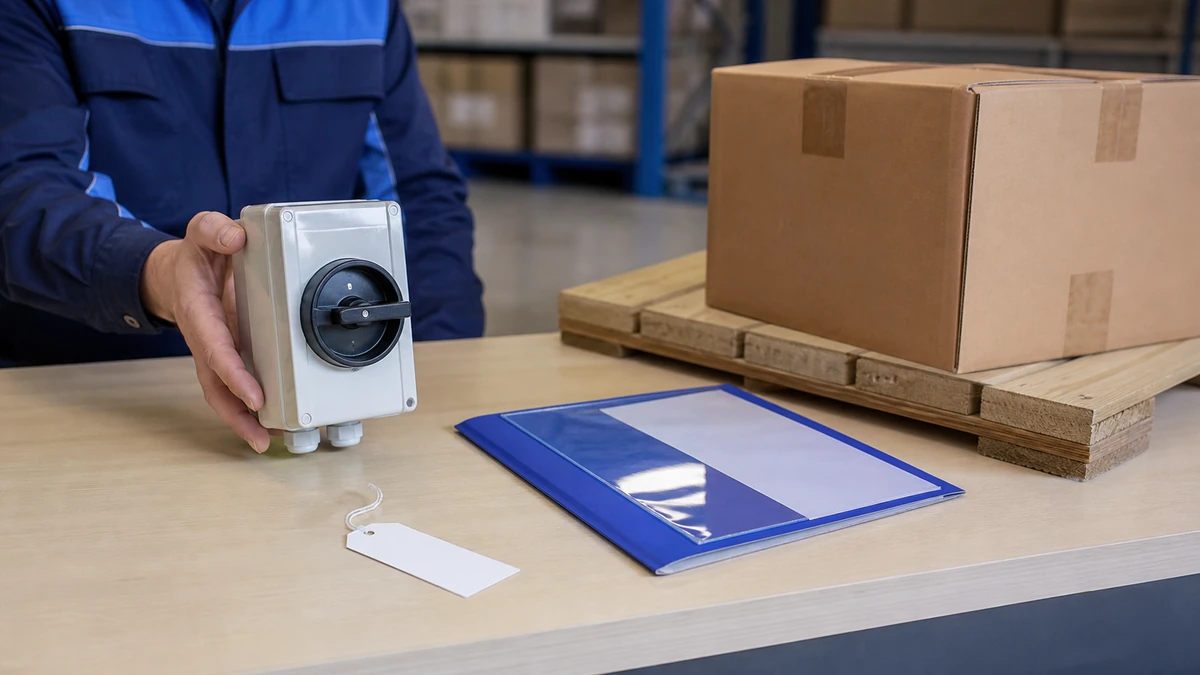
Documentation control, sample acceptance and protective packing are separate handover checks.
RFQ items to include
Use the RFQ to prevent assumptions. If a rating, marking, drawing or approval is required, state it as a requirement and request evidence for the exact model.
Procurement checklist:
Exact application location in the BESS equipment.
Maximum DC voltage and current.
Pole arrangement and wiring concept.
Load switching or isolation-only operating requirement, if defined by the project.
Enclosure, mounting, operator and cable-entry requirements.
Destination market and required marking or approval evidence.
Required datasheet, drawing and certificate package.
Target approval process, such as engineering review before PO release.
How to compare supplier responses
Compare supplier responses by documentation basis, not only by product title. A lower-cost offer is not equivalent if it is based on a different pole arrangement, undocumented duty or missing approval evidence required by the buyer’s market.
Decision table for quotation review:
Quotation item
Acceptable buyer review question
Red flag to resolve before PO
Model number
Is the exact model identified?
Only a family name is quoted.
Rating basis
Are voltage, current and pole arrangement documented?
A headline PV rating is copied without conditions.
Mechanical fit
Is the mounting or enclosure drawing supplied?
Cabinet design must proceed without dimensional confirmation.
التوثيق
Are datasheet, drawing and requested certificates included or listed?
Documentation is promised but not tied to the model.
Market requirement
Is the destination-market request acknowledged?
Marking or approval need is assumed but not evidenced.
Application statement
Is BESS duty reviewed against buyer inputs?
PV use is treated as automatic approval for BESS.
Conclusion
A PV DC isolator switch can be a relevant route for battery energy storage equipment, but PV ratings cannot be assumed to cover BESS duty. The commercial decision should move from product-family interest to exact-model confirmation.
For OEMs, panel builders, engineering distributors and procurement teams, the key step is simple: define the BESS circuit position, voltage, current, pole arrangement, enclosure and destination-market documentation requirements. Then confirm the selected Shieldhz route against current datasheets, drawings and certificate packages before issuing the purchase specification.
الأسئلة الشائعة
Can a PV DC isolator be used in battery energy storage equipment?
It may be considered, but it should not be assumed. The exact model must be checked against the BESS application, including voltage, current, pole arrangement, switching duty, enclosure and documentation requirements.
What is the most common mistake when specifying a dc isolator for battery energy storage?
The common mistake is copying a PV rating into a BESS specification without checking the rating conditions. Buyers should confirm the exact model documentation and wiring arrangement before purchase.
Do I need a different isolator for every BESS location?
Not necessarily. Different locations can create different requirements, so each location should be reviewed against the model datasheet and drawing before one part number is standardized.
What should I send to Shieldhz for a faster quotation?
Send the application, destination market, maximum DC voltage and current, pole arrangement, enclosure or mounting details, cable entry requirements and requested documentation package. Include any required marking or approval request.
Does selecting an emergency-stop style operator validate the system safety function?
No. Selecting an operator style or color does not validate a complete machine safety function. Any emergency-stop or safety-related function must be assessed at the complete machine or system level by the responsible designer.
Is a catalogue page enough for procurement approval?
Usually it is not enough for a controlled OEM or panel-building purchase. Procurement should request the current datasheet, drawing, wiring information and any required certificate or approval evidence for the exact model being ordered.
شي، موكسي
يكتب شي، موكسي مقالات شيلدهز الفنية لمشتري التحكم الصناعي والمكونات الكهربائية، والتي تغطي مفاتيح الكامات الدوارة، ومفاتيح العازل، ومفاتيح فصل التيار المستمر الكهروضوئية، وأزرار الضغط، وأضواء المؤشر، والحاويات المقاومة للماء، والكتل الطرفية. تستند المقالات على خبرة شركة Zhejiang Shihe Electric Co., Ltd. في التصنيع والتصدير، مع التركيز العملي على اختيار الطراز وأوراق البيانات والرسومات والشهادات وتصنيفات IP وتفاصيل الاستفسار التي يجب على المشترين التأكد منها قبل الطلب.