A voltmeter selector switch for a three-phase panel should be purchased from a recorded switching function, position legend and drawing-controlled contact program, not from a copied generic wiring diagram.
Confirm whether the meter reads line-to-line, line-to-neutral or another declared measurement set before selecting the position sequence.
Record the contact program, handle legend, mounting style and documentation revision before releasing panel wiring.
Request the exact-model drawing, datasheet and certificate package needed for the buyer’s destination market and application review.
Specify the meter selector by measurement duty, not by a generic drawing
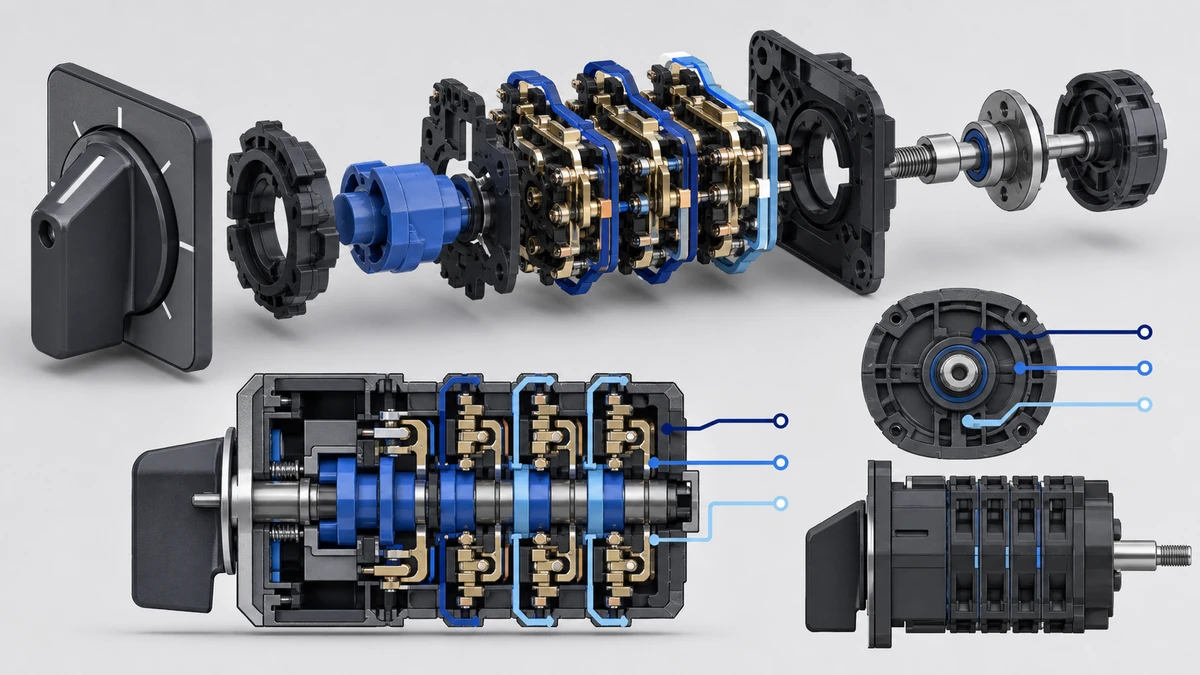
Specify the voltmeter selector switch as a measuring-selector function with a documented contact program. The commercial decision is not “which generic diagram looks familiar”; it is whether the selected rotary cam switch route matches the meter, panel legend, supply system and inspection records.
An exact drawing identifies the interfaces that must be controlled for the approved model route.
What the selector must do
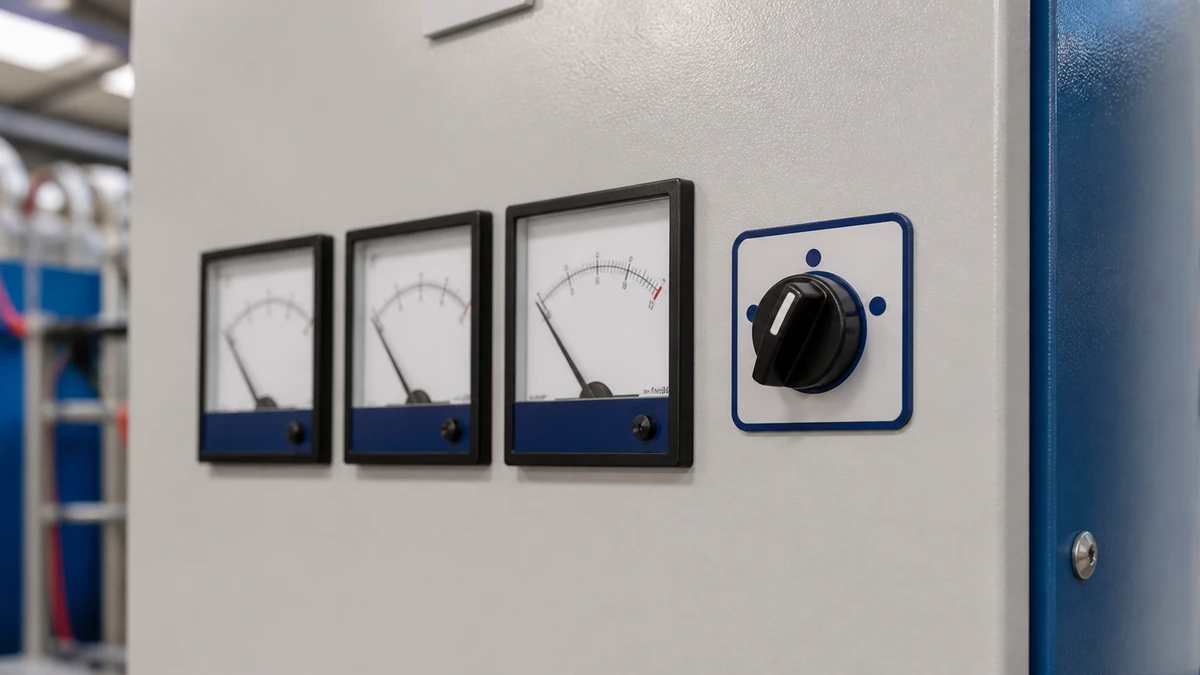
A voltmeter selector routes the measuring instrument to selected voltage points according to the handle position. In a three-phase panel, that usually means choosing between phase-to-phase readings, phase-to-neutral readings or a declared set of auxiliary measurement positions.
إن مجموعة مفاتيح الكامات الدوارة can be reviewed as a product-family starting point, but the purchase record should still identify the exact function required. A sourcing note such as “voltmeter switch, 3 phase” is not enough for production release.
What the selector must not be asked to prove
The selector is not a substitute for devices specified for isolation or protective duties. Do not use its presence as evidence that the panel has overcurrent protection, measurement accuracy or safe isolation unless those separate functions are specified and verified through the relevant devices and documents.
For procurement, keep the meter-selector record narrow: positions, contacts, rating data for the selected model, mounting route, legend and documentation. That prevents a small selector from becoming an undocumented assumption in the panel file.
Choose positions that match the panel legend and operator workflow
Choose positions by the readings the user must see, then make the handle legend match those readings exactly. A mismatch between electrical records and front-panel marking is a common source of inspection delay and field confusion.
Common three-phase voltmeter legends
A three-phase voltmeter selector may be specified for phase-to-phase readings such as L1-L2, L2-L3 and L3-L1. Another panel may require phase-to-neutral readings such as L1-N, L2-N and L3-N, if the system and meter arrangement support that measurement.
The naming convention should follow the buyer’s panel standard. L1/L2/L3, R/S/T, U/V/W or local utility notation should not be mixed on the same record unless the drawing clearly maps the equivalents.
Buyer decision
Typical position record
Record check
Phase-to-phase measurement
OFF, L1-L2, L2-L3, L3-L1
Confirm the voltmeter scale and measurement points match the legend.
Phase-to-neutral measurement
OFF, L1-N, L2-N, L3-N
Confirm neutral availability and measurement intent in the panel design.
No OFF position
L1-L2, L2-L3, L3-L1
Confirm whether continuous meter energization is acceptable for the buyer’s design.
Custom order
OFF plus buyer-defined readings
Require a custom contact schedule and marked position plate record.
OFF position and skipped readings
An OFF position is a design choice, not an assumption. Some buyers want the voltmeter de-energized between checks; others prefer every position to display a reading.
If a position is intentionally omitted, record that omission. Do not let the shop floor infer it from a drawing copied from another panel series.
Position-selection checklist
Confirm the required reading set: phase-to-phase, phase-to-neutral or custom.
Confirm whether OFF is required.
Confirm the exact legend text and order around the handle.
Confirm the panel’s phase notation standard.
Confirm whether the meter face, panel label and selector legend use the same notation.
Record the contact program before wiring is released
Record the contact program before wiring starts, because the position legend alone does not prove how the contacts change state. The buyer should be able to trace each selector position to its intended measuring connection without relying on a generic diagram.
Sample review should connect the exact item to its current drawing and requested evidence package.
Contact schedule records
A useful record shows the handle position and the corresponding closed contacts or switched paths. It should be tied to the exact selector model, drawing number and revision used for the quotation and build.
For voltmeter selection, the contact program should avoid unintended measurement paths according to the buyer’s design. If switching sequence, contact timing or separation behavior matters, require it on the drawing or datasheet for the selected model rather than assuming it from a product family name.
Record item
ما أهمية ذلك
Buyer verification
Position number and legend
Aligns front-panel operation with documentation
Compare label artwork with the switch drawing.
Contact schedule
Shows which paths are made in each position
Check against the meter input requirement.
Switch model and variant
Prevents substitution errors
Match quotation, drawing and purchasing record.
Drawing revision
Controls later production changes
Freeze the revision before wiring release.
Handle and mounting style
Controls mechanical fit and user interface
Check panel cutout and front legend arrangement.
Revision control checklist
Small selector changes can affect both wiring and the visible panel legend. Treat the selector record as part of the controlled panel documentation, not as a catalogue afterthought.
Before wiring release, check:
The quoted model matches the panel bill of materials.
The contact schedule matches the approved drawing.
The handle positions match the panel legend artwork.
The meter rating and measurement range are compatible with the intended measurement points.
The drawing revision is recorded in the panel documentation.
Any buyer-specific markings or destination-market document requests are listed on the purchase order.
Check voltage path records without republishing a wiring diagram
Check the voltage path record by comparing intended readings, selector positions and meter input references. The goal is to verify the selected route, not to reproduce a broad wiring diagram already covered in foundation material.
Line-to-line and line-to-neutral records
Line-to-line and line-to-neutral measurement records should not be treated as interchangeable. A selector ordered for one scheme may not match the other scheme without a different contact program and legend.
If the panel uses instrument transformers, auxiliary measurement devices or a non-standard metering scheme, identify that in the record. The switch specification should follow the actual measuring circuit instead of a default three-phase selector assumption.
Measurement scheme
What to record
Typical sourcing risk
Line-to-line
Each phase pair and position order
Legend says one pair while contacts select another.
Line-to-neutral
Each phase-to-neutral reading
Neutral reference is assumed but not documented.
Instrument-transformer metering
Secondary measurement references
Primary-side language is used on a secondary-side selector record.
Custom metering
Buyer-defined path names
Supplier cannot quote accurately from shorthand text.
Record check action list
Use a record check before production wiring and again before shipment documentation is closed. This is a document-control task as much as an electrical task.
Practical record checks
Read each selector position aloud from the front-panel legend.
Match that position to the contact schedule.
Match the contact schedule to the metering scheme on the approved panel drawing.
Confirm the meter input range and measurement reference stated in the panel design.
Mark any difference as a drawing issue, not a shop-floor interpretation.
Keep the approved selector drawing with the panel documentation package.
Confirm poles, stages and mounting route before the purchase order
Confirm poles, contact stages and mounting route before purchase, because these items can change both the electrical function and the mechanical fit. A voltmeter selector switch is often small in the panel, but its records affect wiring, labels and inspection.
Installation conditions change the product-route and document questions a buyer must resolve.
Pole and stage decisions
The number of poles and contact stages depends on the selected measuring function and contact program. Do not infer the construction from the number of positions alone.
إن positions, poles and contact stages guide is the better reference for these building blocks. For a quotation, still provide the actual meter-selector function and required position sequence.
Panel mounting and handle decisions
Panel mounting details should be confirmed before the model is frozen. Shaft length, front handle style, legend plate arrangement and panel cutout requirements are exact-model and drawing dependent.
If the buyer has an enclosure standard, door thickness range or handle color preference, include it in the request. If environmental sealing, ingress rating or special marking is required, ask for the current datasheet or certificate package for the selected model and destination market.
Purchase-order readiness checklist
Required selector function stated in words.
Position sequence and legend confirmed.
Contact schedule or drawing requested.
AC/DC duty and voltage/current data declared.
Utilization category requested where applicable to the selected route.
Panel mounting method and handle style confirmed.
Datasheet and certificate requirements listed.
Buyer application notes attached to the inquiry.
How Shieldhz confirms a rotary cam switch route
Shieldhz confirms a rotary cam switch route by matching the buyer’s requested function to a model route, drawing and documentation package before quotation is finalized. Final suitability is confirmed against current product documentation and the buyer’s application.
Pre-quotation inputs
For a voltmeter selector switch inquiry, Shieldhz should receive the switching function, AC/DC duty, voltage/current requirement and utilization category requested for the application. The inquiry should also state the pole and contact program, position sequence, panel mounting route, handle route and environmental requirements.
إن rotary cam switch selection guide is useful for structuring these inputs. The quotation should then identify the exact model route rather than relying on a generic selector description.
Documentation package to request
The buyer should request the drawing, datasheet and certificate package required for its engineering file. Which certificate or declaration is relevant depends on the exact model, current documentation, buyer application and destination-market requirements.
Pre-quotation confirmation list
Switching function: voltmeter selector, phase-to-phase, phase-to-neutral or custom.
AC/DC duty: state the circuit type and metering arrangement.
Voltage/current and utilization category: provide the required data for review.
Pole and contact program: provide the required contact schedule or ask Shieldhz to confirm a route.
Panel mounting and handle route: state cutout, shaft, handle and legend requirements.
Environment: state enclosure conditions and any requested sealing or material requirements.
Documentation: request drawing, datasheet and certificate package for the selected model.
Final review: confirm suitability against current product documentation and the buyer’s application.
Separate meter selection from isolation, protection and motor switching decisions
Separate the meter-selector decision from isolation, protection and motor-control decisions. A voltmeter selector switch can be part of a rotary cam switch family, but its specified role in this article is measurement selection.
Do not use the meter selector as protection
A meter selector should not be described or purchased as overcurrent protection. If the panel requires protective devices, isolation functions or disconnecting duties, specify those separately using the applicable product class, standards review and engineering documentation.
IEC describes IEC 60947-3 scope as switches, disconnectors, switch-disconnectors and fuse-combination units within stated distribution- and motor-circuit AC/DC limits. That scope reference should not be used to assume that a particular voltmeter selector model performs a duty not stated in its current documentation.
When other rotary functions are in scope
Rotary cam switches can be configured for many functions, but function names must not be blended. The rotary cam switch functions guide is the appropriate place to compare broad function types before narrowing the quotation.
If the same project also includes motor switching, reversing or control duties, treat those as separate engineering selections and records. Use the rotary cam switch motor-control guide for that decision path rather than extending a voltmeter-selector assumption into a motor circuit.
Build the procurement record so inspection can verify the same selector
Build the procurement record so inspection can verify that the selector installed in the panel is the selector approved in engineering. The record should connect the commercial order, technical drawing and visible operator legend.
Documentation control, sample acceptance and protective packing are separate handover checks.
Buyer-side record pack
A good procurement record is compact but specific. It gives sourcing teams enough detail to buy the correct part and gives panel builders enough detail to wire and label it consistently.
Procurement field
What to enter
Why it helps
Item description
Voltmeter selector switch for three-phase panel
Prevents confusion with other rotary functions.
Measurement scheme
Phase-to-phase, phase-to-neutral or custom
Controls contact program and legend.
Position legend
Exact text and order
Controls front-panel marking.
Model route
Exact quoted model or approved equivalent route
Controls purchasing and build records.
Drawing reference
Drawing number and revision
Controls wiring release.
Documentation request
Datasheet and certificate package required
Supports buyer review and destination-market file.
Incoming and panel-build checks
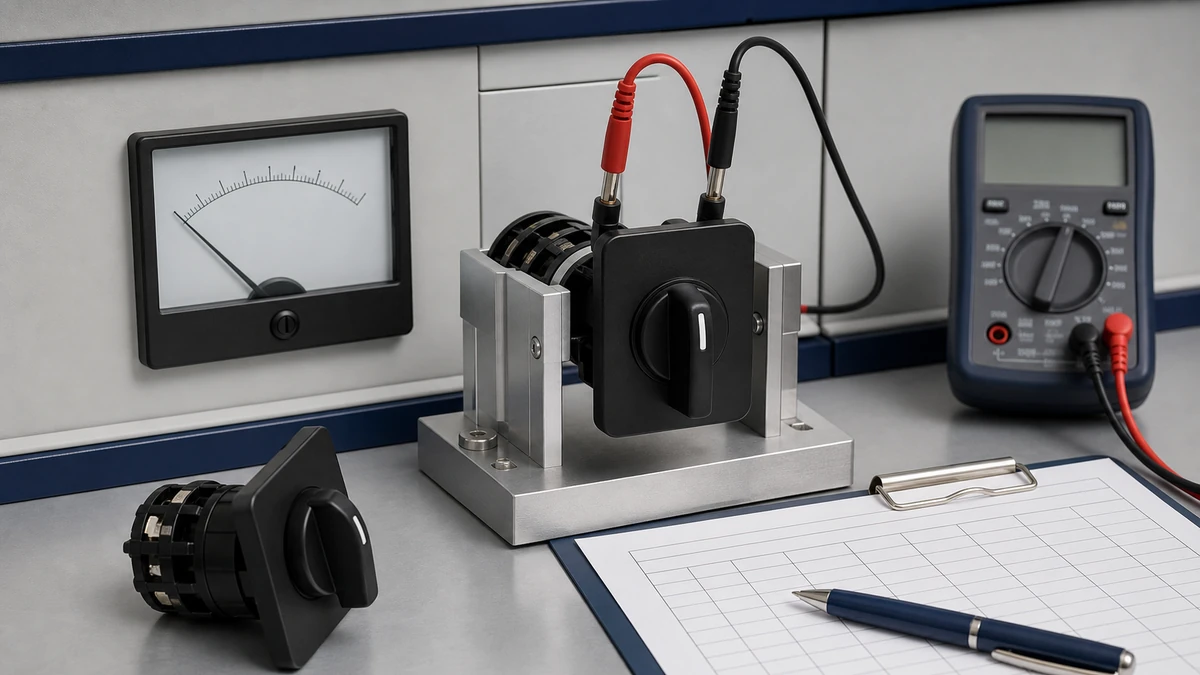
Incoming inspection should compare the received selector against the purchase record, not against memory of a previous build. Panel-build inspection should then compare the installed position legend, wiring record and drawing revision.
Inspection checklist
Confirm the part marking or model reference matches the purchase record.
Confirm the handle style and legend plate match the approved drawing.
Confirm the position count and sequence match the panel label.
Confirm the contact schedule document is available to the build team.
Confirm the installed wiring follows the approved selector drawing.
Confirm the final panel documentation includes the selector drawing revision.
Conclusion
A voltmeter selector switch for a three-phase panel is a documentation-sensitive component. The safest commercial route is to specify the measurement duty, position legend, contact program, mounting route and required documentation before the order is placed.
Do not let a generic diagram become the specification. Own the selector record, request the exact-model drawing and datasheet package, and confirm final suitability against the current documentation and the buyer’s application.
الأسئلة الشائعة
What is the main purchasing risk with a voltmeter selector switch?
The main risk is ordering from an incomplete description such as “three-phase voltmeter switch.” That phrase does not confirm the position sequence, contact program, measurement scheme, handle legend or drawing revision.
Should the selector be specified as line-to-line or line-to-neutral?
Yes, the measurement scheme should be stated clearly. Line-to-line and line-to-neutral selectors may require different contact programs and legends, so they should not be treated as the same item.
Is an OFF position always required?
No. An OFF position is a buyer design choice and should be stated in the specification. If OFF is required, it should appear in both the contact schedule and the panel legend.
Can I use a generic wiring diagram for the purchase order?
A generic diagram can help discussion, but it should not become the controlled purchase record. The order should refer to the approved contact schedule, model route, drawing number and revision for the selected switch.
What documents should sourcing request before confirming the order?
Request the exact-model drawing, datasheet and any certificate package required for the buyer’s application and destination market. The required documents depend on the selected model and the buyer’s compliance file.
Does selecting the voltmeter selector validate the whole panel design?
No. Selecting the meter selector only confirms that component route against its intended measuring function and documentation. The complete panel design must still be reviewed through the buyer’s engineering and compliance process.
شي، موكسي
يكتب شي، موكسي مقالات شيلدهز الفنية لمشتري التحكم الصناعي والمكونات الكهربائية، والتي تغطي مفاتيح الكامات الدوارة، ومفاتيح العازل، ومفاتيح فصل التيار المستمر الكهروضوئية، وأزرار الضغط، وأضواء المؤشر، والحاويات المقاومة للماء، والكتل الطرفية. تستند المقالات على خبرة شركة Zhejiang Shihe Electric Co., Ltd. في التصنيع والتصدير، مع التركيز العملي على اختيار الطراز وأوراق البيانات والرسومات والشهادات وتصنيفات IP وتفاصيل الاستفسار التي يجب على المشترين التأكد منها قبل الطلب.