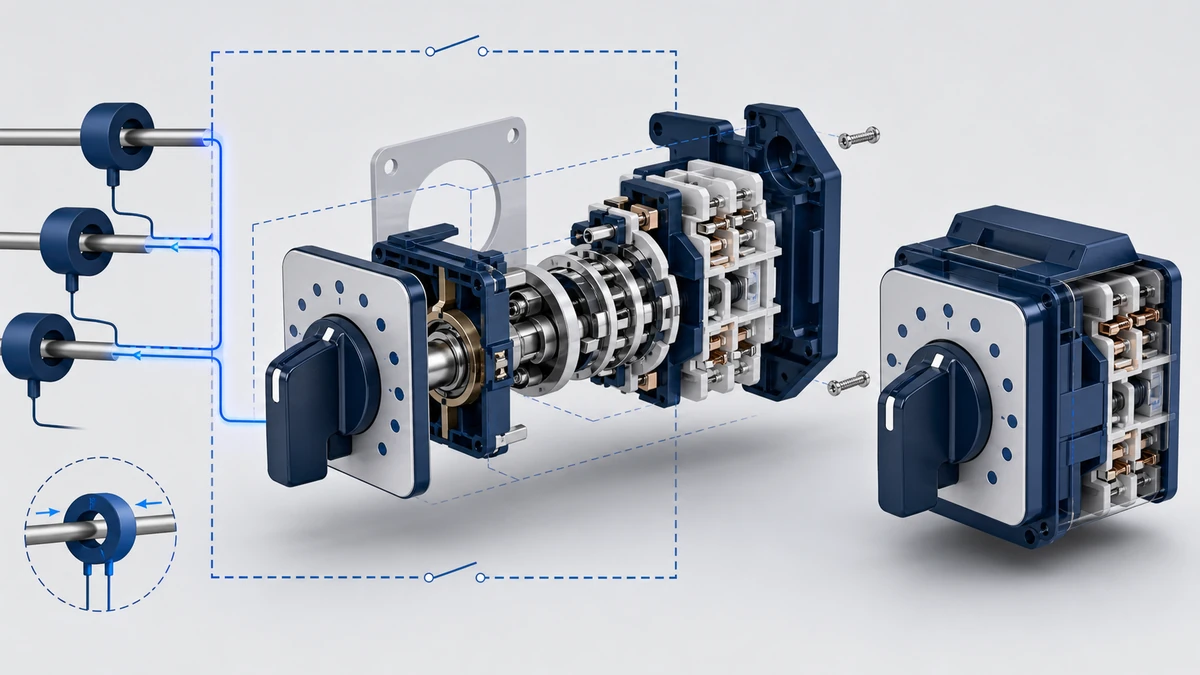
An ammeter selector switch used with CT circuits should be bought and commissioned from documented contact routes, CT secondary continuity requirements, and qualified verification records—not from a front-plate legend alone.
Ask for the exact contact program, position schedule, drawing, datasheet, and any destination-market certificate package needed for the project.
Treat CT secondary open-circuit prevention as a documented boundary condition for qualified commissioning, not as an informal wiring detail.
Confirm final suitability against the exact switch model, current documentation, panel design, and buyer application.
Where the ammeter selector switch fits in a CT metering circuit
An ammeter selector switch is the operator interface that selects which CT-derived current signal is presented to an ammeter, so the buyer decision is the complete metering route and contact program, not only the handle style.
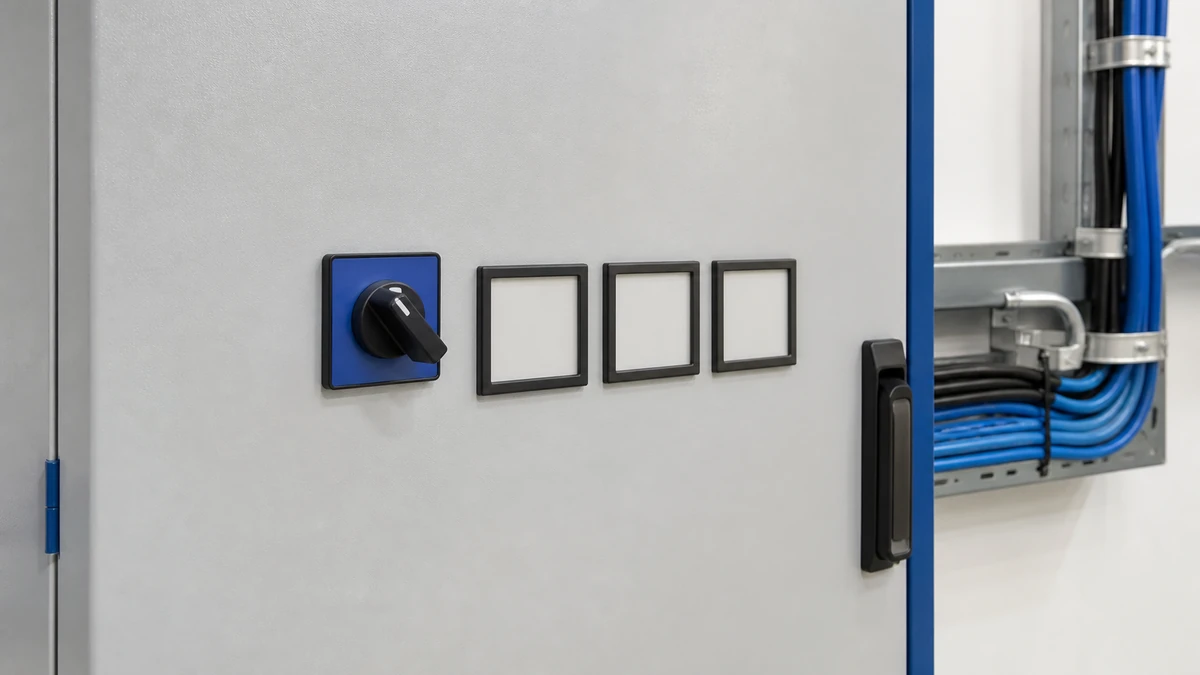
In a three-phase panel, the front plate may show L1, L2, L3, and OFF or similar markings. Behind that plate, the commercial question is whether the specified rotary cam switch contact sequence supports the intended CT secondary route without creating an unacceptable open-circuit condition during selection.
An exact drawing identifies the interfaces that must be controlled for the approved model route.
What the switch is expected to do
For this article, the switch is considered a metering selection component within a documented CT secondary circuit. It is not being selected as a protective device, and it should not be specified as a substitute for protection, metering design, or commissioning procedure.
Phase selections, neutral if applicable, OFF position if required
Determines the number and naming of switch positions
How is the ammeter connected?
Meter input, burden information, and wiring schematic
Confirms the switch is part of a compatible metering route
What contact behavior is required?
Exact contact schedule and any required overlap or shorting arrangement
Prevents assumptions from the front legend
What documentation is needed?
Drawing, datasheet, model code, certificate request if applicable
Supports panel build, inspection, and commissioning records
Who approves the design?
Buyer engineer, panel builder, end-user standard, or project authority
Avoids late changes after fabrication
CT open-circuit boundaries that affect switch selection
The CT secondary continuity boundary should be treated as a design and commissioning constraint before the ammeter selector switch is purchased.
Opening a CT secondary circuit while primary current is present can create hazardous secondary voltage and can damage equipment. This article does not provide live-panel work instructions; it defines the documentation and qualified-check boundaries that sourcing teams should require.
What must be defined before selection
The route should define how each CT secondary path remains controlled through every permitted switch position. If an OFF position is requested, the drawing should show how the CT secondary condition is handled and which contacts provide the required path.
The safest commercial specification is not “three-position ammeter switch.” It is a named switching route with a contact program, CT ratio context, ammeter input information, and project-approved drawings.
Sample review should connect the exact item to its current drawing and requested evidence package.
Boundary checklist for the buyer file
Record the CT ratio and secondary current convention used in the panel design.
Confirm the ammeter input and any burden information used by the designer.
Require the exact switch contact schedule for every handle position.
Identify whether an OFF position is present and how the CT secondary route is documented.
Ensure commissioning acceptance is assigned to qualified personnel under the buyer’s site procedure.
Keep the approved drawing revision with the switch part number and panel bill of materials.
Documentation to collect before commissioning
Commissioning should begin from an approved documentation pack that connects the selected ammeter selector switch to the CT circuit drawing and acceptance criteria.
The pack should be complete enough for a qualified person to verify intent against the installed panel without relying on memory, catalogue photos, or handle markings alone. Missing documents are a commercial risk because they delay acceptance and can force late redesign.
Minimum document pack
A practical pack normally includes the electrical schematic, CT data used by the designer, ammeter data, switch model code, contact schedule, front-plate legend, panel mounting details, and applicable datasheet or certificate files requested for the destination market.
Where certificates or declarations are required, they should be requested for the exact model or product family scope stated by the manufacturer. Do not assume that a different handle, contact stack, enclosure arrangement, or market requirement is covered without checking the current documentation.
Mismatch flags before energization approval
The front legend and schematic use different phase names.
The switch model code on the order does not match the drawing.
The OFF position is shown on the label but not explained in the CT route.
The contact schedule is absent or only shown as a generic catalogue image.
The ammeter input or CT ratio is missing from the commissioning file.
The certificate request is made after the panel has already been built.
Commissioning checks qualified teams can specify without live-panel instructions
The commissioning plan should specify evidence, responsibility, and hold points; it should not be replaced by informal live-panel troubleshooting.
For CT metering circuits, the most useful commercial deliverable is a clear acceptance checklist that a qualified commissioning team can apply under its own approved procedures. This article intentionally avoids step-by-step instructions for live panels.
Desk checks before site work
Desk checks reduce rework because they catch mismatches while drawings, labels, and purchased parts can still be corrected. They also give the buyer a traceable basis for approving the ammeter selector switch route before shipment or panel release.
Recommended desk-review actions:
Compare the switch contact schedule with the project schematic.
Confirm every handle position has a defined metering outcome.
Confirm the CT secondary route is documented for every switch position.
Check that the front legend matches the schematic and purchase code.
Confirm the datasheet and certificate package requested in the RFQ is available for review.
Record the drawing revision used for acceptance.
Installation conditions change the product-route and document questions a buyer must resolve.
Commissioning record content
The commissioning record should show who checked the route, which approved documents were used, and what acceptance criteria were applied. If continuity or functional checks are performed, they should be carried out only by qualified personnel under the buyer’s method statement and site rules.
Useful record fields include the panel identifier, switch model, drawing revision, CT ratio, ammeter reference, test equipment references where applicable, inspection date, and sign-off authority.
Choosing positions, poles and contact stages for a meter route
Positions, poles, and contact stages should be chosen from the required ammeter indications and the documented CT secondary continuity requirement.
A selector with the correct front positions can still be wrong if the contact timing or pole arrangement does not match the CT route. For detailed terminology on these mechanical and electrical choices, refer to the positions, poles and contact stages guide.
Common position decisions
Typical metering selectors may include phase positions and, where specified, an OFF position. The buyer should not assume that an OFF label has a standard internal circuit; it must be confirmed by the contact program and drawing.
Desired front indication
Documentation needed
Commercial risk if omitted
L1 / L2 / L3
Contact schedule for each phase route
Wrong phase displayed or incorrect meter connection
L1 / L2 / L3 / OFF
OFF-position CT secondary treatment
Open-circuit risk if the route is not defined
Multiple meters or special indication
Custom contact program and schematic
Standard selector may not match the application
Replacement switch
Original drawing or reverse-engineered contact schedule approved by buyer
Visual replacement may not duplicate the circuit
Contact stages and sequencing
The contact stages define which circuits are made or broken at each handle position. For CT circuits, the buyer should ask whether any required make-before-break, overlap, or shorting behavior is present in the exact contact program, and should verify that through current product documentation.
Do not infer contact sequence from the number of positions or the handle angle. The quotation should identify the model route clearly enough for engineering approval before procurement.
Ratings, standards and certificates to request
Ratings and approvals should be verified for the exact model, circuit duty, and destination-market requirement rather than assumed from the term “rotary cam switch.”
For low-voltage switching-device scoping, IEC 60947-3 scope describes this scope as switches, disconnectors, switch-disconnectors and fuse-combination units within stated distribution- and motor-circuit AC/DC limits. Whether a particular ammeter selector switch configuration is suitable for a buyer’s application depends on the exact product documentation and use case.
Evidence fields to confirm
Ask for voltage, current, AC/DC duty, utilization category where applicable, contact program, mounting arrangement, handle style, environmental assumptions, and requested documentation package. These fields are model- and application-dependent.
إن rotary cam switch selection guide is useful when the project team is still organizing duty, function, and mechanical constraints before requesting a quotation.
What not to assume
Do not assume a rating, IP class, certification, endurance value, torque value, compliance status, minimum order quantity, lead time, or application fit unless it is stated in the relevant quotation, datasheet, drawing, certificate, or current manufacturer communication.
Also do not assume that a switch selected for one duty is appropriate for another duty. CT ammeter selection, auxiliary control, and motor switching can require different evidence and contact programs.
How Shieldhz confirms a rotary cam switch route
Shieldhz confirms a rotary cam switch route by matching the requested switching function, electrical duty, contact program, mounting route, environment, and document package before quotation; final suitability is confirmed against current product documentation and the buyer’s application.
This pre-quotation confirmation is designed to reduce ambiguity. It helps the buyer receive a switch route that can be checked against the panel drawing instead of a generic catalogue description.
Pre-quotation inputs Shieldhz checks
Provide the following information where available:
Switching function, such as CT ammeter selection, phase selection, voltmeter selection, auxiliary control, or another defined route.
AC/DC duty, voltage, current, and utilization category where applicable.
Pole count, number of positions, handle angle preference, and required contact program.
Panel mounting route, front handle style, legend requirement, and dimensional constraints.
Environment, including enclosure context and destination-market considerations.
Requested drawing, datasheet, and certificate package.
Buyer application notes that affect inspection or commissioning acceptance.
If the same project includes motor switching, treat that as a separate function and use the rotary cam switch motor-control guide for that decision path rather than applying CT-metering assumptions.
Quotation output to review
A useful quotation response should make the proposed model route clear enough for engineering review. Depending on the exact product and request, this may include model identification, a contact drawing or contact schedule, mechanical mounting information, datasheet reference, and certificate availability statement.
The buyer should review these documents before purchase approval. If the commissioning authority requires a specific evidence format, include that requirement in the RFQ.
Commercial sourcing checklist for panel builders and OEMs
A purchase-ready enquiry should specify the ammeter selector switch route, CT metering context, documentation package, and acceptance evidence rather than only a current rating and knob appearance.
This is especially important for distributors and sourcing teams buying on behalf of engineering users. A small omission in the RFQ can become a commissioning delay when the panel drawing, label, and switch contacts do not align.
Documentation control, sample acceptance and protective packing are separate handover checks.
RFQ checklist
State that the application is an ammeter selector switch used with CT circuits.
Attach or describe the approved metering schematic.
List required positions and front legend text.
Provide CT ratio and ammeter input information where relevant to confirmation.
Request the exact contact schedule or drawing.
State voltage, current, AC/DC duty, and utilization category where applicable.
Define panel mounting and handle requirements.
Request datasheet and certificate files needed for the destination market.
Ask whether any special contact sequencing is part of the proposed model.
Identify the buyer’s inspection or commissioning documentation requirement.
Decision table: standard, modified, or recheck
Situation
Recommended sourcing action
Reason
New panel design with known schematic
Request quotation against the schematic and contact program
Reduces ambiguity before build
Replacement of an existing selector
Obtain the original contact schedule or buyer-approved equivalent
Visual matching may not duplicate internal contacts
OFF position required
Request documented CT secondary treatment for OFF
Prevents unsupported assumptions
Destination-market documentation required
Ask for certificate availability before purchase
Avoids late compliance-document gaps
Mixed CT metering and motor switching in one project
Quote as separate functions
Different duties and contact logic may apply
Unclear CT route
Hold purchase until engineering clarification
Prevents ordering a switch that cannot be commissioned
Conclusion
An ammeter selector switch for CT circuits is a documentation-driven purchase. The key commercial decision is not simply the number of positions on the handle; it is whether the exact contact program, CT secondary route, ratings evidence, and commissioning records support the buyer’s panel design.
Shieldhz can help confirm a rotary cam switch route before quotation when the buyer provides the switching function, duty, contact program, mounting requirements, environment, and documentation needs. Final suitability should always be checked against current product documentation and the buyer’s application.
الأسئلة الشائعة
Is an ammeter selector switch the same as a general rotary switch?
No. It may be built as a rotary cam switch, but the CT metering application depends on a specific contact program and documented CT secondary route. The buyer should confirm the exact model drawing rather than relying on a generic rotary switch description.
Why is CT secondary open-circuit prevention important?
A CT secondary circuit can develop hazardous voltage if it is opened while primary current is present. For that reason, the switch route and commissioning checks should treat CT secondary continuity as a documented boundary condition.
Can this article be used as a live-panel commissioning procedure?
No. This article is for procurement, documentation, and qualified commissioning planning. Live-panel work, if required, must be handled only by qualified personnel under approved site procedures and applicable rules.
What should I request from a supplier before ordering?
Request the switch model route, contact schedule, position legend, mounting details, datasheet, and any certificate package required for the destination market. For CT metering, also provide the schematic, CT ratio context, and ammeter input information where available.
Can I add an OFF position to any ammeter selector switch?
Do not assume that. An OFF position must be shown in the contact program and CT secondary route, including how the secondary condition is handled. The exact suitability depends on the model drawing and buyer application.
Does selecting the operator validate the whole metering circuit?
No. Selecting the operator or switch model does not validate the complete CT metering circuit. The panel design, CT data, meter input, wiring route, documentation, and qualified commissioning acceptance all remain part of the buyer’s engineering responsibility.
شي، موكسي
يكتب شي، موكسي مقالات شيلدهز الفنية لمشتري التحكم الصناعي والمكونات الكهربائية، والتي تغطي مفاتيح الكامات الدوارة، ومفاتيح العازل، ومفاتيح فصل التيار المستمر الكهروضوئية، وأزرار الضغط، وأضواء المؤشر، والحاويات المقاومة للماء، والكتل الطرفية. تستند المقالات على خبرة شركة Zhejiang Shihe Electric Co., Ltd. في التصنيع والتصدير، مع التركيز العملي على اختيار الطراز وأوراق البيانات والرسومات والشهادات وتصنيفات IP وتفاصيل الاستفسار التي يجب على المشترين التأكد منها قبل الطلب.