PV DC Isolator Wiring Drawing Review: String Voltage, Polarity, and Pole Mapping
Use a practical buyer checklist to evaluate pv dc isolator wiring drawing inputs, documentation, approval controls and the exact PV DC isolator switch route.
A pv dc isolator wiring drawing should be reviewed as commercial and engineering evidence before procurement, not as a field wiring instruction. The buyer’s decision is whether the proposed switch route, markings, pole arrangement, enclosure format, and documentation package match the application file and destination-market requirements.
Confirm maximum DC voltage/current, polarity labels, and pole mapping against the buyer’s string schedule.
Request the exact drawing, datasheet, and certificate package for the proposed model route, not a generic family reference.
Approve quotations only after the drawing revision and documentation scope are clear.
Treat the wiring drawing as procurement evidence, not a site wiring manual
Use the wiring drawing to decide whether the offered PV DC isolator route matches the buyer’s design file, purchase specification, and approval route. It should show what is being supplied and how the switch route is represented, without replacing the installer’s project-specific wiring documents.
An exact drawing identifies the interfaces that must be controlled for the approved model route.
What the drawing should prove
A useful drawing gives enough evidence for an engineering purchaser to identify the model route, number of poles used, polarity marks, operator positions, enclosure style if applicable, and connection orientation. It should also reference the relevant datasheet or drawing revision so the procurement team can compare like with like.
For a commercial review, the drawing should answer: “Is this the exact switching route we intend to buy?” It should not require the buyer to infer the contact path from a catalogue image alone.
Buyer review checklist
Before approving the offered drawing, check that it includes:
Exact model or route reference.
Drawing number, revision, and date.
DC voltage and current values used for the selection.
PV+ and PV- identification where polarity is relevant.
Number of poles and contact path representation.
ON/OFF position indication or handle orientation reference.
Mounting or enclosure format if it is part of the supplied item.
Notes that identify any destination-market marking or approval request.
Drawing evidence
Buyer decision it supports
Risk if missing
Model route and revision
Confirms the item being quoted
Similar-looking product may be substituted
Voltage/current callout
Checks fit against the buyer’s schedule
Rating basis may be unclear
Pole map
Confirms how contacts are allocated
Route may not match string arrangement
Polarity labels
Confirms connection logic in the buyer file
PV+ and PV- representation may be ambiguous
Documentation reference
Supports approval and supplier comparison
Datasheet and drawing may not describe the same item
Verify string voltage and current before choosing a route
The selected drawing must be checked against the maximum DC voltage and current stated by the buyer or project designer. These values are buyer-application dependent, and final suitability must be confirmed against the current product documentation for the exact model route.
Sample review should connect the exact item to its current drawing and requested evidence package.
Voltage evidence to compare
For PV strings, the procurement file should state the maximum DC voltage basis used for selection. This may come from the buyer’s string schedule, design calculation, or equipment specification.
The drawing should not leave the reviewer guessing whether the route is intended for a lower-voltage or higher-voltage string architecture. If the drawing uses a route diagram that depends on poles being grouped in a defined way, that grouping must be visible and linked to the selected model.
Current evidence to compare
The buyer should provide the expected DC current basis for the application. The supplier documentation should then be checked for the exact current value, utilization category or application notation where provided, and any model-specific conditions.
Do not treat a family headline as proof for every route. The accepted value is the one supported by the current datasheet, drawing, and documentation package for the item being purchased.
Standards-scope boundary
For standards evidence, read the scope carefully rather than assuming that one reference validates every application. The IEC 60947-3 scope describes switches, disconnectors, switch-disconnectors and fuse-combination units within stated distribution- and motor-circuit AC/DC limits.
A certificate, declaration, or test reference still has to match the exact model, construction, rating, and destination-market requirement requested by the buyer.
Check polarity marking and contact-position logic before approving the drawing
The drawing should make PV+ and PV- representation unambiguous wherever the selected route or buyer drawing depends on polarity. This is a drawing-review decision, not a site wiring instruction.
Installation conditions change the product-route and document questions a buyer must resolve.
Polarity labels
Polarity marks should be visible on the route drawing or referenced in a model-specific document. If the drawing shows only generic contact symbols, ask whether polarity is relevant for that exact model and whether the intended PV+ and PV- labels are defined elsewhere.
A procurement review should also check consistency across the quotation, datasheet, label artwork if supplied, and wiring drawing. Mixed naming conventions can delay panel approval even when the hardware route is otherwise correct.
Operator position labels
The drawing should show how ON and OFF positions are represented for the offered operator or handle format. If a padlockable handle, door-mounted handle, or enclosure operator is part of the purchase scope, the drawing should identify the configuration that is actually quoted.
Do not assume that a visual operator style validates a complete machine safety function. Where emergency-stop or safety-function requirements exist, they must be assessed at the machine or system level by the responsible designer.
Polarity and position action list
Use this short review before releasing a purchase order:
Compare PV+ and PV- labels in the drawing with the buyer’s schematic naming.
Check whether the route is polarity-sensitive according to the exact datasheet or drawing notes.
Confirm that ON/OFF representation matches the requested operator format.
Ask for a revised drawing if the quotation and drawing use different model-route names.
Keep the approved drawing revision in the procurement file.
Map poles to the buyer’s string arrangement
Pole mapping should be checked before price comparison because two offers can look similar while using different contact routes. The buyer needs evidence for how many poles are used and how those poles are allocated to PV+ and PV- paths.
Common pole-map review cases
A drawing may show one string with both conductors switched, multiple strings handled through separate routes, or poles grouped in a defined series path for a voltage requirement. The correct interpretation is exact-model and application dependent.
The buyer should not approve a drawing based only on “2P” or “4P” wording. The route diagram must show what those poles are doing in the selected arrangement.
Pole mapping decision table
Buyer arrangement to review
Drawing evidence to request
Procurement decision
One PV string
PV+ and PV- path shown clearly
Confirms basic route alignment
Two conductors switched through separate poles
Pole allocation visible for each conductor
Confirms both paths are represented as intended
Poles grouped in a defined route
Contact sequence and bridge/path notation shown
Confirms the voltage route is documented
Multiple strings in one assembly
Separate routes or repeated paths identified
Confirms string count and product scope
Enclosed isolator with cable-entry constraints
Internal route and entry orientation shown
Confirms the drawing matches the physical build
Questions to ask when pole mapping is unclear
Does the drawing show the exact number of active poles used in the route?
Are PV+ and PV- paths represented consistently from input side to output side?
Are any poles grouped for a defined route, and is that grouping documented?
Does the model code on the drawing match the quoted item?
Is the pole route supported by the current datasheet for the destination market?
Match model-route evidence to the procurement file
Model-route pages should be used to narrow the discussion, but the purchase decision should still rely on the exact drawing and documentation package supplied for the quoted item. A route page is a starting point for commercial investigation, not a substitute for model-specific confirmation.
Route comparison during supplier shortlisting
During early comparison, buyers can use Shieldhz route pages to identify which product family or route may be relevant before requesting drawings. The next step is to ask for the exact drawing revision and documentation set tied to the intended procurement item.
Drawing revision and destination-market documentation
When to request a revised drawing
Request a revised drawing when the model code, pole map, voltage/current value, polarity mark, operator format, or enclosure description does not match the quotation. Also request clarification if the drawing appears to describe a general family rather than the exact route being purchased.
For OEM and panel-builder procurement, version control matters. A small drawing mismatch can create downstream approval questions even before production begins.
Review enclosure, mounting, and cable-entry details early
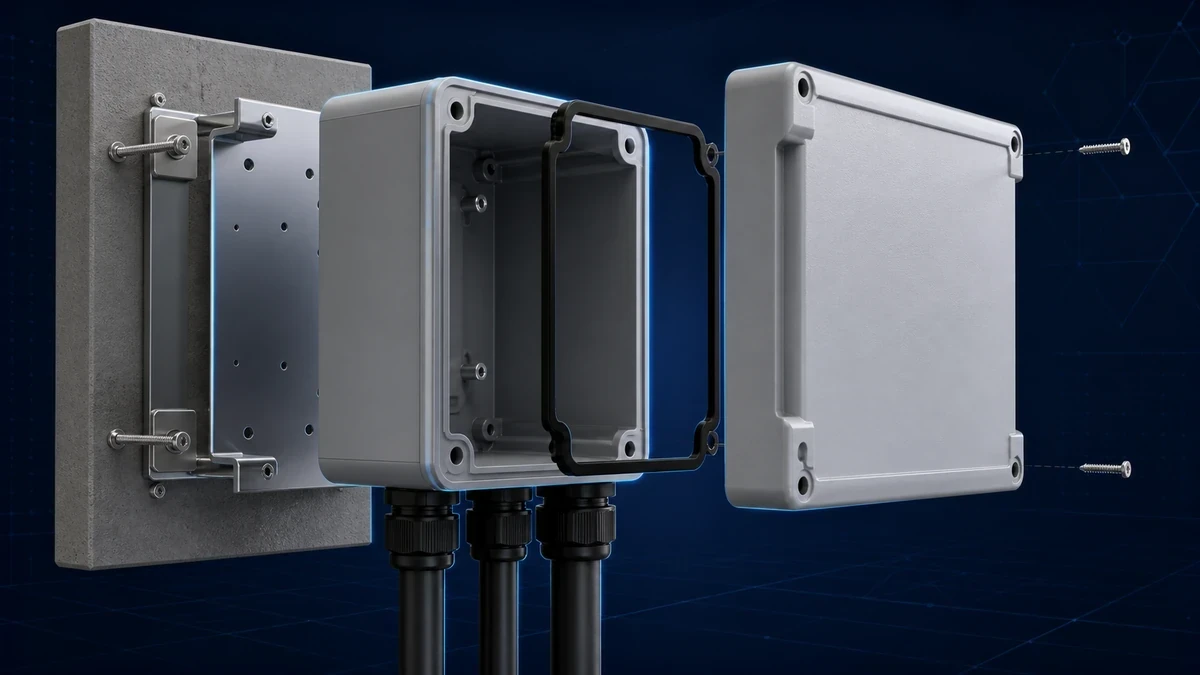
Physical configuration should be reviewed together with the electrical route because enclosure, mounting, and entry orientation can change the drawing evidence needed for approval. These items are exact-model and buyer-application dependent.
Documentation control, sample acceptance and protective packing are separate handover checks.
Panel-mounted and enclosed versions
If the buyer is purchasing a panel-mounted switch, the drawing should show the relevant mounting format or reference the mechanical drawing used for panel cut-out and operator placement. If the buyer is purchasing an enclosed isolator, the drawing package should identify the enclosure arrangement that is part of the supply.
Do not assume that the same electrical route automatically means the same installation envelope. Mechanical details should be confirmed from current drawings.
Environment and entry assumptions
Ingress protection class, enclosure material, cable-entry position, and accessory configuration should be checked against the exact product documentation and buyer environment. These are not universal family claims.
If the product will be installed in a destination market with specific marking or approval expectations, state those requirements in the RFQ. The supplier can then confirm what documentation is available for the exact model and configuration.
Mechanical review checklist
Before approving the drawing package, confirm:
Mounting type requested by the buyer.
Enclosure included or excluded from the supply scope.
Operator or handle format shown in the drawing.
Cable-entry orientation or location if it affects the build.
Labeling or marking artwork if required for approval.
Environmental assumptions that must be checked against the datasheet.
Drawing revision used by both engineering and procurement.
Lock the documentation package before price comparison
Price comparison is incomplete unless every offer is tied to the same documentation expectation. A lower quotation is not comparable if it excludes drawings, datasheets, certificate evidence, or destination-market marking information required by the buyer.
Document list for procurement control
The buyer should define the required documentation package in the RFQ. The PV DC isolator documentation checklist can be used as a reference point for building that request.
Documentation item
Why it matters in drawing review
Buyer note
Wiring drawing
Confirms route, polarity, and pole mapping
Must show exact model or route
ورقة البيانات
Confirms rated values and conditions
Must be current for the quoted item
Mechanical drawing
Confirms mounting and envelope
Needed for panel or enclosure integration
Certificate or declaration package
Supports market and approval review
Must match model and destination requirement
Label or marking file, if required
Supports OEM or panel approval
Must match buyer marking request
Revision record
Keeps engineering and purchasing aligned
Store with purchase file
Revision control actions
Use these actions to avoid approval gaps:
Put the drawing number and revision in the quotation request.
Ask the supplier to confirm whether the datasheet and drawing describe the same item.
Identify any certificate, declaration, or marking requirement by destination market.
Store the approved drawing and datasheet with the purchase order.
Reconfirm documentation if the model route or enclosure format changes.
How Shieldhz confirms a PV DC isolator switch route
Shieldhz confirms a PV DC isolator switch route by checking the buyer’s application inputs against the current product documentation before quotation. Final suitability is confirmed against current product documentation and the buyer’s application, not by a generic catalogue description alone.
Pre-quotation inputs Shieldhz asks buyers to confirm
Buyers can start from the نطاق مفاتيح العازل الكهروضوئي للتيار المستمر and then provide the details needed for route confirmation. The more specific the input, the easier it is to quote the correct drawing and documentation package.
Provide:
Application type and destination market.
Maximum DC voltage and current.
String arrangement or pole arrangement.
Enclosure and environment expectation.
Mounting format and cable-entry requirement.
Requested drawing, datasheet, and certificate package.
Any approval, marking, or buyer-specific documentation requirement.
Confirmation output for buyers
Shieldhz can then align the proposed model route with the requested evidence package. The confirmation should identify the model route, drawing reference, documentation scope, and any application or market assumptions that still require buyer review.
This process helps engineering distributors, OEMs, and panel builders compare offers using the same evidence basis. It also reduces the chance that a quotation is approved on a broad family description instead of the exact route required.
Conclusion
A PV DC isolator wiring drawing is a procurement-control document. It helps buyers confirm string voltage, current basis, polarity labels, pole mapping, enclosure format, and documentation scope before committing to a model route.
For commercial investigation, the best decision is not “which switch looks similar?” but “which exact route is supported by the drawing, datasheet, certificate package, and buyer application file?” Keep that evidence together, confirm revisions, and approve the purchase only when the route and documentation package are clear.
الأسئلة الشائعة
Is a pv dc isolator wiring drawing the same as installation instructions?
No. It is primarily evidence for engineering and procurement review. Installation must follow the buyer’s project documents, local requirements, and the current product documentation for the exact model.
What should be checked first: voltage or pole count?
Check maximum DC voltage/current and pole mapping together. The pole route can affect how the drawing supports the selected voltage arrangement, so these items should not be reviewed in isolation.
Why does polarity matter in the drawing review?
Polarity matters when the selected route or documentation depends on defined PV+ and PV- paths. The drawing should make those paths clear enough for the buyer to approve the route without interpretation.
Can one drawing support several destination markets?
Only if the documentation package, markings, and model details match the relevant destination-market requirements. Buyers should request confirmation for the exact model and market rather than assuming one drawing covers all approvals.
Does selecting an emergency-stop style operator validate a complete safety function?
No. Selecting an operator or handle style does not validate a complete machine safety function. Any emergency-stop or safety-related function must be assessed at the machine or system level by the responsible designer.
What should a buyer send to request an accurate quotation?
Send the application, destination market, maximum DC voltage/current, string or pole arrangement, enclosure and mounting requirements, cable-entry needs, and requested documentation package. Also state any required approval or marking expectation at the RFQ stage.
شي، موكسي
يكتب شي، موكسي مقالات شيلدهز الفنية لمشتري التحكم الصناعي والمكونات الكهربائية، والتي تغطي مفاتيح الكامات الدوارة، ومفاتيح العازل، ومفاتيح فصل التيار المستمر الكهروضوئية، وأزرار الضغط، وأضواء المؤشر، والحاويات المقاومة للماء، والكتل الطرفية. تستند المقالات على خبرة شركة Zhejiang Shihe Electric Co., Ltd. في التصنيع والتصدير، مع التركيز العملي على اختيار الطراز وأوراق البيانات والرسومات والشهادات وتصنيفات IP وتفاصيل الاستفسار التي يجب على المشترين التأكد منها قبل الطلب.