How to Review a Rotary Cam Switch Contact Diagram Before Ordering a Non-Standard Function
Use a practical buyer checklist to evaluate rotary cam switch contact diagram inputs, documentation, approval controls and the exact rotary cam switch route.
A non-standard rotary cam switch function should be approved from the contact diagram, not from a short function name alone. Before ordering, confirm every handle position, contact state, duty condition and drawing revision against the machine or panel sequence.
Ask for a route-specific rotary cam switch contact diagram before releasing the purchase order.
Compare the diagram with the real control sequence, load duty, mounting route and marking requirement.
Freeze the approved drawing, datasheet and requested certificate package in the quotation or ordering record.
Start with the switching route, not the catalog name
Approve the intended switching route before you approve a non-standard part number. A catalog family or function label can narrow the search, but the buyer decision must be based on the exact contact program and documentation for the route being ordered.
استخدم مجموعة مفاتيح الكامات الدوارة as the starting point for construction options, then move quickly to the diagram-level review. For non-standard functions, the commercial risk is usually not whether a switch family exists; it is whether the ordered route matches the machine sequence without interpretation gaps.
Standard function name versus engineered route
A standard name such as ON-OFF, changeover, voltmeter selector or motor reversing may not describe all contact timing, pole count or position details. Two switches can share a common name while using different contact stages, handle angles or closed-contact combinations.
For a non-standard function, ask the supplier to identify the route as a defined contact program. If the program is adapted from a standard function, record what changed.
Buyer approval record
The approval record should identify the drawing revision, model route, contact diagram and any quotation assumptions. This protects both engineering and sourcing teams from ordering by description alone.
A useful approval record includes:
Requested function and handle positions.
Contact diagram revision.
Electrical duty and utilization category used for selection.
Mounting and handle details.
Datasheet and requested certificate package, where applicable to the exact model and destination market.
Read the contact diagram as an approval document
Use the rotary cam switch contact diagram to confirm what is open and closed at every handle position. The diagram is the buyer’s main evidence for whether the proposed function matches the intended sequence.
If your team needs a deeper refresher on interpreting position count, pole count and contact stages, use the positions, poles and contact stages guide as the foundation. This article stays focused on approval before ordering a non-standard function.
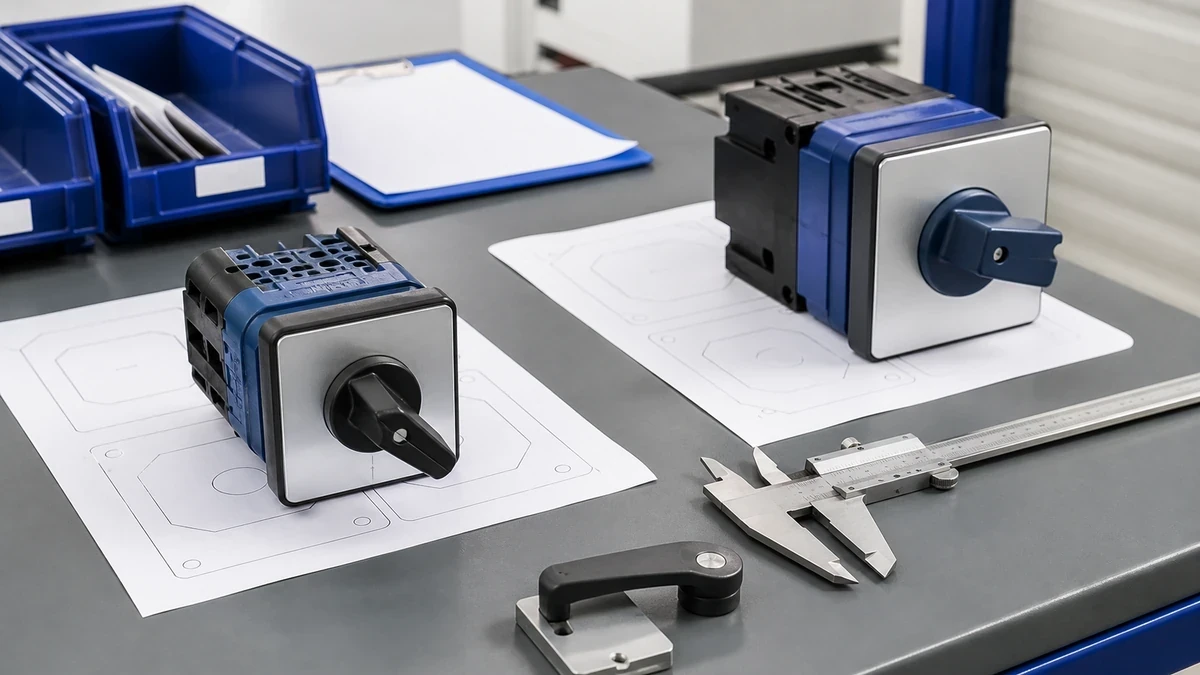
An exact drawing identifies the interfaces that must be controlled for the approved model route.
Position-by-position review
Read each handle position from left to right or as shown on the supplier drawing. Do not assume that the center position is OFF unless the contact diagram confirms it.
Check that the label, angle and contact state all describe the same position. If the panel legend says “AUTO-OFF-MANUAL,” the diagram should show the actual contact closures for AUTO, OFF and MANUAL, not just the three words.
Contact rows and closure marks
Each contact row represents a switching path controlled by the cam. The closure mark shows where that path is closed for a specific handle position.
For buyer approval, confirm:
Which contact rows are closed in each handle position.
Which rows remain open in OFF or neutral positions.
Whether any contacts change state together or in a defined sequence.
Whether the contact numbering on the drawing matches the wiring documentation used by the panel team.
Timing notes and special sequences
Some non-standard routes depend on timing details such as maintained, momentary, spring-return, overlap or no-overlap behavior. These details must be shown or stated on the approved drawing.
Do not infer make-before-break or break-before-make behavior from a function name. Ask for the exact route confirmation if the connected circuit depends on transition timing.
Diagram item
Buyer check
Approval evidence
Handle positions
Are all required positions present and correctly named?
Position table or drawing legend
Contact closures
Are the required rows closed in each position?
Contact diagram with revision
Open states
Are OFF or neutral states actually open where required?
Position-by-position review
Contact timing
Is overlap, no-overlap or momentary action required?
Written route note or drawing callout
Numbering references
Do contact identifiers match the panel documentation?
Matched schematic and supplier drawing
Match the contact program to the load and duty
Confirm the electrical duty before accepting the contact program. A diagram can be logically correct and still require model-level verification for voltage, current, AC/DC duty and utilization category.
When a project references IEC 60947-3, keep the evidence boundary narrow: the IEC 60947-3 scope describes this scope as switches, disconnectors, switch-disconnectors and fuse-combination units within stated distribution- and motor-circuit AC/DC limits. Any claim about a specific rotary cam switch must still be checked against the exact model documentation and the buyer’s application.
AC and DC duty are not interchangeable assumptions
Do not approve a non-standard route using only a current value. AC and DC switching duties can require different model confirmation, and utilization category matters when stated by the project.
Ask the supplier to confirm the proposed route against:
AC or DC duty.
Rated voltage and current required by the circuit.
Utilization category requested by the design.
Number of poles switched simultaneously.
Any project documentation requirement for the destination market.
Motor-control routes need dedicated review
Motor-control applications often depend on contact sequence, direction logic and OFF-position behavior. For these applications, use the rotary cam switch motor-control guide as supporting reading, then approve the actual contact diagram for the route.
Do not approve a reversing or speed-selection route from a title alone. Confirm the closed contacts in every position and the transition behavior between positions.
If the application involves
Confirm before quotation
ما أهمية ذلك
AC load switching
Voltage, current and utilization category
Model suitability depends on documented duty
تبديل حمولة التيار المستمر
DC voltage/current and interruption condition
DC duty must be confirmed separately
Motor control
Direction, speed, OFF position and transition logic
Contact sequence can affect control behavior
Instrument selection
Common point, selected phases or signals, OFF state
Incorrect selection can misroute measurement circuits
Control circuit selection
Maintained or momentary action and contact grouping
The logic sequence depends on exact contact closures
Convert the machine sequence into a contact-approval checklist
Translate the machine or panel sequence into a contact-approval checklist before you compare supplier options. This prevents the review from becoming a visual guess based only on a diagram.
Start with the intended operating sequence, then map each required circuit path to each handle position. If a path must never be closed together with another path, state that as a requirement before the supplier confirms the route.
Sample review should connect the exact item to its current drawing and requested evidence package.
Build a sequence matrix
A simple sequence matrix is often enough for buyer approval. Put handle positions across the top and controlled circuits down the side.
Use plain language at this stage. For example, “Pump 1 command closed in position 1” is clearer than approving from a part code without context.
Identify forbidden combinations
Non-standard functions often exist because the buyer needs a specific combination of closed and open contacts. Forbidden combinations are as important as required closures.
List combinations that must not occur in any maintained position. If transition behavior matters, state whether the concern applies only to maintained positions or also during rotation.
Practical checklist: sequence-to-diagram review
List every handle position in the exact order expected on the panel.
Mark which circuit paths must be closed in each position.
Mark which paths must remain open.
Note any momentary, spring-return or maintained action.
Note whether contact overlap or separation during transition is relevant.
Compare the completed matrix with the supplier’s rotary cam switch contact diagram.
Resolve every mismatch before quotation approval.
Decide what must appear on the supplier drawing
The supplier drawing should show enough information for engineering, purchasing and panel assembly to order the same route without relying on memory. For a non-standard function, the drawing is part of the commercial specification.
إن rotary cam switch functions guide can help align function language, but the approved drawing should carry the project-specific route details. If a detail affects wiring, mounting or labeling, ask for it on the drawing or in the quotation record.
Contact program and position legend
The drawing should show the contact program and the position legend together. This makes it easier to verify that the legend on the operator matches the electrical sequence.
Confirm whether position labels are text, symbols, angle marks or a separate marking plate detail. Marking requirements can be exact-model and order-configuration dependent.
Mechanical route and mounting details
A non-standard contact route can still fail the approval process if the mechanical route is unclear. Confirm panel mounting style, handle type, shaft or actuator arrangement and any enclosure interface required by the buyer’s design.
Environmental suitability, ingress protection references and material details should be checked against the current datasheet or model documentation. Do not assume those details from appearance or product family alone.
Drawing item
Why the buyer needs it
Approval question
Model or route reference
Identifies the proposed build
Is this the route being quoted?
مخطط الاتصال
Confirms electrical sequence
Does every position match the sequence matrix?
Position legend
Confirms operator labeling
Will the panel user see the intended positions?
Mounting details
Supports panel design
Does it match the panel cutout and handle route?
Electrical data reference
Supports duty review
Is the proposed model checked against application values?
Documentation list
Controls the order package
Are datasheet and requested certificates identified?
Practical checklist: drawing package request
Ask for the quotation package to identify:
Contact diagram and revision.
Position legend and handle angle.
Pole and contact-stage arrangement.
Model or route reference.
Mounting and handle configuration.
Datasheet reference for the proposed model.
Requested certificate package, where available for the exact model and destination market.
Review alternatives and revisions before the quotation is frozen
Treat every alternative route as a new approval item. A small change in contact program, handle angle or contact timing can change the function delivered to the panel.
استخدم rotary cam switch selection guide to structure the broader selection discussion, then hold the non-standard function to a drawing-based approval. The final ordering decision should not depend on an unapproved equivalent.
Function-code variants
Function codes can be useful for quotation and repeat ordering, but they should not replace the approved contact diagram. If a supplier proposes a variant, ask what changed from the previous route.
Common changes to review include:
Added or removed contact rows.
Different OFF position.
Different handle angle.
Different maintained or momentary behavior.
Different marking or operator configuration.
Distributor and OEM substitution control
Engineering distributors and OEM sourcing teams should control substitutions tightly. A substitute may be acceptable only if the buyer approves the contact diagram, duty confirmation and documentation package for that exact model.
Do not release a substitute based only on similar appearance, position count or function name. Require the same approval evidence used for the original route.
Practical checklist: revision control
Record the supplier drawing number and revision.
Save the contact diagram used for approval.
Confirm whether the quoted model matches that drawing.
Require written confirmation for any alternative route.
Re-check the duty data if the model changes.
Re-check mounting and handle details if the construction changes.
Keep the approved documentation with the purchase order record.
How Shieldhz confirms a rotary cam switch route
Shieldhz confirms a non-standard route by matching the requested function, electrical duty, contact program and mechanical configuration before quotation. Final suitability is confirmed against current product documentation and the buyer’s application.
This pre-quotation step is intended to reduce ambiguity before the buyer releases an order. It does not replace the buyer’s responsibility to validate the complete machine, panel or system design.
Installation conditions change the product-route and document questions a buyer must resolve.
Inputs needed before route confirmation
For a practical confirmation, provide the switching function and the intended handle positions. Include the AC/DC duty, voltage, current and utilization category requested by the application.
Shieldhz also checks the pole and contact program, panel mounting and handle route, environmental conditions stated by the buyer, and the requested drawing, datasheet and certificate package. Availability and applicability of certificates depend on the exact model, documentation status and destination-market requirement.
Output for quotation approval
The quotation route should identify the proposed model or contact program, drawing reference and documentation package. If the route is non-standard, the buyer should approve the contact diagram before the purchase order is issued.
A clear confirmation package helps engineering and sourcing teams approve the same object:
Confirmation input
What Shieldhz reviews
Buyer approval point
Switching function
Required positions and contact sequence
Does the function match the machine sequence?
AC/DC duty
Duty type, voltage, current and utilization category
Is the model checked against application values?
Pole and contact program
Number of switched paths and contact closures
Does the diagram match the sequence matrix?
Mounting and handle route
Panel interface, operator type and position marking
Does the construction fit the panel design?
البيئة
Buyer-stated installation conditions
Are datasheet details suitable for the application?
حزمة الوثائق
Drawing, datasheet and requested certificates
Is the order record complete?
Approve the non-standard function before issuing the purchase order
Release the purchase order only after the contact diagram, duty confirmation and documentation package are aligned. This is the point where engineering approval and commercial ordering should meet.
A non-standard function should not be ordered from an email description alone if the contact sequence affects the panel or machine logic. The approved drawing should be the reference for both the quotation and the order.
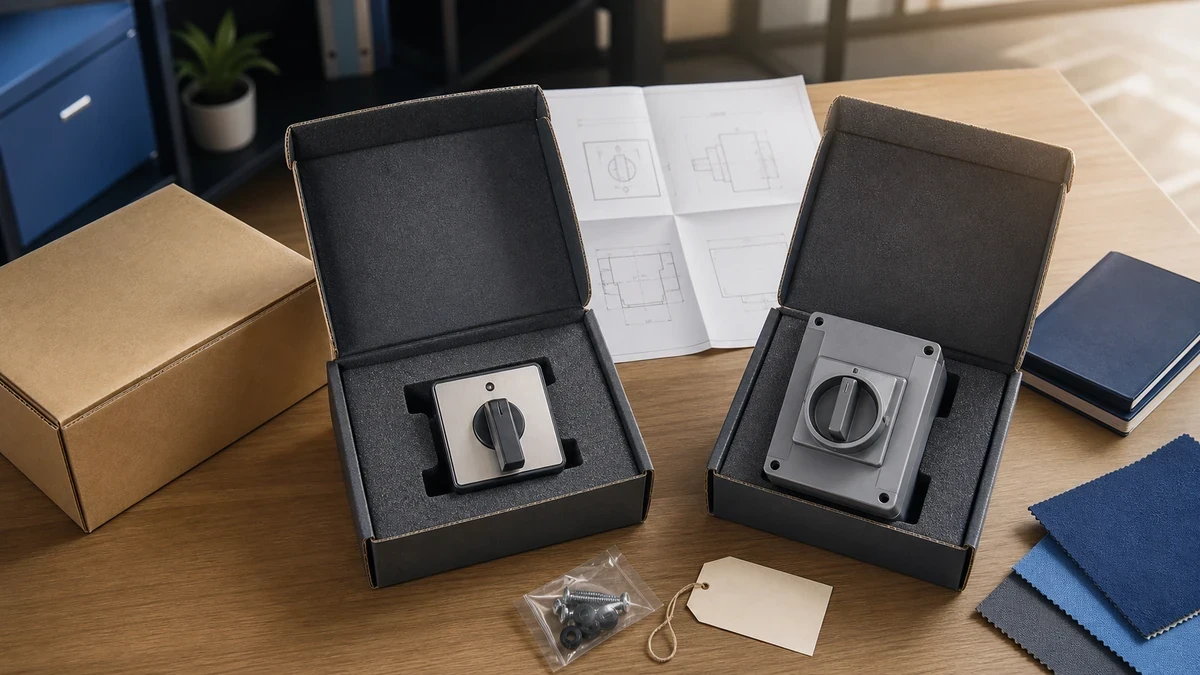
Documentation control, sample acceptance and protective packing are separate handover checks.
Engineering signoff
Engineering should confirm that the rotary cam switch contact diagram matches the required sequence. If there are open questions about transition behavior, handle action or contact grouping, resolve them before release.
The signoff should also confirm that electrical data has been checked against the current datasheet for the proposed model. Application fit remains dependent on the buyer’s circuit, installation and destination requirements.
Purchasing release
Purchasing should quote and order the approved route, not a simplified description. Include the drawing revision or route reference in the purchase order where possible.
If the supplier updates the drawing after quotation, treat it as a revision requiring review. A revised drawing may still be acceptable, but it should be approved intentionally.
Decision point
Release order
Hold order
مخطط الاتصال
Approved and revision recorded
Diagram missing or not reviewed
Function sequence
Matches buyer matrix
Mismatch or unclear transition behavior
الخدمة الكهربائية
Checked against current documentation
Voltage, current or utilization category unclear
Mounting route
Matches panel design
Handle, angle or mounting details unresolved
التوثيق
Datasheet and requested certificate package identified
Documentation not defined
Alternative model
Approved as exact route
Offered as “similar” without diagram review
Practical checklist: purchase-order freeze
Before issuing the purchase order, confirm:
The approved rotary cam switch contact diagram is attached or referenced.
The drawing revision matches the quotation.
The model or route reference is not ambiguous.
Duty values and utilization category have been reviewed.
Mounting and handle route are confirmed.
The datasheet and requested certificate package are identified.
Any alternative requires written buyer approval.
Conclusion
A non-standard rotary cam switch function should be bought from an approved contact diagram, not from a function label alone. The buyer’s workflow should move from sequence matrix, to diagram review, to duty confirmation, to drawing and documentation approval.
For panel builders, OEMs, machine designers, distributors and sourcing teams, this workflow reduces avoidable ambiguity before quotation and purchase order release. The final decision should always be checked against the current product documentation and the buyer’s exact application.
الأسئلة الشائعة
What is the most important item to check on a rotary cam switch contact diagram?
The most important item is the contact state in every handle position. Confirm which contact paths are closed, which remain open and whether the diagram matches the intended machine or panel sequence.
Can I order a non-standard function from a function name only?
It is not recommended for buyer approval. A function name may not define contact timing, pole count, OFF behavior, handle angle or marking details, so the approved contact diagram should control the order.
What should I send to request a non-standard route?
Send the required switching sequence, AC/DC duty, voltage, current, utilization category, pole requirement, mounting route, handle or marking requirement and any documentation requirement. A simple sequence matrix is often the clearest starting point.
Does a correct contact diagram automatically confirm application suitability?
No. A correct diagram confirms the logic route, but final suitability depends on the exact model documentation, electrical duty, installation conditions, destination requirements and the buyer’s application.
How should sourcing teams handle alternative models?
Treat an alternative as a new approval item. Require the contact diagram, duty confirmation, drawing reference and documentation package for the exact proposed model before accepting a substitution.
What documents should be kept with the purchase order?
Keep the approved contact diagram, drawing revision, quotation, datasheet reference and requested certificate package where applicable. These records help engineering, purchasing and assembly teams work from the same approved route.
شي، موكسي
يكتب شي، موكسي مقالات شيلدهز الفنية لمشتري التحكم الصناعي والمكونات الكهربائية، والتي تغطي مفاتيح الكامات الدوارة، ومفاتيح العازل، ومفاتيح فصل التيار المستمر الكهروضوئية، وأزرار الضغط، وأضواء المؤشر، والحاويات المقاومة للماء، والكتل الطرفية. تستند المقالات على خبرة شركة Zhejiang Shihe Electric Co., Ltd. في التصنيع والتصدير، مع التركيز العملي على اختيار الطراز وأوراق البيانات والرسومات والشهادات وتصنيفات IP وتفاصيل الاستفسار التي يجب على المشترين التأكد منها قبل الطلب.