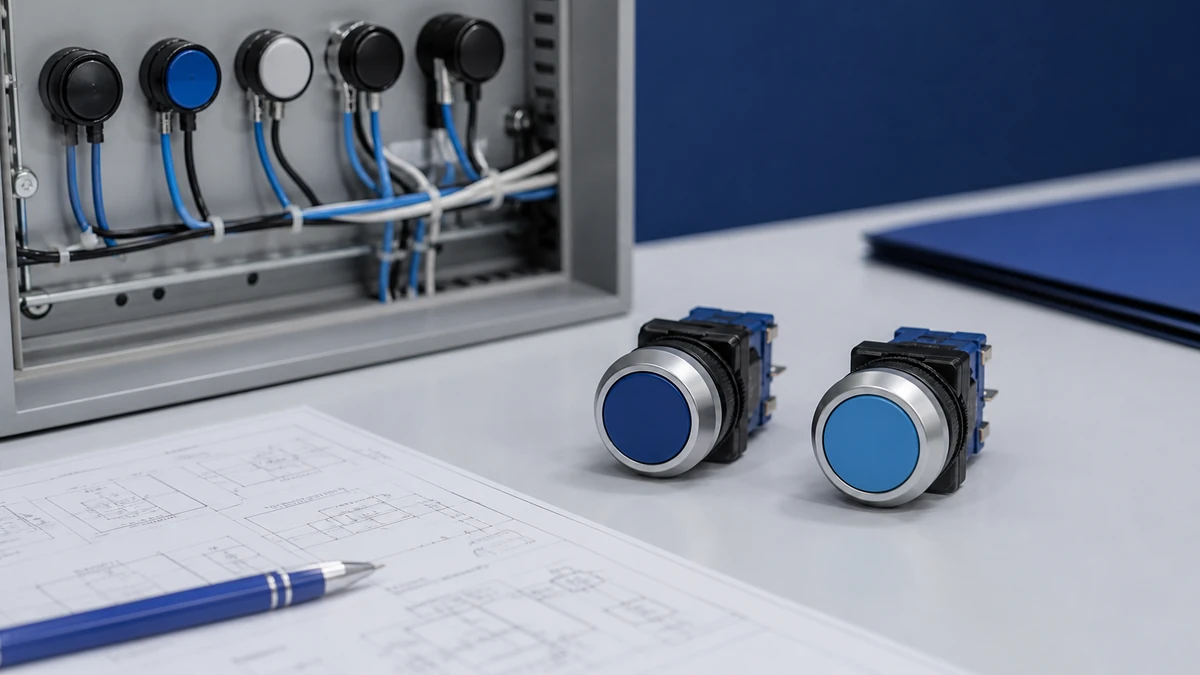
12V Push Button Switch vs 24V Push Button Switch for Panels
Use a practical buyer checklist to evaluate 12v push button switch inputs, documentation, approval controls and the exact push button, selector switch or emergency-stop operator route.
Choose the push button switch voltage around the panel control supply first. A 12v push button switch is appropriate when the control circuit is designed for 12 V and the selected contact configuration is documented for the actual load; 24 V is appropriate when the panel architecture, PLC inputs, relays or machine specification are built around 24 V.
Confirm the control supply before choosing the operator model or contact blocks.
Match contact rating, contact arrangement and mounting details to the exact drawing and datasheet.
For selectors and emergency-stop operators, confirm the complete control function separately; the operator alone does not validate the machine function.
What the 12V vs 24V decision really controls in a panel
The right choice is the control supply that the panel already uses or will be designed around, not the voltage printed in a catalogue headline. In most panel decisions, “12 V” or “24 V” is a compatibility question between the operator contact assembly and the connected control circuit.
An exact drawing identifies the interfaces that must be controlled for the approved model route.
A buyer comparing a 12v push button switch with a 24 V push button should first confirm what voltage is present at the control circuit. Then check whether the exact switch contact arrangement is documented for the actual current and switching duty.
A push button operator does not create the control voltage. It opens or closes a control circuit that has already been designed by the machine builder or panel engineer.
If the panel control supply is 12 V DC, the switch route should be checked for 12 V operation and the connected load. If the panel control supply is 24 V DC, the same confirmation is made against 24 V and the connected load.
The contact rating is an exact-model question
Do not assume that every contact block in a product family has the same rating. Contact rating, electrical endurance and permitted load type are exact-model and datasheet dependent.
The commercial risk is ordering by headline voltage only. The engineering route is to order by voltage, current, contact form, mounting size, operator type and documentation package.
Buyer decision
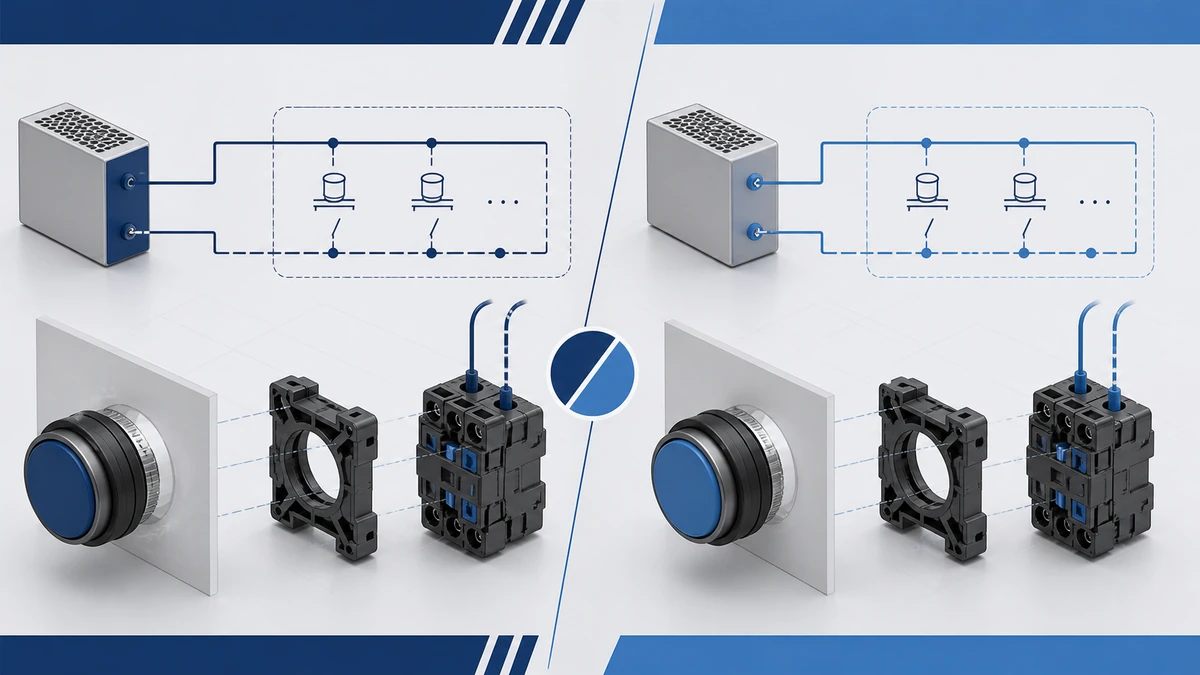
12 V route
24 V route
What to verify before ordering
Existing control supply
Use when panel control is 12 V
Use when panel control is 24 V
Schematic or control-power specification
Connected device
PLC input, relay input or other 12 V control load
PLC input, relay input or other 24 V control load
Input current and switching duty
Contact assembly
Exact contact block must cover the load
Exact contact block must cover the load
Current datasheet and drawing
Procurement wording
“12 V control circuit compatible”
“24 V control circuit compatible”
Do not rely on catalogue shorthand alone
Mixed-voltage machine
Use only on the confirmed 12 V circuit
Use only on the confirmed 24 V circuit
Circuit-by-circuit confirmation
When a 12v push button switch is the better commercial route
Choose a 12v push button switch when the machine control circuit is intentionally built around 12 V and the selected model’s contact ratings cover the actual load. This is often a controlled engineering choice, not a cheaper or simpler default.
A 12 V route can make sense when the panel already uses a 12 V control supply, when the connected device requires a 12 V input, or when the buyer is replacing like-for-like equipment documented at 12 V. The correct purchase specification should still include the operator action, contact arrangement, cutout and documentation requirements.
Typical reasons buyers ask for 12 V
Machine builders and maintenance planners may specify 12 V because the machine platform already has a 12 V control circuit. Some compact machines, vehicle-adjacent equipment and battery-supported systems may also have a 12 V control architecture.
For replacement work, the most important evidence is the existing drawing, panel schematic or approved spare-parts list. A 12 V label on a removed component is useful, but it is not enough to confirm the replacement route.
Risks to check before quoting
A 12 V control circuit may be more sensitive to voltage drop depending on load current, cable length and connection layout. It may also have a lower margin if the connected device needs a defined input threshold.
Before quoting, confirm:
Control voltage: AC or DC, nominal voltage and expected tolerance.
Connected load: PLC input, relay input, contactor input or other control device.
Contact form: NO, NC or combined contact arrangement.
Operator action: momentary, maintained, selector or emergency-stop operator.
Panel requirement: cutout size, mounting depth and panel thickness range from the exact drawing.
Documentation: datasheet, drawing and applicable certificate evidence for the exact selected model.
When 24V is the stronger default for many control panels
Choose 24 V when the panel control architecture, field devices and purchasing specification are already based on 24 V control circuits. It is often the expected route in industrial panels, but it still needs exact-model confirmation.
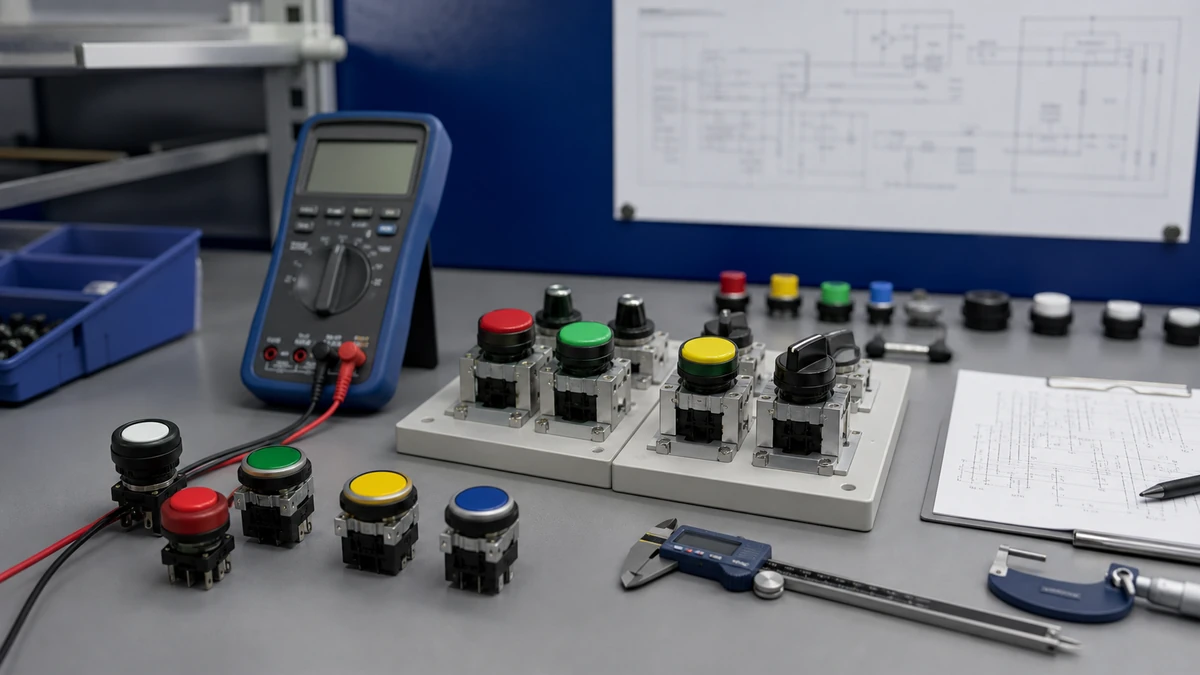
Sample review should connect the exact item to its current drawing and requested evidence package.
The advantage for procurement is consistency. If PLC inputs, relay interfaces and panel documentation are already 24 V, selecting a 24 V-compatible push button route reduces the chance of mixed-voltage ordering mistakes.
Why 24 V DC is common in panels
Many machine-control designs use 24 V DC for control circuits, sensors and PLC inputs. That makes 24 V a familiar purchasing description for panel builders and distributors.
However, “common” does not mean universal. The buyer still needs to confirm AC/DC type, current, contact duty and the exact operator assembly.
Where the 24 V assumption can fail
The 24 V assumption can fail when a machine has a mixed-voltage control system, an imported machine with a different control supply, or a retrofit panel that preserved an older voltage architecture. It can also fail when the buyer is replacing a device from memory instead of from a drawing.
Use this action list before approving a 24 V route:
Check the panel schematic, not only the purchasing description.
Confirm the control circuit is 24 V at the point where the operator contacts connect.
Confirm whether the circuit is AC or DC.
Confirm the current through the switch contact.
Confirm the exact model drawing, contact block arrangement and marking requirements.
Record any buyer-specific destination-market document requirements.
Contact arrangement can matter more than the voltage label
After voltage, confirm the contact arrangement because the machine function is defined by NO, NC and contact-block configuration. A correct voltage with the wrong contact form can still produce the wrong machine behavior.
For a practical explanation of normally open and normally closed selection, use the Shieldhz NO and NC contact guide. In quotation work, this contact decision should be made before the final model route is locked.
Momentary push button contact routes
A momentary push button returns after the operator releases it. Buyers commonly specify it for start, reset, jog, acknowledge or similar control functions, but the final application fit depends on the machine circuit.
The contact route should state whether the function needs NO, NC or both. For example, a start command often uses an NO contact in many control designs, while a stop command may use an NC contact, but the machine schematic is the authority.
Maintained and selector routes
A maintained push button or selector switch changes the contact state until the operator changes it again. This makes contact arrangement and position logic especially important.
For selectors, specify the number of positions, maintained or spring-return action, and the contact state in each position. Do not purchase by handle style alone.
Function requirement
Likely contact question
Buyer evidence needed
Quotation risk if omitted
Start or enable command
NO contact, or circuit-specific alternative
Machine schematic
Operator fits mechanically but does not match function
Stop command
NC contact, or circuit-specific alternative
Control drawing
Incorrect state in normal operation
Reset or acknowledge
Momentary action and required contact form
PLC input list or schematic
Wrong action type ordered
Mode selection
Contact state per selector position
Selector truth table or drawing
Incorrect mode logic
Replacement part
Match original contact arrangement
Old part number, drawing and photo if available
Voltage matches but contact stack differs
Compatibility checks for PLC inputs, relays and panel wiring
Confirm the connected device before placing the order because the switch contact only has to match the voltage, current and switching duty it will actually see. The same panel may contain several control circuits, so each operator route should be checked against its own circuit.
Installation conditions change the product-route and document questions a buyer must resolve.
A push button contact used on a PLC input usually switches a small control signal. A push button contact used with a relay or other control load may see a different current profile, so the selected contact block must be checked against the datasheet.
Inputs and coils
When the switch is connected to a PLC input, confirm the input voltage, input type and required signal state. If the switch is connected to a relay input or other control component, confirm the steady current and switching conditions.
Avoid ordering based only on panel voltage. The selected model must be reviewed against the current product documentation and the buyer’s circuit.
Cable run and voltage drop
Voltage drop can matter more in lower-voltage circuits, especially when cable runs are long or load current is higher. This is not a reason to reject 12 V automatically, but it is a reason to verify the design.
A practical buyer checklist:
Identify whether the control circuit is 12 V DC, 24 V DC or another supply.
Confirm the device being switched and its input current.
Confirm the wire route length if voltage drop is a known design concern.
Check whether the operator is panel-mounted, enclosure-mounted or mounted on a remote station.
Confirm the environment against the exact model’s documented protection and material details.
Request the current datasheet and drawing before releasing the purchase order.
Emergency-stop and selector operators still need the same voltage check
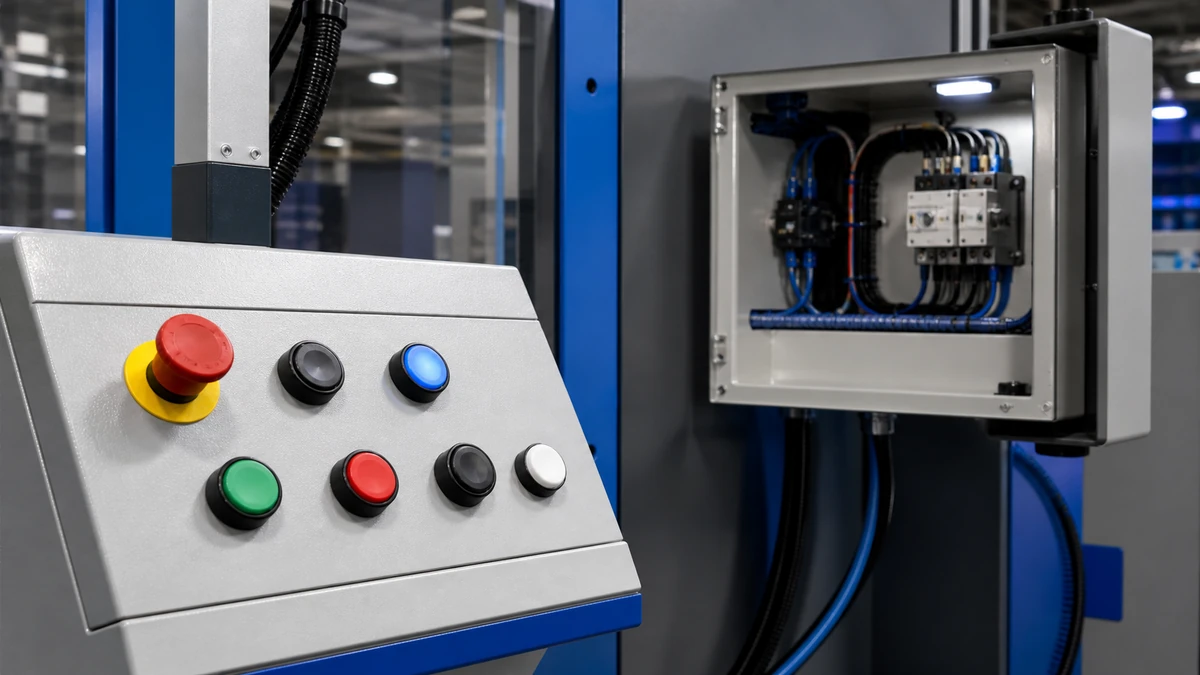
Apply the same control-supply check to emergency-stop and selector operators, but do not treat operator selection as validation of a complete machine safety function. The operator is one component in a wider control design, and the machine builder must validate the complete safety-related function where applicable.
Use the Shieldhz emergency-stop and selector layout guide when comparing panel layout and operator route. The voltage question still comes back to the actual control circuit connected to the contacts.
Emergency-stop operator boundary
For emergency-stop routes, confirm the operator type, reset action, contact arrangement and mounting details. Also confirm the destination-market documentation requested by the buyer.
Selecting an emergency-stop operator does not prove the complete machine safety function, performance level, category or validation result. Those depend on the full machine design, risk assessment, safety-related control architecture and current documentation.
Selector switch route
For selector switches, the commercial risk is unclear position logic. A buyer should specify the number of positions, maintained or spring-return action, key or non-key route if relevant, and the contact state per position.
Voltage compatibility is only one part of the route. The selector’s mechanical action and contact state must match the machine function.
Documentation and standards evidence to request before purchase
Ask for the current drawing, datasheet and applicable certificate evidence for the exact model because standards references do not prove every configuration. Product documentation can vary by model, contact assembly, operator type and destination market.
O IEC 60947-5-1 listing is an IEC catalogue listing for control-circuit devices and switching elements, and the catalogue notes that a more recent edition exists. Treat this as a subject-area reference, not as a universal product-certification claim for any specific push button switch.
Standards listing boundary
A standard title or catalogue listing is not the same as a certificate for a chosen part number. Buyers should request the exact documentation package needed for their application, destination market and internal approval process.
If a certificate is required, it should be reviewed against the exact model, configuration and current documentation. Do not assume one certificate covers every operator, contact block or accessory combination.
Datasheet package
A useful quotation package should identify the operator, contact arrangement, electrical data, mounting data and documentation route. It should also clarify any buyer-specific marking or legend requirements.
Decision table for document review:
Document or input
Por que é importante
Buyer action
Current product datasheet
Confirms electrical and mechanical data for the selected model
Review before purchase approval
Desenho de dimensões
Confirms cutout, mounting depth and panel fit
Compare with panel drawing
Contact arrangement detail
Confirms NO/NC and contact quantity
Match to machine schematic
Certificate evidence, if requested
Supports market or project documentation review
Check exact model and current validity
Legend or marking requirement
Prevents unclear operator function on the panel
Approve text, symbol and layout before order
How Shieldhz confirms a push button, selector switch or emergency-stop operator route
Shieldhz confirms the route by matching the requested operator, contact arrangement and documentation package to the buyer’s panel and market before quotation. Final suitability is confirmed against current product documentation and the buyer’s application.
Documentation control, sample acceptance and protective packing are separate handover checks.
The confirmation process is practical: it turns a general request such as “12v push button switch” or “24 V emergency stop” into an exact model route. This helps distributors, panel assemblers and procurement teams avoid ordering by incomplete catalogue wording.
Inputs Shieldhz checks before route
Before quotation, the useful confirmation inputs are:
Machine function and destination market.
Operator action: momentary, maintained, selector or emergency-stop operator.
Control voltage and current, including AC or DC.
Contact arrangement: NO, NC, quantity and contact state by position where applicable.
Panel cutout, mounting method, panel thickness and available mounting depth.
Environment, including the protection and material requirements stated by the buyer.
Marking, symbol or legend requirements.
Exact drawing, datasheet and certificate package requested for approval.
For assemblies involving contact blocks and markings, the Shieldhz contact block and legend plate guide can help buyers prepare the contact and marking details before quotation.
Outputs procurement should receive
The quotation route should identify the selected model or model family, the contact configuration, the control-voltage compatibility basis and the documentation package available for review. If a requested requirement depends on the exact model, destination market or certificate scope, it should be stated as a confirmation item rather than assumed.
Procurement should avoid releasing an order from a short phrase such as “12 V push button” alone. A complete order description protects both the panel build and the replacement-parts process.
Conclusion
A 12v push button switch is the right route when the panel control circuit is designed for 12 V and the exact contact assembly is documented for the connected load. A 24 V push button route is appropriate when the machine control architecture and documentation are built around 24 V.
The best commercial decision is not “12 V or 24 V” in isolation. It is control-supply compatibility plus contact arrangement, operator action, panel fit, environment and current documentation for the exact selected model.
Perguntas frequentes
Can I use a 24V push button switch in a 12V control panel?
Possibly, but only if the exact contact assembly is documented for the 12 V circuit and the connected load. Do not decide from the voltage label alone; check the datasheet, contact rating and panel schematic.
Is a 12v push button switch safer than a 24V push button switch?
Do not treat the voltage choice alone as a safety-performance decision. Suitability depends on the complete control circuit, product documentation, installation and the buyer’s application.
Why do many industrial panels specify 24V control circuits?
Many industrial control systems use 24 V DC because PLC inputs, sensors and relay interfaces are often designed around that control voltage. It is still a design choice, so the panel schematic and exact component documentation should be checked.
Does an emergency-stop operator voltage confirm the machine safety function?
No. Selecting an emergency-stop operator does not validate the complete machine safety function. The full safety-related control system must be assessed and validated by the machine builder or responsible engineer.
What information should I send to quote a 12V or 24V push button switch?
Send the control voltage, AC/DC type, current, operator action, NO/NC contact arrangement, panel cutout, mounting constraints, environment and required documentation. If it is a replacement, also send the existing part number, drawing or clear identification details.
Can one push button family cover both 12V and 24V routes?
Some model families may include contact configurations documented for both voltage routes, but this is exact-model dependent. Confirm the selected operator, contact block, ratings and documentation before purchase.
Shi, Muxi
Shi, Muxi escreve artigos técnicos da Shieldhz para compradores de controle industrial e componentes elétricos, abrangendo chaves de came rotativas, chaves isoladoras, seccionadores PV DC, botões de pressão, luzes indicadoras, gabinetes à prova d'água e blocos de terminais. Os artigos são baseados na experiência de fabricação e exportação da Zhejiang Shihe Electric Co., Ltd., com ênfase prática na seleção de modelos, planilhas de dados, desenhos, certificações, classificações de IP e detalhes de consulta que os compradores devem confirmar antes de fazer o pedido.