Emergency Stop Button Manufacturers: Documentation and Supplier Evaluation
Use a practical buyer checklist to evaluate emergency stop button manufacturers inputs, documentation, approval controls and the exact push button, selector switch or emergency-stop operator route.
When comparing emergency stop button manufacturers, shortlist suppliers by exact-model documentation, assembly configuration, destination-market evidence and quotation support—not by catalog images alone. Shieldhz can be evaluated as one supplier candidate when the required operator route, drawings, datasheets and certificate package are confirmed against the buyer’s application.
Ask each manufacturer for the exact drawing, datasheet and available certificate package for the configured operator, contact arrangement and accessories.
Confirm that the emergency-stop operator fits the machine safety concept; selecting the operator alone does not validate the complete emergency-stop function.
Compare suppliers with the same checklist: operator action, contacts, panel mounting, environment, marking, destination market and commercial terms.
Build the shortlist around manufacturers, not only part numbers
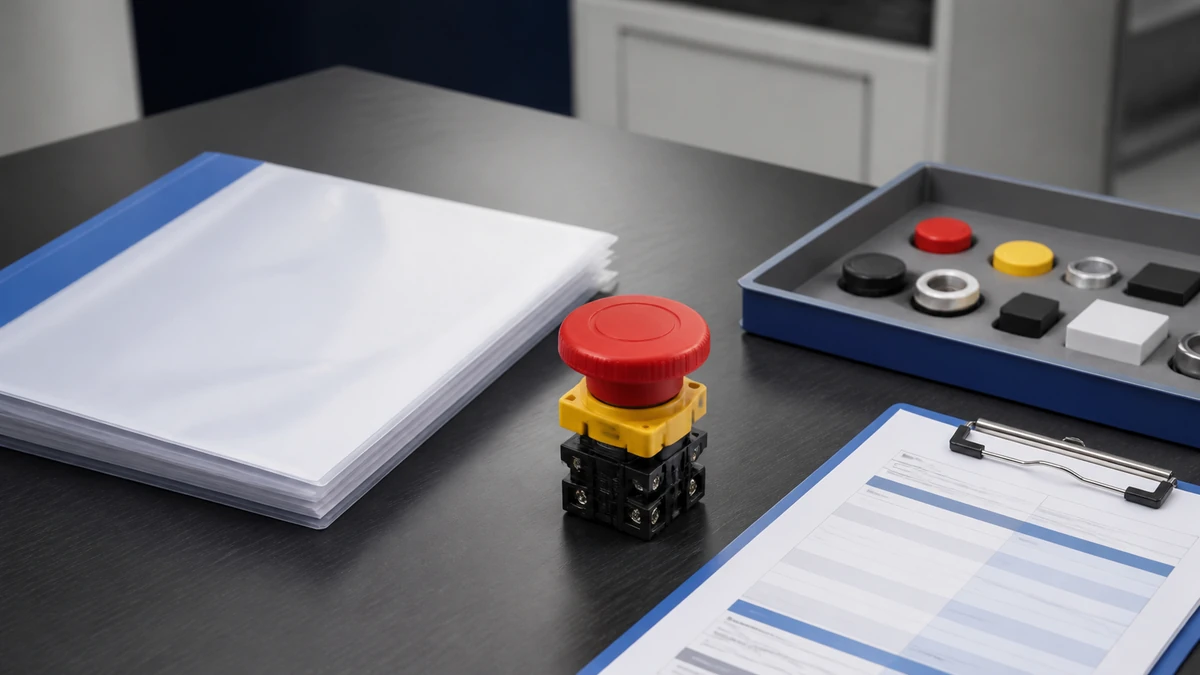
Start by shortlisting manufacturers that can document the exact emergency-stop operator assembly you intend to buy, not just show a similar product photo. For buyers comparing emergency stop button manufacturers, the useful question is whether the supplier can support the configured route from inquiry to purchase specification.
Shieldhz should be treated as a supplier candidate, not as an automatic fit for every application. Review the push button and indicator light range as a starting point, then confirm the exact model, accessory combination and documentation package before releasing a purchase order.
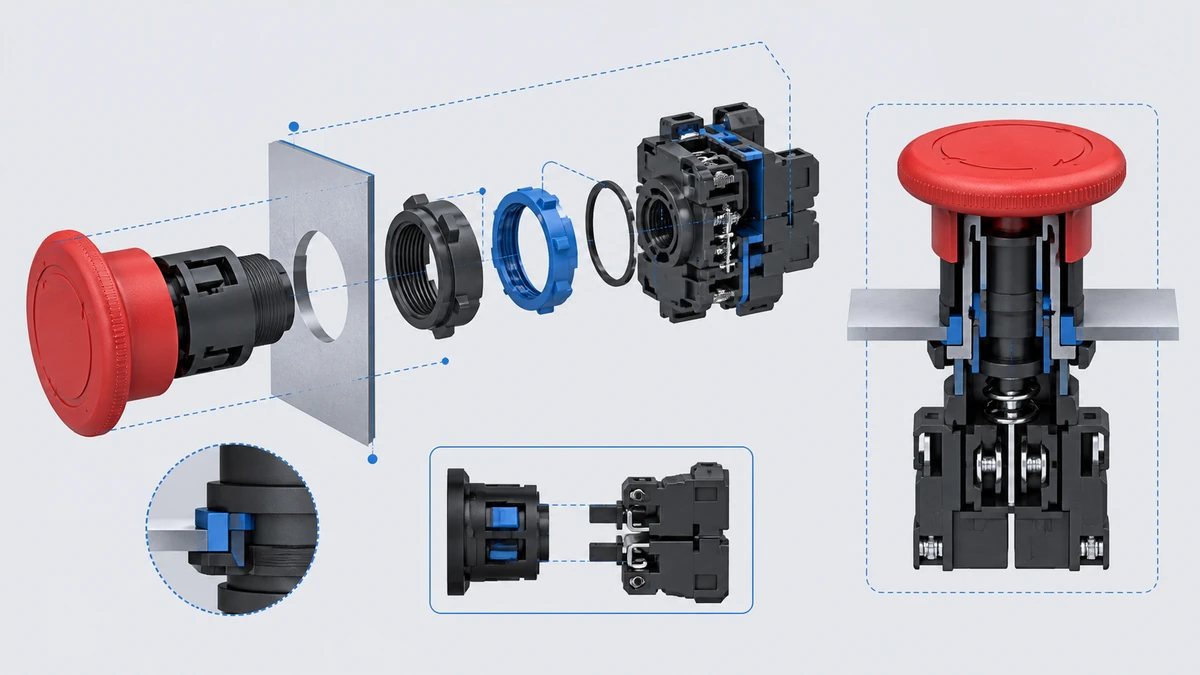
An exact drawing identifies the interfaces that must be controlled for the approved model route.
What a manufacturer should be able to confirm
A manufacturer or authorized supply route should be able to identify the operator style, contact arrangement, mounting method, marking and documentation for the exact part being quoted. If the response stays at the family-name level, the buyer still carries configuration risk.
Ask whether the quoted item is a complete assembly or a route made from separate operator, contact block and marking components. The answer affects drawings, inspection, spares and panel-build instructions.
Buyer action list for the first shortlist
Collect the exact product series and model route, not only a marketing name.
Ask whether the quote covers the operator head, contact blocks, mounting hardware and legend or marking items.
Request the datasheet revision or drawing reference used for the quotation.
Confirm whether destination-market documentation is available for the exact model.
Record any exceptions, substitutes or pending confirmations before comparing price.
Evaluate documentation before price
Treat documentation as a gating item before comparing price, MOQ or lead time. Price is only useful after the buyer knows which exact operator assembly is being compared.
O ISO 13850 overview describes ISO 13850 as setting functional requirements and design principles for the emergency-stop function. That boundary matters: an emergency-stop operator is one device-level input, and selecting it does not prove that the complete machine safety function, control architecture or stopping performance is valid.
Documents to request from each supplier
Request documents by exact model and configuration. Avoid accepting a broad certificate, catalog page or drawing unless it clearly covers the quoted route.
Document or evidence item
What it helps the buyer verify
Buyer caution
Exact-model datasheet
Electrical, mechanical and environmental information for the quoted item
Ratings and limits are model-dependent
Desenho dimensional
Panel cutout, depth, clearance and mounting details
Confirm revision and accessory stack-up
Contact arrangement information
NO/NC quantity and contact block arrangement
Check the configured assembly, not only the series
Marking or legend details
Text, symbols, plate size and orientation
Marking requirements depend on machine and destination market
Certificate package, if required
Evidence available for a specific model and market route
Availability is exact-model and destination-market dependent
Documents to compare before commercial ranking
Compare documents for completeness, not only for whether a file exists. A supplier with a clear drawing and stated limitations may be easier to manage than one offering a broad claim without traceability.
For panel assemblers and distributors, document control is part of the purchase decision. If drawings, datasheets or certificates are needed for the buyer’s own customer submittal, request them before accepting substitutes.
Match the operator type to the machine-stop concept
Choose the operator type only after the machine-stop concept, reset behavior and user-interface layout are defined. Emergency-stop operators, selector switches and ordinary push buttons may share a panel location, but they serve different control purposes.
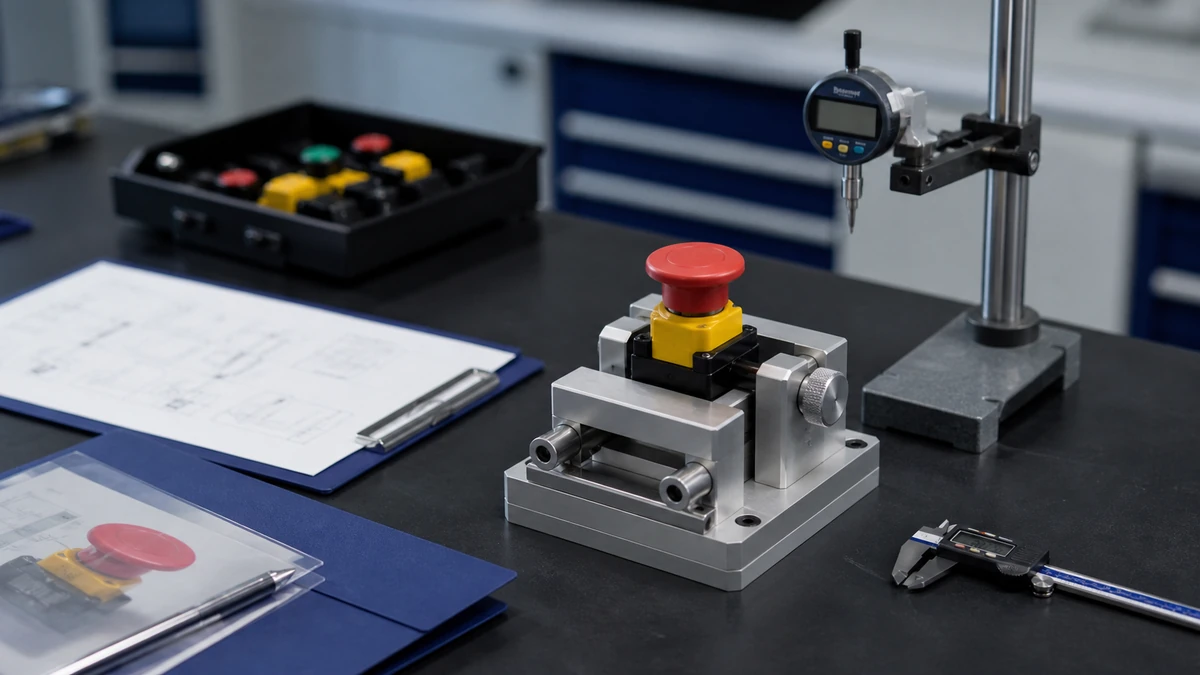
Sample review should connect the exact item to its current drawing and requested evidence package.
Emergency-stop operator attributes to verify
Confirm the operating action, release method, color and marking route against the machine design and the applicable requirements for the destination market. Do not assume that every product family has the same action, head size, illumination option or contact stack.
Also confirm whether the emergency-stop operator is intended to be non-illuminated or illuminated, and whether the buyer’s control voltage and current are suitable for the selected components. These details are exact-model and application dependent.
When a selector or ordinary push button is different
A selector switch is normally chosen for mode, function or command selection, while an ordinary push button is chosen for momentary or maintained control commands. These components should not be treated as emergency-stop operators unless the exact design, marking, action and safety concept support that use.
If the machine requires a stop, reset, start or mode function near the emergency-stop location, specify each operator separately. This avoids accidental substitution and makes panel drawings easier to audit.
Check contacts, mounting and accessories as an assembly
Evaluate the complete operator assembly because the head, contact blocks, mounting parts and legend items determine what the panel builder actually installs. A correct-looking operator head can still be wrong if the contact arrangement, mounting depth or marking package differs from the drawing.
Installation conditions change the product-route and document questions a buyer must resolve.
Contact arrangement evidence
Confirm the required NO and NC contact arrangement from the electrical design, then verify that the quoted configuration matches it. Do not rely on a generic product image to determine contact count or contact type.
Buyer requirement
What to confirm on the quote
Por que é importante
NC contact for emergency-stop input
Exact contact block type and quantity
The control design depends on the contact arrangement
Additional signaling contact
Separate contact block and wiring purpose
Panel drawings must distinguish control and indication needs
Contact stack depth
Installed depth behind the panel
Enclosure clearance can change with accessories
Contact ratings
Exact-model datasheet values
Values vary by model, load type and application conditions
Panel-mount accessory confirmation
Check panel cutout, panel thickness, mounting method and rear clearance using the exact drawing. If a legend plate, protective shroud or other accessory is part of the design, include it in the quote and drawing review.
Practical assembly checklist:
Confirm panel cutout diameter and tolerance from the drawing.
Confirm panel thickness range for the selected mounting hardware.
Confirm rear clearance with the contact blocks installed.
Confirm legend plate text, symbol, orientation and language.
Confirm whether the ordered item is supplied assembled or as separate components.
Compare manufacturers with a commercial evaluation matrix
Rank manufacturers by documented fit, quotation clarity and support for the buyer’s destination market before giving weight to price. A lower unit price can create cost later if drawings, certificates or configuration details remain unresolved.
Shieldhz can be included in this matrix as a candidate supplier when the requested model route and documentation package are confirmed. The same evaluation criteria should also be applied to any alternate manufacturer, distributor or approved-vendor source.
Supplier evidence scoring
Use a structured matrix so engineering, purchasing and panel assembly teams make the same decision. Adjust weighting to the buyer’s risk profile and destination market.
Evaluation criterion
Strong evidence
Risk signal
Exact-model identification
Clear model route and accessory list
Family name only
Pacote de documentação
Datasheet, drawing and requested certificate evidence tied to the model
Generic brochure without traceability
Configuration support
Contacts, marking, mounting and environment reviewed before quote
Supplier asks only for quantity
Destination-market support
Market documentation availability confirmed for the route
Unclear or assumed compliance
Substitution control
Alternatives listed with differences
Unannounced substitution risk
Commercial clarity
Price, pack quantity, lead-time basis and validity stated
Incomplete commercial conditions
Risk questions for purchasers
Before approving a supplier, ask whether the quotation is specific enough for engineering release. If the answer is no, the part should stay in review.
Is the quote tied to a drawing or datasheet revision?
Are contacts and accessories included in the part route?
Are marking and legend requirements written into the offer?
Is the certificate package available for the destination market, if required?
Are substitutions prohibited unless approved by the buyer?
Is final suitability still pending application review?
How Shieldhz confirms a push button, selector switch or emergency-stop operator route
Shieldhz confirms a route by matching the buyer’s stated application requirements to current product documentation before quotation or final selection. Final suitability is confirmed against current product documentation and the buyer’s application, not by product-family assumptions.
This process helps machine builders, control-panel assemblers, maintenance planners and distributors avoid ordering a near-match. It also keeps emergency-stop operator selection separate from validation of the complete machine safety function.
Inputs Shieldhz requests before quotation
Shieldhz’s practical pre-quotation confirmation should cover the following inputs:
Machine function and destination market.
Operator action, such as momentary, maintained, selector or emergency-stop release style.
Control voltage and current for the intended circuit.
Required contact arrangement, including NO and NC quantity.
Panel cutout, mounting method, panel thickness and available rear depth.
Environment, including enclosure conditions, exposure and cleaning assumptions.
Marking, legend, language or symbol requirements.
Required drawing, datasheet and certificate package for the exact model route.
Output the buyer should expect
The buyer should expect a confirmed model route or a request for missing information. If the application cannot be confirmed from available documentation, that limitation should be stated before the order is placed.
A useful quotation package identifies the operator, contact blocks, mounting and marking items included. It should also state which drawings, datasheets and certificate documents are being used for the offer.
Validate destination-market and application constraints before ordering
Confirm destination-market and application constraints before purchase release because documentation and suitability are not universal across models or regions. The same operator family may have different evidence, options or limits depending on exact configuration.
Do not treat a catalog statement as approval for every machine, enclosure or country. Buyers should align the supplier’s documentation with the machine builder’s risk assessment, panel specification and customer submittal requirements.
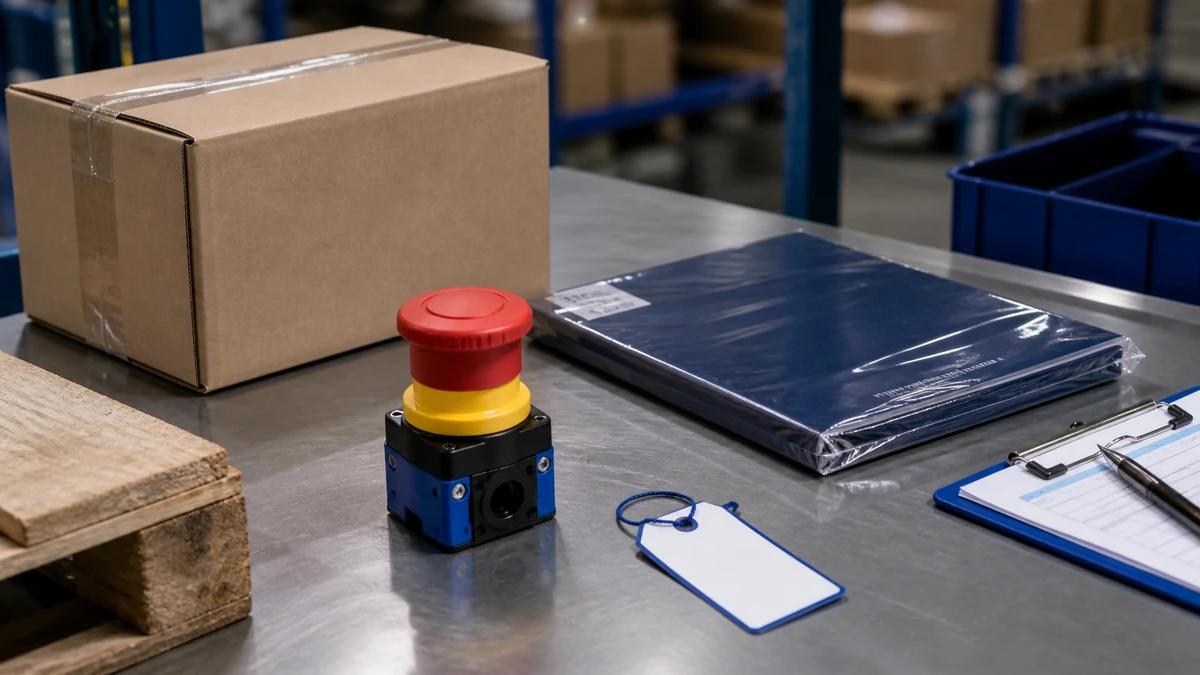
Documentation control, sample acceptance and protective packing are separate handover checks.
Destination-market questions
Destination-market review should be explicit in the inquiry. If a certificate, declaration or marking is needed, request it by exact model and configuration.
Checklist for market review:
Which country or region will the machine or panel ship to?
Does the buyer require a specific certificate package for the exact model?
Is the certificate evidence current and tied to the configured part?
Are language, symbol or legend requirements defined?
Are customer submittal documents required before shipment?
Application constraints to document
Application constraints can affect product selection, even when the operator appears physically compatible. Confirm voltage, current, load type, panel environment, user access and cleaning exposure against current documentation.
Where environmental ratings, mechanical endurance, torque values or other limits are important, request exact-model data. Do not copy values from a different model, accessory combination or older revision without supplier confirmation.
Convert the shortlist into a controlled purchase specification
Turn the selected manufacturer route into a controlled purchase specification so engineering intent survives procurement, assembly and maintenance. This is where a commercial investigation becomes an executable buying decision.
A controlled specification reduces accidental substitution and helps maintenance teams reorder the same configured assembly later. It also gives distributors a clear basis for quoting approved alternatives when substitutions are allowed.
Specification fields to include
Include enough detail for another buyer to reproduce the same order without interpretation. If a field is unknown, leave it open for engineering approval rather than allowing assumption.
Specification field
Example of what to record
Manufacturer or approved supplier
Shieldhz or other approved source, as evaluated
Exact model route
Operator head, contacts, mounting items and accessories
Função
Emergency-stop, start, stop, reset, selector or indication-related role
Electrical requirements
Control voltage, current and contact arrangement
Mechanical requirements
Cutout, panel thickness and rear clearance
Marking requirements
Legend text, symbol, language and orientation
Documentação
Drawing, datasheet and certificate package required
Substitution rule
Allowed only with engineering and documentation review
Purchase-release checklist
Before releasing the order, complete a final cross-check. This should be done even when the supplier has been used before, because product routes and project requirements can change.
Confirm the configured model matches the latest panel drawing.
Confirm contact arrangement against the electrical schematic.
Confirm marking and legend details against the HMI or panel layout.
Confirm documentation package against customer and destination-market needs.
Confirm commercial terms are tied to the exact route.
Confirm any approved alternatives are documented with differences.
Conclusion
Emergency stop button manufacturers should be compared through plural supplier research: documentation quality, exact-model configuration, destination-market evidence, quotation clarity and application fit. Shieldhz can be evaluated as one supplier candidate, but the correct decision depends on the buyer’s machine function, control design, panel constraints and required documentation package.
Most importantly, an emergency-stop operator is not the complete emergency-stop function. Treat the operator as one documented component in a broader machine safety design, and confirm final suitability against current product documentation and the buyer’s application before ordering.
Perguntas frequentes
What should I ask emergency stop button manufacturers before requesting price?
Ask for the exact model route, contact arrangement, panel cutout, mounting method, marking requirements and documentation package. Price comparison should come after the supplier confirms the configured product being quoted.
Can I approve an emergency-stop operator from a catalog image?
No. A catalog image does not confirm contact arrangement, mounting depth, marking, documentation or destination-market evidence. Use the exact drawing and datasheet for the configured route.
Does selecting an emergency-stop operator validate the machine safety function?
No. Selecting the operator is only one device-level decision. The complete machine safety function depends on the machine design, control architecture, risk assessment, stopping performance and applicable requirements.
Should purchasing allow substitute emergency-stop operators?
Only if engineering reviews the substitute against the same criteria as the original route. Contacts, mounting, markings, documentation and destination-market evidence should be compared before approval.
What documentation is most important for panel builders?
Panel builders usually need the exact dimensional drawing, datasheet, contact arrangement and marking details. If customer or market submittals are required, the certificate package should also be confirmed by exact model.
Can Shieldhz be considered for emergency-stop operator supply?
Yes. Shieldhz can be considered as a supplier candidate when the buyer provides the application inputs needed to confirm the model route, documentation package and quotation details against current product information.
Shi, Muxi
Shi, Muxi escreve artigos técnicos da Shieldhz para compradores de controle industrial e componentes elétricos, abrangendo chaves de came rotativas, chaves isoladoras, seccionadores PV DC, botões de pressão, luzes indicadoras, gabinetes à prova d'água e blocos de terminais. Os artigos são baseados na experiência de fabricação e exportação da Zhejiang Shihe Electric Co., Ltd., com ênfase prática na seleção de modelos, planilhas de dados, desenhos, certificações, classificações de IP e detalhes de consulta que os compradores devem confirmar antes de fazer o pedido.