AC-21A vs AC-23A Cam Switch Duty: What Panel Builders Need to Check
Use a practical buyer checklist to evaluate AC-21A vs AC-23A cam switch inputs, documentation, approval controls and the exact rotary cam switch route.
The AC-21A vs AC-23A cam switch decision is a utilization-category decision: confirm what the switch is actually making and breaking, then match the exact model documentation to that duty. Do not select from current or motor kW alone.
Confirm whether the load is mainly resistive, mixed, motor, or highly inductive before requesting a quote.
Keep voltage, current, AC/DC duty, utilization category, pole count, and contact program together in the same specification.
Ask for the applicable drawing, datasheet, and certificate package for the exact switch route and destination market.
AC-21A vs AC-23A is a duty decision, not a size shortcut
AC-21A and AC-23A should be treated as different switching duties, not as two labels for the same ampere rating. The practical boundary is what the cam switch must make, carry, and break in the buyer’s circuit.
For the standards boundary, see the IEC 60947-3 scope. IEC describes this scope as switches, disconnectors, switch-disconnectors and fuse-combination units within stated distribution- and motor-circuit AC/DC limits.
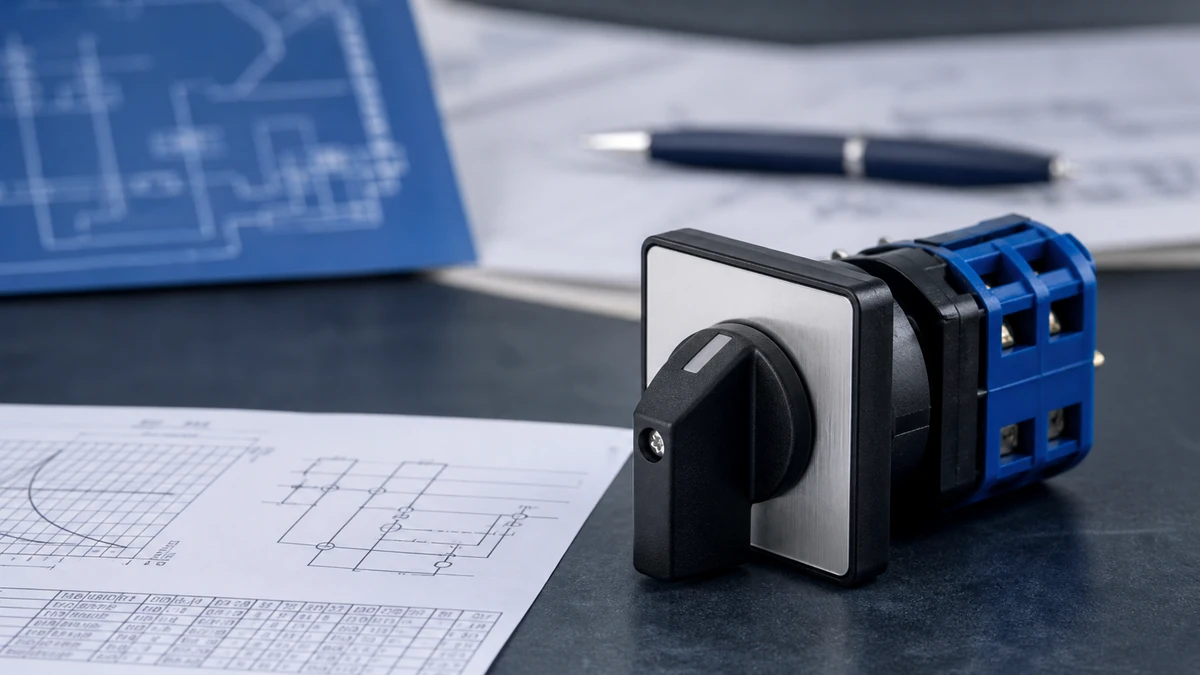
An exact drawing identifies the interfaces that must be controlled for the approved model route.
The buyer decision boundary
AC-21A is normally considered when the load is non-inductive or only slightly inductive, subject to the exact product documentation. AC-23A is investigated when the switch is expected to switch motor loads or other highly inductive loads, again only within the documented rating of the exact model.
The important commercial point is this: a part number that looks acceptable at one current level may not be acceptable for a different utilization category at the same current. Panel builders should therefore request the rating table, not only the headline ampere size.
Exact voltage, current, duty, motor circuit conditions, contact program, documentation
Why this affects sourcing
For sourcing teams, the AC-21A vs AC-23A cam switch decision changes the quotation input. A request that says “same ampere rating” is incomplete if the utilization category is missing.
For engineering distributors, it also affects substitution. A substitute must be checked against the same voltage, current, utilization category, function, mounting, and documentation requirements; a similar handle style or frame size is not enough.
When AC-21A may be the route
AC-21A may be the route when the cam switch is used for a documented non-inductive or slightly inductive switching duty. The exact switch model, circuit voltage, load current, pole arrangement, and product documentation still control the decision.
Use o Faixa do interruptor de came rotativo as a starting point for available product families, then narrow the route through the actual duty and documentation.
Typical AC-21A investigation cases
Panel builders may investigate AC-21A for duties such as resistive load switching or simple supply selection where the circuit behavior fits the documented utilization category. The final answer is not assumed from the application name; it is confirmed from the electrical data and the selected switch documentation.
If the circuit includes inductive elements, transformers, motors, or unusual inrush behavior, do not force an AC-21A route without review. Those details can change the duty boundary.
AC-21A pre-checklist
Before asking for an AC-21A quotation, collect:
Rated operational voltage and frequency.
Load current under the operating condition to be switched.
Whether the switch makes and breaks current, or only changes state under controlled conditions.
Number of poles to be switched.
Required positions and contact sequence.
Panel cutout, mounting depth, and handle style.
Required drawing, datasheet, and certificate expectations for the destination market.
When AC-23A should be investigated
AC-23A should be investigated when the cam switch is expected to switch motor loads or other highly inductive loads under the conditions covered by the exact product documentation. This is not a universal motor kW route; the selected model must be checked against voltage, current, duty, switching function, and documentation.
For motor-related switching functions, use the rotary cam switch motor-control guide to frame the function before confirming the utilization category.
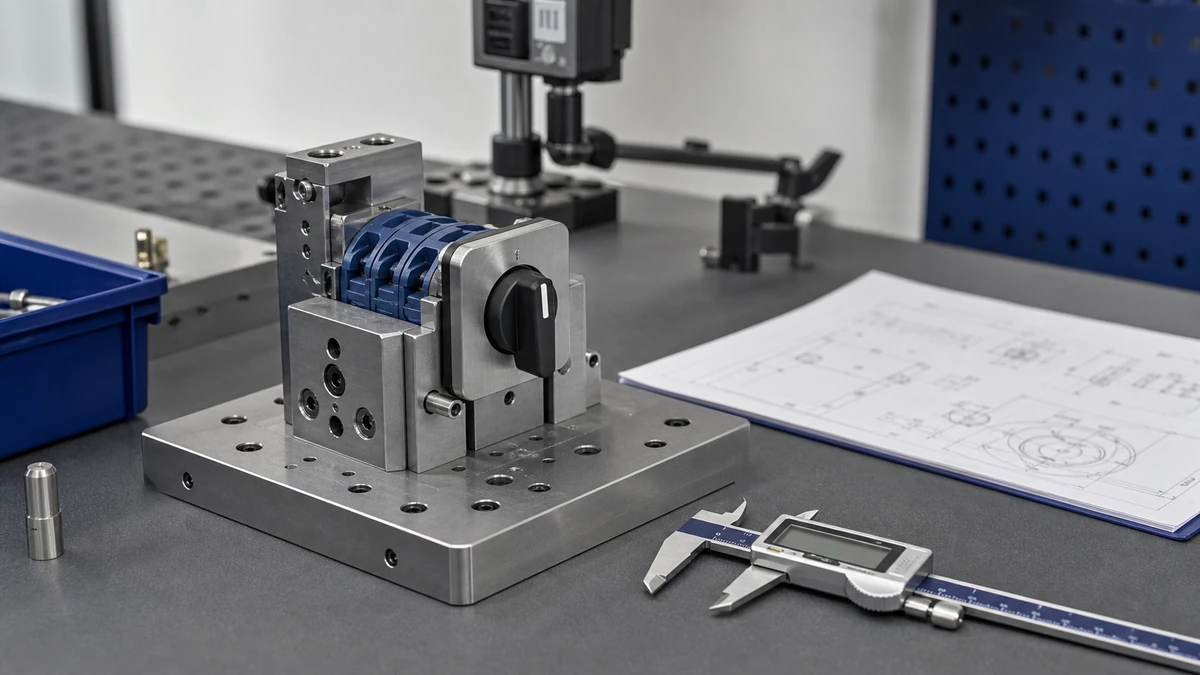
Sample review should connect the exact item to its current drawing and requested evidence package.
Motor duty is not one single selection path
A motor circuit can involve direct switching, reversing, multi-speed selection, star-delta sequencing, or auxiliary control interaction. Those functions do not have the same contact program or duty assumption.
A motor nameplate kW value alone does not confirm the cam switch route. The quotation should include the motor voltage, full-load current if applicable, starting or operating method, switching sequence, and whether the switch is intended to make or break load current.
AC-23A investigation checklist
Use this checklist when AC-23A is being considered:
Confirm the motor or highly inductive load type.
Provide rated operational voltage and current for the switched circuit.
State the required switching function, such as on-off, reversing, changeover, or sequence control.
Confirm whether switching occurs under load.
Define pole count and required isolation of phases or conductors.
Provide any drawing or schematic that shows the switching sequence.
Request the exact-model datasheet and applicable certificate package before release.
Why current, voltage and utilization category must stay together
A cam switch current rating is only meaningful when it is read with voltage and utilization category. The same nominal ampere value may not describe the same duty across AC-21A, AC-23A, AC or DC service, or different product series.
Same current does not mean same switching duty
A buyer request that says “25 A cam switch” leaves too much open. The supplier still needs to know whether that 25 A is for a resistive load, motor load, mixed load, AC circuit, DC circuit, and at what voltage.
That is why panel builders should write the specification as a combined line item: voltage, current, utilization category, function, and poles. Separating those items increases the risk of a wrong comparison between models.
Incomplete request
Better request for quotation review
Por que é importante
“25 A cam switch”
“Cam switch for stated voltage/current, AC-21A or AC-23A to be confirmed by datasheet”
“Changeover function with pole count, positions, load type, utilization category, mounting”
Function and duty both affect selection
“Same as existing”
“Existing part number plus drawing, rating, category, contact program, and application details”
Substitution needs documented equivalence
AC and DC must not be mixed casually
If the application is DC, do not infer suitability from an AC utilization category. DC switching behavior and documented ratings must be checked separately for the exact product route.
If the panel builder is unsure whether the switched circuit is AC power, DC power, or a control circuit, that must be clarified before commercial comparison. The wrong assumption can make two quotations look equivalent when they are not.
Contact program decisions that sit beside utilization category
Utilization category does not define the whole cam switch. The contact program, positions, poles, and stage arrangement determine whether the switch performs the required circuit function.
Installation conditions change the product-route and document questions a buyer must resolve.
Function first, then contact sequence
A two-position on-off switch, a changeover switch, a voltmeter selector, and a motor reversing switch may all be called rotary cam switches. They are not interchangeable unless the contact sequence and rating documentation support the same use.
The quotation should state each position and what contacts are open or closed in that position. If the drawing is available, include it with the enquiry.
Poles and stages affect the model route
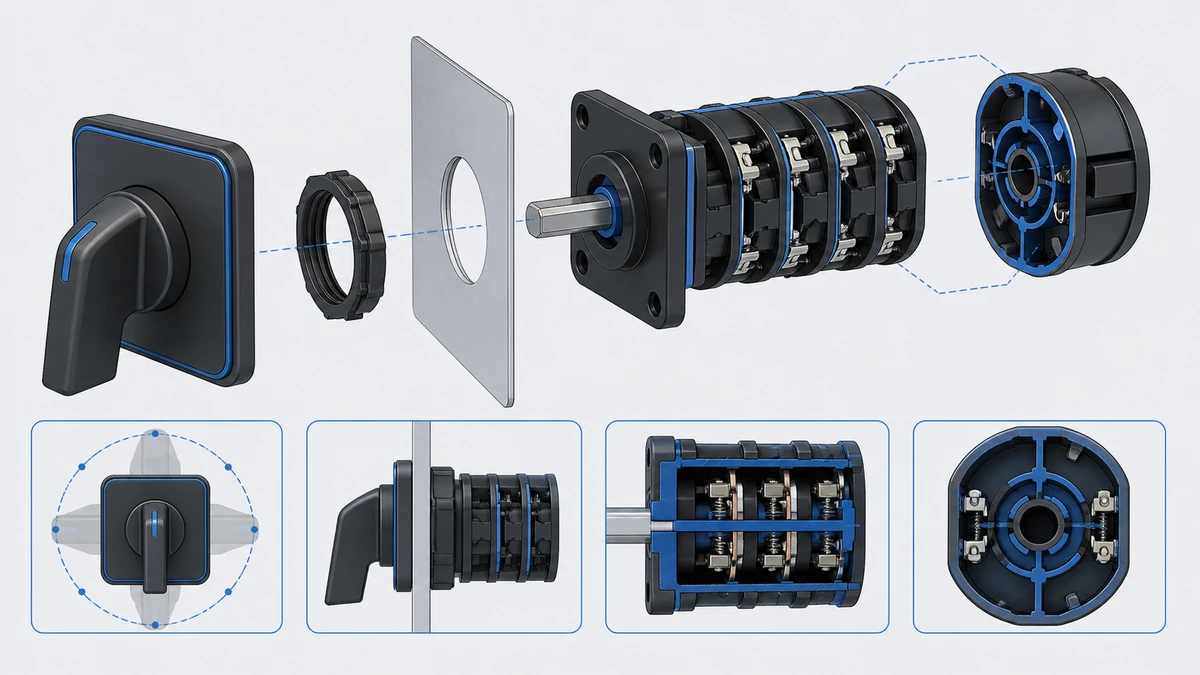
Pole count decides how many conductors are switched. Contact stages and cam programming decide the timing and combination of those contacts.
For commercial comparison, ask suppliers to quote against the same contact program. A different internal arrangement may change depth, mounting, rating documentation, or suitability for the circuit.
Panel interface and environment checks before sourcing
A technically suitable utilization category still does not complete the sourcing decision. The panel interface, operator route, enclosure environment, and destination documentation must also match the buyer’s application.
Panel builders should confirm the cutout, mounting style, shaft length, handle type, legend plate requirement, and available depth behind the panel. A correct electrical selection can still fail the mechanical layout if these items are left open.
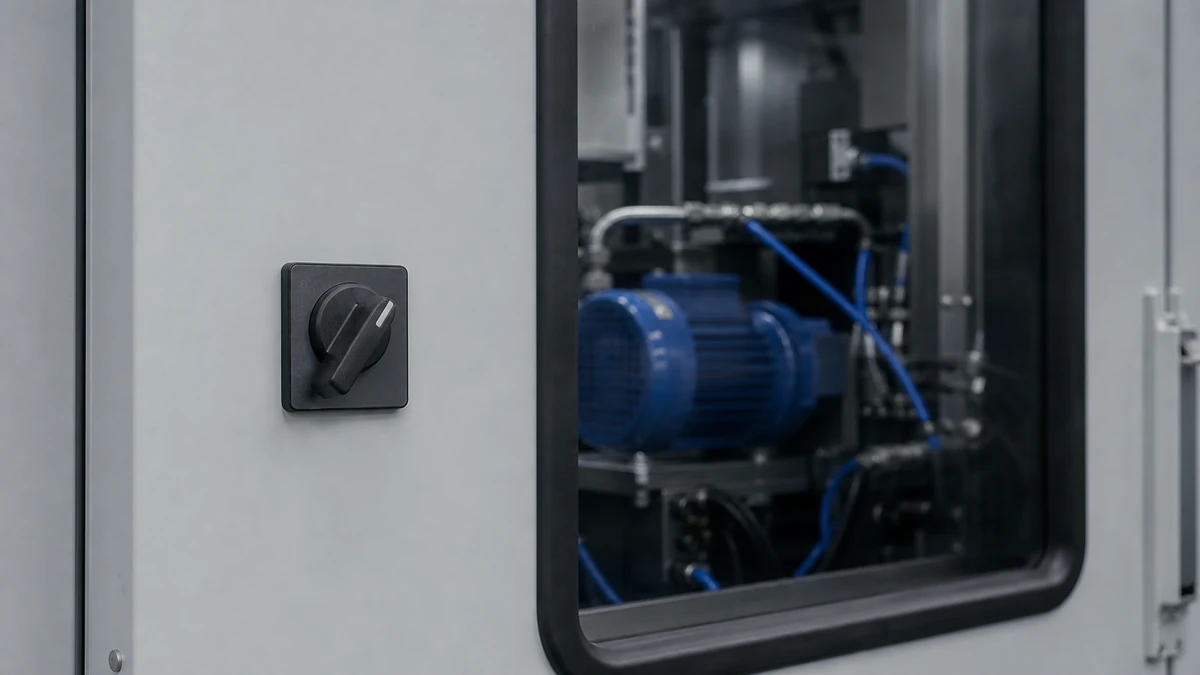
If the switch is mounted through an enclosure door, the handle route and shaft arrangement should be checked against the drawing. Do not assume that a visually similar operator has the same dimensions.
Environment and destination market
Environmental requirements depend on the enclosure, installation location, cleaning method, exposure, and buyer specification. Any IP rating, material requirement, temperature range, or certificate request should be confirmed from current documentation for the exact model.
Destination market matters because documentation expectations can differ. Ask for the drawing, datasheet, and certificate package required for the buyer’s project rather than assuming one document set covers every market.
Panel-builder action list
Before purchase release, verify:
Panel cutout and mounting depth.
Handle type, color, marking, and legend requirement.
Shaft length or door-coupling arrangement if applicable.
Enclosure and environmental assumptions.
Destination-market documentation request.
Exact part number and revision shown on the quotation.
Documentation a distributor or OEM should request
The safest commercial comparison is between documented switch routes, not between short descriptions. Request the documents that prove what the quoted model is intended to cover.
Minimum document package for comparison
A typical pre-order document request may include a drawing, datasheet, contact program, and applicable certificate package. The exact package depends on model, buyer application, and destination market.
Document or input
What it should clarify
Buyer use
Product drawing
Dimensions, mounting, handle route, terminal marking where shown
Panel layout and build review
Folha de dados
Electrical ratings, utilization category references, environmental limits where stated
Engineering selection check
Programa de contato
Position-by-position contact operation
Schematic and function verification
Certificate package
Applicable approvals or declarations for the exact route where available
Destination-market and project documentation
Quotation line
Part number, configuration, accessories, document revision if provided
Procurement control
Revision control matters
If the switch route is used across multiple machines or panel variants, keep the quoted part number, contact program, and documentation revision with the project file. This makes later purchasing and substitution checks more controlled.
For distributors, this also reduces ambiguity when a buyer asks for an alternative. The alternative must be checked against the same documented requirements, not only the same price class or handle appearance.
How Shieldhz confirms a rotary cam switch route
Shieldhz confirms a rotary cam switch route by checking the buyer’s switching duty, mechanical route, and documentation request before quotation. Final suitability is confirmed against current product documentation and the buyer’s application.
Documentation control, sample acceptance and protective packing are separate handover checks.
Pre-quotation confirmation inputs
For an AC-21A vs AC-23A cam switch enquiry, Shieldhz typically needs the switching function first. Examples include on-off, changeover, reversing, multi-step selection, instrument selection, or a custom contact sequence.
The next confirmation is AC/DC duty, rated voltage and current, and the requested or suspected utilization category. If AC-21A or AC-23A is not yet confirmed by the buyer, the load description and circuit behavior should be provided for review.
Model route and document confirmation
Shieldhz also checks pole count, positions, contact stages, panel mounting, handle route, and environmental or enclosure assumptions. Any requested drawing, datasheet, and certificate package should be stated at enquiry stage.
The quotation route is then tied to the exact model configuration available for that duty and documentation set. If the buyer’s application, destination market, or project specification changes, the switch route should be rechecked before release.
Common purchasing mistakes when comparing AC-21A and AC-23A offers
Most purchasing errors happen when a quote is compared by ampere rating, handle type, or price without confirming the utilization category and contact program. The correction is to compare complete switch routes.
Mistake 1: Treating AC-21A and AC-23A as interchangeable
AC-21A and AC-23A are not interchangeable labels. They indicate different duty assumptions, and the exact model documentation must support the intended use.
If a supplier offers a lower-cost part, ask which utilization category and voltage/current line it is being quoted against. If the answer is unclear, the quote is not ready for engineering release.
Mistake 2: Selecting from motor kW alone
Motor kW can be useful application context, but it is not a universal cam switch selection path. Voltage, current, switching condition, motor circuit arrangement, and contact program still need review.
This is especially important for reversing or multi-step motor functions. The switch must match the intended sequence as well as the documented duty.
Mistake 3: Ignoring operator and safety-function boundaries
A handle color, marking, or operator style does not validate a complete machine safety function. If an emergency-stop style operator or red/yellow handle is requested, the full machine safety function must be assessed separately by the machine builder or responsible designer.
The cam switch selection can support the specified operating interface only within its documented product role. It should not be treated as proof that the complete safety function is compliant or validated.
Conclusion
The AC-21A vs AC-23A cam switch decision belongs at the utilization-category boundary. AC-21A may be investigated for documented non-inductive or slightly inductive switching duties, while AC-23A should be investigated for motor or highly inductive switching duties.
For panel builders, OEMs, distributors, and sourcing teams, the practical rule is simple: do not buy from current, kW, or handle style alone. Confirm voltage, current, AC/DC duty, utilization category, contact program, mounting route, environment, and the exact documentation package before purchase release.
Perguntas frequentes
Is AC-23A always required for a motor circuit?
Not automatically, but it should be investigated when the cam switch is expected to switch a motor load or other highly inductive load. The final route depends on the exact model documentation and the buyer’s circuit conditions.
Can I replace an AC-23A cam switch with an AC-21A cam switch of the same ampere rating?
Do not assume that is acceptable. The same ampere value does not confirm the same utilization category, voltage, switching duty, contact program, or documentation coverage.
Can I select the cam switch from motor kW?
Motor kW alone is not enough. Provide voltage, current, switching function, load condition, contact sequence, and required documentation so the correct route can be checked.
What information should I send for a quotation?
Send the switching function, AC/DC duty, voltage, current, suspected utilization category, pole count, positions, contact program, mounting details, handle route, environment, and requested drawing, datasheet, and certificate package.
Does choosing a red/yellow operator validate an emergency-stop function?
No. Selecting an operator or handle style does not validate a complete machine safety function. The responsible machine designer must assess the full safety function, architecture, and applicable requirements.
What is the fastest way to avoid a wrong AC-21A vs AC-23A comparison?
Compare only complete, documented switch routes. Each offer should show the exact model configuration, utilization category basis, electrical data, contact program, mounting route, and requested documentation package.
Shi, Muxi
Shi, Muxi escreve artigos técnicos da Shieldhz para compradores de controle industrial e componentes elétricos, abrangendo chaves de came rotativas, chaves isoladoras, seccionadores PV DC, botões de pressão, luzes indicadoras, gabinetes à prova d'água e blocos de terminais. Os artigos são baseados na experiência de fabricação e exportação da Zhejiang Shihe Electric Co., Ltd., com ênfase prática na seleção de modelos, planilhas de dados, desenhos, certificações, classificações de IP e detalhes de consulta que os compradores devem confirmar antes de fazer o pedido.