Panel Builder Supplier Qualification: Quality, Drawing, and Change-Control Questions
Use a practical buyer checklist to evaluate panel builder supplier qualification inputs, documentation, approval controls and the exact industrial control component portfolio route.
Panel builder supplier qualification should be a buyer-owned gate that verifies quality control, drawing control, documentation, change notification, and commercial handover before routine purchasing starts.
Define the approved model route before comparing unit prices.
Request current drawings, datasheets, marking details, and destination-market documents for the exact model under review.
Put change-control, sample approval, and quotation handover rules in writing before the first production order.
Why panel builder supplier qualification starts with the buyer’s own process
A supplier is qualified only when your team can match the supplier’s evidence to your application, destination market, and internal approval rules. The supplier can provide product information and quotation support, but the qualification decision belongs to the OEM, panel builder, distributor, or procurement organization.
Panel builder supplier qualification is not just a sourcing task. It is an engineering and commercial control point that decides whether a specific product route can be released for drawings, BOMs, purchasing, incoming inspection, and future change management.
Define the qualification boundary
Start by deciding what is being qualified. A company-level approval is different from approving a product family, exact model, wiring diagram, actuator color, enclosure style, or marking layout.
A practical boundary statement should answer:
Which buyer site or business unit is approving the supplier?
Which product family and exact model route are in scope?
Which destination market and customer standard apply?
Which drawing revision and datasheet revision are approved?
Which evidence is required before purchasing can release an order?
Separate supplier approval from product approval
Supplier approval confirms whether a company can be added to the purchasing system. Product approval confirms whether a specific component route is acceptable for a specific application.
Qualification layer
Buyer decision
Typical evidence to request
Supplier-level approval
Can this company be considered for sourcing?
Business details, contact ownership, quotation format, quality contact, documentation response process
Product-family approval
Is this family relevant to the design need?
Catalog page, datasheet, application notes, available model structure
Exact-model approval
Can this model be released on a BOM?
Drawing, ratings as documented, marking, certificate where applicable, sample approval record
Order-release approval
Can procurement place the order?
Approved quotation, model code, revision, packaging or labeling request, delivery and commercial terms
Buyer action checklist:
Create a supplier qualification form before requesting mass pricing.
Require exact model references, not only product descriptions.
Link approval records to drawing and datasheet revisions.
Define who can approve substitutions or alternates.
Store change-control contacts in the purchasing record.
Quality questions that separate catalog supply from controlled supply
Quality confidence depends on traceable controls for the exact product route, not broad sales statements. Ask how the supplier controls specifications, inspection references, nonconforming material, corrective actions, and document revisions.
A useful quality review does not need to copy a full factory audit. It should identify whether the supplier can support your approval records with consistent product identification and documented responses.
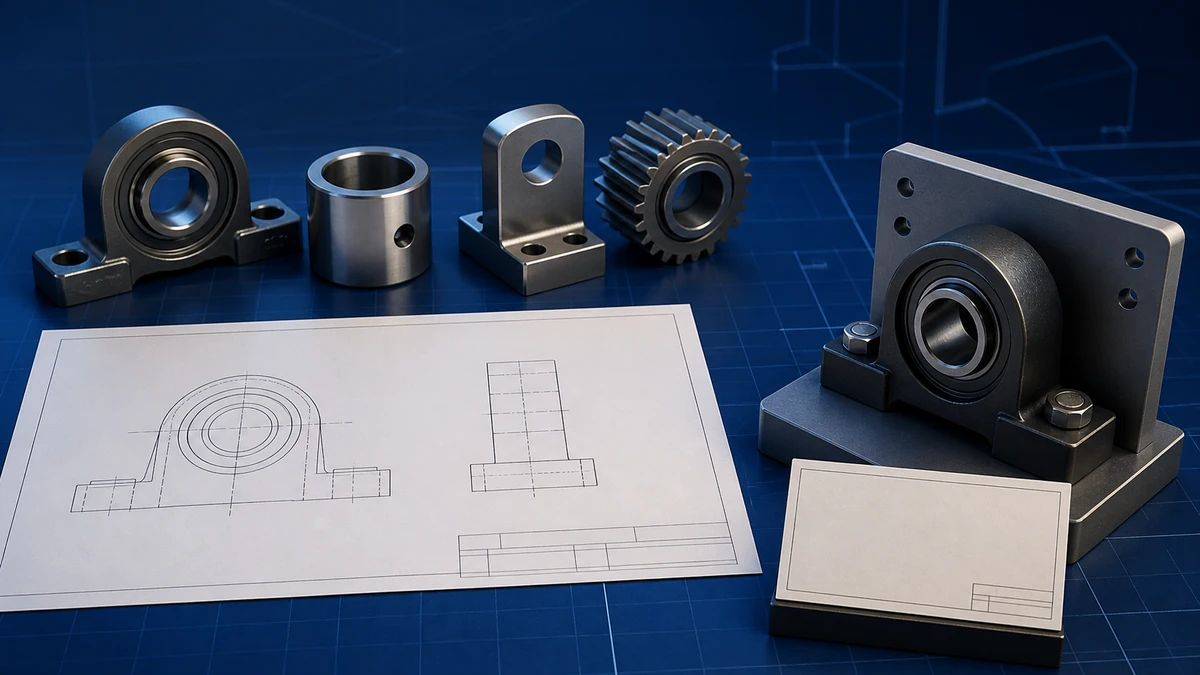
An exact drawing identifies the interfaces that must be controlled for the approved model route.
Ask process questions that produce evidence
Generic quality claims are less useful than controlled documents. Request evidence that can be attached to your internal supplier file and reviewed again if a product, drawing, or destination-market requirement changes.
Quality questions to ask:
What document identifies the exact model structure?
Which drawing or datasheet revision is current for quotation?
How are customer-specific markings or packaging instructions controlled?
What information appears on labels, packaging, or product marking for this model?
How are nonconforming shipments reported and contained?
Who receives engineering or commercial change notices?
Review quality records before price dominates the decision
A lower unit price can become expensive if engineering cannot verify the model, drawing, or change history. Keep the quality review close to the quotation review so purchasing does not approve an item that engineering cannot release.
Quality topic
Qualification question
Acceptable buyer-side record
Model control
Is the quoted item tied to an exact model code?
Quotation with model code and configuration notes
Drawing control
Is the drawing current and approved by engineering?
Approved drawing revision in document system
Inspection reference
What characteristics should incoming inspection verify?
Inspection checklist linked to drawing or datasheet
Marking control
Are markings model-specific and application-appropriate?
Marking confirmation or drawing note
Nonconformance handling
How will issues be reported and contained?
Named contact and written response process
Change notice
How will buyer approval be requested before changes?
Change-control clause or supplier agreement note
Drawing and model-route control before quotation approval
Approve the route before approving the price. If the model code, drawing, electrical inputs, mechanical dimensions, actuator details, enclosure arrangement, or marking are unclear, the quotation is not yet ready for release.
Drawing control is especially important when several similar industrial control components can appear interchangeable in a catalog view. The qualification record should make the approved selection unambiguous.
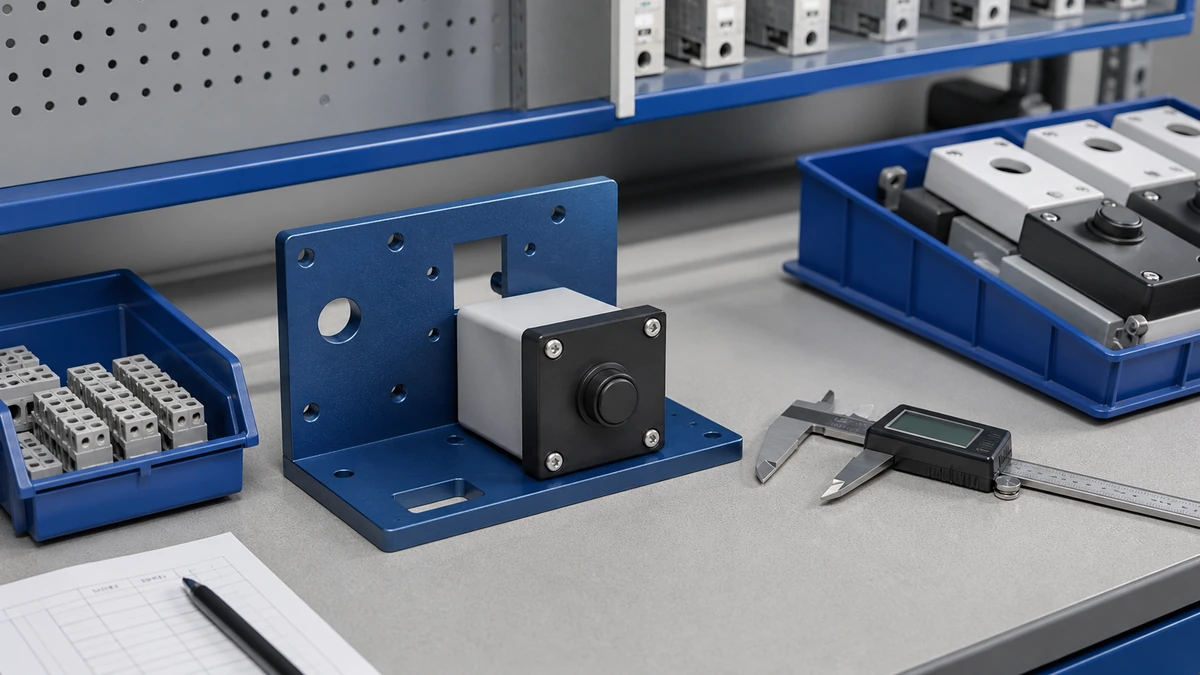
Sample review should connect the exact item to its current drawing and requested evidence package.
Confirm the model route
A model route is the path from product family to exact orderable configuration. It should include the product family, series, poles or contact arrangement where relevant, actuator or handle type, mounting style, enclosure or accessory option where relevant, and any marking or packaging request.
Do not rely on short descriptions such as “selector switch,” “isolator,” or “indicator.” Those phrases can describe a broad function, not the final approved component.
Lock the drawing package
The drawing package should be complete enough for engineering release and incoming inspection. It does not need to be excessive, but it should prevent ambiguity.
Drawing package checklist:
Exact model code and description
Current drawing or datasheet revision
Electrical characteristics as documented for that model
Mechanical dimensions and mounting information
Operator, handle, color, lens, or enclosure details where applicable
Marking and label requirements, if requested
Packaging or identification requirements for receiving
Buyer approval date and approver name
Any limits or exclusions noted by engineering
Decide how alternates will be handled
Alternates should not enter production through purchasing shortcuts. If an alternate model is proposed, it should go through the same drawing, documentation, marking, and application review as the original.
Alternate situation
Risk if uncontrolled
Buyer control
Similar model code
Wrong configuration may be ordered
Require engineering approval before release
Updated drawing
Mounting or marking may differ
Compare revision changes before purchase
Different actuator or enclosure
Operator interface may change
Validate mechanical and human-interface requirements
Different destination market
Documentation may not match project needs
Request market-specific evidence for the exact model
Supplier substitution
BOM traceability may be lost
Block substitutions without written approval
Change-control questions to ask before first order
Change-control terms should be agreed before the supplier is approved, not after the first issue occurs. The buyer should define which changes require notice, which require approval, and which prevent shipment until engineering releases the revision.
Change control is not only about major design changes. It may include marking, drawing revision, documentation status, packaging, part numbering, sourcing route, and commercial details that affect receiving or customer documentation.
Define what counts as a controlled change
The buyer should list change triggers in the supplier qualification file. This reduces disagreement later and helps procurement know when to pause ordering.
Controlled-change checklist:
Model code or configuration change
Drawing or datasheet revision change
Marking, label, or packaging change
Material, component, or construction change that affects the approved documentation
Manufacturing location or route change, if relevant to the buyer’s approval file
Certificate or destination-market documentation change
MOQ, lead-time, or commercial term change that affects production planning
Discontinuation, replacement, or end-of-availability notice
Put approval timing into the purchase process
A change notice is useful only if it arrives before the buyer is committed to production. Define the contact, the required notice content, and the approval hold point.
Change type
Supplier should provide
Buyer decision
Drawing revision update
Old and new revision, change summary, affected model
Accept, reject, or request sample review
Marking change
Proposed marking artwork or drawing note
Approve if it matches project requirements
Documentation change
Updated datasheet or certificate status for exact model
Documentation, standards, and destination-market evidence
Documentation should be requested for the exact model, destination market, and buyer application. Broad references to product families are useful for screening, but final approval needs current documents that match the item being purchased.
The evidence set may include drawings, datasheets, declarations, certificates, test summaries where applicable, installation information, and marking confirmations. The required set depends on the product, market, customer specification, and buyer risk level.
Treat standards as scope references, not automatic approval
Standards language must be read carefully. For example, the IEC 60947-3 scope describes switches, disconnectors, switch-disconnectors and fuse-combination units within stated distribution- and motor-circuit AC/DC limits.
That scope statement does not by itself approve a specific model for a specific application. The buyer still needs to confirm the current datasheet, markings, certificates where required, installation conditions, and application constraints.
Build a destination-market document list
A project for one market may require different evidence from a project for another market. Do not assume that a document used in one quotation is enough for a different destination or customer specification.
Documentation request checklist:
Exact model code and product family
Destination country or region
Applicable customer or end-user specification
Current datasheet and drawing
Certificate or declaration requested, if applicable
Marking and label requirements
Installation or usage constraints noted in documentation
Buyer-required language, format, or file naming
Validity or revision status at time of approval
Product-family fit questions for industrial control components
Select the product family by function first, then qualify the exact model. The right commercial decision starts with separating switching, isolation, indication, operator interface, enclosure, and environmental requirements before requesting a quotation.
O Shieldhz industrial control component range can be used as a portfolio starting point during supplier qualification. Final suitability still depends on the current model documentation and the buyer’s application.
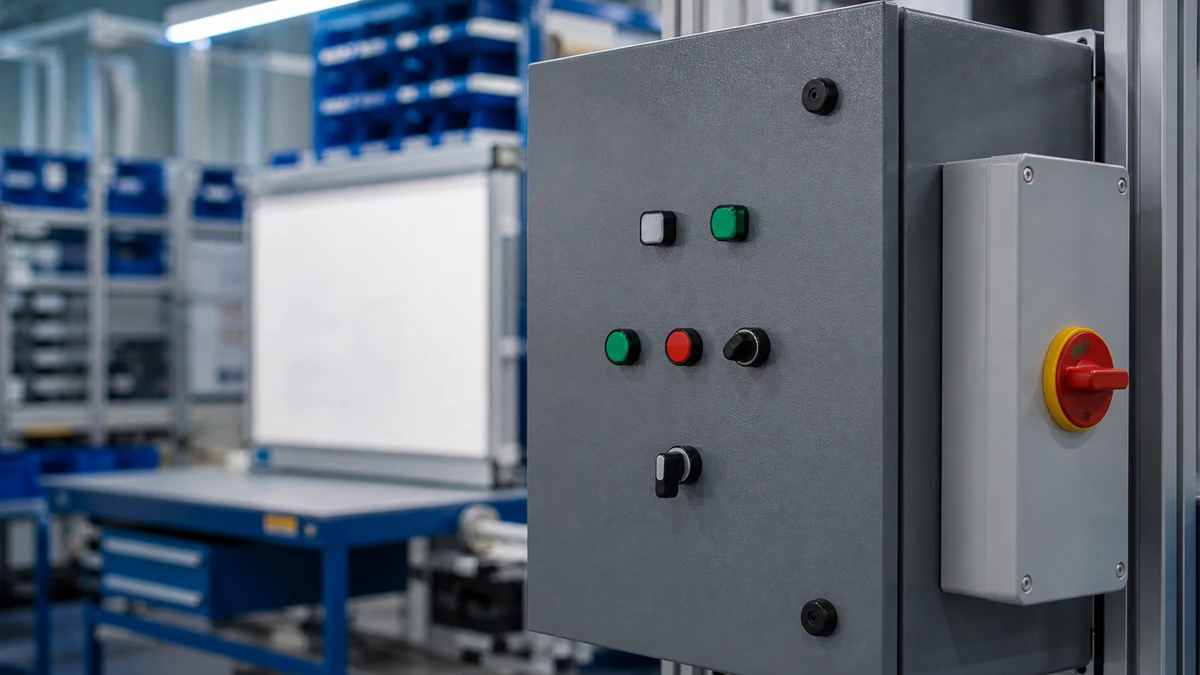
Installation conditions change the product-route and document questions a buyer must resolve.
Match the product family to the function
A rotary cam switch, DC isolator, push button, indicator light, or isolator box may sit in the same panel project, but they do not perform the same job. Qualification should reflect the function and the documentation needed for that function.
Do not qualify a switching device, isolator, or operator as if it were a different protective device. Its role should be documented according to the exact product type, datasheet, and application design.
For emergency-stop stations or operators, selecting the operator does not validate the complete machine safety function. The complete safety function depends on the machine risk assessment, control architecture, diagnostics, wiring, validation, and applicable standards selected by the machine builder.
How Shieldhz confirms a industrial control component portfolio route
Shieldhz can support pre-quotation confirmation by aligning the buyer’s requested application, market, model route, documentation, and commercial handover inputs before quotation release. This does not replace the buyer’s own supplier qualification process.
Final suitability is confirmed against current product documentation and the buyer’s application. The buyer should retain the approval record in its own engineering, purchasing, or quality system.
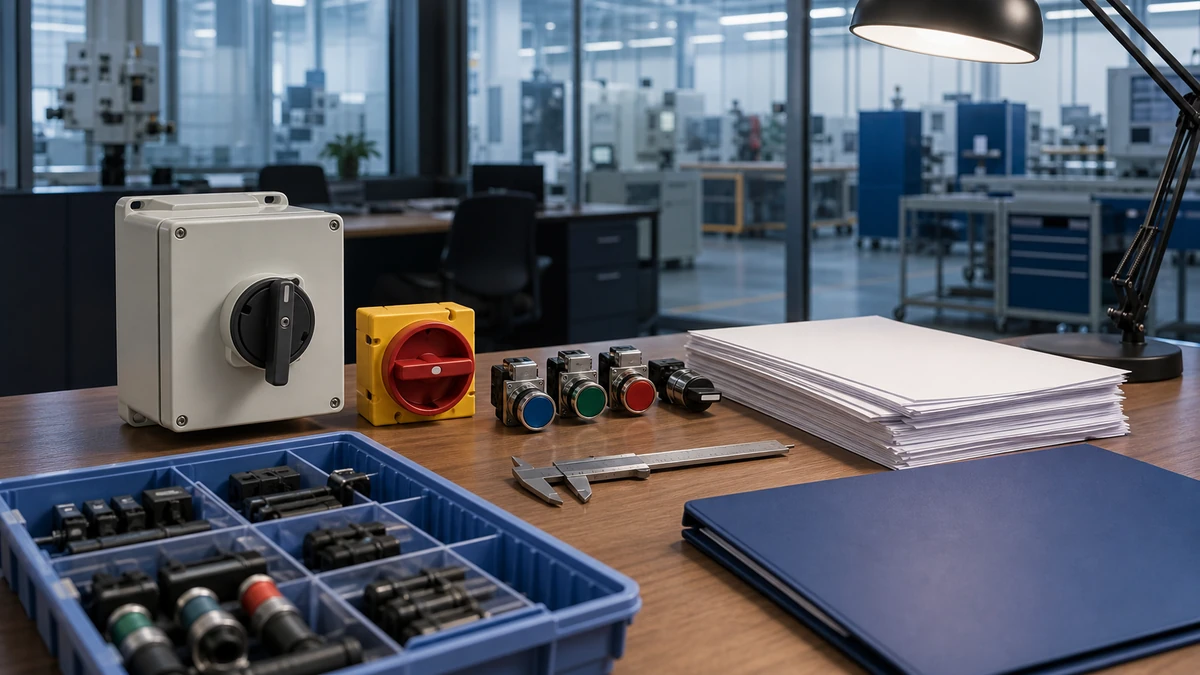
Documentation control, sample acceptance and protective packing are separate handover checks.
Pre-quotation confirmation inputs
A practical confirmation should start with the intended application and destination market. That context helps avoid quoting a model route that cannot be released later by engineering or customer documentation review.
Pre-quotation input checklist:
Application description
State the machine, panel, equipment, or installation context in which the component will be used.
Mercado de destino
Identify the country, region, or customer standard that will drive documentation requirements.
Product family and exact model route
Confirm whether the route is a cam switch, DC isolator, push button, indicator, enclosed isolator, or another listed component family.
Electrical inputs
Provide voltage, current, circuit type, number of poles, switching sequence, indication requirement, or other model-dependent data.
Mechanical inputs
Provide mounting method, cutout, handle or actuator preference, enclosure route, dimensions, and installation constraints.
Requested documentation
List the drawing, datasheet, certificate, declaration, marking file, or installation information needed for approval.
Approval records
Define who approves samples, drawings, documentation, and any later revisions.
Marking requirements
State text, symbols, labels, colors, or customer-specific identification needs.
Sample and change-control expectations
Confirm whether samples are required and what changes require written approval.
Commercial handover requirements
Confirm quotation format, model code format, packaging request, delivery basis, payment terms, and purchasing contacts.
What the buyer should verify before release
The buyer should verify that the quotation, drawing, datasheet, and internal BOM all describe the same item. Any mismatch should be resolved before the supplier is treated as approved for routine orders.
Release checklist:
Quoted model code matches approved drawing
Current documentation is stored in the buyer system
Application limits are understood by engineering
Destination-market documents have been reviewed
Marking and packaging instructions are recorded
Sample approval is complete, if required
Change-control contact and rule are documented
Procurement can order without interpreting engineering details
Procurement handover: scoring, samples, and ongoing records
Procurement should receive a controlled sourcing package, not just an email price. A clean handover reduces order errors and gives purchasing a clear rule for samples, alternates, revisions, and commercial changes.
The handover should be short enough for purchasing to use and detailed enough for engineering to defend later. It should include the approved model route, current documents, quotation basis, and escalation contacts.
Use a scorecard that reflects engineering risk
A supplier scorecard should not reward price alone. It should include document quality, model clarity, change-control willingness, and commercial fit.
Scorecard area
What to score
Buyer note
Model clarity
Exact model code, configuration, description
Low score if quotation uses vague descriptions
Documentação
Drawing, datasheet, certificate where needed
Score by exact-model match and revision control
Engineering response
Ability to answer application-specific questions
Record unresolved assumptions
Change control
Written notice and approval process
Must be clear before production release
Sample process
Availability and approval record route
Required where buyer policy demands it
Commercial fit
Price, MOQ, lead time, packaging, payment terms
Treat as model- and quotation-specific
Handover quality
Clean purchasing instructions
Reduces future ordering errors
Decide when to require samples
Samples are not always the same as approval. A sample can support mechanical fit, marking review, visual inspection, or engineering evaluation, but it must be tied to the same model route that will be ordered.
Sample approval action list:
Request samples using the exact model code.
Attach the sample request to the drawing revision.
Inspect physical details against the drawing or datasheet.
Record any deviations or buyer-requested changes.
Confirm whether the approved sample becomes the production reference.
Block production purchase if the production quote differs from the approved sample route.
Keep the supplier file alive
Supplier qualification is not a one-time event. Update the file when documents change, model routes are revised, destination markets change, or procurement terms affect production planning.
At minimum, review the supplier file when a new project uses the component in a different application, when a customer requests additional documentation, or when the supplier proposes a replacement. This keeps the buyer in control of approval rather than relying on assumptions from an earlier purchase.
Conclusion
Panel builder supplier qualification works best when engineering, quality, and procurement agree on the same controlled route: exact model, current drawing, required documentation, change-control rules, and commercial handover.
Shieldhz can support model-route and documentation confirmation during quotation, but the buyer should own the qualification decision. Final approval should always be checked against current product documentation and the buyer’s actual application, destination market, and internal release process.
Perguntas frequentes
What is panel builder supplier qualification?
It is the buyer’s process for approving a supplier and product route before routine purchasing. It usually checks quality contacts, exact model control, drawings, documentation, change-control rules, and commercial handover.
Should procurement qualify a supplier before engineering reviews the product?
Procurement can screen the supplier, but engineering should review the exact product route before release. A low price is not enough if the drawing, model code, documentation, or application fit is unclear.
What documents should be requested before approving a control component supplier?
Request the current drawing, datasheet, exact model code, marking details, and any destination-market documents required by the project. The final list depends on the model, buyer application, customer specification, and destination market.
How should changes be controlled after approval?
The buyer should define which changes require notice and which require written approval before shipment. Drawing revisions, model substitutions, marking changes, documentation changes, and discontinuation notices should be controlled.
Does selecting an emergency-stop operator validate machine safety?
No. Selecting an operator is only one component decision. The complete machine safety function must be designed and validated through the machine builder’s risk assessment, control architecture, wiring, diagnostics, and applicable safety requirements.
Can one approved model be used in every future project?
Not automatically. A model approved for one application or market may need a new review for another circuit, enclosure, customer specification, or destination market. Always check the current documentation and application requirements before reuse.
Shi, Muxi
Shi, Muxi escreve artigos técnicos da Shieldhz para compradores de controle industrial e componentes elétricos, abrangendo chaves de came rotativas, chaves isoladoras, seccionadores PV DC, botões de pressão, luzes indicadoras, gabinetes à prova d'água e blocos de terminais. Os artigos são baseados na experiência de fabricação e exportação da Zhejiang Shihe Electric Co., Ltd., com ênfase prática na seleção de modelos, planilhas de dados, desenhos, certificações, classificações de IP e detalhes de consulta que os compradores devem confirmar antes de fazer o pedido.