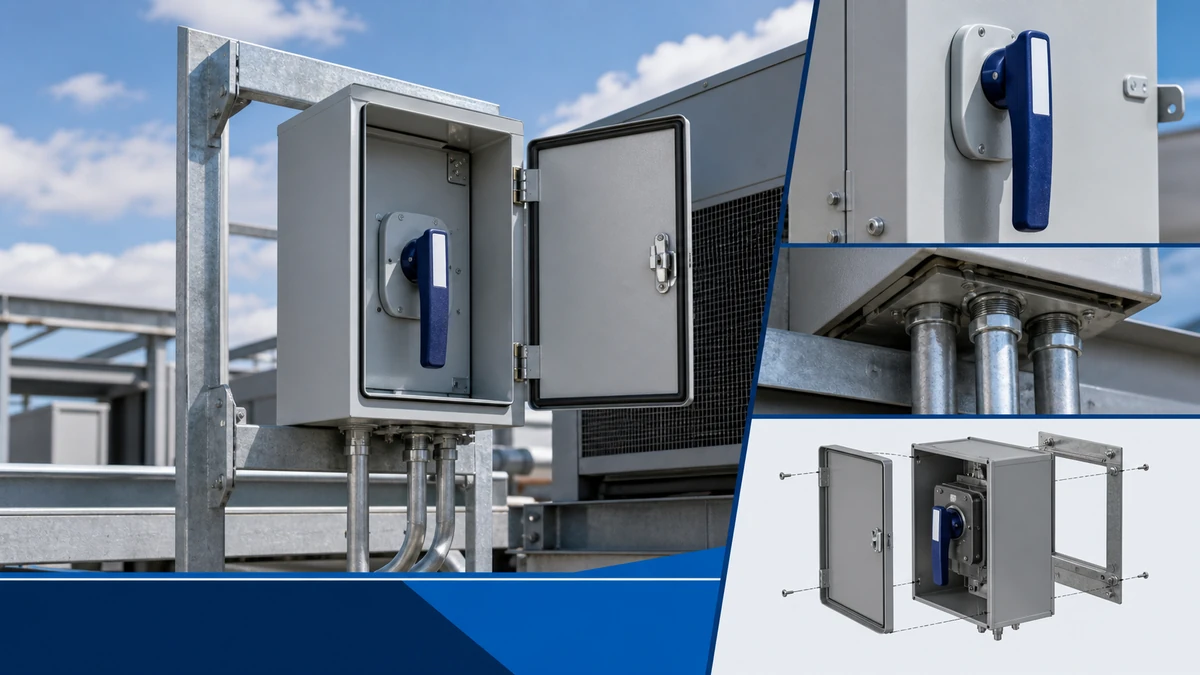
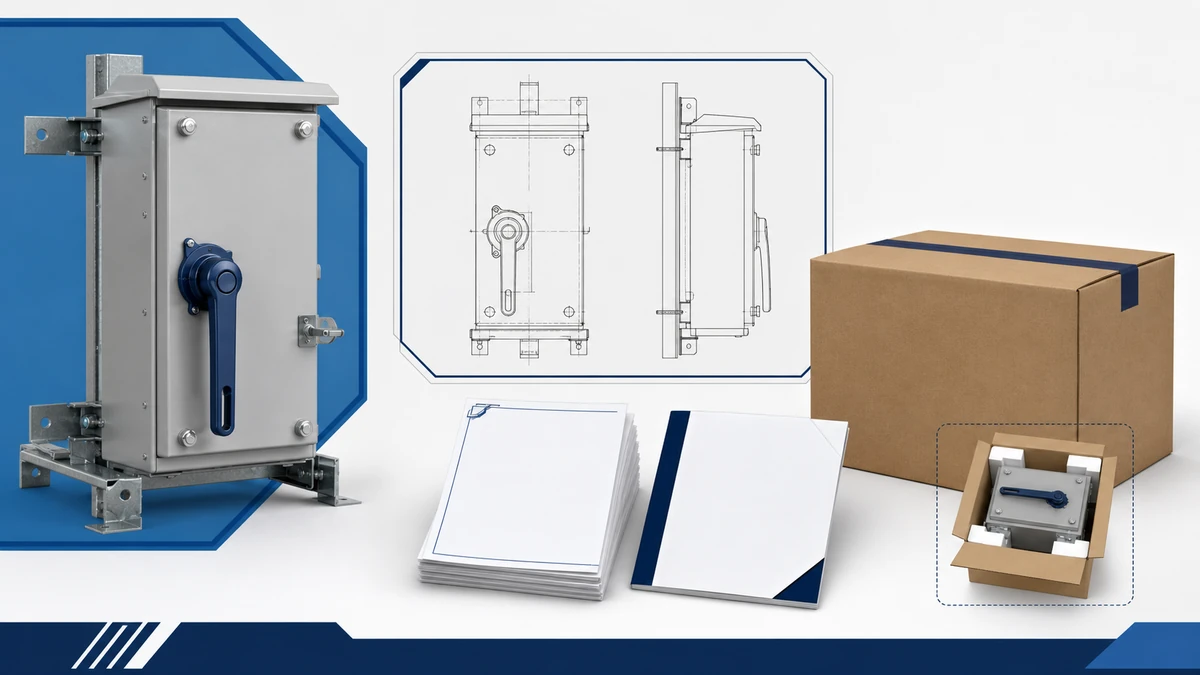
An outdoor maintenance isolator must be selected for its declared isolation and switching duty, not only its enclosure appearance.
Cable-entry sealing, handle lockability, mounting position, and servicing procedure affect the installed result.
Use the manufacturer drawing and rating documentation to confirm the route.
Outdoor equipment maintenance requires a reliable, weatherproof means of isolating circuits before any service work begins. An enclosed switch disconnector outdoor installation combines a manually operated isolation mechanism with a sealed, IP-rated enclosure, creating a visible safe off-state while protecting internal contacts from rain, dust, UV exposure, and temperature extremes. Under IEC 60947-3:2020+AMD1:2025, which applies to switches, disconnectors, switch-disconnectors, and fuse-combination units for distribution and motor circuits with rated voltage up to 1000 V AC or 1500 V DC, the device must achieve full galvanic isolation in the open position. This requirement underpins every lockout/tagout procedure on outdoor machinery, pumping stations, rooftop PV arrays, and agricultural equipment. The sections below cover how these devices work internally, how to diagnose and service them, how to specify the right model, and how Shieldhz validates configurations before shipment.
What Is an Enclosed Switch Disconnector and Why It Matters for Outdoor Equipment
An enclosed switch disconnector is a manually operated isolation device housed within a sealed, weatherproof enclosure. Its primary role in outdoor maintenance workflows is to create a confirmed, visible open-circuit state that permits safe servicing of downstream equipment. Without a visible isolation gap, lockout/tagout procedures cannot be considered complete under most industrial safety frameworks.
For outdoor service, the enclosure is as important as the switching element itself. Housings are typically constructed from UV-stabilized polycarbonate or glass-fiber-reinforced polyester. These materials maintain structural integrity across the ambient temperature ranges declared in the product datasheet, which for most industrial outdoor deployments span from sub-zero winter conditions to high-summer surface temperatures. Confirm the declared operating temperature range against your site’s recorded extremes before selecting a model.
A bare rotary cam switch or cam-operated isolator without an IP-rated housing degrades rapidly in exposed conditions. Moisture ingress raises contact resistance over time, particulate contamination accelerates contact wear, and UV exposure embrittles unprotected actuator components. An enclosed design eliminates these degradation pathways and reduces unplanned maintenance interventions caused by weather-related switch failure. For applications spanning AC feeder isolation in wet industrial environments through to PV string isolation on rooftop arrays, the enclosure IP class must be matched to the specific site conditions, not treated as a generic default.
To understand the underlying switching technology before reviewing specific outdoor configurations, the Shieldhz reference on what a load isolator switch is provides a useful foundation, and the IEC 60947-3 standard overview explains the applicable regulatory framework in plain language.
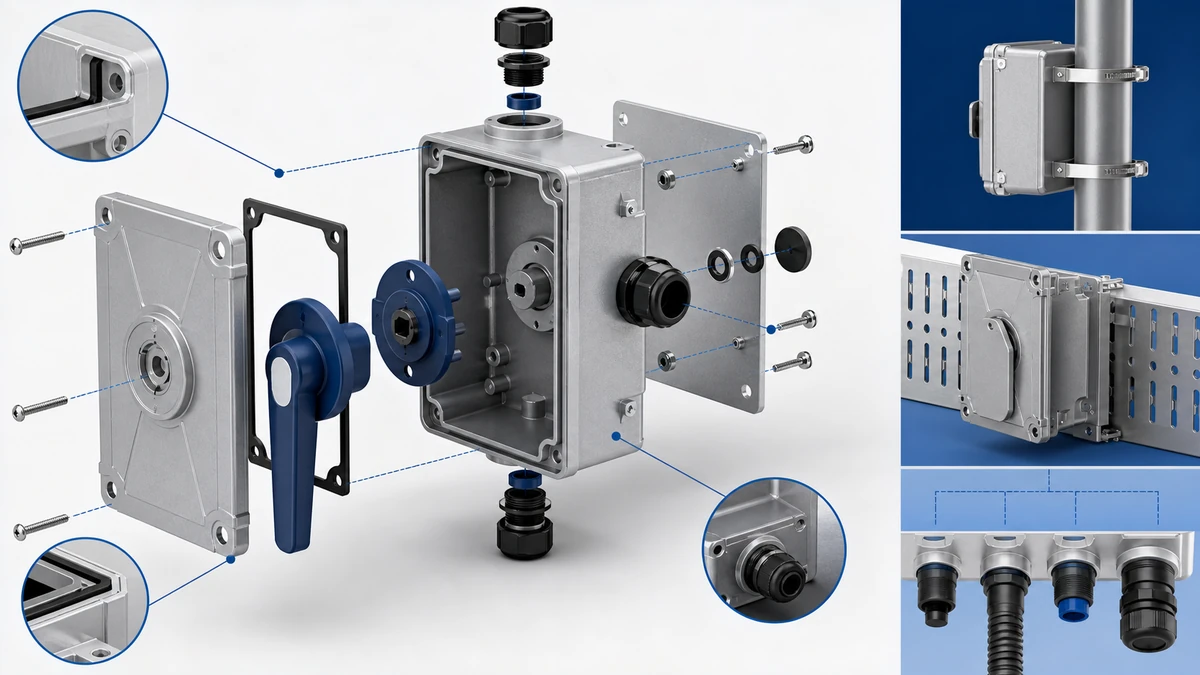
Enclosed Switch Disconnectors for Outdoor Equipment Maintenance: engineering anatomy reference for technical selection.
How Enclosed Switch Disconnectors Work: Internal Mechanics and Contact Architecture
Understanding what happens inside the enclosure during every switching operation is the foundation for accurate fault diagnosis. Most field failures in outdoor enclosed switch disconnectors trace back to specific, identifiable wear points within the contact system or the enclosure seal rather than to random component failure.
Contact-Break Mechanism
When the operating handle rotates, a cam shaft translates rotary motion into linear separation of the moving contact bridge from the fixed contact jaw. The separation geometry is engineered to produce a rapid, positive break. The contact gap distance at full-open position varies by voltage class and pole configuration and is stated in the product datasheet; do not assume a universal value. This declared gap must satisfy the visible isolation distance requirement under IEC 60947-3.
In an industrial motor isolation scenario, service technicians rely on this defined open-gap state to confirm a safe off-condition before beginning maintenance. A degraded cam profile or worn pivot bearing can reduce the travel arc and leave contacts in a partial-open state. This is a common root cause during troubleshooting when continuity tests return unexpected results across open poles: the symptom looks like a wiring fault, but the actual cause is insufficient cam travel.
Arc-Quenching Design
When contacts separate under load, an electric arc forms across the widening gap. Arc energy scales with the interrupted current and system voltage. Higher-current disconnectors typically incorporate ceramic arc-quenching chambers with magnetic blow-out geometry to deflect and cool the arc column. Silver-tin oxide contact material is commonly used for its resistance to arc erosion and its ability to maintain low contact resistance across a serviceable number of switching cycles.
The exact contact material composition, rated mechanical and electrical endurance, and acceptable arc-erosion limits are product-specific and are stated in the manufacturer datasheet. Do not apply values from one product family to another. When inspecting contact faces in the field, watch for pitting or erosion that exceeds the end-of-life marking or dimensional limit stated in the product documentation. At that point, continued service will degrade dielectric performance and increase thermal risk.
For DC circuits used in photovoltaic string isolation, arc behavior differs fundamentally from AC circuits. DC arcs do not self-extinguish at current zero, which requires different arc-quenching geometry and an explicit DC current and voltage rating on the selected device. An AC-rated enclosed switch disconnector cannot be substituted for a DC-rated isolator on PV string circuits without specific confirmation from the manufacturer.
Enclosure Integration and Sealing
The contact assembly is sealed within an IP-rated housing. For outdoor equipment maintenance applications, the enclosure IP class per IEC 60529 prevents moisture ingress from reaching live contact surfaces. Gasket condition and cable entry seal integrity are primary inspection points during scheduled maintenance: a failed door gasket allows sustained moisture exposure that accelerates contact oxidation and insulation tracking simultaneously. Confirm the enclosure’s rated IP class from the product datasheet for the specific variant and mounting configuration you have selected, as this varies across product families.
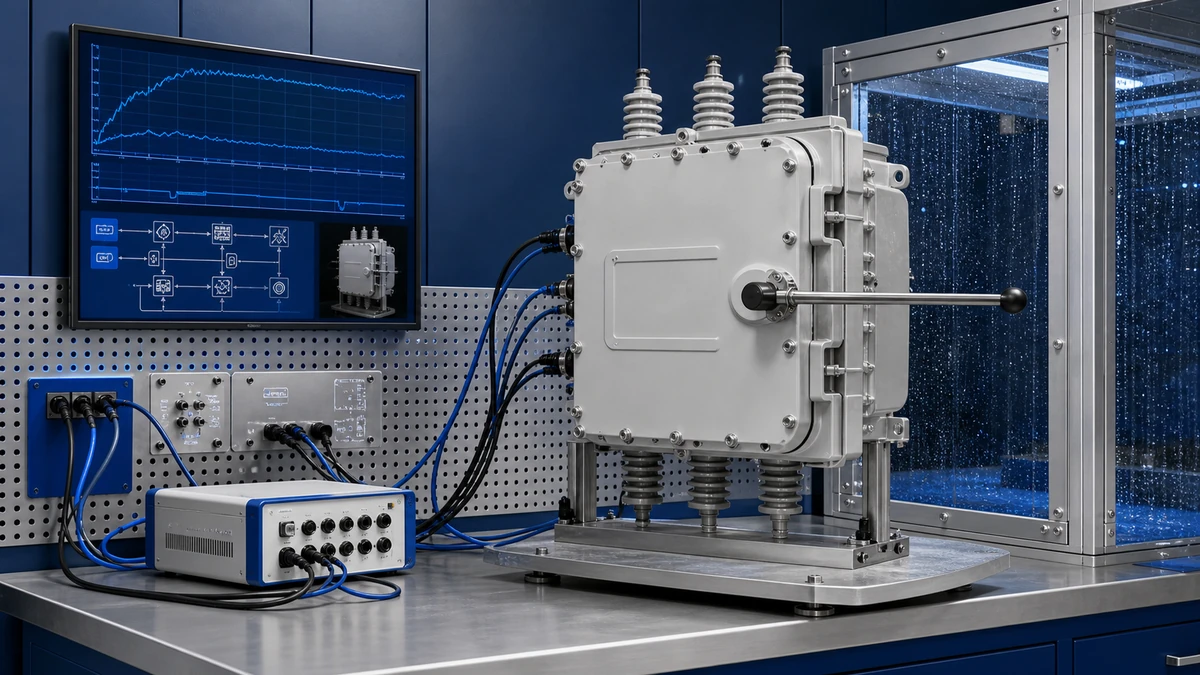
Enclosed Switch Disconnectors for Outdoor Equipment Maintenance: test and measurement reference for technical selection.
Diagnosing Common Faults in Outdoor Enclosed Switch Disconnectors
Systematic fault diagnosis in outdoor enclosed switch disconnectors matches the observed symptom to the specific component most likely to have degraded in field conditions. The table below covers the six failure modes most frequently encountered during outdoor maintenance inspections.
Sintoma
Probable Cause
Diagnostic Test
Handle rotates but circuit remains open
Worn or fractured cam disc; contact bridge not seating
Measure contact resistance across load terminals; readings above the datasheet limit indicate contact failure
Handle stiff or seized
Corrosion in shaft bearing; lubricant hardening at low temperature
Inspect shaft for oxidation; measure actuation torque against the rated handle torque in the product datasheet
Partial or intermittent continuity
Pitting or erosion on contact surfaces from repetitive arc events
Visual inspection under magnification; resistance cycling test across 10 consecutive operations
Enclosure condensation or water ingress
Degraded IP-rated door seal; cable gland failure
Inspect gasket compression; pressure-test enclosure per IEC 60529 procedures for the declared IP class
Insulation breakdown between poles
Moisture contamination on creepage paths; tracking damage
Apply 500 V DC insulation resistance test; values below 1 MOhm between poles indicate compromised insulation
Overheating at terminal connections
Loose or undersized conductor termination; oxidized terminal surface
Thermographic scan during loaded operation; confirm terminal torque against the manufacturer datasheet
Prioritizing Enclosure-Related Symptoms
Outdoor installations are disproportionately affected by enclosure seal degradation. A failed door gasket allows sustained moisture exposure that accelerates contact pitting and insulation tracking simultaneously. IEC 60947-3:2020+AMD1:2025 requires that devices maintain their rated insulation voltage after damp-heat conditioning, making post-ingress insulation resistance testing the most reliable confirmation step after any suspected water entry.
Gasket compression set is best assessed by measuring the enclosure door gap at four corners with feeler gauges. An uneven gap at any corner indicates the seal has lost its seating geometry. Replace the gasket based on measured compression set, not visual appearance alone: a gasket that looks intact can have permanently deformed cross-section that no longer seals under vibration or thermal cycling.
Thermographic scanning during loaded operation is the fastest way to locate loose terminal connections without a full shutdown. Any connection running significantly above adjacent terminals should be flagged for re-torque at the next isolation window. Confirm acceptable temperature rise limits from the product datasheet rather than applying a fixed threshold universally.
For DC isolator switches used in PV string applications, arc erosion at load contacts is a recurring fault pattern specific to DC duty. Inspect contact wear depth against the manufacturer’s declared end-of-life limit before re-energizing any suspect isolator after maintenance.
Step-by-Step Maintenance Procedure for Outdoor Enclosed Switch Disconnectors
A structured maintenance procedure for outdoor enclosed switch disconnectors combines lockout/tagout discipline with systematic inspection of mechanical and electrical components. Skipping either element introduces risk that the other cannot compensate for.
Phase 1: Lockout/Tagout and Isolation Preparation
Notify all affected personnel and identify every energy source feeding the disconnector, including any backfeed paths from downstream equipment.
Turn the rotary actuator to the OFF position and verify visually that the isolation gap is confirmed open.
Apply a personal padlock to the lockout hasp and attach a signed tag stating the date, technician name, and reason for isolation.
Use a calibrated voltage tester to verify absence of voltage at all load-side terminals before opening the enclosure door.
For waterproof isolator switch installations mounted on outdoor panels, confirm that the enclosure’s IP rating as declared in the product datasheet is not compromised by any existing physical damage before re-sealing after work.
Phase 2: Mechanical and Contact Inspection
Inspect the enclosure gasket for cracking, compression set, or UV degradation. Replace if deformation exceeds the threshold stated in the product maintenance documentation.
Check the rotary actuator for smooth operation across all positions. Stiff or grinding motion indicates internal cam wear or debris ingress.
Examine contact surfaces for pitting, erosion, or carbonized deposits. Compare observed condition against the datasheet end-of-life criteria for the specific product; do not apply contact resistance or erosion limits from a different product family.
Verify all terminal torque values against the manufacturer datasheet. Loose terminals are a primary cause of thermal failure under sustained load.
Phase 3: Functional Verification and Documentation
Perform a no-load switching cycle at least three times, confirming positive detent engagement at each position and consistent actuator travel.
Re-energize under supervision and measure operating voltage at load-side terminals, confirming it matches the rated supply within the tolerance declared in the site commissioning record.
Document all findings, torque values, and test results in the maintenance log. Retain records for regulatory inspection and warranty reference.
Maintenance records should include the date, product model and serial reference, observed contact condition, gasket replacement status, terminal torque readings, and the name of the certifying technician. For installations subject to periodic third-party inspection, confirming documentation requirements with the relevant authority before beginning maintenance avoids re-work.
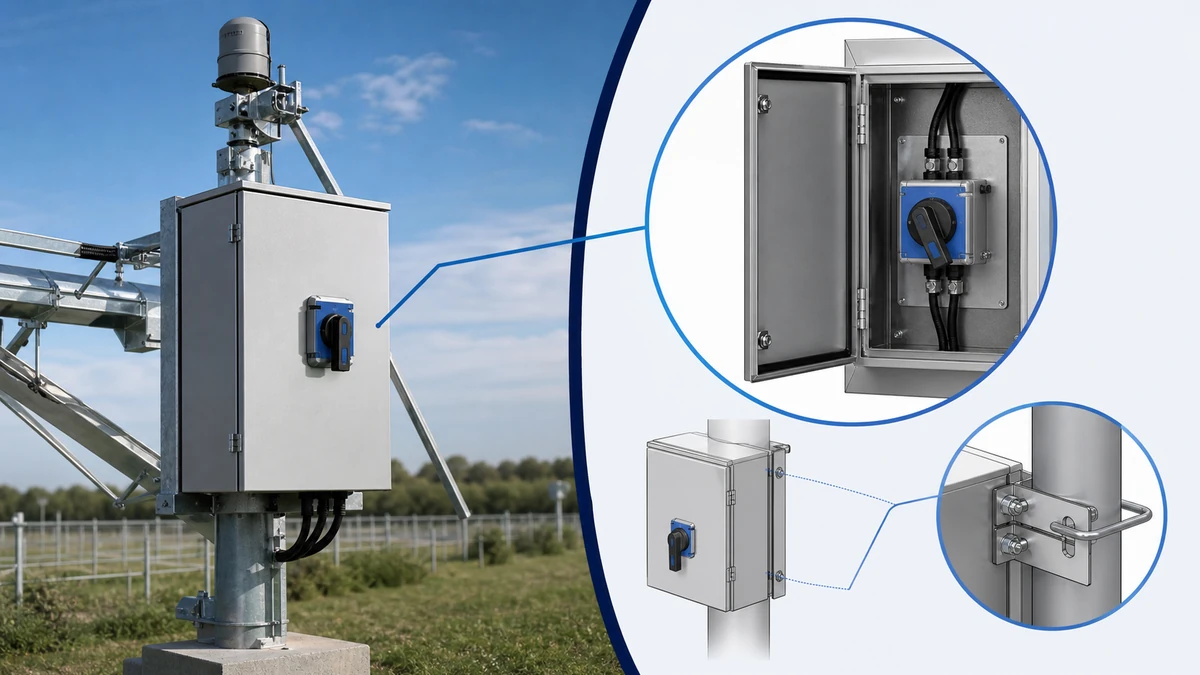
Enclosed Switch Disconnectors for Outdoor Equipment Maintenance: application context reference for technical selection.
Selecting the Right Enclosed Switch Disconnector for Your Outdoor Application
Completing a thorough maintenance procedure on an incorrectly specified device compounds rather than resolves field problems. Selection accuracy is as critical as the maintenance work itself.
Parâmetros-chave de seleção
Before comparing models, define four inputs: the maximum continuous current the disconnector must carry under the declared ambient temperature, the minimum IP class required by the installation environment, the applicable certification standard for the target market, and the specific outdoor use case. These four inputs determine which product family and variant is appropriate.
IEC 60529 classifies enclosure ingress protection numerically. A minimum of IP65 is generally appropriate for exposed outdoor locations, as it excludes dust ingress and low-pressure water jets from any direction. Applications involving pressure washdown require IP66 as a minimum. Temporary submersion or standing water exposure requires IP67 or IP68 confirmation from the product datasheet. Do not assume that all members of a product family share the same IP rating: confirm the declared class for the specific enclosure variant and cable entry configuration you will use.
For AC isolation circuits, IEC 60947-3 governs rated making and breaking capacity and utilization categories. The utilization category declared on the product label and datasheet determines whether the device is rated for motor starting and stopping duty or for general distribution isolation only.
For photovoltaic DC string isolation, confirm that the selected model carries an explicit DC voltage and current rating and is certified under the applicable PV installation standard for your jurisdiction. An AC-rated device cannot be substituted for a DC-rated isolator without specific manufacturer confirmation.
General machinery isolation, light industrial outdoor panels
Up to 63 A
IP66
IEC 60947-3, CE, RoHS
Heavy outdoor motor feeders, pump stations
Up to 32 A DC
IP65 to IP67
IEC/EN 60947-3, PV-applicable cert
Rooftop and ground-mount solar string isolation
Até 100 A
IP67
IEC 60947-3, relevant regional certs
Commercial and industrial outdoor distribution, MCC maintenance isolation
Current ratings in the table above are indicative ranges for product family navigation only. The actual rated current of a specific model depends on pole count, contact program, enclosure variant, and ambient temperature rating as declared in the product datasheet. Always confirm from the datasheet before committing to a selection.
The Shieldhz Faixa do interruptor de came rotativo covers the underlying switching technology used across multiple enclosed disconnector product families. For buyers evaluating specific cam switch models as part of a custom panel build, the LW28 rotary cam switch and LW42 rotary cam switch series represent the panel-mount variants that underpin the enclosed outdoor configurations.
Enclosed Switch Disconnectors for Outdoor Equipment Maintenance: supply handover reference for technical selection.
How Shieldhz Configures and Validates Enclosed Switch Disconnectors for Outdoor Maintenance Use
Shieldhz is the export brand of Zhejiang Shihe Electric Co., Ltd., founded in 2014 and based in Yueqing, Zhejiang Province. The company operates a factory of over 5,000 square metres with more than 100 employees and over 40 production machines, and holds certifications including ISO 9001, CE, RoHS, TUV, UL, UKCA, CCC, and CB across applicable product lines. The following describes how Shieldhz handles the configuration and validation sequence specifically for outdoor enclosed switch disconnector inquiries.
Step 1: Model Route and Rating Confirmation
Shieldhz begins by confirming the operating voltage, rated current, pole count, and utilization category against the buyer’s circuit diagram or motor nameplate. For outdoor isolator applications, the review also checks whether AC or DC supply is involved. AC motor isolation routes to the appropriate cam switch or weatherproof isolator box within the SHP product family. DC string isolation for PV systems routes to the appropriate DC-rated isolator variant.
Enclosure frame size is cross-checked against any panel cutout constraints provided by the buyer. Where the buyer provides a control cabinet drawing, the mounting footprint, handle projection, and cable entry direction are confirmed before production is confirmed. This step prevents dimensional conflicts that would require enclosure modification after delivery.
Step 2: Contact Program and IP Rating Verification
Once the model route is confirmed, Shieldhz verifies the contact program against the buyer’s control schematic. For outdoor maintenance use, this means confirming the number of switching positions, the position sequence, and the contact table showing which poles are open or closed at each handle position. Buyers should provide or request a contact-table drawing to verify this independently before placing an order.
The enclosure IP rating is validated against the declared installation environment. The SHP waterproof isolator switch and SH30 rotary cam switch line carry tested IP ratings that Shieldhz confirms against the specific installation conditions described in the buyer inquiry. Where the installation environment falls between standard IP classes, Shieldhz engineering can advise on which product variant covers the declared exposure without over-specifying to a higher-cost housing unnecessarily.
Step 3: Documentation Package
Shieldhz provides a documentation package that includes the product datasheet, dimensional and mounting drawing, wiring diagram, and applicable test certificates. Where CE marking or IEC 60947-3 compliance documentation is required for the buyer’s installation or procurement standard, these are confirmed at the inquiry stage, not after shipment. Buyers subject to regional certification requirements should declare this at inquiry so that the correct certificate package is prepared alongside the product.
For OEM buyers building outdoor control panels for regulated markets, Shieldhz can supply the Declaration of Conformity, test report summary, and product marking documentation as part of the standard delivery package when requested. Panel builders who need to include third-party certification evidence in their own technical file should specify this requirement explicitly during the inquiry process.
To request a configuration review or discuss your outdoor disconnector specification, contact Shieldhz through the inquiry form on the Chave isoladora à prova d'água SHP product page.
Perguntas frequentes
What is the difference between a switch disconnector and a standard isolator switch for outdoor use?
A switch disconnector is rated to make and break circuits under full load current, while a basic isolator is designed only to open and close circuits that have already been de-energized upstream. For outdoor maintenance workflows where a technician may need to interrupt a live feeder, the switch disconnector’s rated breaking capacity under IEC 60947-3:2020+AMD1:2025 is the critical operational distinction. The specific rated making and breaking capacity is stated in the product datasheet and varies by model, pole count, and utilization category.
How often should an outdoor enclosed switch disconnector be serviced?
Service intervals depend on the number of switching operations performed, the ambient conditions at the installation site, and the maintenance schedule declared in the product documentation. High-humidity, coastal, or chemically aggressive environments typically warrant shorter intervals due to accelerated gasket degradation and contact oxidation. As a starting point, a 12-month inspection cycle combined with an operation-count review is a commonly used baseline in industrial practice, but confirm the recommended interval with the manufacturer documentation for the specific product.
What IP rating is sufficient for an outdoor enclosed switch disconnector mounted on an exposed panel?
IP65 is generally the minimum acceptable rating for exposed outdoor locations, as it excludes dust ingress and low-pressure water jets from any direction. Applications involving regular pressure washdown require IP66 as a minimum. Installations subject to temporary submersion or standing water exposure require IP67 or IP68 as appropriate to the site conditions. Confirm the declared IP class for the specific enclosure variant and cable entry configuration from the product datasheet rather than relying on a product family default.
Can an enclosed switch disconnector rated for AC circuits be used for PV DC string isolation?
An AC-rated switch disconnector cannot be substituted for a DC-rated isolator on PV string circuits without explicit confirmation from the manufacturer. DC arcs do not self-extinguish at current zero and require different arc-quenching geometry to interrupt safely. Always confirm that the selected model carries an explicit DC voltage and current rating and is certified under the applicable PV installation standard for your jurisdiction before installation.
What causes a switch disconnector handle to become stiff or impossible to rotate in cold weather?
Low-temperature lubricant hardening in the cam shaft bearing is the most common cause, particularly on units not specified for operation at the recorded site winter minimum. Shaft corrosion from prior moisture ingress and partial cam wear can also restrict actuator travel. Inspect the shaft and bearing surface, confirm the product’s declared operating temperature range covers the installation site’s winter minimum, and replace lubricant with a grade specified for the operating temperature range in the manufacturer documentation.
How is insulation resistance tested on an outdoor enclosed switch disconnector after suspected water ingress?
With the device isolated and fully de-energized, apply a 500 V DC test voltage between each pair of poles using a calibrated insulation resistance tester. Values below 1 MOhm indicate compromised insulation requiring immediate attention before re-energizing. The test should also be performed between each pole and the enclosure earth terminal to detect any leakage path to the housing. Record all readings in the maintenance log and compare against the baseline readings taken at commissioning where available.
What documentation should be requested when purchasing an enclosed switch disconnector for a regulated outdoor installation?
At minimum, request the product datasheet, dimensional and wiring drawings, the IEC 60947-3 test certificate or test report reference, and the CE Declaration of Conformity. Where the installation falls under a specific regional PV, marine, or industrial safety standard, confirm that the certificate package explicitly covers the relevant standard and the specific product variant, pole count, and rating being purchased. For panel builders who must include third-party certification evidence in their own technical file, specify this requirement at the inquiry stage so the documentation is prepared alongside the product order rather than requested retrospectively.
Shi, Muxi
Shi, Muxi escreve artigos técnicos da Shieldhz para compradores de controle industrial e componentes elétricos, abrangendo chaves de came rotativas, chaves isoladoras, seccionadores PV DC, botões de pressão, luzes indicadoras, gabinetes à prova d'água e blocos de terminais. Os artigos são baseados na experiência de fabricação e exportação da Zhejiang Shihe Electric Co., Ltd., com ênfase prática na seleção de modelos, planilhas de dados, desenhos, certificações, classificações de IP e detalhes de consulta que os compradores devem confirmar antes de fazer o pedido.