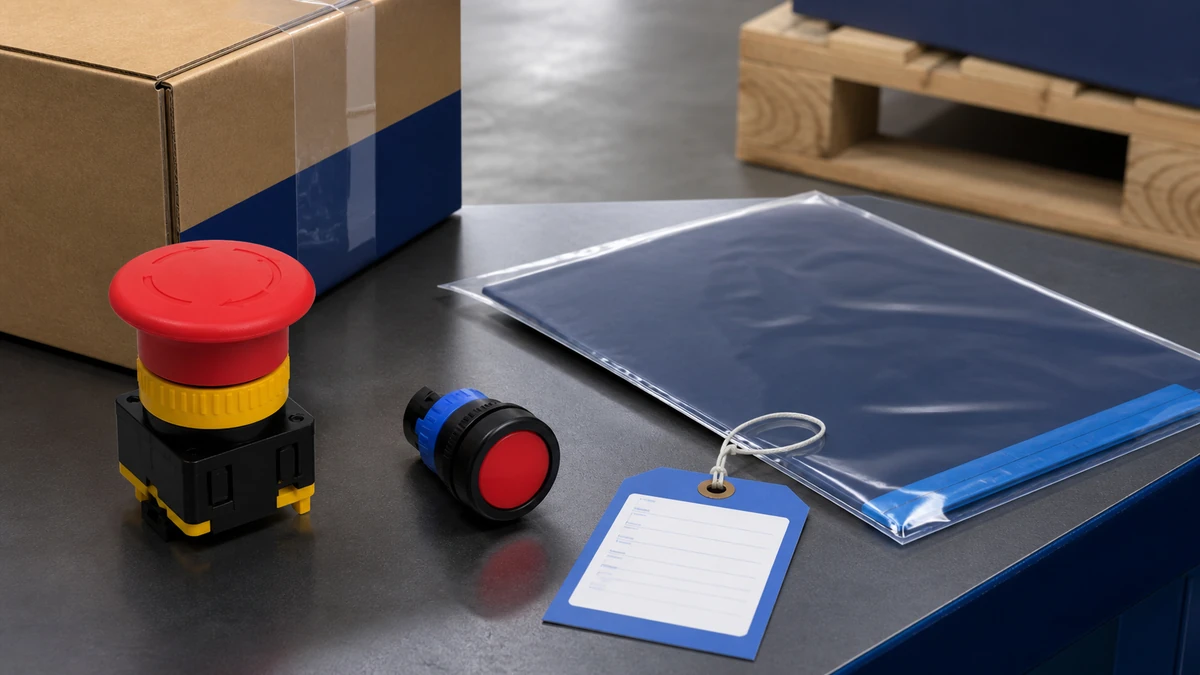
Emergency Stop Button vs Stop Push Button: Function and Control-Circuit Role
Use a practical buyer checklist to evaluate emergency stop button vs stop push button inputs, documentation, approval controls and the exact push button, selector switch or emergency-stop operator route.
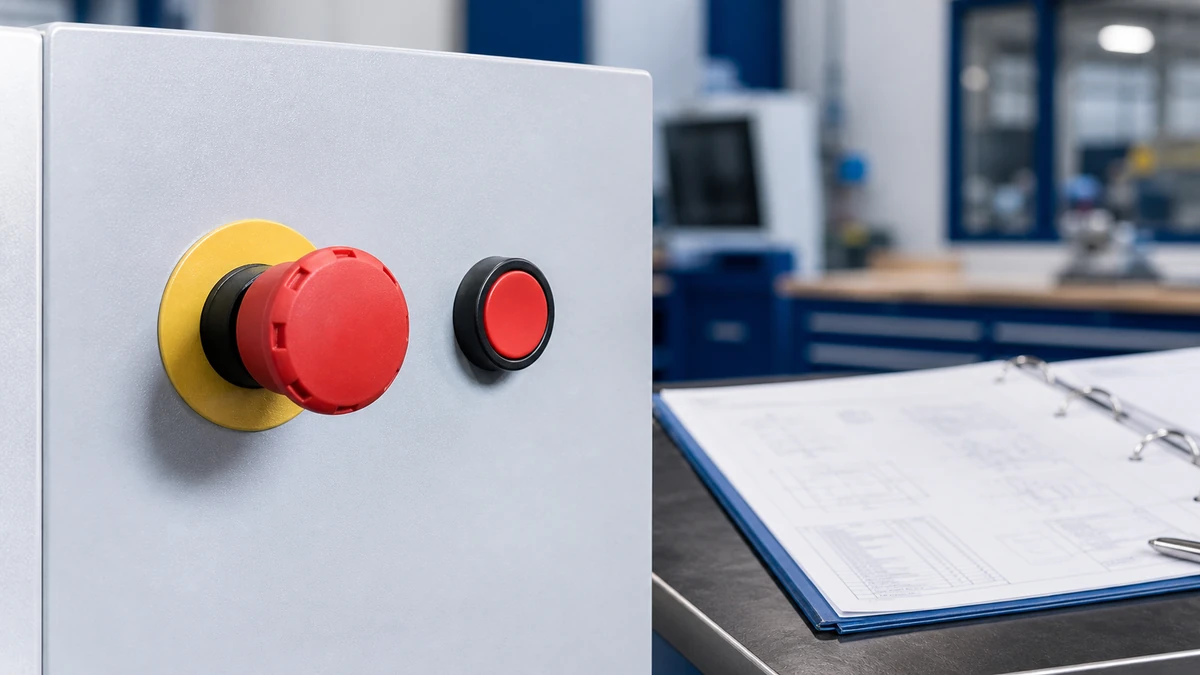
The practical difference in an emergency stop button vs stop push button decision is role: an emergency-stop operator is selected for an emergency-stop function, while a normal stop push button is selected for routine stopping or process control. The operator choice affects contact arrangement, marking, reset expectations, documentation, and how the control circuit is reviewed, but it does not by itself validate a complete machine safety function.
Confirm whether the input is for emergency stopping, routine stopping, jog/hold-to-run interruption, or another machine command.
Verify contact type, actuator action, panel cutout, marking, and documentation against the exact model and buyer application.
Do not treat the operator alone as proof of compliance; complete safety-function suitability depends on the machine design, destination market, risk assessment, and validation route.
Emergency stop button vs stop push button: what decision are you really making?
You are deciding whether the control device represents an emergency function or a normal machine command. That decision changes how the device is specified, documented, labeled, and reviewed by the panel builder or machine builder.
A normal stop push button can be part of ordinary operating control. An emergency-stop operator is a visible and intentional device for stopping in an emergency, and its role should be separated from normal start/stop convenience controls.
An exact drawing identifies the interfaces that must be controlled for the approved model route.
Control-circuit role
A stop push button is typically used as an input to the machine control circuit for routine stopping. The exact contact logic, voltage, and current depend on the control architecture and the chosen model.
An emergency-stop operator is also wired into a control circuit, but its intended function is different. It is normally specified as part of an emergency-stop function that may also include safety logic, monitored contacts, reset behavior, and validation by the machine builder.
Procurement consequence
For purchasing, the difference is not just the button color or head shape. The RFQ should state the intended function, actuator action, contact arrangement, panel mounting, marking, and required documentation package.
If the RFQ only says “red stop button,” the supplier may not know whether the buyer needs a normal stop operator or an emergency-stop operator. That ambiguity can create rework in drawings, panel layout, labels, and spare-parts lists.
When should the machine use an emergency-stop operator instead of a normal stop push button?
Use an emergency-stop operator when the control is intended for emergency stopping, not for normal production stopping or routine operator convenience. A normal stop push button is better suited when the command is part of ordinary machine operation and is not intended to represent an emergency-stop function.
O ISO 13850 overview describes ISO 13850 as setting functional requirements and design principles for the emergency-stop function. This article therefore treats the operator as one device in that function, not as proof that a complete machine safety function has been designed, validated, or accepted.
Decision table: emergency stop or normal stop?
Buyer question
Emergency-stop operator route
Normal stop push button route
Is the command intended for emergency stopping?
Usually the route to evaluate
Usually not the intended route
Is the command used during normal cycle control?
Avoid using it as a routine control
Common use case
Does the function require reset and safety validation review?
Likely depends on the full safety function
Usually reviewed as a control command
Is distinctive emergency marking required?
Confirm by machine standard, destination market, and drawing
Use normal device marking suited to the panel
Can the operator selection alone prove safety compliance?
Não
Não
Buyer action list
Ask the machine designer whether the command is emergency, operational, maintenance, or setup related.
Confirm whether the operator is part of a safety-related function or only a standard control input.
Separate emergency-stop devices from ordinary stop devices in the bill of materials and panel drawings.
Request exact datasheets, drawings, and any required certificates for the selected model and destination market.
How the control-circuit role changes contact selection
The contact arrangement should follow the intended circuit role, not only the visible operator style. For both emergency-stop and normal stop devices, contact selection depends on the control circuit, monitoring method, voltage/current level, and exact product construction.
The basic contact decision is often between normally closed and normally open contacts, plus the number of contact blocks required. For a refresher on contact states, see the NO and NC contact guide.
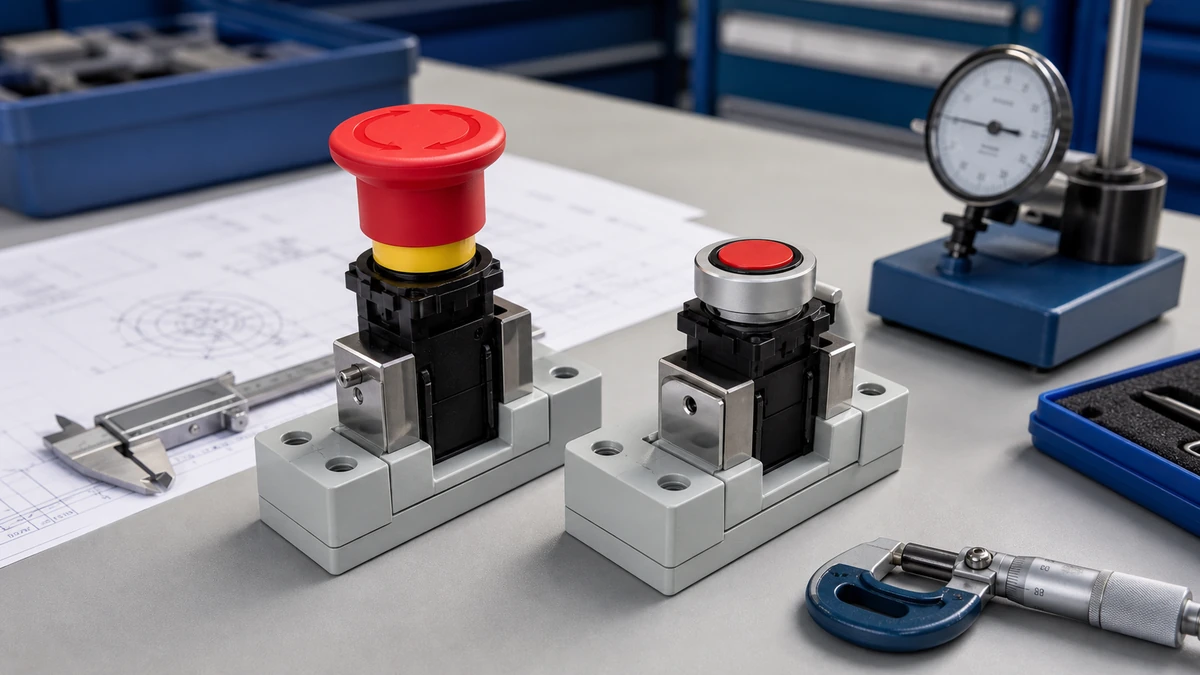
Sample review should connect the exact item to its current drawing and requested evidence package.
NC, NO and mixed contact arrangements
Normal stop push buttons are often specified with contacts that suit the controller input logic. Some panels may use NC contacts for stop commands, while others may use a different input scheme depending on the control design.
Emergency-stop operators are commonly reviewed for NC contact paths and, in many applications, multiple contact channels. The exact requirement is not universal; it must be confirmed against the machine safety concept, controller, monitoring method, and current product documentation.
Reset and restart expectations
An emergency-stop action should not be confused with restart authorization. Releasing or resetting the emergency-stop operator is not the same as permitting unexpected restart; restart behavior belongs to the broader machine control and safety design.
A normal stop push button may be momentary or maintained depending on the command logic. Emergency-stop operators are commonly maintained until deliberately reset, but the buyer still needs to confirm the exact actuator action and product series.
Decision table: contact-route questions
Specification item
Por que é importante
Buyer confirmation
Contact state
Determines input behavior in the circuit
NO, NC, or mixed arrangement
Contact quantity
Affects monitoring and controller inputs
Single, dual, or other exact configuration
Actuator action
Changes how the command is held or released
Momentary, maintained, twist-release, pull-release, key-release, or other listed action
Control voltage/current
Must match the documented electrical data
Confirm against datasheet and drawing
Contact block compatibility
Prevents assembly mismatch
Confirm exact operator and block combination
Operator action, color and visual intent: avoiding mixed messages
The visible device should communicate the function clearly to the operator and maintenance team. A normal stop control and an emergency-stop control should not be made visually interchangeable unless the machine documentation intentionally defines that arrangement.
For broader device fundamentals, the Noções básicas sobre interruptores de botão article explains push-button terminology without turning this article into a general device definition.
Emergency-stop visual route
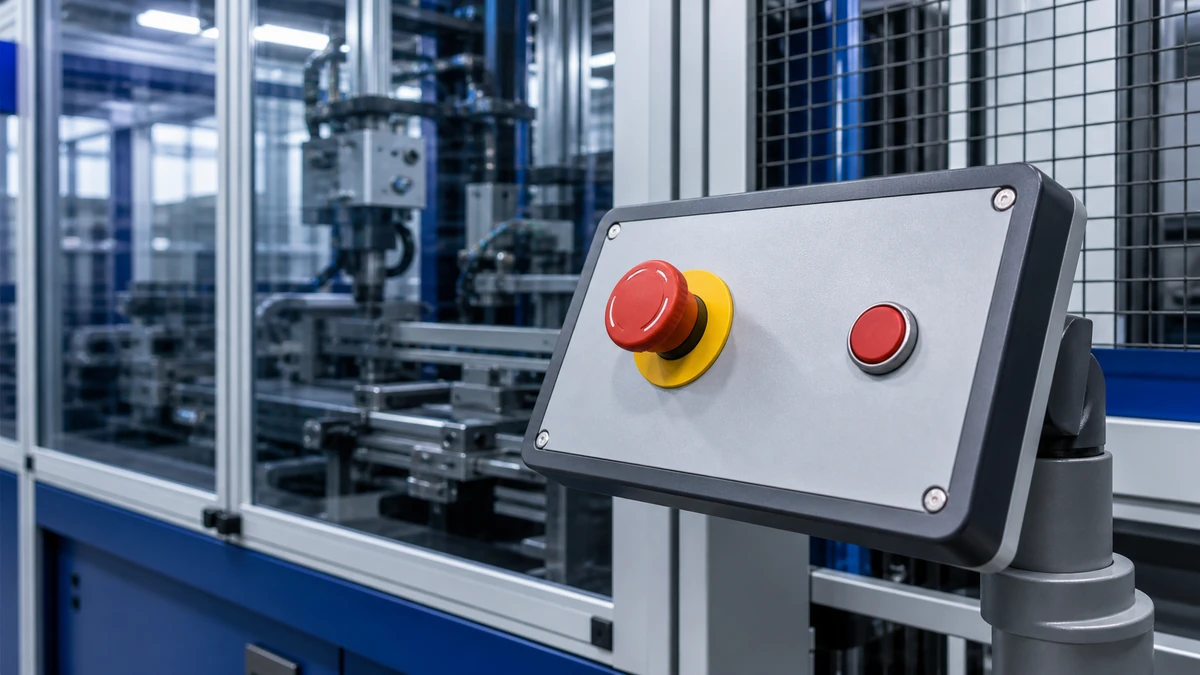
Emergency-stop operators are often specified with a mushroom-style head and conspicuous marking or background. The exact color, legend, release style, and guard/accessory requirements depend on the machine standard, destination market, panel design, and exact product range.
Do not assume that a red actuator automatically makes the device an emergency stop. The function, contacts, installation, marking, and validation route must support the intended emergency-stop role.
Normal stop visual route
A normal stop push button should be marked as a normal machine command. It may be paired with start, reset, jog, mode, indicator, or selector functions depending on the operator station design.
If the project also includes selector switches or layout constraints, use the emergency-stop and selector layout guide as a layout reference. This article remains focused on device role and control-circuit selection rather than full operator-station layout.
Practical marking checklist
Confirm the exact legend text required on the panel or legend plate.
Separate emergency labels from routine stop labels.
Check language, symbol, and destination-market requirements before quotation.
Confirm whether illumination is required and, if so, the voltage and color.
Match the marking package to the drawing revision used for panel assembly.
Specification comparison for buyers and panel assemblers
The purchase specification should state the function first, then the mechanical and electrical details. This prevents a normal stop device from being substituted into an emergency-stop role, or an emergency-stop operator being used where a simple process stop was intended.
Installation conditions change the product-route and document questions a buyer must resolve.
Mechanical and mounting information
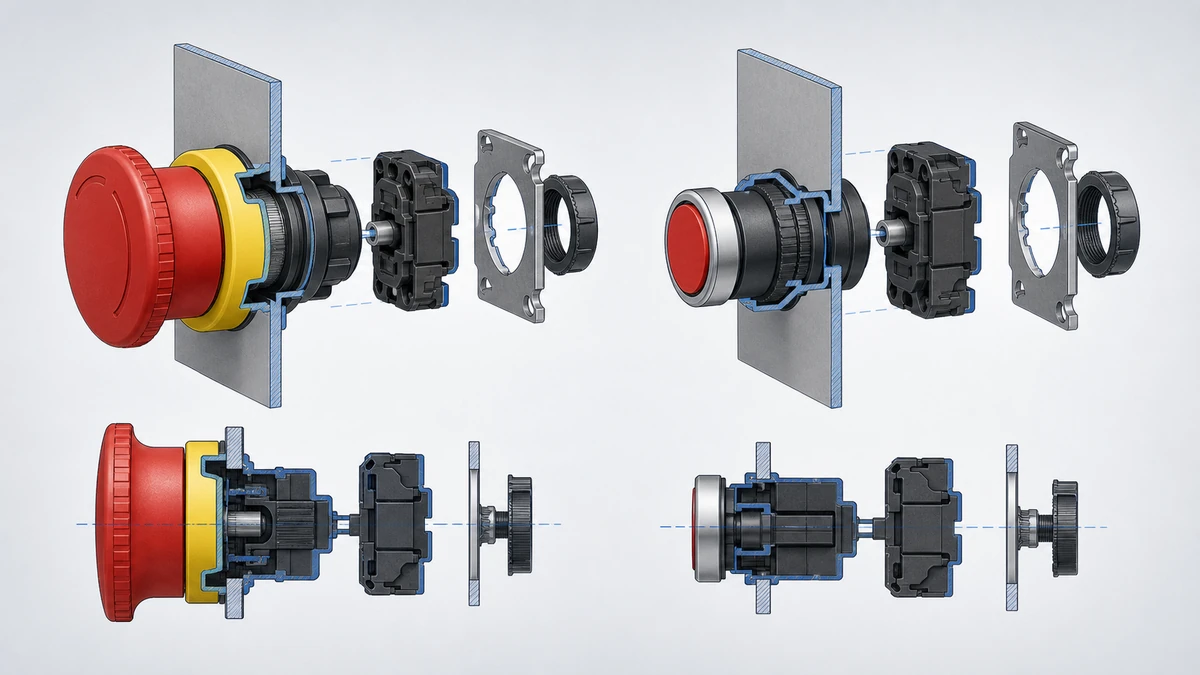
Panel assemblers need the cutout size, mounting method, panel thickness range if applicable, operator depth, and accessory stack. These values are exact-model dependent and should be taken from the current drawing or datasheet.
Do not rely only on a catalog image. Similar-looking operators can differ in mounting hardware, contact-block arrangement, lamp module options, or accessory compatibility.
Electrical and environmental information
The control voltage, current, contact configuration, and illumination voltage must match the circuit. Environmental details such as enclosure location, washdown exposure, dust, oil mist, temperature range, and outdoor exposure should be stated as application requirements, then checked against the exact selected model.
Ratings, IP class, material, endurance, and certification status are not universal across every product route. They must be verified using the specific datasheet, drawing, certificate, and destination-market requirement.
Decision table: RFQ comparison
RFQ field
Emergency-stop operator
Normal stop push button
Function statement
“Emergency-stop operator for machine emergency-stop function”
“Normal stop push button for control command”
Actuator action
Specify release method and maintained behavior as required
Specify momentary or maintained action
Contacts
State required NC/NO quantity and monitoring expectation
State required input contact logic
Marcação
Emergency-stop legend/background if required
Normal stop legend or symbol
Documentação
Drawing, datasheet, and any required certificate package
Drawing, datasheet, and any required certificate package
Validation boundary
Part of wider safety-function review
Part of control-circuit review
How Shieldhz confirms a push button, selector switch or emergency-stop operator route
Shieldhz confirms the route by matching the buyer’s stated function and application inputs to the current product documentation before quotation. Final suitability is confirmed against current product documentation and the buyer’s application, not by the product name alone.
For device families and available operator styles, buyers can review the push button and indicator light range before requesting a model-specific confirmation.
Pre-quotation confirmation inputs
Provide these details before the quotation is finalized:
Machine function and destination market.
Operator action, such as momentary, maintained, twist-release, pull-release, key-release, or selector action.
Control voltage and current for the circuit.
Contact arrangement, including NO/NC quantity and any required contact separation by function.
Panel cutout, mounting method, and panel thickness or enclosure constraints.
Environment, such as indoor panel, dust, moisture, oil, cleaning exposure, temperature, or outdoor location.
Marking and legend requirements, including language, symbol, color, and whether illumination is needed.
Exact drawing, datasheet, and certificate package required for the buyer’s documentation file.
Quotation route outcome
The outcome is a proposed operator route with the documented contact blocks, lamp options if needed, mounting accessories, and marking approach. If a certificate is required, the exact certificate scope must be checked for the selected model and destination market.
Shieldhz does not treat an emergency-stop operator selection as validation of the complete machine safety function. That validation remains part of the buyer’s machine design, risk assessment, integration, testing, and acceptance process.
Documentation package and quotation checkpoints
The documentation package should prove what is being supplied, not overstate what the device alone can do. For a buyer or distributor, the most useful quotation is tied to a specific model, drawing revision, datasheet, and requested documentation package.
Drawing and datasheet checkpoints
The drawing should confirm the visible operator, mounting dimensions, cutout, contact block arrangement, and accessory stack. The datasheet should confirm electrical data, environmental data, material information where listed, and any model-specific options.
For assembly choices involving operators, contact blocks, lamps, and legends, use the contact block and legend plate guide as a supporting reference. The exact combination should still be checked against the active product documentation.
Certificate and destination-market checkpoints
If the buyer requires certificates, declarations, or market-specific documents, state that requirement before ordering. The available certificate package can vary by model, series, configuration, and destination market.
Avoid assuming that a certificate shown for one operator style applies to every contact block, lamp, accessory, or assembled variant. The documentation should match the quoted and delivered configuration.
Buyer documentation checklist
Match the quotation model number to the panel drawing.
Confirm the contact arrangement shown in the drawing.
Confirm the actuator action and release method.
Check marking, legend, and color requirements.
Request certificates only for the exact model and destination-market route.
Keep the final datasheet and drawing revision with the machine file.
Common selection mistakes that increase rework
Most rework comes from treating a visual device choice as a finished engineering decision. The safer commercial route is to specify the function, contact logic, mounting, marking, and documentation before the panel is built.
Documentation control, sample acceptance and protective packing are separate handover checks.
Mistake 1: calling every red button an emergency stop
A red push button may be a normal stop, reset, alarm acknowledge, or another command depending on the panel design. The device becomes part of an emergency-stop route only when the machine function, contacts, marking, installation, and safety design support that role.
If procurement orders only by color and diameter, the received device may not match the intended circuit. The RFQ should use functional wording such as “emergency-stop operator” or “normal stop push button.”
Mistake 2: ignoring maintained versus momentary action
A normal stop button may be momentary or maintained depending on the control system. An emergency-stop operator is commonly selected with a maintained action and deliberate release method, but the exact requirement must be confirmed for the machine design and selected series.
Mixing action types can change how the controller input behaves. It can also affect maintenance troubleshooting and operator expectations.
Mistake 3: copying contact sets from another project
A previous machine may have used different control voltage, controller input logic, monitoring method, or safety architecture. Copying the contact arrangement without checking the current project can produce a mismatch.
Use the current schematic, risk assessment output, and product documentation. Treat every substitution as a new confirmation, especially when changing operator series, contact block type, or lamp option.
Rework-prevention action list
Put the intended function in the item description.
Add actuator action and release method to the BOM.
State contact arrangement in NO/NC terms.
Confirm control voltage/current and illumination voltage if applicable.
Attach the correct drawing and datasheet to the purchase request.
Do not approve substitutions without checking documentation and buyer application.
Conclusion
The emergency stop button vs stop push button decision is a function decision before it is a hardware decision. A normal stop push button supports routine control, while an emergency-stop operator is selected for an emergency-stop function and must be reviewed within the wider machine safety design.
For a reliable quotation, specify the machine function, destination market, actuator action, contact arrangement, control voltage/current, mounting details, environment, marking, and documentation package. The operator can be selected and documented precisely, but it does not by itself validate the complete machine safety function.
Perguntas frequentes
Is an emergency stop button the same as a stop push button?
No. A stop push button is usually a normal control command, while an emergency-stop operator is selected for an emergency-stop function. The distinction affects contacts, marking, actuator action, documentation, and safety-function review.
Can I use a normal stop push button as an emergency stop?
Do not assume that a normal stop push button is suitable for emergency-stop use. Suitability depends on the machine design, destination market, contact arrangement, operator action, marking, installation, documentation, and validation of the complete function.
Does buying an emergency-stop operator make the machine compliant?
No. Selecting an emergency-stop operator does not validate a complete machine safety function. Compliance and suitability depend on the full machine design, risk assessment, circuit architecture, installation, testing, documentation, and applicable market requirements.
Which contacts should I specify for an emergency-stop operator?
Specify the contact arrangement required by the machine safety design and controller input scheme. Many applications review NC contact paths and multiple channels, but the exact requirement must be confirmed against the safety concept, drawing, and current product documentation.
What should be included in an RFQ for a stop or emergency-stop device?
Include the intended function, actuator action, contact arrangement, control voltage/current, panel cutout, mounting method, environment, marking or legend, illumination needs if any, and required drawing, datasheet, and certificate package. This allows the supplier to confirm the exact model route.
Can the same supplier provide push buttons, selector switches and emergency-stop operators?
Yes, depending on the required model route and documentation package. The buyer should still confirm the exact device function, mounting, contact blocks, marking, voltage, environment, and destination-market documentation before approving the quotation.
Shi, Muxi
Shi, Muxi escreve artigos técnicos da Shieldhz para compradores de controle industrial e componentes elétricos, abrangendo chaves de came rotativas, chaves isoladoras, seccionadores PV DC, botões de pressão, luzes indicadoras, gabinetes à prova d'água e blocos de terminais. Os artigos são baseados na experiência de fabricação e exportação da Zhejiang Shihe Electric Co., Ltd., com ênfase prática na seleção de modelos, planilhas de dados, desenhos, certificações, classificações de IP e detalhes de consulta que os compradores devem confirmar antes de fazer o pedido.