Panel Indicator Light Manufacturers: Sourcing Checks for Control Panels
Use a practical buyer checklist to evaluate panel indicator light manufacturers inputs, documentation, approval controls and the exact push button, selector switch or emergency-stop operator route.
Select panel indicator light manufacturers by checking model-specific evidence for the exact pilot light you will install, not by accepting a broad control-component catalogue as proof of fit.
Ask for the drawing, datasheet, marking details and certificate package tied to the exact indicator-light model and destination market.
Confirm control voltage, panel cutout, mounting method, lens color, legend needs and environmental exposure before comparing quotations.
If the same supplier also provides push buttons, selector switches or emergency-stop operators, keep the evidence route separate for each device type.
Compare manufacturers by exact indicator-light evidence, not catalogue breadth
The best shortlist is built from indicator-light evidence for the exact model, rating and panel configuration you intend to buy.
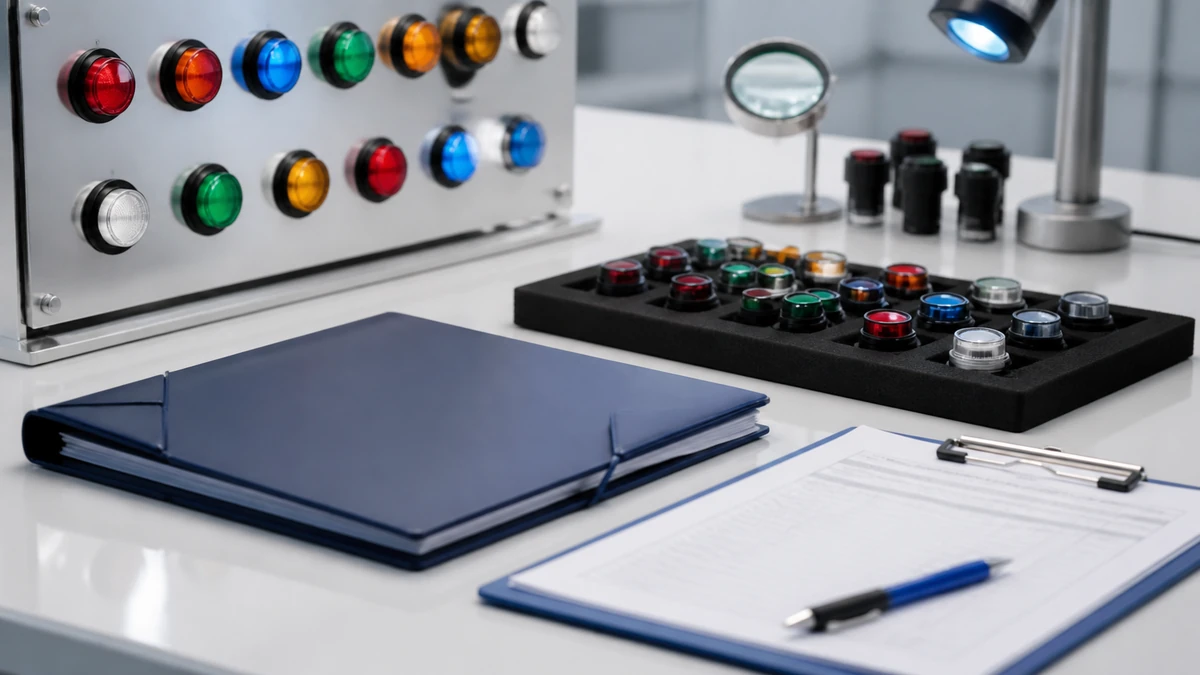
A manufacturer may offer push buttons, selector switches and accessories, but that does not automatically prove that a specific indicator light matches your panel drawing, control voltage or market documentation needs. Treat the indicator light as its own sourced component with its own evidence pack.
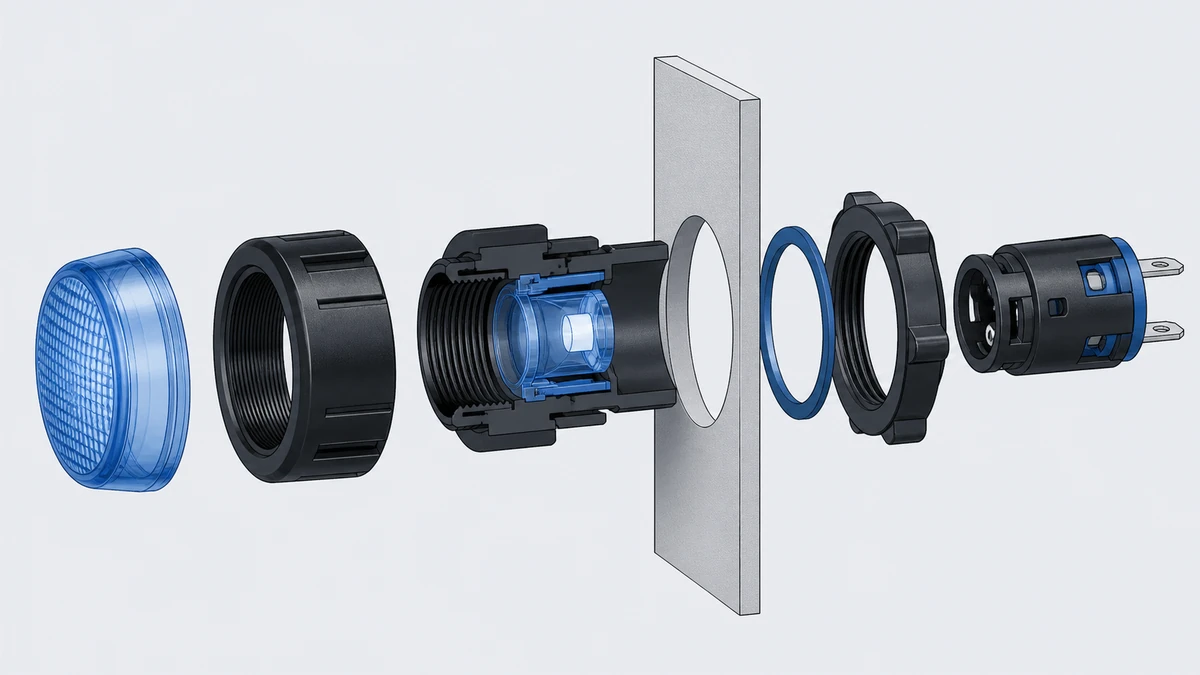
An exact drawing identifies the interfaces that must be controlled for the approved model route.
Supplier-evidence table
Buyer question
Evidence to request
Por que é importante
Is this an indicator-light model or only a general control-device family?
Model number, product photo, drawing and datasheet
Prevents substituting a similar-looking device
Does the unit match the panel layout?
Panel cutout, bezel size, mounting depth and fixing method
Avoids enclosure rework and assembly delays
Does the illumination match the control circuit?
Rated voltage, current data where declared, lamp type and wiring diagram
Prevents mismatch with the panel supply
Is the documentation usable for the destination market?
Current certificate or declaration package where applicable
Supports buyer compliance review
Can the supplier quote the exact configuration repeatedly?
Complete ordering code and option breakdown
Reduces variation between samples and batches
First-pass rejection checks
Use these checks before investing time in samples or extended quotation rounds:
Reject vague offers that provide only a family name without an exact model code.
Ask whether the lens color, voltage and mounting style are standard or option-specific.
Confirm whether the drawing revision matches the quoted product.
Separate indicator-light claims from push-button or selector-switch claims.
Request packaging, labeling and documentation expectations in writing before purchase order release.
Confirm indicator-light function before comparing model numbers
Indicator-light selection should start with the visual signal required by the machine or panel, then move to the manufacturer’s model code.
For control panels, buyers usually need a clear status indication such as power available, run, fault, alarm, enabled or maintenance mode. The selected color, lens style and marking should support that function in the buyer’s application and any internal panel-design standard.
Color, lens and marking decisions
Color choice is application-dependent and should be confirmed against the machine builder’s design rules, site standard or destination-market expectations. Do not assume that a color convention from one customer or industry applies universally.
For each indicator light, define:
Signal meaning, such as power, fault, ready, trip indication or manual mode.
Lens color and whether the lens is flush, raised or another available style.
Whether text is needed on a legend plate, enclosure label or separate panel marking.
Whether the indicator must be visible from a particular operator position.
Whether replacement lamps or complete-unit replacement are expected in the maintenance plan.
Pilot-light-only sourcing versus mixed control stations
Some projects source indicator lights alone. Others combine them with push buttons, selector switches and emergency-stop operators in one control station.
If your project includes mixed devices, use the supplier’s push button and indicator light range only as the starting point. Then verify the evidence for each selected part number separately, because a push-button family listing does not validate an indicator-light model.
Match electrical data to the panel control circuit
The indicator light must be matched to the actual control voltage, wiring method and panel design for the exact model being quoted.
Do not rely on appearance or panel cutout alone. Two indicator lights can look similar while having different illumination elements, voltage options, connection layouts or documentation status.
Sample review should connect the exact item to its current drawing and requested evidence package.
Voltage and current checks
Ask the manufacturer to confirm the voltage option by full model code. Where the datasheet provides current or power data, compare it with the panel supply design and the number of indicators energized at the same time.
Practical buyer checks:
Identify the control voltage and whether it is AC, DC or another specified supply condition.
Confirm the indicator-light voltage code in the quotation.
Check any polarity requirement where applicable.
Review declared current or power data if provided in the current datasheet.
Confirm whether the lamp element is integrated or serviceable for the selected model.
Wiring and circuit-interface checks
Indicator lights are normally signal devices in the control circuit. They should not be treated as protective devices, and they should not be described as providing overcurrent protection.
For sourcing, request the connection diagram and mounting instructions for the exact model. If the panel also includes illuminated push buttons or combined operators, keep the lamp circuit and contact arrangement evidence separate.
Electrical item
O que confirmar
Evidence source
Supply type
AC, DC or specified circuit condition
Datasheet and wiring diagram
Nominal voltage
Exact voltage option in ordering code
Quotation and datasheet
Illumination element
LED, lamp module or other model-specific construction
Datasheet and exploded drawing where available
Wiring points
Connection layout and marking
Drawing or installation sheet
Panel circuit role
Status indication only, unless the design states otherwise
Buyer schematic and manufacturer documentation
Check mechanical fit and environment against the control-panel drawing
Mechanical suitability depends on the exact cutout, panel thickness, mounting method, front profile and installation environment.
A manufacturer’s catalogue image is not enough for panel builders. The physical drawing should match the enclosure door, internal clearance, operator spacing and any panel-label arrangement.
Cutout, depth and mounting stack
Confirm the mounting hole size, allowable panel thickness where declared, fixing method, front bezel diameter and rear projection. These values affect drilling, punching, panel layout and wire-routing clearance.
Ask for a dimensioned drawing before tooling or enclosure fabrication. If the project is already in production, compare the drawing with the existing panel standard and the current installed part.
Environmental exposure and cleaning
Ingress rating, material, operating temperature and chemical exposure statements are exact-model and documentation-dependent. Do not assume that a similar-looking indicator light has the same environmental profile.
For harsh or washdown-adjacent installations, share the enclosure location, cleaning method and exposure conditions with the supplier. Final acceptance should be made by the buyer against current documentation and the actual application.
Mechanical checklist:
Panel cutout size and tolerance required by the drawing.
Panel thickness and mounting nut or retaining method.
Rear clearance behind the door or mounting plate.
Lens profile and risk of accidental impact.
Label or legend plate position.
Environmental exposure, including dust, moisture, oil mist or cleaning agents where relevant.
Service access for maintenance staff.
Treat documentation as a sourcing filter, not as an afterthought
A serious sourcing process should require current, model-specific documentation before price becomes the deciding factor.
For industrial buyers, documentation protects the quotation route. It helps engineering, purchasing and quality teams confirm that the offered indicator light is the same item reviewed for the control panel.
Installation conditions change the product-route and document questions a buyer must resolve.
Documentation package to request
Ask the manufacturer or distributor for a package tied to the exact part number and configuration. If a certificate or declaration is needed, specify the destination market and buyer requirements before quotation.
Recommended document request:
Dimensioned drawing with model or family reference.
Datasheet showing electrical and mechanical parameters for the selected option.
Ordering-code explanation.
Wiring or installation instruction where available.
Material or environmental information where required by the buyer.
Certificate, declaration or test-document package where applicable to the selected model and market.
Labeling and packaging information if the buyer needs receiving inspection or resale documentation.
Standards and evidence boundary
O IEC 60947-5-1 listing is useful as a catalogue reference for the control-circuit-device subject area, and the IEC page notes that a more recent edition exists. That listing should not be treated as a universal product-certification claim for any specific indicator light.
For procurement, the correct question is not “does the catalogue mention a standard?” The correct question is “which current document supports this exact model, option, marking and destination market?”
Verify commercial terms without assuming production capability
Commercial comparison should be based on the exact configured indicator light, its documentation package and the buyer’s order conditions.
Price alone can hide changes in lens color, voltage, connection style, packaging, markings or documentation availability. Ask every shortlisted manufacturer to quote the same specification and state exceptions clearly.
Quotation variables to lock
The quotation should identify the complete part number and any option codes. It should also state whether samples, production units and repeat orders will use the same configuration.
Lock these items before purchase order release:
Model code and description.
Voltage and lens color.
Mounting size and visible front style.
Quantity and packaging unit.
Marking, label or legend requirements.
Documentation included with the shipment.
Incoterm or delivery term if relevant to the buyer’s process.
Validity period of the quotation.
Any substitution policy or approval requirement.
Distributor and OEM-resale considerations
Engineering distributors and OEM resellers should check whether the manufacturer can provide repeatable ordering data, product images, drawings and documents suitable for downstream review. Avoid rewriting a vague product family into a specific promise that the manufacturer has not documented.
If the buyer needs private labeling, kitting or panel-specific packaging, confirm it as a quotation item. Availability, lead time and minimum quantity are supplier- and order-dependent, so they should be confirmed for the exact inquiry rather than assumed.
How Shieldhz confirms a push button, selector switch or emergency-stop operator route
Shieldhz confirms an operator route by collecting the control-panel function, application conditions and documentation requirements before matching a model for quotation.
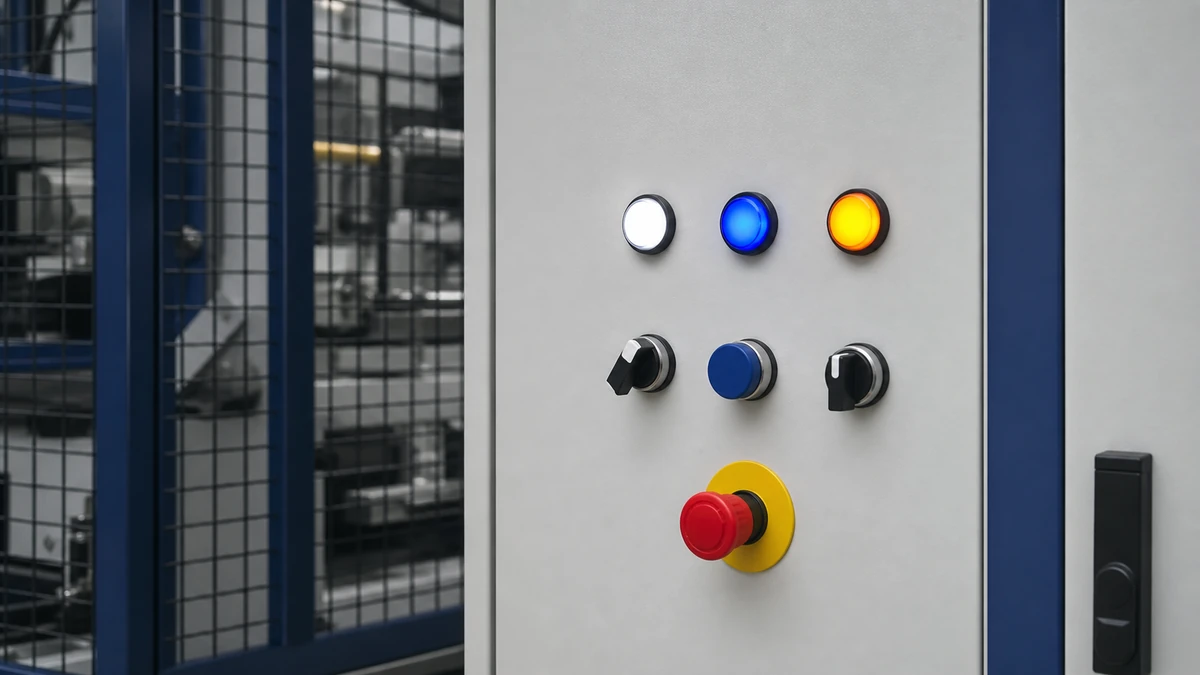
This route is especially useful when the same project includes indicator lights plus push buttons, selector switches or emergency-stop operators. The selected operator does not by itself validate a complete machine safety function; the full safety function must be assessed in the buyer’s machine design, risk assessment and applicable documentation.
Inputs Shieldhz requests before quotation
For push buttons and selectors, Shieldhz first confirms the machine function and destination market. If the buyer needs background on operator types, the Noções básicas sobre interruptores de botão article can support early internal alignment without replacing model-specific review.
Pre-quotation inputs include:
Machine function and destination market.
Operator action, such as momentary, maintained, selector position or emergency-stop operator style.
Control voltage and current conditions for the relevant circuit.
Contact arrangement, including the required normally open and normally closed configuration; for contact logic background, use the NO and NC contact guide.
Panel cutout, mounting depth and panel thickness.
Environment, including enclosure location and exposure conditions.
Marking, legend or language requirements.
Required drawing, datasheet and certificate package for the exact model route.
Route outcomes and documentation confirmation
After the inputs are clear, Shieldhz can route the inquiry to a specific configuration and documentation set. For projects with emergency-stop or selector placement questions, the emergency-stop and selector layout guide helps buyers organize the layout discussion before final part confirmation.
Where accessories are involved, the contact block and legend plate guide helps separate operator heads, contact blocks, lamp elements and marking components. Final suitability is confirmed against current product documentation and the buyer’s application, not by catalogue similarity alone.
Build a procurement scorecard before sample approval
A scorecard helps procurement compare panel indicator light manufacturers on evidence, fit and repeatability rather than on unit price alone.
Use the scorecard after engineering has defined voltage, cutout, lens color, marking and documentation needs. Weighting can be adjusted for OEM production, retrofit maintenance or distributor resale.
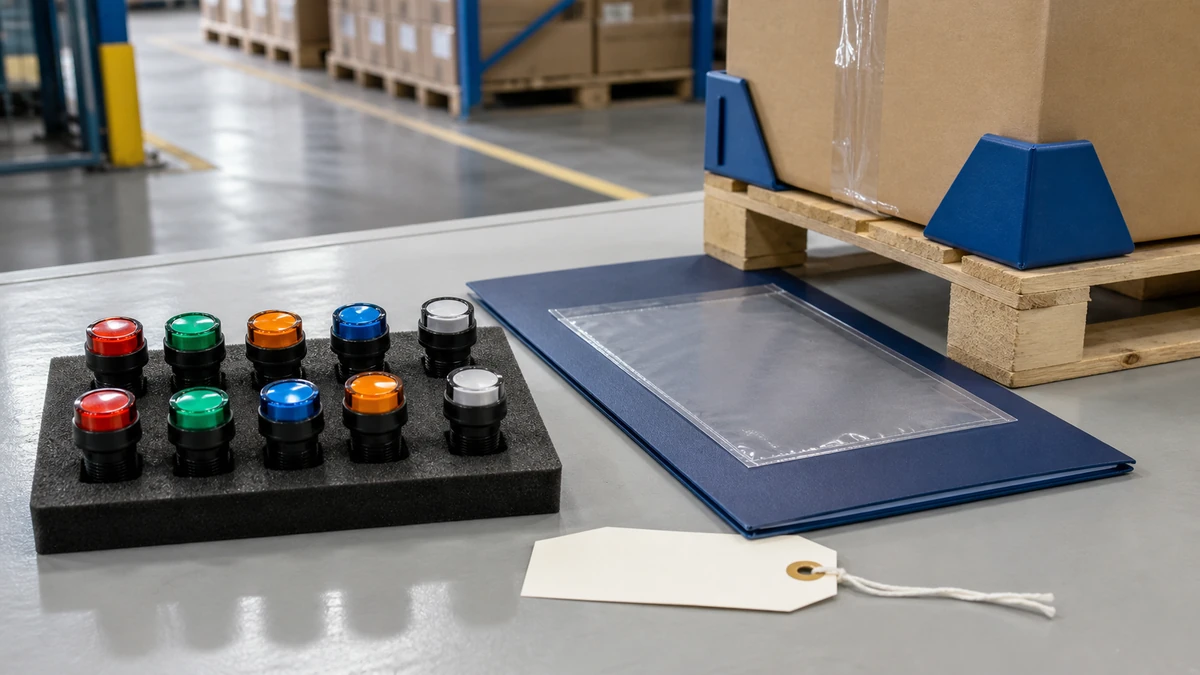
Documentation control, sample acceptance and protective packing are separate handover checks.
Shortlist decision table
Sourcing criterion
Strong response
Weak response
Buyer action
Exact model identification
Complete part number and option breakdown
Family name only
Request full ordering code
Drawing control
Dimensioned drawing tied to model
Catalogue image only
Hold sample approval
Electrical match
Voltage and wiring data confirmed
“Standard voltage” statement
Ask for datasheet reference
Documentação
Current package for selected model where required
Generic certificate or no revision detail
Clarify destination market
Mechanical fit
Cutout, depth and mounting shown
Approximate size only
Compare with panel drawing
Commercial clarity
Quantity, packing and exceptions stated
Price only
Requote with full specification
Change control
Substitution needs buyer approval
Supplier may ship equivalent
Add approval condition to PO
Sample and incoming-inspection actions
Samples should be checked against the same evidence used for quotation. Do not approve a sample if the model code, marking or documentation does not match the purchase specification.
Practical sample checks:
Compare the sample label or marking with the quoted model code.
Measure front diameter, mounting cutout interface and rear depth.
Confirm lens color and visual appearance under expected panel lighting.
Check connection layout against the wiring diagram.
Review supplied documentation revision.
Record any approved deviation before production ordering.
For repeat orders, define what receiving inspection must check.
Conclusion
Sourcing panel indicator lights is a model-specific evidence exercise. The safest commercial route is to compare panel indicator light manufacturers by exact drawings, datasheets, voltage options, mechanical fit, marking needs and destination-market documentation.
A broad control-device catalogue can help create a shortlist, but it should not replace indicator-light evidence for the selected part number. Lock the configuration before quotation, review the sample against the same evidence and keep push-button, selector and emergency-stop documentation routes separate when a panel uses mixed devices.
Perguntas frequentes
What should I ask panel indicator light manufacturers for first?
Ask for the exact model code, datasheet, dimensioned drawing and available documentation package for the selected voltage, color and mounting style. Do this before comparing price.
Is a push-button catalogue enough evidence for an indicator light?
No. A push-button catalogue can show the supplier’s broader range, but the indicator light still needs its own model-specific drawing, electrical data and documentation.
Can I assume the same IP rating or certification across similar indicator lights?
No. IP class, certification status and environmental claims are exact-model and documentation-dependent. Confirm them against the current datasheet, certificate or declaration for the selected configuration.
How do I compare two similar-looking pilot lights?
Compare the ordering code, voltage, lens color, cutout size, mounting depth, connection layout, documentation package and sample markings. Similar appearance is not enough for sourcing approval.
What if the panel also uses emergency-stop operators?
Treat the emergency-stop operator as a separate device route with its own documentation and application review. Selecting an operator does not validate the complete machine safety function.
Should procurement approve a lower-cost substitute?
Only after engineering confirms that the substitute matches the required model evidence, panel fit, electrical data, documentation and buyer application. Add written approval rules so substitutions are not made silently.
Shi, Muxi
Shi, Muxi escreve artigos técnicos da Shieldhz para compradores de controle industrial e componentes elétricos, abrangendo chaves de came rotativas, chaves isoladoras, seccionadores PV DC, botões de pressão, luzes indicadoras, gabinetes à prova d'água e blocos de terminais. Os artigos são baseados na experiência de fabricação e exportação da Zhejiang Shihe Electric Co., Ltd., com ênfase prática na seleção de modelos, planilhas de dados, desenhos, certificações, classificações de IP e detalhes de consulta que os compradores devem confirmar antes de fazer o pedido.