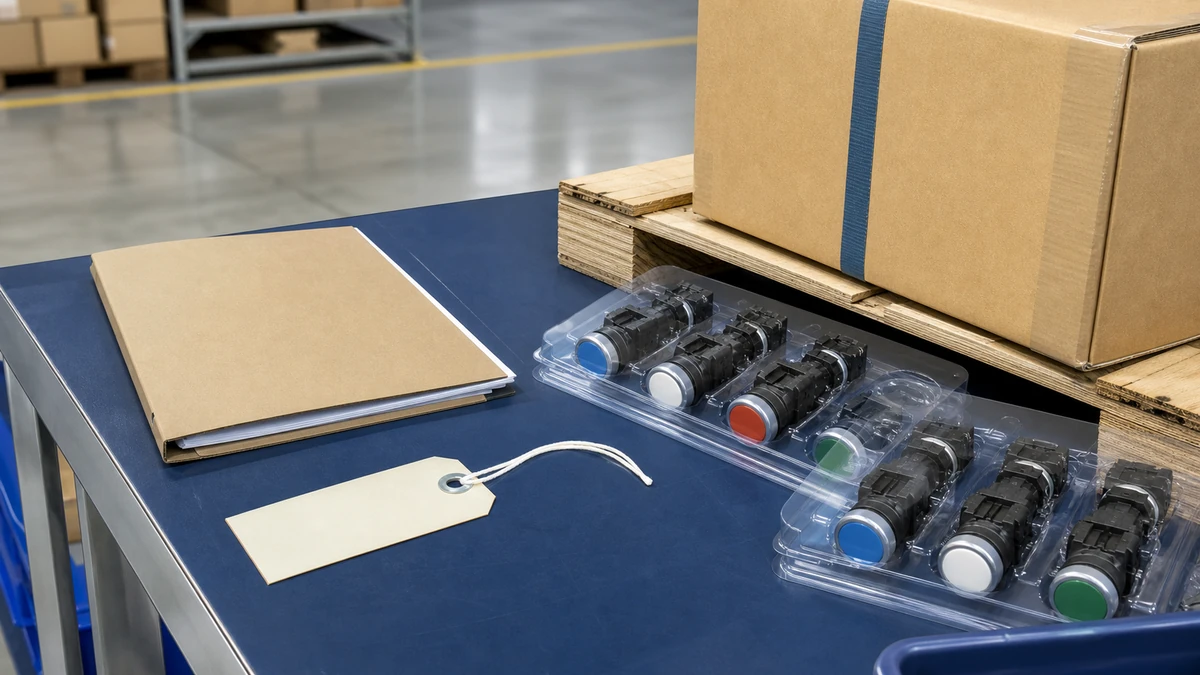
Push Button Switch Manufacturers and Suppliers: OEM Buyer Checklist
Use a practical buyer checklist to evaluate push button switch manufacturers inputs, documentation, approval controls and the exact push button, selector switch or emergency-stop operator route.
Selecting between push button switch manufacturers, suppliers and OEM routes is a sourcing decision that should start with machine function, documentation needs and destination-market requirements—not only with price or panel diameter.
Shortlist suppliers by product family, drawing support, contact configuration, operator style and documentation availability.
Confirm exact-model ratings, certificates, drawings and datasheets before releasing a purchase order.
Treat emergency-stop and selector-switch selection as part of a broader machine-control review; the operator alone does not validate the complete safety function.
Decide whether you need a manufacturer, supplier or OEM route
Choose the route that matches your engineering control, documentation burden and purchasing pattern. A machine builder buying repeat panels may need a different supplier model than a distributor filling mixed maintenance demand.
Manufacturer route
A manufacturer route is usually preferred when you need stable product families, drawing confirmation, repeat model numbers and OEM coordination. It can also matter when your team needs to align operator style, contact arrangement, lamp voltage and legend marking across several machines.
The tradeoff is that the buyer must usually provide clearer technical inputs earlier. Without those inputs, the quotation may be fast but incomplete.
Distributor or trading-supplier route
A distributor or trading-supplier route can be useful for mixed brands, small replenishment orders or maintenance replacement searches. The buyer should still verify whether the exact model, drawing, accessory stack and documentation package match the machine requirement.
Buying route
Best fit
Buyer risk to control
Direct manufacturer
OEM panels, repeat builds, custom markings, coordinated product family
Confirm exact model, documentation and destination-market evidence
Engineering supplier
Project sourcing with technical comparison
Check whether the supplier can provide current drawings and datasheets
Distributor
Maintenance replacement or multi-brand procurement
Avoid substituting similar-looking operators without electrical and mounting checks
Private-label/OEM route
Brand-controlled panel programs
Define marking, packaging, documentation and revision-control expectations
An exact drawing identifies the interfaces that must be controlled for the approved model route.
Build a shortlist around the machine function, not only the panel hole
Start with what the operator must do in the control system, then narrow the supplier list. A similar-looking push button can have different action, contacts, lamp circuit, mounting stack and documentation status by exact model.
State whether the function needs a momentary push button, maintained push button, selector switch, key selector, illuminated operator or emergency-stop operator. The action affects the contact arrangement and how the control circuit responds.
Do not use color or actuator shape as the only specification. A red mushroom operator, for example, still needs an exact contact configuration, mounting method and documentation package.
Match the control-panel role
Classify each operator by panel role before contacting push button switch manufacturers. Typical roles include start, stop, reset, jog, mode select, local/remote select, alarm acknowledge and status indication.
Buyer action checklist:
List every panel operator by machine function.
Note whether each action is momentary, maintained, spring-return or key-controlled.
Identify whether illumination is required and what control voltage applies.
Record the target panel cutout, panel thickness and available depth.
Separate new-machine sourcing from maintenance replacement sourcing.
Compare product families by operator, contact and accessory architecture
Compare product families by how the operator, contact blocks, lamp units, mounting parts and markings fit together. A low unit price is not useful if the contact block stack, legend plate or lamp voltage cannot match the panel design.
Shieldhz’s push button and indicator light range is a practical starting point for reviewing available operator families before narrowing to exact models.
Operator and indication choices
Confirm whether the family includes non-illuminated operators, illuminated operators, pilot lights, selector switches, key selectors and emergency-stop operators. Also confirm whether the appearance and panel layout can remain consistent across the machine.
For illuminated devices, specify the lamp voltage and current path from the control design. Do not assume that a lamp unit from one family fits another unless the supplier confirms it against current documentation.
Accessory and marking system
Accessories affect both assembly work and maintenance clarity. Legend plates, contact blocks, lamp modules and mounting collars should be checked as a matched assembly, not as isolated parts.
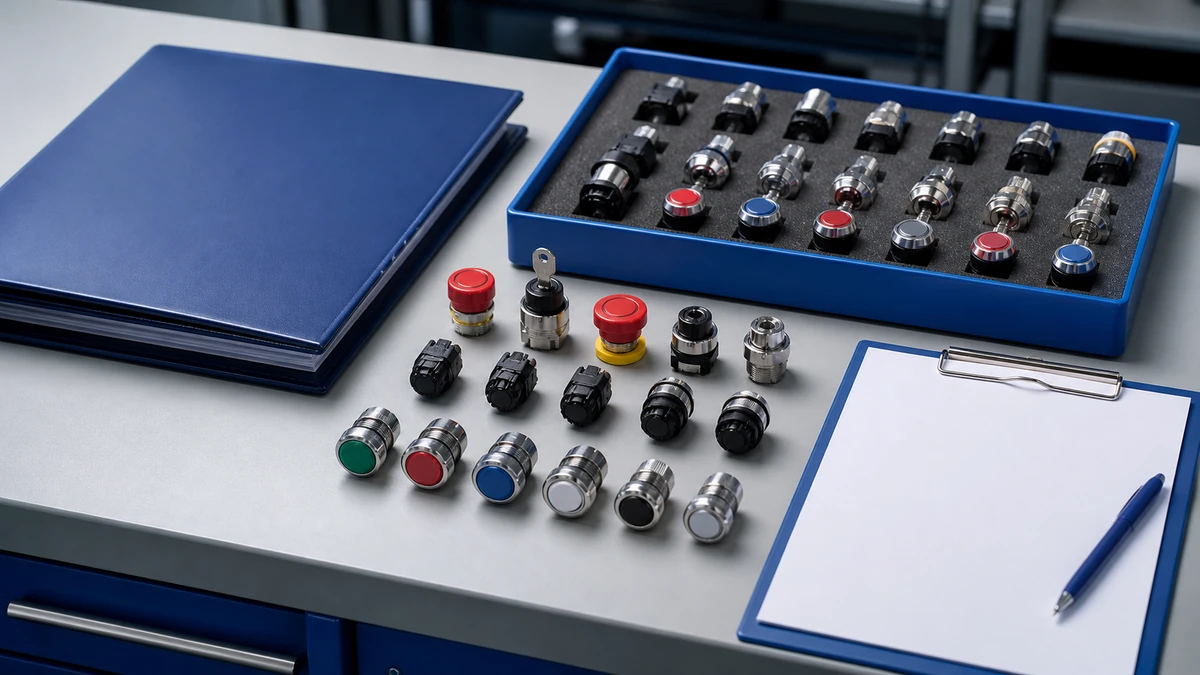
Sample review should connect the exact item to its current drawing and requested evidence package.
Verify contact logic, voltage and current before pricing
Confirm contact logic, voltage and current before asking suppliers to finalize pricing. The wrong contact arrangement can create a costly redesign even if the operator fits the hole.
For a refresher on normally open and normally closed behavior, see the NO and NC contact guide. Then verify the exact contact block combination by model, drawing and datasheet.
Contact arrangement decision
Define the required number of normally open and normally closed contacts for each operator. Include whether the contacts are used for control input, signal feedback, lamp logic or interlocking within the control design.
Panel function
Common contact question
What to confirm with the supplier
Start
Is one NO contact enough for the control scheme?
Exact contact block model and rated use from datasheet
Stop
Is NC required by the control design?
Contact action, block position and wiring diagram
Redefinir
Is a separate feedback contact needed?
Number of contacts and mechanical stack allowance
Selector
Does each position require independent contacts?
Position chart and contact truth table by exact model
Illuminated push button
Is lamp circuit separate from switch contacts?
Lamp voltage, lamp unit model and wiring diagram
Electrical confirmation
Ask for the control voltage, current category and load information to be checked against the current datasheet. Electrical limits are exact-model and application dependent, and they should not be inferred from product appearance.
Do not ask a switch operator to perform functions outside its documented control-circuit role. Coordinate the complete circuit design with the machine electrical specification.
Treat emergency-stop and selector-switch sourcing as a safety-interface decision
Source emergency-stop and selector-switch operators as control-interface components that must be reviewed inside the complete machine design. Selecting an emergency-stop operator does not, by itself, validate the full machine safety function.
Confirm actuator style, reset method, contact arrangement, mounting and marking against the machine design and destination-market expectations. Evidence such as drawings, datasheets and certificates must be checked for the exact model under consideration.
The complete safety function depends on more than the operator. It can include circuit architecture, control devices, risk assessment, wiring, diagnostics, stopping behavior and validation performed by the machine builder or responsible party.
Selector-switch route
Selector switches require position logic, not only a number of positions. Specify maintained or spring-return action, key removal positions if relevant, contact truth table and legend marking.
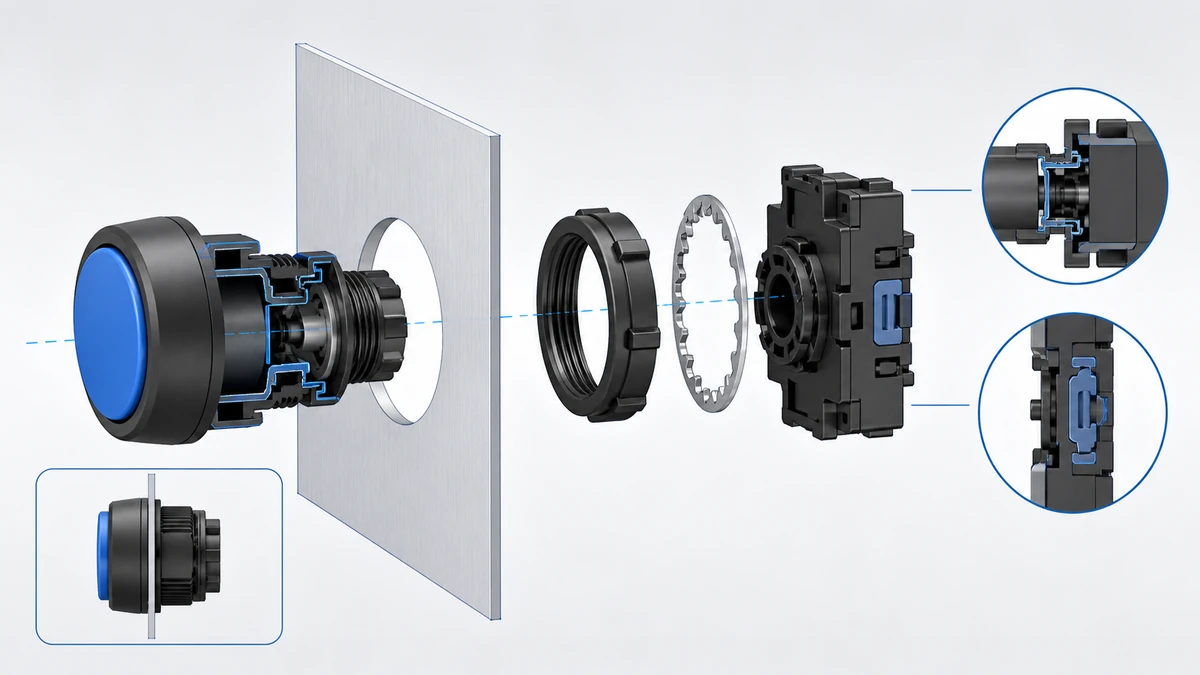
Installation conditions change the product-route and document questions a buyer must resolve.
Buyer action checklist:
State the function of each emergency-stop or selector operator.
Provide the required contact arrangement and position logic.
Confirm reset, key or spring-return behavior.
Request exact-model documentation before approval.
Review final suitability against the buyer’s machine safety and control design.
Confirm environmental, mechanical and panel-integration details
Confirm panel and environment details before approving a supplier shortlist. Mechanical mismatch often appears late, when the panel is already drilled or the enclosure layout is fixed.
Panel cutout and mounting
Provide the panel cutout, panel thickness and available rear clearance. Confirm mounting hardware, maximum accessory stack and whether the operator family matches the panel-building method.
Tightening requirements, if relevant, should be taken from the exact product documentation. Do not reuse torque assumptions from another series or supplier.
Environment and use conditions
Describe the operating environment in practical terms: indoor or outdoor placement, washdown exposure, dust, oil mist, vibration, ambient temperature range and operator frequency. Any ingress or environmental rating should be confirmed by exact model, datasheet and applicable documentation.
Practical confirmation list:
Panel cutout and panel thickness
Front-panel exposure conditions
Rear-panel space and wiring access
Required operator color and legend text
Illumination voltage, if used
Maintenance replacement constraints
Destination market and documentation requirements
How Shieldhz confirms a push button, selector switch or emergency-stop operator route
Shieldhz confirms the route by collecting the application inputs needed to match a product family, exact model and documentation package. Final suitability is confirmed against current product documentation and the buyer’s application.
Pre-quotation confirmation inputs
A practical pre-quotation review should include the machine function and destination market, operator action, control voltage and current, contact arrangement, panel cutout and mounting, environment, marking or legend requirements, and the required drawing, datasheet and certificate package.
For emergency-stop operators, Shieldhz can help identify an operator route and documentation set, but the buyer remains responsible for validating the complete safety function within the machine or system.
Documentation package confirmation
Before quotation finalization, confirm what documents are needed for approval. This may include a dimensional drawing, wiring or contact diagram, datasheet, accessory list, marking layout and any certificate package available for the exact model and destination-market requirement.
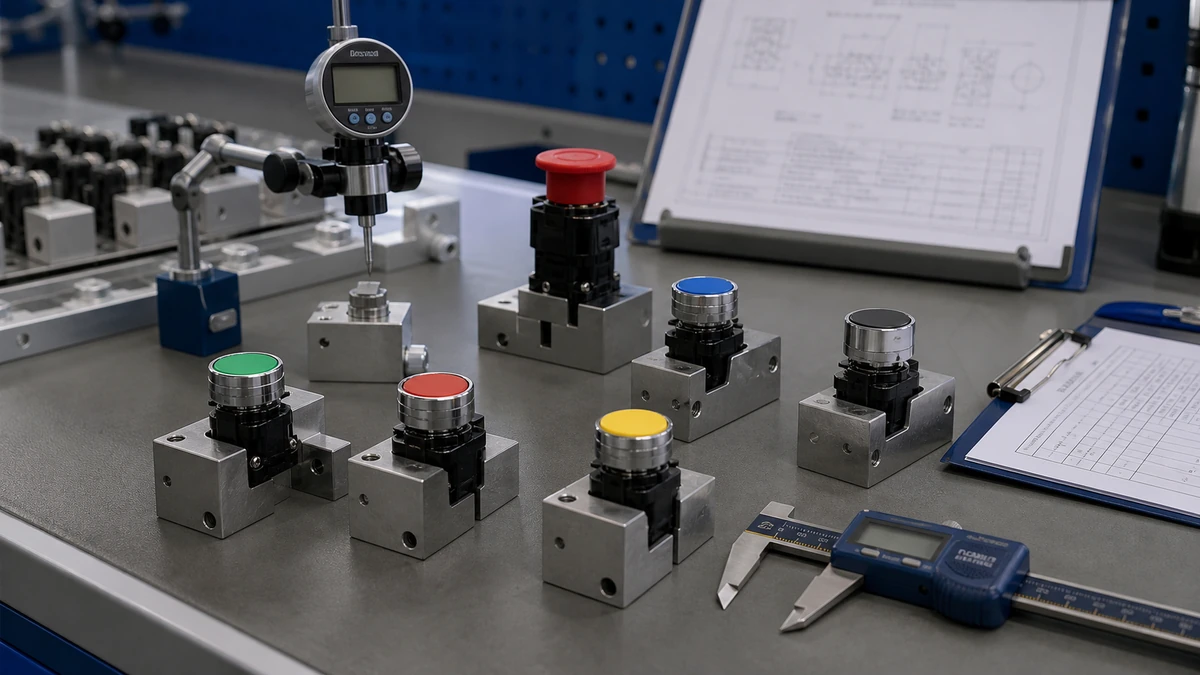
Documentation control, sample acceptance and protective packing are separate handover checks.
Shieldhz buyer-verification workflow:
Receive the machine function, panel layout and destination-market information.
Identify the operator family and accessory route.
Confirm contact arrangement, lamp voltage and mounting details.
Check marking, legend and color requirements.
Prepare the exact drawing, datasheet and certificate package available for that model.
Finalize the quotation only after technical route confirmation.
Compare quotations by documentation and risk, not just unit price
Compare supplier quotations by total engineering fit, not only by unit price. A quotation with unclear contact blocks, missing drawings or uncertain documentation can create more risk than a higher-priced but better-defined model route.
Technical quotation comparison
Ask each supplier to quote the same technical requirement. If one supplier quotes only an operator head and another quotes a complete assembly, the prices are not comparable.
Quotation item
Por que é importante
What to request
Exact model number
Prevents substitution ambiguity
Full model code and accessory list
Drawing
Confirms panel and rear-space fit
Current dimensional drawing
Acordo de contato
Confirms control logic
Contact diagram or contact table
Lamp data
Confirms illumination circuit
Lamp voltage and lamp unit model
Marcação
Confirms panel usability
Legend text, plate style or marking method
Documentação
Supports buyer approval
Datasheet and available certificate package by exact model
Standards and evidence boundary
Use standards references carefully. The IEC 60947-5-1 listing describes the control-circuit-device subject area and notes that a more recent edition exists; it should be treated as catalogue context, not as a universal product-certification claim.
Commercial comparison checklist:
Confirm whether the quote is for a complete assembly or separate parts.
Check whether accessories are included or optional.
Ask whether drawings and datasheets are current for the quoted model.
Confirm packaging, labeling and marking expectations if relevant.
Define inspection requirements before shipment if your procurement process requires them.
Treat MOQ, lead time and certificates as supplier-, model-, order- and destination-dependent.
Conclusion
The best push button switch manufacturers and suppliers for an OEM buyer are the ones that can confirm the exact operator route, contact arrangement, mounting fit, marking requirement and documentation package for the buyer’s application. Price matters, but it should be compared only after the technical scope is aligned.
Use this checklist to separate supplier capability from model-level quotation detail. Shortlist by product family and documentation support first, then confirm the exact model against current drawings, datasheets, certificates and the machine’s control requirements.
Perguntas frequentes
How should OEM buyers shortlist push button switch manufacturers?
Start with the machine function, destination market, operator type, contact arrangement, panel cutout and documentation requirement. Then compare manufacturers or suppliers by their ability to support the exact model route with current drawings, datasheets and available certificate packages.
Is a lower-priced push button switch quotation always better?
No. A lower price may exclude contact blocks, lamp units, legend plates or documentation that another quotation includes. Compare complete assemblies, exact model numbers and documentation scope before making a commercial decision.
What information should I send before requesting a quotation?
Send the machine function, operator action, control voltage and current, NO/NC contact arrangement, panel cutout, panel thickness, environment, marking requirements and destination market. If you need documents for approval, state the drawing, datasheet and certificate package required.
Can an emergency-stop operator alone validate machine safety?
No. An emergency-stop operator is only one part of the overall machine safety function. The complete function depends on the machine design, circuit architecture, risk assessment, validation process and applicable requirements for the buyer’s application.
Are IP ratings, certificates and electrical ratings the same for every model in a product family?
No. These details are exact-model, datasheet, certificate, destination-market and application dependent. Always confirm them against current product documentation before approval or purchase.
When should I involve the supplier in the design process?
Involve the supplier before the panel layout and bill of materials are frozen. Early confirmation helps avoid late changes to cutouts, contact blocks, lamp voltage, legends, accessory stacks and documentation requirements.
Shi, Muxi
Shi, Muxi escreve artigos técnicos da Shieldhz para compradores de controle industrial e componentes elétricos, abrangendo chaves de came rotativas, chaves isoladoras, seccionadores PV DC, botões de pressão, luzes indicadoras, gabinetes à prova d'água e blocos de terminais. Os artigos são baseados na experiência de fabricação e exportação da Zhejiang Shihe Electric Co., Ltd., com ênfase prática na seleção de modelos, planilhas de dados, desenhos, certificações, classificações de IP e detalhes de consulta que os compradores devem confirmar antes de fazer o pedido.