CE, RoHS, and Market Documentation for Industrial Control Components: What Buyers Should Verify
Use a practical buyer checklist to evaluate industrial control component compliance documents inputs, documentation, approval controls and the exact industrial control component portfolio route.
Industrial control component compliance documents should be verified against the exact model, drawing, rating, marking, and destination market before a buyer treats them as usable purchasing evidence. CE, RoHS, and market documentation are not interchangeable, and a document for one construction, rating, or product family should not be assumed to cover another.
Buyer actions:
Match every declaration, certificate, datasheet, and drawing to the exact model code being quoted.
Confirm the destination market and requested compliance package before purchase order release.
Treat final suitability as application-dependent and verify it against current product documentation, panel design, and buyer requirements.
Verify the document-to-model match before evaluating any compliance claim
The first buyer decision is whether the document actually belongs to the component being purchased. A CE declaration, RoHS statement, datasheet, drawing, or test reference is only useful when it can be traced to the exact model, configuration, rating, and revision under review.
An exact drawing identifies the interfaces that must be controlled for the approved model route.
What “document-to-model” means in purchasing
Document-to-model verification checks that the document title, product family, model code, electrical data, mechanical construction, and marking path align. It also checks whether the document covers a series, a specific model, or only selected variants within a series.
A buyer should not rely on a broad product family document if the ordered model uses a different contact arrangement, enclosure, actuator style, pole configuration, current rating, voltage rating, or accessory set. These variables can change the evidence needed for market access, panel approval, or customer documentation.
Minimum traceability fields to compare
Use the quoted model code as the master reference. Then compare it with the product marking, drawing, datasheet, declaration, packaging label, and commercial quotation.
Checklist for first-pass verification:
Exact model code and naming convention
Product family and function
Rated voltage and current as listed for that model
AC/DC use condition, where applicable
Pole, contact, or actuator configuration
Enclosure or mounting format, where applicable
Drawing or datasheet revision
Declaration issue date and responsible issuer
Destination-market language or marking requirements
Match the documentation request to the component family being sourced
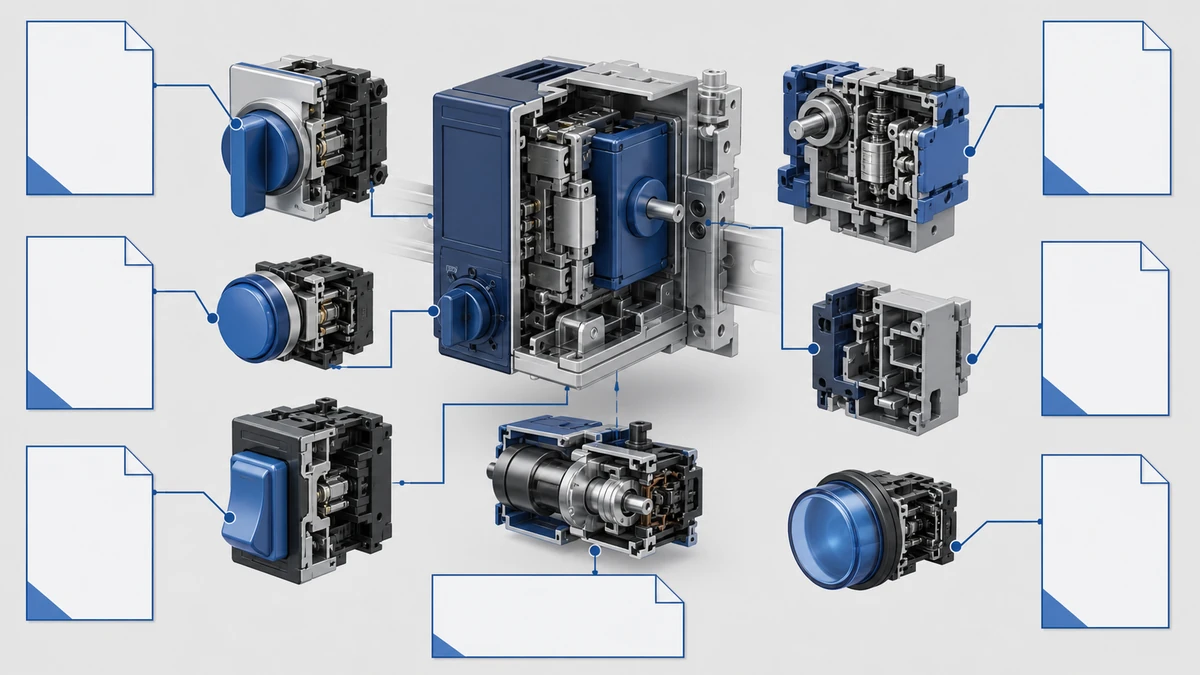
The correct documentation package depends on the component family, exact construction, and buyer application. A rotary cam switch, DC isolator, push button, indicator, or enclosed isolator may require different drawings, declarations, ratings evidence, and installation information.
Operators and indicators follow a different verification route. The push button and indicator light range should be checked against actuator type, color, contact arrangement, illumination data where applicable, and mounting details. If an enclosed device is being sourced, the waterproof isolator box range should be checked against the exact enclosure, switch, rating, and installation configuration stated in current documentation.
Model code, contact sequence, pole count, handle or actuator position
Is this suitable for the quoted electrical condition?
Datasheet, rating table, product marking, test-related evidence where available
Voltage, current, AC/DC condition, utilization category where stated
Is this the correct mechanical fit?
Dimension drawing, panel cut-out, mounting data
Cut-out size, mounting depth, enclosure format, accessory fit
Is CE/RoHS evidence available for this model route?
Declaration, RoHS statement, supporting records where applicable
Product scope, model range, revision, issuer, date
Is destination-market documentation required?
Market-specific declaration, label, language, importer data where applicable
Destination country, buyer specification, marking and document language
Treat CE evidence as a model-specific conformity route, not a universal certificate
CE documentation should be checked as a conformity route for the exact product being placed on the relevant market. It should not be treated as proof that every variant, accessory, configuration, or buyer application is automatically covered.
Check the declaration scope
For many industrial control components, buyers commonly ask for an EU Declaration of Conformity or equivalent supplier declaration where applicable. The key issue is not only whether a document exists, but whether the product description and model scope cover the quoted component.
The declaration should identify the manufacturer or responsible issuer, applicable EU legislation or standards as stated by the issuer, product family, model scope, date, and signature or authorized name. If the declaration lists a series, the buyer should confirm that the ordered model falls inside that series and that no configuration exclusions apply.
Understand the standard reference boundary
A standard reference is not the same as a market approval for every configuration. The IEC 60947-3 scope is described by IEC as switches, disconnectors, switch-disconnectors and fuse-combination units within stated distribution- and motor-circuit AC/DC limits. Buyers should verify any standard reference against the exact model, stated ratings, intended function, and destination-market requirements.
Do not assume that a switch, isolator, or operator performs another protection function unless the current product documentation explicitly supports that role for the exact model and application. Selection must remain tied to the stated function and documented ratings.
CE review checklist
Before accepting CE evidence, confirm:
The declaration names the correct product family and model range.
The quoted model is included without unsupported assumptions.
The document date and revision are current for the quotation.
Marking on the product or packaging is consistent with the documentation, where required.
Installation instructions or datasheet conditions are available where needed.
The buyer’s application does not require additional system-level assessment.
Verify RoHS evidence against material scope, model scope, and supply status
RoHS documentation should be reviewed as restricted-substance evidence for the quoted product route. A RoHS statement for a product family is useful only when the exact model, material construction, and supply revision are within its stated scope.
Sample review should connect the exact item to its current drawing and requested evidence package.
What to ask for
For procurement records, buyers commonly request a RoHS declaration or supplier statement. Depending on the buyer’s industry and customer requirements, additional material declarations, component material summaries, or supplier confirmations may be requested.
The required depth is buyer-application dependent. A distributor purchase may need a basic declaration, while an OEM customer file may require a more detailed material compliance trail linked to the finished equipment documentation.
RoHS document decision table
If the buyer needs to prove…
Ask for…
Verify before acceptance
Basic restricted-substance position
RoHS declaration or supplier statement
Product scope, issuer, date, model coverage
Customer file traceability
Model-linked compliance statement and current datasheet
Model code, revision, supplied construction
Change-sensitive production
Confirmation process for material or supplier changes
Notice terms, drawing revision, approval record
Multi-market shipment
Destination-market compliance package
Required regulation version, language, importer or buyer record needs
When to request clarification
Request clarification if the RoHS document uses only a generic family name, lacks a date, omits the issuing party, or does not align with the quoted model route. Also clarify if the buyer’s customer requires evidence for a particular regulation version, exemption position, or material declaration format.
Confirm ratings, markings, and drawings before purchase order release
The purchasing decision should be based on the current datasheet, drawing, marking, and quoted model configuration. Compliance documents do not replace electrical and mechanical verification.
Electrical data to compare
Check the quoted voltage, current, AC/DC condition, utilization category where stated, number of poles, and contact arrangement against the datasheet and product marking. For DC isolation or photovoltaic-related use, confirm that the exact model documentation states the relevant DC conditions and installation assumptions.
Avoid converting one rating into another unless the manufacturer documentation explicitly supports it. A rating for one operating condition should not be reused for a different voltage, current, load type, wiring arrangement, or environmental condition without confirmation.
Mechanical and environmental data to compare
Check panel cut-out, mounting depth, handle or actuator format, enclosure size, cable entry arrangement where applicable, and environmental data stated for the exact model. If an IP rating, operating temperature, or mechanical endurance value is required, verify it in current documentation for the model being purchased.
Mechanical fit is a commercial risk as well as an engineering risk. A component that is electrically correct but mechanically incompatible can delay panel assembly, rework drawings, and complicate customer approval records.
Pre-PO verification checklist
Before releasing the PO, compare:
Quotation model code
Datasheet model code
Drawing revision
Marking photo or marking specification where available
Electrical rating table
Wiring or contact diagram
Mounting and cut-out data
Enclosure or accessory details where applicable
Compliance documents requested by the buyer
Destination-market requirements
Check destination-market documentation separately from product datasheets
Market documentation depends on where the product or finished equipment will be sold, imported, installed, or audited. A datasheet may support selection, but it does not automatically satisfy customs, customer, or market-access documentation requirements.
Installation conditions change the product-route and document questions a buyer must resolve.
Destination market drives document format
A buyer supplying the EU may focus on CE and RoHS records. Another buyer may need language-specific labels, importer information, customer forms, country-specific declarations, or project documentation. These requirements should be stated before quotation because they can affect the documentation package and approval workflow.
The same component may be used in different commercial routes. The required documentation can change when the buyer is an OEM exporting machinery, a panel builder delivering to a project site, or a distributor supplying multiple downstream customers.
Commercial documentation decision table
Commercial route
Documentation question
Buyer action
OEM equipment export
Does the component document support the finished equipment file?
Request model-linked declarations and current datasheets early
Panel build for a specified project
Does the project require listed markings, language, or certificates?
Provide project documentation requirements before quotation
Distributor inventory
Can documentation be supplied by exact model at resale?
Store model-linked documents and revision dates
Replacement or maintenance supply
Does the replacement match the original function and rating?
Compare model, rating, drawing, and installed condition
Private-label or customer-specific package
Are labels, manuals, and declarations aligned?
Define approval records and marking responsibilities before order
Questions to ask the buyer’s end customer
Use these questions before approving a documentation package:
Which destination country or region applies?
Is the component sold alone, inside a panel, or inside finished equipment?
Are CE, RoHS, or other market documents required by contract?
Are original manufacturer documents required, or are supplier declarations acceptable?
Is a specific language, label format, or document revision required?
Does the customer require pre-approval before shipment?
How Shieldhz confirms a industrial control component portfolio route
Shieldhz confirms the portfolio route before quotation by linking the buyer’s application, destination market, product family, exact model path, and requested documentation package. Final suitability is confirmed against current product documentation and the buyer’s application.
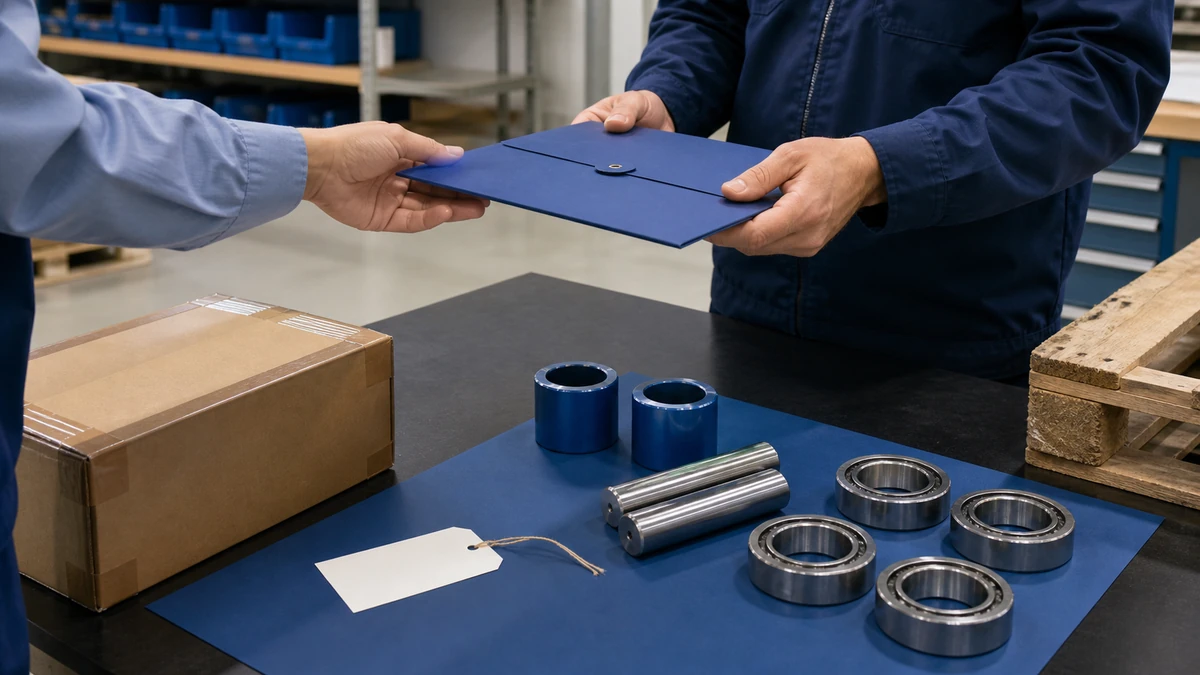
Documentation control, sample acceptance and protective packing are separate handover checks.
Pre-quotation confirmation inputs
The confirmation process starts with the buyer’s intended use and destination market. Shieldhz then narrows the route to a product family and exact model candidate, instead of treating the portfolio as one universal compliance package.
Practical inputs include:
Application description and installation context
Destination market or project country
Product family and required function
Exact model route or required configuration
Electrical inputs such as voltage, current, AC/DC condition, and load type where relevant
Mechanical inputs such as mounting, cut-out, enclosure, actuator, or handle requirements
Requested documentation, including CE, RoHS, drawing, datasheet, and market records
Buyer approval records or project document list
Marking, label, language, or packaging needs where applicable
Sample approval, drawing approval, or change-control requirements
Commercial handover requirements for quotation, PO, shipment, and resale files
Approval records and change control
For engineering distributors, OEMs, and panel builders, the useful record is the approved model route. That record should include the model code, drawing or datasheet revision, documentation list, quotation reference, and any buyer-approved substitutions or limitations.
If a sample is reviewed, the approval should state whether it covers only physical fit, documentation acceptance, or full buyer application approval. Any later change in model code, rating, material construction, marking, or documentation revision should be reviewed before assuming continuity.
Commercial handover
The quotation should state the model route and requested documents clearly enough for procurement, engineering, and quality teams to use the same reference. If the buyer needs documents before PO release, that requirement should be stated at inquiry stage.
A clean handover reduces the risk of ordering a similar-looking product with a different document route. It also helps distributors maintain consistent resale records for downstream customers.
Identify red flags before documents enter the approval file
The buyer should pause approval when the document trail cannot be tied to the exact model or destination-market requirement. Most documentation problems are easier to solve before PO release than after goods are received.
Red flags that require clarification
Clarify before accepting a document if you see:
The model code on the declaration does not match the quotation.
The document lists only a broad series with no model scope explanation.
The datasheet rating differs from the marking or quotation.
The drawing revision is missing or outdated.
The RoHS statement lacks date, issuer, or product scope.
The document refers to a different product family.
Destination-market requirements are not stated.
The buyer’s customer requires a certificate format not yet confirmed.
The operator or indicator is being used in a safety-related function without system-level validation.
For emergency-stop applications, selecting an emergency-stop operator does not validate a complete machine safety function. The complete function depends on machine risk assessment, control architecture, wiring, diagnostics, reset logic, applicable standards, and the buyer’s safety validation.
Corrective actions before approval
When a red flag appears, ask for a revised quotation reference, corrected model code, updated drawing, current datasheet, or clarified declaration scope. If the buyer’s application requires special documentation, state the required document title and acceptance criteria.
Do not resolve document gaps by assuming that a similar model is equivalent. Equivalence should be confirmed through current product documentation and buyer approval.
Write purchase orders that preserve the approved documentation route
The purchase order should preserve the exact model and documentation assumptions approved during engineering review. If the PO is too generic, procurement may unintentionally break the traceability chain.
PO language to include
A practical PO should include the approved model code, quantity, destination market, required documents, drawing revision where applicable, and any marking or packaging requirements. If substitution is not allowed without written approval, state that clearly.
Suggested PO checklist:
Exact model code and description
Approved drawing or datasheet revision where required
Electrical and mechanical configuration
Required CE, RoHS, and market documents
Destination market or project reference
Required label, marking, or language conditions where applicable
Sample approval reference if used
No-substitution or change-approval requirement
Delivery documentation handover contact
When to allow alternatives
Alternatives should be handled as new model routes, not informal substitutions. The buyer should compare the alternative model’s documentation, rating, drawing, marking, and fit before approval.
This is especially important where the component is already listed in a panel drawing, customer BOM, equipment file, or distributor resale record. A small change in actuator, enclosure, contact arrangement, or rating can create a documentation mismatch.
Conclusion
Industrial control component compliance documents are commercially useful only when they are tied to the exact model being purchased. CE, RoHS, datasheets, drawings, markings, and destination-market records should be reviewed as one traceable package, not as separate generic files.
For OEMs, panel builders, engineering distributors, and procurement teams, the practical decision is simple: verify the document-to-model route before approving the quotation or PO. Final suitability remains dependent on current product documentation, the destination market, and the buyer’s application.
Perguntas frequentes
What are industrial control component compliance documents?
They are the documents buyers use to support product selection, purchasing approval, and market records. They may include CE declarations, RoHS statements, datasheets, drawings, wiring diagrams, marking information, and destination-market documents where applicable.
Is a CE document enough to approve an industrial control component?
Not by itself. Buyers should verify that the CE document covers the exact model and that the datasheet, drawing, marking, and application conditions are also acceptable for the intended use.
How should buyers verify RoHS documentation?
Buyers should check the issuer, date, product scope, model coverage, and any stated regulation version or exemption position. If the buyer’s customer needs a specific material declaration format, that requirement should be confirmed before quotation.
Can one document cover a whole product series?
Sometimes a document may state coverage for a series, but buyers should confirm that the ordered model is inside the stated scope. A series-level document should not be assumed to cover every rating, construction, accessory, or configuration.
Does selecting an emergency-stop operator validate machine safety?
No. Selecting an emergency-stop operator does not validate a complete machine safety function. The complete function must be assessed and validated at machine or system level by the buyer according to the applicable safety requirements.
What should procurement request before releasing a purchase order?
Procurement should request the exact model code, current datasheet, relevant drawing, required CE and RoHS documents, destination-market requirements, and any marking or packaging conditions. If substitutions or changes need approval, that should be written into the PO.
Shi, Muxi
Shi, Muxi escreve artigos técnicos da Shieldhz para compradores de controle industrial e componentes elétricos, abrangendo chaves de came rotativas, chaves isoladoras, seccionadores PV DC, botões de pressão, luzes indicadoras, gabinetes à prova d'água e blocos de terminais. Os artigos são baseados na experiência de fabricação e exportação da Zhejiang Shihe Electric Co., Ltd., com ênfase prática na seleção de modelos, planilhas de dados, desenhos, certificações, classificações de IP e detalhes de consulta que os compradores devem confirmar antes de fazer o pedido.