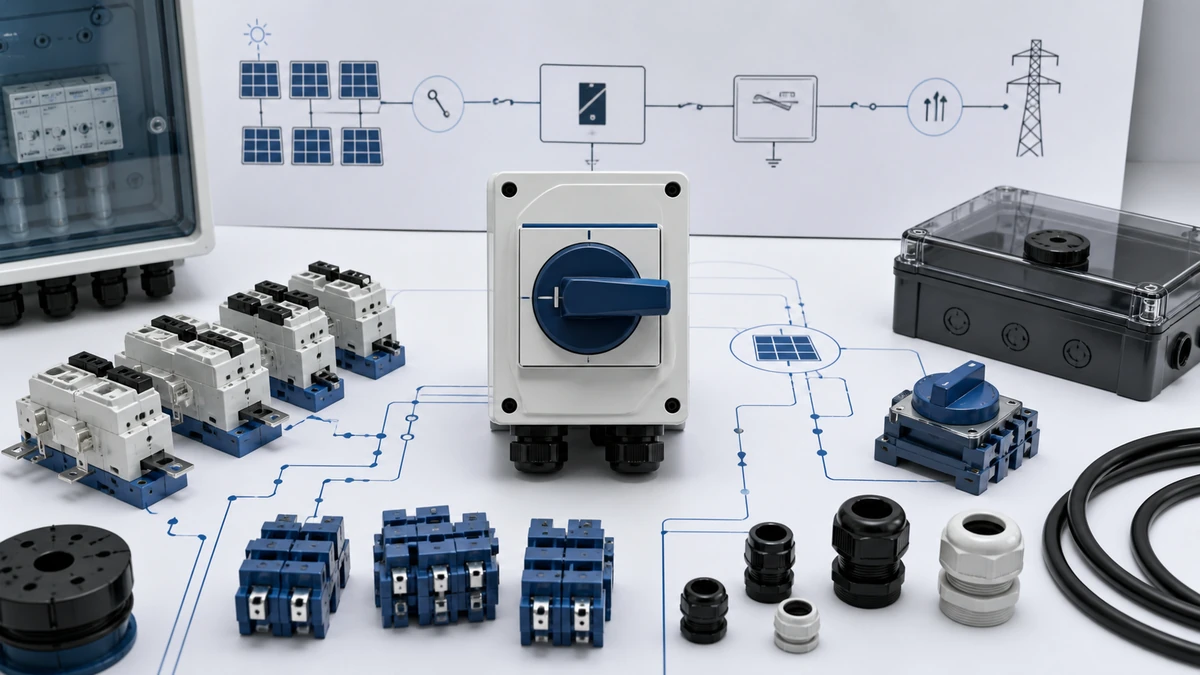
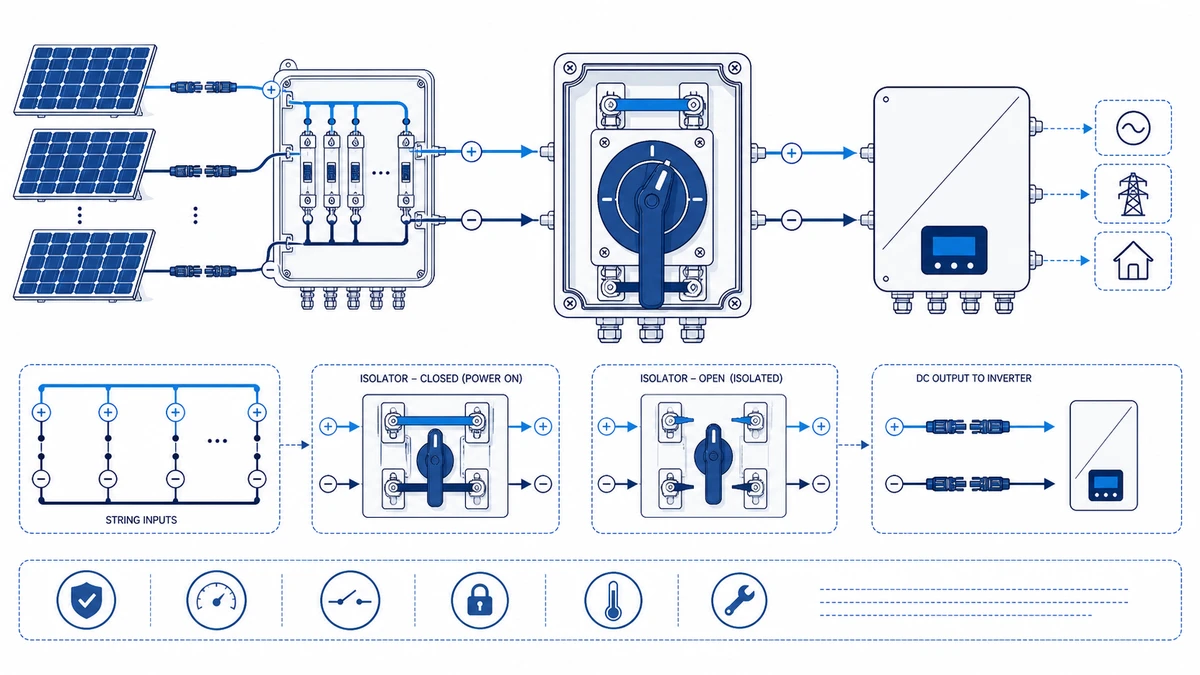
Choosing the right PV DC isolator switch for a solar string comes down to four confirmed parameters: maximum system voltage, continuous current at the correct DC utilization category, pole count, and enclosure IP rating. Get any one wrong and the result is arc faults, contact failure, or a non-compliant installation. This guide walks panel builders, control engineers, and OEM buyers through every decision point — from voltage and current sizing to pole configuration and enclosure selection — then covers the documentation checks needed before procurement. References align with IEC 60947-3:2020+AMD1:2025, which applies to switches, disconnectors, switch-disconnectors, and fuse-combination units for distribution and motor circuits, with rated voltage up to 1000 V AC or 1500 V DC.
Why PV Strings Need a Dedicated DC Isolator Switch
A PV DC isolator switch creates a safe, visible off-state between the solar array and the inverter. It allows technicians to de-energize the DC circuit before maintenance, fault investigation, or emergency response. Unlike an AC circuit, a DC solar string does not pass through a natural current zero-crossing at contact separation. The arc drawn when contacts open must be extinguished by the switch geometry itself — through contact gap distance, arc chute design, or magnetic blowout geometry — not by the waveform. A device built only for AC duty cannot do this reliably at rated DC string voltage.
Rated operating voltages for solar string isolators range from 600 V DC for residential arrays to 1000 V DC and 1500 V DC for commercial and utility-scale strings. The isolator must be rated for DC, evaluated against a DC utilization category, and matched to the enclosure environment where it will be mounted.
To understand what distinguishes a PV DC isolator from a general-purpose disconnect, the PV DC isolator switch explained reference page covers the switching physics and application context in detail.
The rated insulation voltage (Ui) of the isolator must equal or exceed the maximum open-circuit voltage (VOC) of the string under worst-case cold-temperature conditions. Cold-morning VOC in alpine or high-latitude installations can exceed the Standard Test Conditions (STC) nameplate value by a meaningful margin depending on the module’s voltage temperature coefficient. Always run the temperature-corrected calculation using the module datasheet and the lowest recorded site temperature before confirming the voltage frame.
For a 1000 V STC string, many project specifications apply a voltage margin after cold-temperature VOC correction; in those cases a 1500 V DC-rated device is often the practical route. Confirm the required margin from the applicable installation code and project specification. Confirm Ui on the product datasheet — not just the rated operational voltage (Ue), which may carry separate conditions.
Continuous Current and Derating
The isolator must carry the maximum continuous string current with a margin. A commonly applied design practice sizes the switch at a minimum of 1.25 times the string short-circuit current (ISC) to accommodate irradiance transients and elevated enclosure temperatures. Confirm the rated operational current (Ie) at the DC utilization category — DC breaking is more demanding than AC breaking due to the absence of a natural zero crossing, and manufacturers typically rate Ie separately for DC and AC duties.
If the enclosure ambient temperature regularly exceeds 40 degrees C, request the manufacturer’s current derating curve before confirming the frame size. A nominally rated switch may carry a reduced continuous current at elevated mounting temperatures. The exact derating percentage depends on the specific model and should be taken from the product datasheet rather than assumed.
Standard frame sizes step from 16 A to 20 A to 25 A to 32 A. If the 1.25 x ISC calculation lands between standard steps, round up to the next available frame. Never interpolate down.
Pole Count and String Configuration
A 2-pole isolator simultaneously disconnects both the positive and negative conductors of a single string. This is the standard configuration for single-string installations and ungrounded DC systems, where leaving one conductor live during isolation creates a shock hazard.
A 4-pole device performs the same simultaneous disconnection for two strings at once. In dual-string or multi-string combiner boxes, a single 4-pole isolator replaces two separate 2-pole devices, reducing footprint and wiring termination count. Review the Shieldhz DC isolator switch range to cross-reference available pole configurations against your array layout before specifying.
Enclosure IP Rating
For outdoor string combiner positions, IP65 is a common baseline ingress protection level. IP65 indicates that the enclosure is dust-tight and protected against water jets from any direction. IP66 adds resistance to powerful water jets; IP67 adds temporary immersion capability. Coastal sites, flood-prone ground-mount installations, and enclosures subject to direct hose-down should be evaluated against IP66 or IP67. IEC 60529 test conditions should be checked against the actual enclosure variant and installation exposure.
Always confirm the IP rating from the specific product datasheet and variant code, not from a range-level claim.
Quick-Reference Sizing Table
Parameter
Minimum Requirement
Verification Source
Rated insulation voltage (Ui)
Greater than or equal to 1.25 x VOC at lowest site temperature
Module datasheet + site temperature record
Rated operational current (Ie) at DC utilization category
Greater than or equal to 1.25 x ISC per string
Product datasheet at DC category
Pole count
2-pole for single string; 4-pole for dual string
Array configuration drawing
Enclosure IP rating
IP65 minimum for outdoor mounting
IEC 60529; product datasheet
DC utilization category
DC-21A, DC-21B, DC-22A, or DC-23B as applicable
Test certificate; product datasheet
Breaking capacity at rated DC voltage
Confirmed at maximum system voltage
Manufacturer test certificate
PV DC Isolator Types: Rotary Disconnect, Load-Break, and Fused Isolator
Three principal isolator types are used in solar PV string circuits. The correct type depends on the string voltage, whether overcurrent protection is needed at the same disconnect point, and the relevant installation standard.
Rotary Disconnect Switch
A rotary disconnect switch uses snap-action contact separation and an air-gap arc elongation path to interrupt DC load current. It is the standard choice for residential and commercial rooftop strings operating at 600 V DC to 1000 V DC. The device is compact, panel-mountable, and well-suited to string combiner and inverter DC-input positions. Confirm the device carries a DC utilization category — not just an AC category — before specifying.
The GF40 PV DC isolator switch is designed for solar DC string duty. Confirm the rated voltage, current frame, pole count, and IP rating against the product datasheet for the specific variant before ordering.
Load-Break Switch
A load-break switch incorporates dedicated arc chutes engineered to safely interrupt DC arc energy at elevated string voltages. This type is specified when the string open-circuit voltage exceeds 1000 V DC, where rotary disconnect arc elongation geometry may be insufficient to reliably extinguish the arc at rated fault energy. For utility-scale 1500 V DC tracker string applications, a load-break switch with the appropriate DC-23B utilization category is the correct selection.
The GF51 PV DC isolator switch is configured for higher-voltage solar DC applications. Verify the rated voltage, breaking capacity, and utilization category on the datasheet before specifying for 1500 V DC systems.
Fused Isolator
A fused isolator combines a disconnect switch with integrated fuse holders in a single device. It is required when the installation standard mandates string-level overcurrent protection at the same disconnect point, as is common under IEC 60364-7-712 for unprotected string circuits. The fuse current rating must independently satisfy the 1.25 x ISC threshold; the fuse and switch ratings must both be confirmed separately.
When combining both functions in a single device, confirm the fuse class — IEC 60269-6 gPV is the dedicated class for PV string fuses — and verify that the holder accepts the correct fuse body and cap for the fuse current rating selected.
The GF41 solar DC switch provides a compact DC disconnect option for solar string applications; confirm the variant specification against your fuse or non-fused requirement.
Type Comparison Table
Feature
Rotary Disconnect
Load-Break Switch
Fused Isolator
Typical voltage range
Up to 1000 V DC
Up to 1500 V DC
Up to 1000 V DC
Arc interruption method
Contact gap and air elongation
Arc chutes rated for DC arc energy
Fuse element interrupts fault current; switch provides isolation
Overcurrent protection
None; separate fuse required
None standard
Integrated fuse holders, gPV class
Typical DC utilization category
DC-21A or DC-22A
DC-21B or DC-23B
DC-21A or DC-22A plus fuse class
Primary application
Rooftop and commercial string combiner
Utility-scale 1500 V DC strings
String-level disconnect plus overcurrent in one device
IEC 60947-3 explains how utilization categories define the making and breaking test conditions that a switch must pass before it can be rated for a given DC application.
For the normative source, the IEC 60947-3 standard publication is available from the IEC webstore and covers the full DC utilization category test requirements and rated performance conditions.
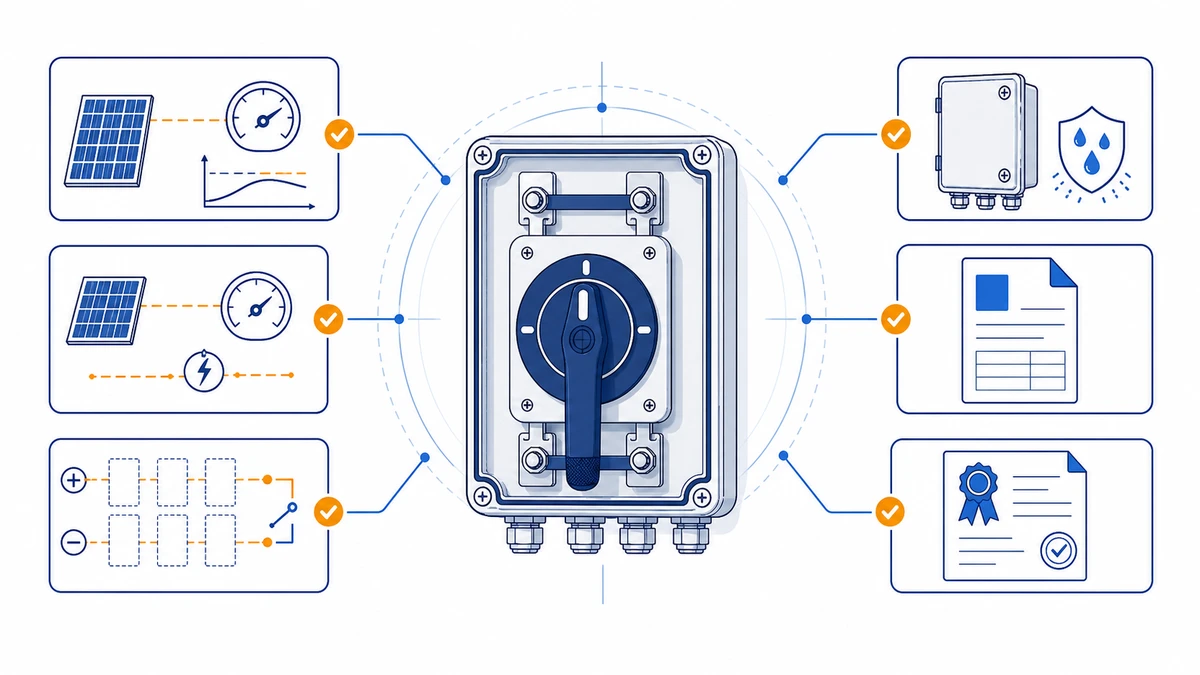
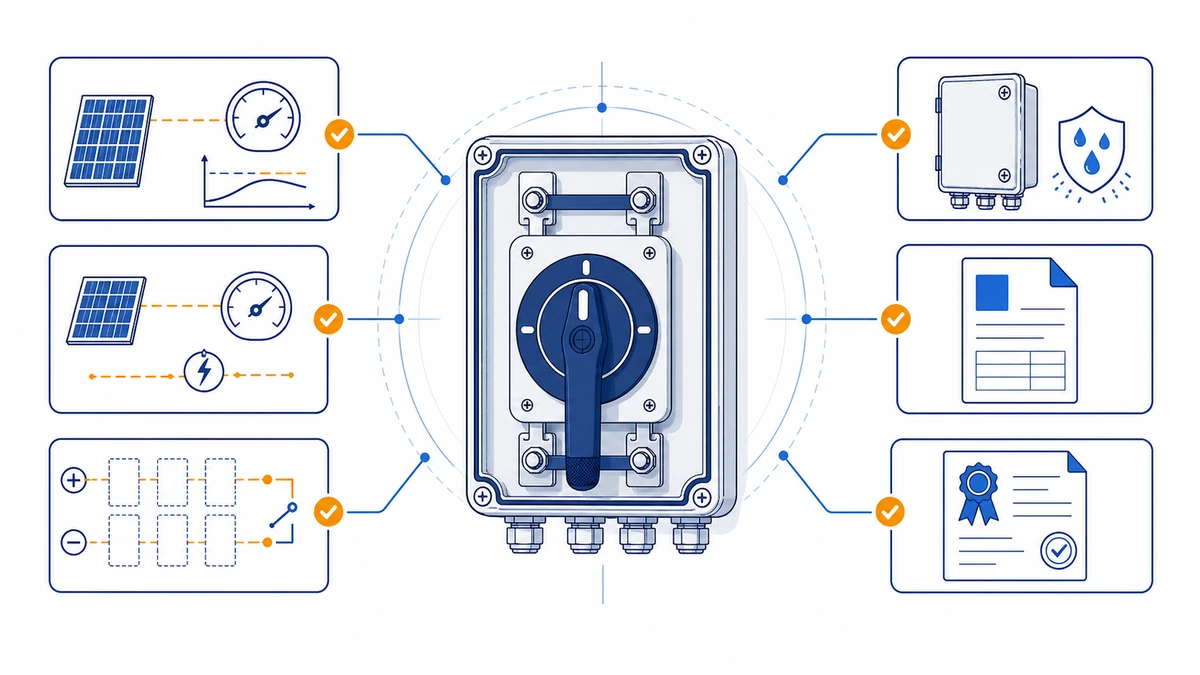
Figure 2. Selection checks should connect DC voltage, string current, pole count, enclosure, cable entry, and documentation.
Step-by-Step Sizing Worked Example
The following worked example demonstrates the sizing sequence for a commercial rooftop string. Apply the same sequence to any string, substituting your module datasheet values.
Given parameters from module datasheet:
– String VOC at STC: 1000 V DC
– String ISC at STC: 10 A
– Installation: rooftop combiner box, outdoor, ambient up to 45 degrees C
– Lowest recorded site temperature: minus 10 degrees C
Step 1 — Temperature-corrected voltage rating
Read the module voltage temperature coefficient from the datasheet. For this example, assume the temperature-corrected VOC at minus 10 degrees C is 1050 V DC. Apply the IEC 60364-7-712 factor:
Required voltage rating: 1.25 x 1050 V = 1312.5 V DC
Select a switch rated at 1500 V DC to meet this requirement with margin.
Step 2 — Current rating with derating
Apply the 1.25 x ISC requirement:
Required current rating: 1.25 x 10 A = 12.5 A minimum
Standard frame sizes: 16 A is the next step above 12.5 A. However, the enclosure ambient reaches 45 degrees C. Request the manufacturer’s derating curve for the selected model and confirm the 16 A frame still carries at least 12.5 A continuous at 45 degrees C. If derating reduces the 16 A frame below 12.5 A at that temperature, step up to the 20 A frame. Confirm the exact derating percentage from the product datasheet.
Step 3 — Pole count
Single string with ungrounded conductors: 2-pole isolator required to disconnect both positive and negative simultaneously.
Step 4 — Utilization category
Confirm the selected device carries a DC utilization category. For a resistive-to-moderately-inductive PV string load, DC-22A or DC-22B is the common applicable category. Verify against the product datasheet and test certificate.
Step 5 — IP rating
Outdoor rooftop combiner box: IP65 minimum. Site has no elevated water immersion risk: IP65 confirmed.
Result for this worked example: 1500 V DC, 20 A (after derating check), 2-pole, IP65, DC-22A or DC-22B utilization category. Document each parameter against the module datasheet before procurement.
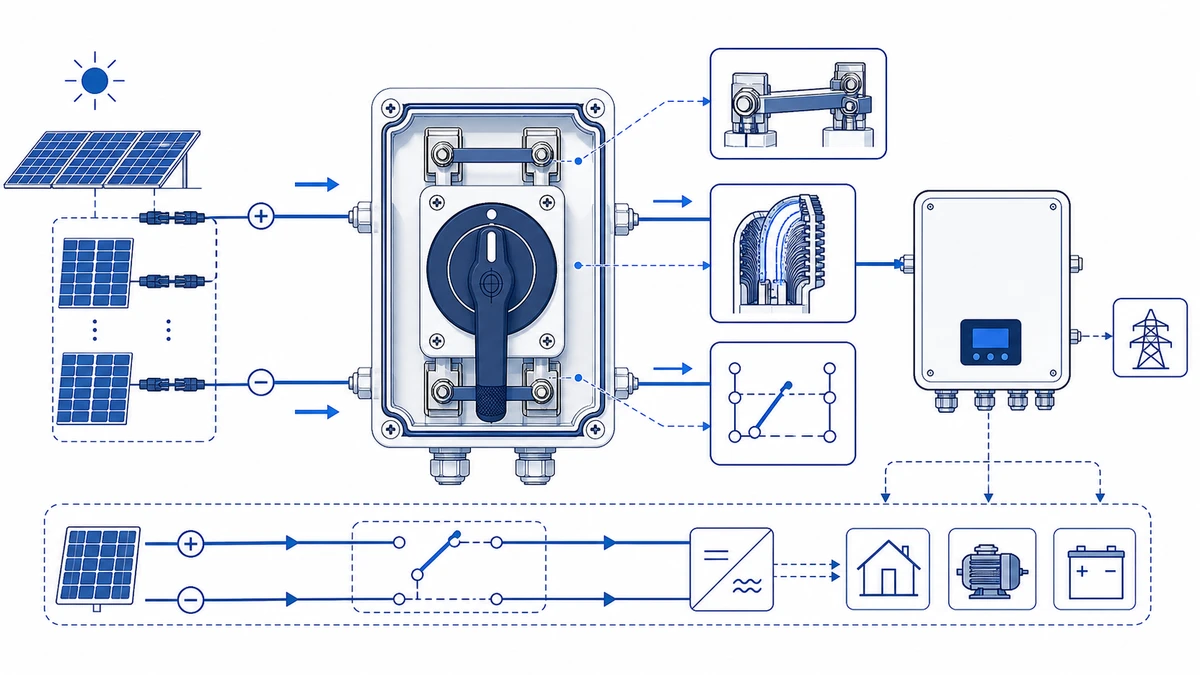
Figure 3. Application wiring context should be verified against the manufacturer contact chart before energizing.
Eight Specification Errors That Cause Field Failures
The following failure modes appear consistently in solar string installations where the isolator was selected without a structured parameter check.
Failure Mode 1 — Voltage rating below actual VOC. Specifying a 600 V DC switch in a string where temperature-corrected VOC reaches 1000 V DC causes sustained arc and contact welding at the first disconnection. Always run the temperature-corrected voltage calculation before confirming the frame.
Failure Mode 2 — AC-rated switch in a DC circuit. AC isolators rely on the natural zero-crossing to extinguish arcs. On DC circuits, arcs sustain and erode contacts within a small number of operations. Confirm the switch carries a DC utilization category and a verified DC breaking capacity at the application voltage.
Failure Mode 3 — Current rating applied without derating. A 32 A rated switch in a 40 A string application overheats terminals and degrades insulation. Apply the 1.25 x ISC factor and the ambient temperature derating before confirming the current frame.
Failure Mode 4 — Single-pole switch in an ungrounded DC circuit. One conductor remains live during isolation, creating a direct shock hazard. Use a 2-pole or 4-pole isolator that disconnects both positive and negative conductors simultaneously.
Failure Mode 5 — Insufficient IP rating for the mounting environment. An IP54 switch in a rooftop combiner box exposed to driving rain may allow moisture ingress that tracks across internal surfaces and causes insulation failure. Do not assume IP54 is sufficient for outdoor string-level positions; evaluate IP65 or higher when the enclosure faces rain, hose-down cleaning, coastal air, or high humidity.
Failure Mode 6 — No lockout provision confirmed. Field technicians cannot safely lock the isolator in the OFF position if the switch lacks a padlock lug or hasp. Confirm padlocking capability in the OFF position on the product datasheet before ordering.
Failure Mode 7 — Terminal torque not applied from the datasheet. Over-torquing cracks insulation; under-torquing produces loose connections that generate resistive heating. Apply the manufacturer’s specified torque value for the conductor size being terminated, taken from the product datasheet for the specific model variant.
Failure Mode 8 — Certificate not verified for the target market. Sourcing a switch without confirming the applicable certification exposes the installation to inspection failure. Request the test certificate with model number and scope before purchase, and confirm coverage for the relevant market or regional standard.
How Shieldhz Confirms PV DC Isolator Switch Configurations
Shieldhz is the export brand of Zhejiang Shihe Electric Co., Ltd., a manufacturer founded in 2014 and based in Yueqing, Zhejiang, with a factory of more than 5000 square metres, over 100 employees, and more than 40 production machines. The company operates an ISO 9001 quality management system and holds CE, RoHS, TUV, UL, UKCA, CCC, and CB certifications where applicable to specific product lines and markets.
For PV DC isolator switch inquiries, Shieldhz follows a defined technical intake sequence to align the configured product with the solar string installation before production is confirmed.
Electrical parameter intake. The buyer provides string VOC, ISC, pole count, and installation voltage class. Shieldhz maps these values against the rated voltage, rated operational current at the DC utilization category, and available pole configurations across the GF40, GF51, and GF41 series. Where the temperature-corrected VOC or the ambient derating calculation pushes the requirement above a standard frame boundary, Shieldhz flags this during the intake review rather than defaulting to the nearest lower frame.
Utilization category and contact program verification. Shieldhz confirms the applicable DC utilization category for the string load type — DC-21A, DC-22A, DC-21B, or DC-23B as relevant — and provides the corresponding contact table and wiring diagram for the selected model. This step prevents the substitution of an AC-rated variant into a DC application.
Enclosure and IP confirmation. For outdoor string combiner positions, Shieldhz confirms the IP rating of the selected model variant against the mounting environment described by the buyer. Where the application requires IP66 or IP67, or where an integrated weatherproof housing is preferred, the enclosure route is identified during the intake review.
Documentation package. After model confirmation, Shieldhz prepares a documentation package that includes the product datasheet, dimensional drawing, wiring diagram, and applicable test certificate. For markets requiring IEC or CE compliance evidence, the certificate confirms the switch has been evaluated against the relevant DC utilization category and rated insulation voltage. Buyers specifying regional standards — including Australian AS/NZS requirements or other local equivalents — should confirm the applicable documentation during the inquiry stage.
To initiate a sizing review, submit your string parameters — VOC, ISC, pole count, IP requirement, applicable installation standard, and required certification documentation — through the Shieldhz contact page. The technical team will return a confirmed model number, wiring diagram, mounting drawing, and certificate package matched to your string configuration.
Figure 4. A complete inquiry should include rating, contact sequence, mounting, enclosure, and document requirements.
Frequently Asked Questions
What voltage rating should a PV DC isolator switch carry for a 1000 V string?
The rated insulation voltage (Ui) must equal or exceed 1.25 times the temperature-corrected maximum open-circuit voltage of the string. For a 1000 V STC string, the temperature-corrected VOC under cold-morning conditions may reach or exceed 1050 V DC depending on the module’s voltage temperature coefficient and the lowest recorded site temperature. Applying the 1.25 factor to 1050 V gives a minimum required rating of 1312.5 V DC, making a 1500 V DC-rated model the practical standard selection for 1000 V strings. Always run the temperature-corrected calculation using site data — not just the STC nameplate figure.
Can I use an AC-rated rotary isolator in a DC solar string circuit?
No. An AC isolator relies on the natural current zero-crossing every half-cycle to extinguish the arc at contact separation. A DC circuit has no zero-crossing, so the arc sustains and concentrates its energy on the contacts. An AC-rated device used on a DC string will weld or erode contacts rapidly, creating both a fire risk and a loss of the isolation function. Confirm that the selected switch carries a dedicated DC utilization category and a verified DC breaking capacity at the rated string voltage.
What is the difference between a 2-pole and a 4-pole PV DC isolator?
A 2-pole isolator simultaneously disconnects both the positive and negative conductors of a single string. In an ungrounded DC system, this is the minimum safe configuration because a single-pole device leaves one conductor live during isolation. A 4-pole isolator performs the same simultaneous disconnection for two strings at once, replacing two separate 2-pole devices in dual-string combiner boxes and reducing the total number of switch positions and wiring terminations required.
What is the difference between IP65 and IP67, and which rating applies to an outdoor combiner box?
IP65 certifies that the enclosure is dust-tight and protected against water jets from any direction at low pressure. IP67 adds the ability to withstand temporary immersion in water to a defined depth and duration. IP65 is commonly used for rooftop and ground-mount combiner boxes in standard outdoor environments. IP66 is appropriate where powerful water jets are possible. IP67 may be appropriate for coastal sites, flood-prone areas, or enclosures where direct immersion exposure cannot be excluded. Confirm the IP rating from the product datasheet for the specific model variant and enclosure code.
What does the DC utilization category on an IEC 60947-3 switch tell me?
The utilization category defines the type of load, the voltage level, and the current conditions under which the switch has been tested to make and break reliably. Categories such as DC-21A, DC-22A, DC-21B, and DC-23B indicate that the switch has been evaluated for DC switching duty at rated voltage. DC-21B and DC-23B apply to higher-energy switching duties associated with PV string loads. Confirming the utilization category on the test certificate ensures the switch has been validated for the specific load type and energy level present in your solar string application, rather than only for AC or lower-energy DC circuits.
When do I need a fused isolator rather than a standard rotary disconnect switch?
A standard rotary disconnect switch provides the required isolation point for most residential and commercial string installations. A fused isolator is required when the applicable installation standard — such as IEC 60364-7-712 for certain string circuit configurations — mandates string-level overcurrent protection at the same disconnect point. Combining both functions in one device reduces panel space and simplifies wiring, but both the fuse current rating and the switch current rating must independently satisfy the 1.25 x ISC threshold. The fuse must also be the correct class — IEC 60269-6 gPV for PV string duty — not a general-purpose fuse class.
What documentation should I request from a supplier before purchasing a PV DC isolator switch?
Request the product datasheet confirming the rated insulation voltage, rated operational current at the DC utilization category, pole count, and IP rating for the specific model variant ordered. Request the test certificate showing the model number and scope of evaluation against IEC 60947-3 or the applicable regional standard, with the DC utilization category explicitly covered. For project submissions requiring authority approval, request the dimensional drawing and wiring diagram. For markets with specific regional requirements — such as TUV evaluation, UL listing, or AS/NZS compliance — confirm that the certificate scope covers the applicable standard before purchase.
Shi, Muxi
Shi, Muxi writes Shieldhz technical articles for industrial control and electrical component buyers, covering rotary cam switches, isolator switches, PV DC disconnects, push buttons, indicator lights, waterproof enclosures, and terminal blocks. The articles are based on Zhejiang Shihe Electric Co., Ltd.'s manufacturing and export experience, with practical emphasis on model selection, datasheets, drawings, certifications, IP ratings, and inquiry details buyers should confirm before ordering.