Control Panel Legend Plates: Function Naming, Language, and Revision-Control Checks
Use a practical buyer checklist to evaluate control panel legend plates inputs, documentation, approval controls and the exact push button, selector switch or emergency-stop operator route.
Control panel legend plates should be managed as controlled engineering data, not treated as last-minute accessories. The buyer decision is to lock the function name, language, plate format, and revision status before quotation and again before production release.
Assign one owner for legend text, language, and revision approval.
Tie each legend to a device tag, drawing reference, and current BOM line.
Confirm exact plate fit, marking method, and documentation against the selected operator model and buyer application.
Why legend governance belongs in the control-panel purchasing package
Legend governance should sit inside the same purchasing and drawing-control route as the operator, contact arrangement, and panel layout. A plate that uses the wrong function name, language, or revision can create rework even when the push button, selector switch, pilot light, or emergency-stop operator itself is correctly selected.
For buyers comparing options, the main commercial issue is not only the plate price. It is whether the legend text is stable, approved, repeatable, and traceable when the same panel is built again.
An exact drawing identifies the interfaces that must be controlled for the approved model route.
What the legend plate must control
A controlled legend package should define:
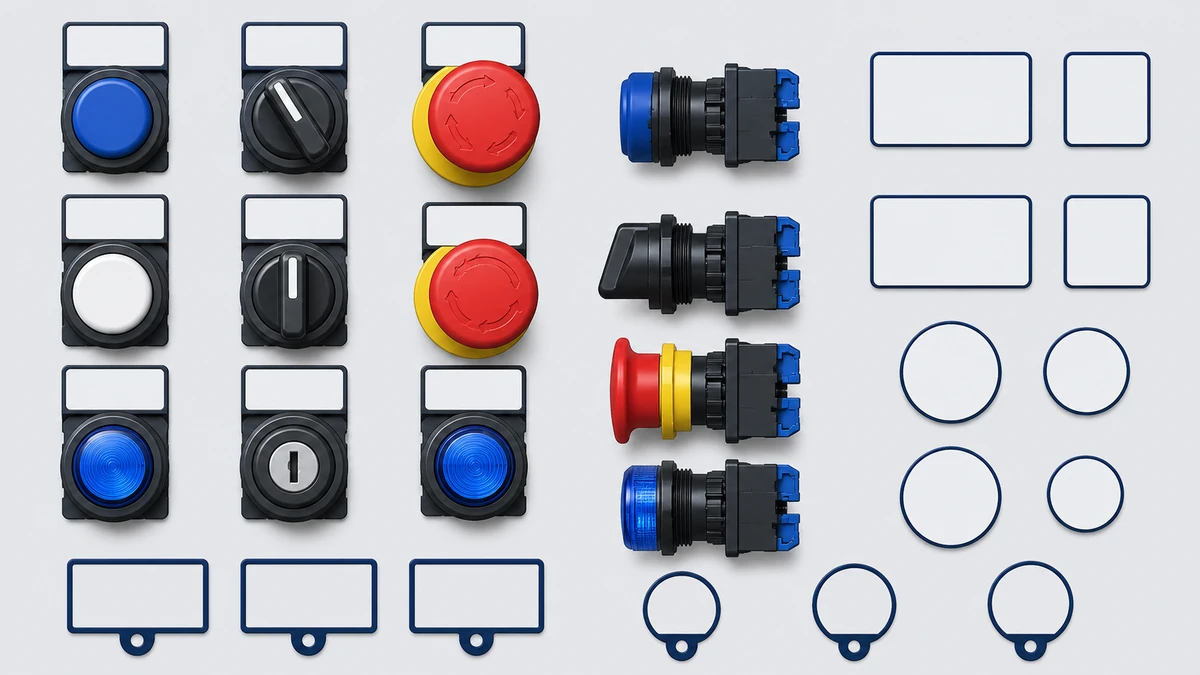
Device tag or position reference.
Exact legend text, including capitalization and line breaks.
Language or symbol requirement.
Plate size, color, and mounting style where applicable.
Matching operator series or panel cutout route.
Drawing revision, BOM revision, and approval date.
If your team needs a broader component overview before narrowing the legend decision, use the contact block and legend plate guide as the foundation article.
What the legend plate should not decide
A legend plate should identify the intended operator function. It should not be used to compensate for an unclear machine design, an undocumented control function, or a late change in operator action.
The plate also does not validate the electrical design. Contact arrangement, control voltage/current, enclosure environment, and market documentation remain exact-model, drawing, datasheet, certificate, destination-market, and buyer-application dependent.
Build function names from the machine action, not from device shorthand
The safest naming route is to describe the machine function the operator controls, not the internal hardware nickname. Operators, assemblers, and maintenance teams usually need to know what will happen when the control is used.
Avoid labels that only describe the component, such as “PB1,” “S2,” or “GREEN.” Those references belong in drawings and BOMs, while the visible legend should communicate the field function.
Use action-first wording
Good legend text is short, active, and consistent across the machine family. Choose a verb-noun pattern where possible.
Buyer decision
Preferred control-panel legend approach
Risk if not controlled
Start a motor or cycle
“START PUMP,” “CYCLE START,” or approved local equivalent
Different panels use different wording for the same action
Stop a function
“STOP,” “FEED STOP,” or function-specific wording
Operator may not know whether the whole machine or one section is affected
Select a mode
“AUTO / MANUAL,” “LOCAL / REMOTE”
Selector position is unclear during setup or maintenance
Reset an alarm or fault
“RESET,” “FAULT RESET”
Reset is confused with start or acknowledge
Indicate a condition
“POWER ON,” “RUN,” “FAULT”
Indicator meaning varies between panels
For teams still aligning basic operator terminology, the push button switch basics article can help separate component type from function naming.
Keep tags and visible text separate
Device tags such as PB101, SS202, or HL305 are useful for drawings, maintenance records, and spare parts. They are not usually enough as the only visible legend because they do not describe the operator’s function.
A practical format is to show the function on the legend plate and keep the tag in the drawing, wiring schedule, or a secondary identification method if required by the buyer’s documentation rules.
Decide language, symbols, and abbreviations before release
The correct language decision depends on the destination market, machine owner standards, operator training environment, and drawing package. Do not assume one language, symbol set, or abbreviation style will fit every buyer or destination.
Language should be agreed before the panel build is released. Late translation changes can affect plate size, line breaks, stock availability, and approval drawings.
Sample review should connect the exact item to its current drawing and requested evidence package.
Language and translation checks
Use this checklist before requesting a quote or approving artwork:
Confirm the destination country or region for the machine.
Confirm the machine owner’s preferred control-panel language.
Identify any legends that require bilingual text.
Review whether translated text still fits the plate size.
Approve abbreviations before manufacturing, not during assembly.
Keep the approved language file with the drawing revision.
Translations should be checked by the buyer or a qualified party familiar with the application. Shieldhz can quote against supplied text, but the buyer remains responsible for confirming that the wording is correct for the machine and destination.
When icons help and when words are clearer
Symbols can reduce translation burden, but they are not automatically clearer for every audience. If the operator team is trained around written functions, a word legend may be preferred.
A combined approach may be useful where space allows: a symbol for quick recognition and text for unambiguous function naming. Final suitability depends on the exact plate format, operator arrangement, buyer standard, and destination requirements.
Match the legend plate format to the operator and panel layout
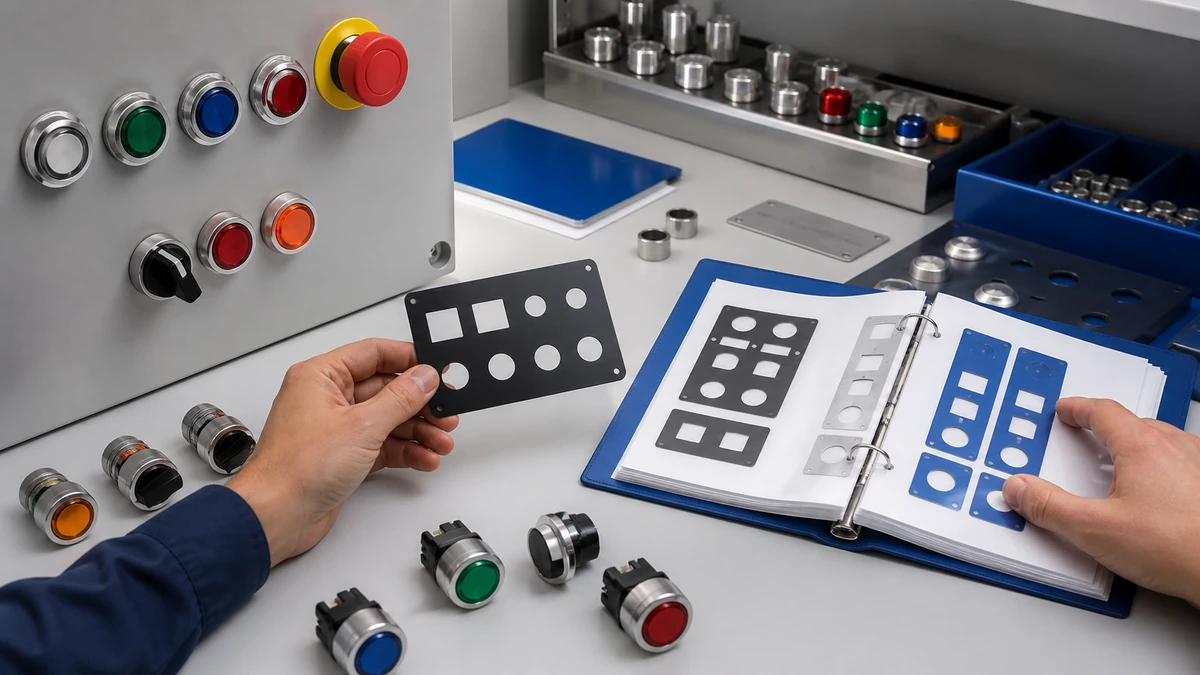
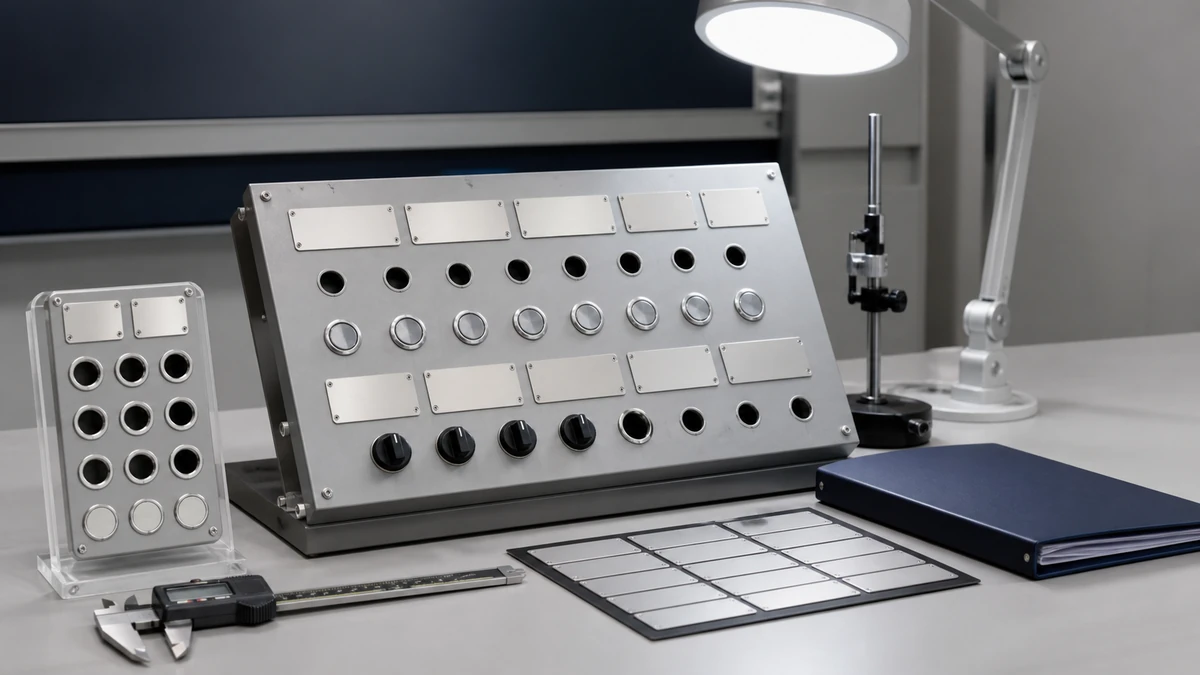
The plate format should be selected after the operator series, panel cutout, mounting method, and layout spacing are known. A correct legend on the wrong plate format still creates an assembly problem.
Legend plate geometry must be checked against the exact selected operator model and panel drawing. Do not assume interchangeability between product families without confirming dimensions and mounting details.
Format decisions that affect the quote
Specification item
What to confirm
Why it matters commercially
Operator family
Push button, selector switch, indicator, emergency-stop operator, or other control-circuit device
Plate fit and wording style may differ by operator type
Panel cutout and spacing
Hole size, pitch, enclosure door layout, and neighboring devices
Avoids interference and unreadable text
Plate shape and size
Round, rectangular, engraved, printed, or holder-style format where offered
Affects artwork, assembly route, and replacement matching
Color and contrast
Buyer standard, function group, and readability requirement
Some plate details are model-specific. Material, marking method, environmental suitability, dimensions, and accessory compatibility should be confirmed from current product documentation and the buyer’s application.
This is especially important when the same machine design is built for different destination markets or when an enclosure layout changes between revisions.
Run revision control before artwork, quotation, and repeat ordering
Revision control should happen before the legend artwork is manufactured and again before repeat ordering. The aim is to prevent old text from being reordered simply because it existed in a previous purchase.
A practical legend revision route links the function name, device tag, drawing sheet, and BOM line. If any of those change, the legend should be reviewed.
Installation conditions change the product-route and document questions a buyer must resolve.
Triggers that require a legend review
Change trigger
Legend review action
Typical owner
Machine function changes
Check whether visible text still describes the action
Controls engineer or machine designer
Operator type changes
Confirm plate fit and wording
Panel designer or assembler
Selector positions change
Review each position label and orientation
Controls engineer
Destination market changes
Review language and documentation package
Project engineer or procurement
Drawing revision changes
Confirm whether the plate artwork also changes
Document control
Buyer standard changes
Align abbreviations, colors, and layout style
Buyer engineering or quality team
Minimum change-control action list
Before release, complete these checks:
Compare the legend list with the latest panel layout drawing.
Verify each legend against the latest I/O, function, or control description.
Confirm the buyer-approved language and abbreviation file.
Record the plate revision in the BOM or controlled purchasing note.
Archive superseded legend text so it is not reordered by mistake.
Require approval when a repeat order uses a different drawing revision.
A low-cost plate can still stop a panel from shipping if the wording is wrong. Treat the approval file as production data, not informal correspondence.
Purchase legend plates as controlled line items, not loose accessories
The buyer should purchase legend plates with enough detail for repeatable supply and incoming inspection. A vague line such as “legend plate for push button” is usually not enough for a controlled panel program.
The line item should connect the legend to the operator model route, panel location, and approved text. This helps distributors, assemblers, and maintenance planners avoid mixing plates between similar machines.
Recommended ordering data
Include the following in the RFQ or purchase package:
Operator type and selected series or model route.
Device tag and panel location.
Exact legend text, including line breaks.
Language version and approved translation file if applicable.
Plate format, size, color, and marking preference where required.
Drawing number and revision.
Quantity per panel and quantity of spare plates if needed.
Requested documentation package, such as drawing, datasheet, and certificate where applicable.
The requested documentation should match the application and destination market. Do not assume that the same document package is needed, available, or sufficient for every order.
Approval sample or artwork review
For new programs, translated panels, or customer-specific wording, an artwork approval step can reduce rework. The approval should show the visible text, line breaks, orientation, and matching device reference.
If a buyer needs physical samples, that requirement should be discussed before quotation. Availability, timing, and scope depend on the exact model, artwork route, quantity, and commercial agreement.
How Shieldhz confirms a push button, selector switch or emergency-stop operator route
Shieldhz confirms the operator route by checking the buyer’s function, application inputs, documentation needs, and exact product data before quotation or supply. Final suitability is confirmed against current product documentation and the buyer’s application.
This process is intended to align the operator, contact arrangement, panel fit, and legend requirement. It does not replace the buyer’s machine design validation or destination-market compliance review.
Pre-quotation confirmation inputs
Shieldhz typically needs the following information to confirm a practical route:
Machine function and destination market.
Operator action, such as momentary, maintained, illuminated, selector, key selector, or emergency-stop operator type.
Control voltage and current for the control circuit.
Contact arrangement, including normally open and normally closed requirements.
Panel cutout, mounting method, and available space.
Environmental conditions relevant to the selected product documentation.
Marking, language, and legend plate requirements.
Exact drawing, datasheet, and certificate package requested by the buyer.
For contact selection context, buyers can review the NO and NC contact guide before confirming the contact arrangement.
Documentation and standards boundary
Control-circuit devices are covered by specific standards and product documentation routes. The IEC 60947-5-1 listing describes the control-circuit-device subject area and notes that a more recent edition exists; this catalogue listing should not be treated as a universal product-certification claim for any specific item.
For emergency-stop and selector decisions, layout and operator selection must be handled carefully. The emergency-stop and selector layout guide gives related layout context, but selecting an emergency-stop operator alone does not validate a complete machine safety function.
Verify receiving, installation, and replacement controls
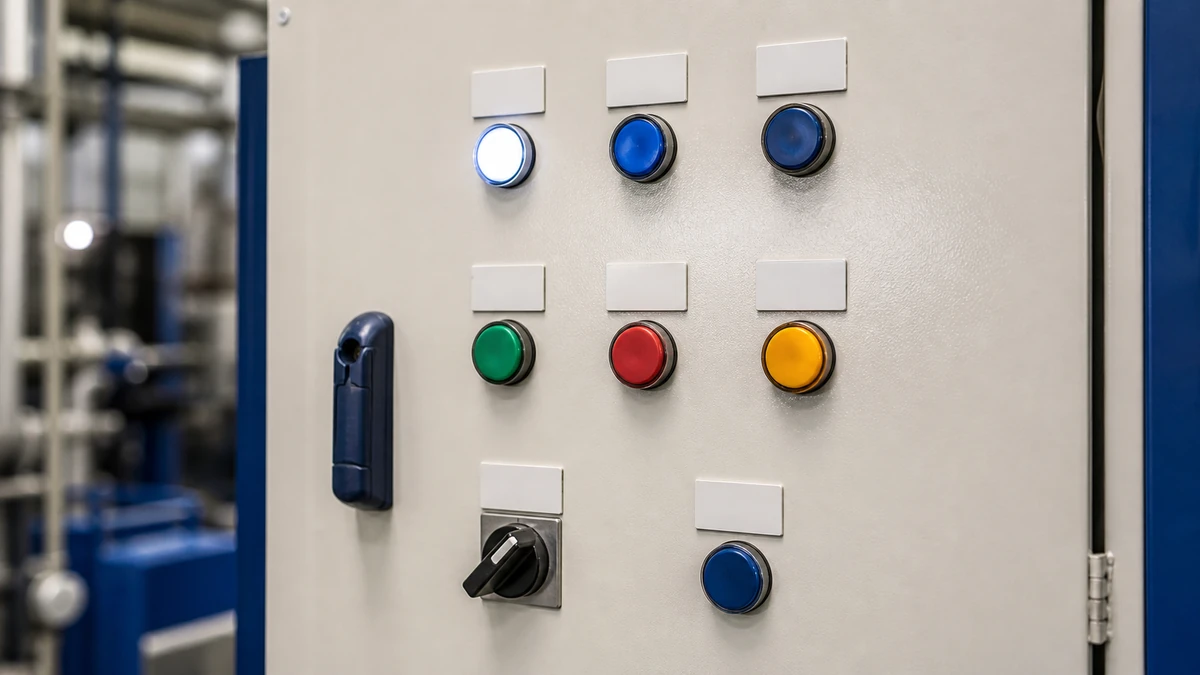
Incoming and installation checks should confirm that the legend plate matches the approved panel revision before the panel leaves assembly. The correct time to catch a mismatch is before the operator is installed and the enclosure door is finalized.
Maintenance teams should also control replacement legends. A replacement plate with old wording can reintroduce a removed function name or obsolete language.
Documentation control, sample acceptance and protective packing are separate handover checks.
Receiving inspection checklist
Use this checklist for incoming or kitting inspection:
Match each plate to the purchase line, drawing number, and revision.
Compare visible text against the approved legend list.
Check language version and line breaks.
Confirm plate format against the selected operator and panel layout.
Separate obsolete or superseded plates from current stock.
Record discrepancies before assembly begins.
This check is especially useful when several panels share similar operator layouts but use different machine functions.
Maintenance replacement checklist
For maintenance planners and spare-parts teams:
Store legend plates by machine model, drawing revision, and device tag.
Do not substitute a similar text plate without engineering approval.
Confirm replacement wording after machine upgrades or control changes.
Keep translated spare plates aligned with the active destination-market version.
Update spare kits when the panel drawing revision changes.
Replacement control protects repeatability. It also helps distributors and procurement teams avoid ordering based on an outdated description from an old invoice.
Conclusion
Control panel legend plates deserve formal governance because they carry the visible function name of the control system. The best commercial decision is to control legend text, language, format, and revision status before quotation, before assembly, and before repeat ordering.
Shieldhz can support the model route and quotation confirmation when buyers provide the machine function, destination market, operator action, control data, contact arrangement, panel mounting details, environment, marking requirements, and requested documentation package. Final selection remains dependent on current product documentation and the buyer’s application.
Frequently Asked Questions
What information is needed to quote control panel legend plates?
A useful RFQ includes the operator type or model route, device tag, exact legend text, language, plate format, panel drawing revision, quantity, and requested documentation. If the text is translated or customer-specific, include the approved wording file.
Should the visible legend use device tags or function names?
Use function names for the visible legend in most control-panel layouts, and keep device tags in the drawing or identification system. A tag such as PB101 helps maintenance trace the circuit, but it does not tell an operator what the control does.
Can one legend plate design be reused across different machines?
It can be reused only if the function, operator fit, language, panel layout, and revision status remain correct. Reuse should be checked against the active drawing and BOM, not assumed from a previous order.
Who should approve legend text?
Approval should usually involve the controls engineer or machine designer, document-control owner, and the buyer or end-user representative responsible for language and machine standards. Procurement should buy only against the approved revision.
Do emergency-stop legends prove the safety function is compliant?
No. An emergency-stop legend and operator selection do not validate the complete machine safety function. The overall safety function depends on the machine design, risk assessment, circuit architecture, components, documentation, and applicable requirements for the destination and application.
When should a legend plate revision be changed?
Change the legend revision when the visible text, language, line break, plate format, device association, or controlled drawing reference changes. If the machine function changes, the legend should be reviewed even if the old plate still physically fits.
Shi, Muxi
Shi, Muxi writes Shieldhz technical articles for industrial control and electrical component buyers, covering rotary cam switches, isolator switches, PV DC disconnects, push buttons, indicator lights, waterproof enclosures, and terminal blocks. The articles are based on Zhejiang Shihe Electric Co., Ltd.'s manufacturing and export experience, with practical emphasis on model selection, datasheets, drawings, certifications, IP ratings, and inquiry details buyers should confirm before ordering.