A 1000V DC isolator switch and a 1500V DC isolator switch differ in rated insulation voltage, contact gap distance, arc-quenching geometry, and creepage clearance — not just a nameplate label. In solar PV string circuits, selecting the wrong voltage class creates arc flash risk, voids compliance with IEC 60947-3:2020+AMD1:2025, and exposes insulation to electric field stress it was never designed to withstand. This article explains the internal design differences, wiring architecture implications, failure modes, and step-by-step selection logic that industrial panel engineers, panel builders, and OEM procurement teams need to specify the correct isolator for 1000V or 1500V DC PV systems.
The Electrical Fundamentals: Voltage Rating as a System Design Parameter
Understanding why voltage rating is not a cosmetic specification starts with how string voltage is calculated and how close real installations routinely operate to that ceiling.
String Voltage and the Cold-Temperature Ceiling
In photovoltaic installations, the DC isolator switch must be selected at or above the string maximum open-circuit voltage under worst-case cold-temperature conditions. For a standard 1000V system, string voltage typically approaches 1000V DC under those conditions. For utility-scale 1500V systems, string voltage can reach 1500V DC, which means the isolator must interrupt a significantly higher potential difference when breaking load current.
The consequence extends beyond a larger number on the nameplate. Higher voltage demands wider contact separation distances per pole. Arc extinction at 1500V DC requires more aggressive arc chute geometry because DC arcs do not self-extinguish at current zero-crossings the way AC arcs do.
What Changes Internally Between 1000V and 1500V Designs
IEC 60947-3:2020+AMD1:2025 applies to switches, disconnectors, switch-disconnectors, and fuse-combination units for distribution and motor circuits, with rated voltage up to 1000V AC or 1500V DC. The standard governs minimum rated making and breaking capacity, creepage distances, and insulation voltage. A 1500V-rated isolator must demonstrate greater creepage and clearance distances than a 1000V-rated unit — confirm the exact values against IEC 60664-1 pollution degree for the installation environment. Contact materials in both classes are typically silver-based alloys, but spring preload and contact pressure are calibrated per datasheet to sustain stable contact resistance across the arc-erosion cycle appropriate to each voltage class.
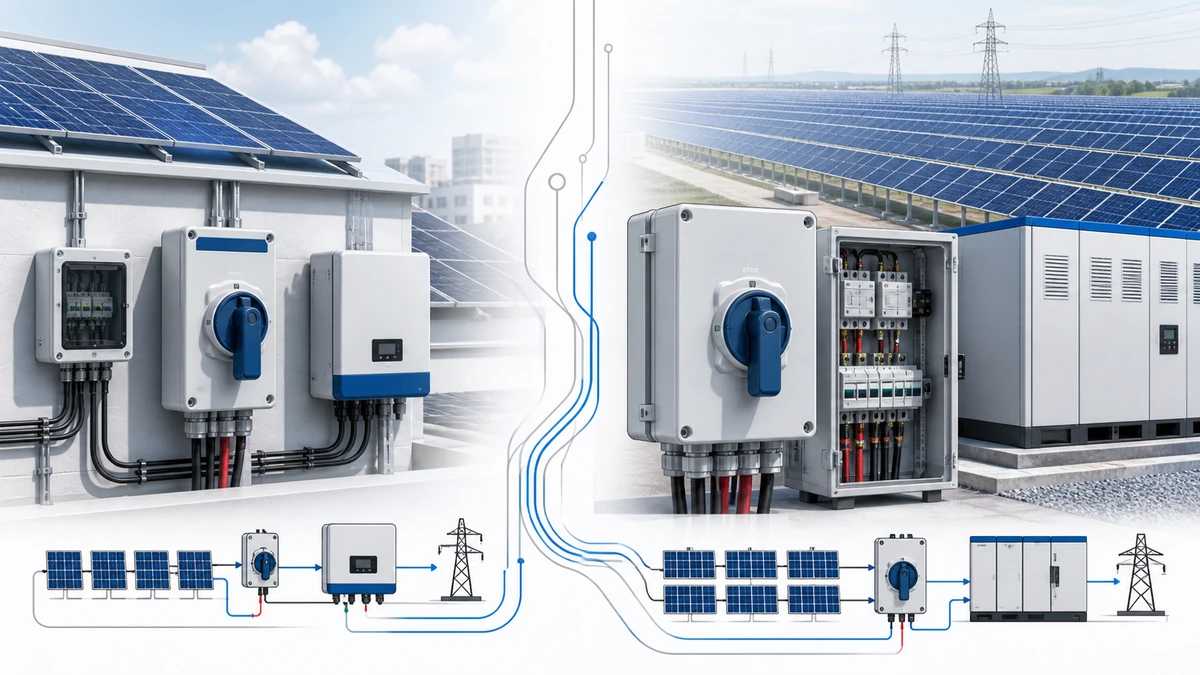
For rooftop PV arrays operating at 1000V, a switch such as the GF40 PV DC isolator switch is sized around string open-circuit voltage, pole count, and enclosure IP rating. For 1500V utility-scale projects, confirm the isolator rated insulation voltage, breaking capacity, and IEC 60947-3 utilization category directly from the product datasheet before specifying.
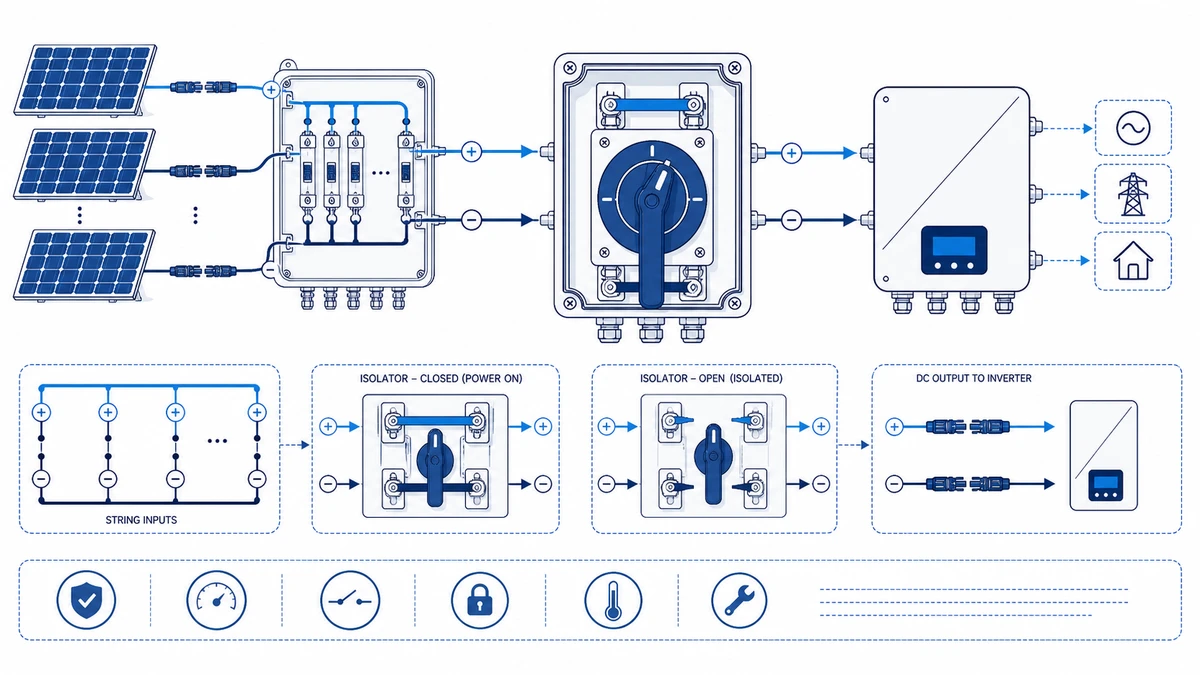
Figure 1. Core concept behind 1000V vs 1500V DC isolator switch selection.
Specification verification points for contact gap and arc geometry:
Always verify the declared contact gap per pole on the certified datasheet, not on a moulded enclosure label — family markings occasionally reflect a product range rather than a specific variant.
During commissioning, use the insulation test method and instrument rating specified by the project procedure and local code; do not assume a 1000V-class test setup is sufficient for a 1500V-class system.
On high-altitude installations above approximately 2,000 m, creepage distances derate due to reduced air density — confirm the supplier has applied the IEC 60664-1 altitude correction or specify a unit with increased creepage margin.
After any sustained arc event such as nuisance operation during a ground fault, replace the isolator rather than returning it to service; DC arc erosion is cumulative and is not visible on external inspection.
How 1000V and 1500V Solar PV Systems Are Wired Differently
String architecture is the underlying driver behind every isolator specification decision. Once module count is fixed, the isolator voltage class is effectively determined.
String Voltage and Module Count
In a 1000V DC system, a typical string consists of a limited number of crystalline silicon modules whose combined open-circuit voltages are evaluated at the lowest expected ambient temperature. IEC 62548 requires that the temperature coefficient for open-circuit voltage — typically in the range of -0.30% to -0.34% per degree Celsius for crystalline silicon — be applied to determine worst-case string voltage. The resulting maximum string voltage must not exceed 1000V DC at the inverter input terminals.
In a 1500V DC system, the same module family allows longer strings, reaching maximum string voltages up to 1500V DC. The higher voltage class can reduce the number of parallel strings needed to deliver equivalent array power, which may lower DC combiner current, cable quantity, and balance-of-system complexity when the full design supports it.
Why the Isolator Specification Changes with Architecture
Each architectural change cascades into isolator requirements. A DC isolator rated for 1000V DC cannot be substituted into a 1500V string circuit. The rated insulation voltage and the rated impulse withstand voltage must match or exceed the actual string voltage with the safety margin required by IEC 60364-7-712.
Beyond voltage withstand, DC arc interruption becomes significantly more demanding at 1500V. When a DC isolator breaks a live string, the arc energy is proportional to the system voltage. At 1500V DC, contact gap geometry, arc chute design, and contact material must all be engineered for higher arc extinction duty than at 1000V. For engineers specifying DC isolator switches for utility-scale arrays, this means the 1500V isolator is not a relabeled 1000V unit — it represents a distinct contact and enclosure design category verified through separate type-testing under IEC 60947-3.
1000V vs 1500V DC Isolator: Side-by-Side Specification Comparison
With the wiring architecture and internal design differences established, a direct parameter comparison makes the specification decision concrete and auditable.
Parameter
1000V DC Isolator
1500V DC Isolator
Rated operational voltage (Ue)
1000V DC
1500V DC
Rated insulation voltage (Ui)
1000V
1500V
Contact gap per pole
Confirm from datasheet
Confirm from datasheet; wider by design
Pole configurations
2P / 4P
2P / 4P
DC arc energy class
Lower
Higher
Applicable PV design standard
IEC 62548, AS/NZS 5033
IEC 62548, NEC Article 690
Typical outdoor enclosure IP rating
Confirm from datasheet
Confirm from datasheet
Certification scope
Confirm IEC 60947-3 test report
Confirm IEC 60947-3 test report at 1500V DC
All values are datasheet-dependent and vary by product series, pole configuration, and certified model code. Do not rely on family-level references for procurement; obtain and review the specific model datasheet.
Why Contact Gap and Arc Energy Determine the Voltage Class
In DC circuits there is no natural current zero-crossing to assist arc extinction. At 1500V DC, the arc energy during interruption is substantially higher than at 1000V DC. This is why 1500V-rated isolators require a wider contact gap per pole and a more robust arc-quenching chamber, as governed by IEC 60947-3 making and breaking capacity requirements.
For utility-scale PV systems where 1500V string architecture reduces cable cross-section and combiner box count, GF51 PV DC isolator switch is engineered for the higher insulation voltage and contact separation requirements of the 1500V DC class. For residential and smaller commercial systems operating at 1000V, GF40 provides a compact route within the 1000V DC class.
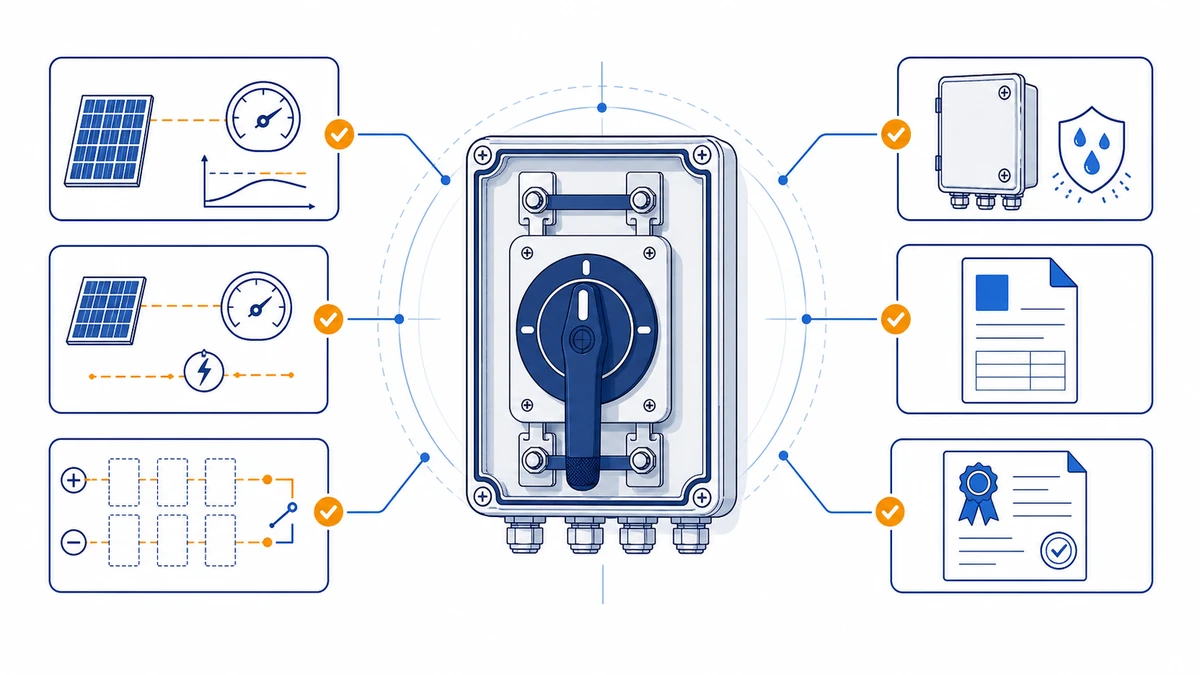
Practical specification checks before procurement:
When comparing two isolators with identical current ratings, check whether the breaking capacity figure on the datasheet is stated at the device full rated voltage or at a lower reference voltage — some datasheets de-rate breaking capacity at higher DC voltages.
For 4-pole configurations, confirm that each pole independently meets the contact gap and creepage requirement; some 4-pole units achieve the voltage rating by connecting poles in series, which changes the wiring topology and fault-response behavior.
If the project spans multiple climate zones, specify the enclosure IP rating for the harshest environment — the marginal cost of a higher IP class is small relative to re-specification risk at commissioning.
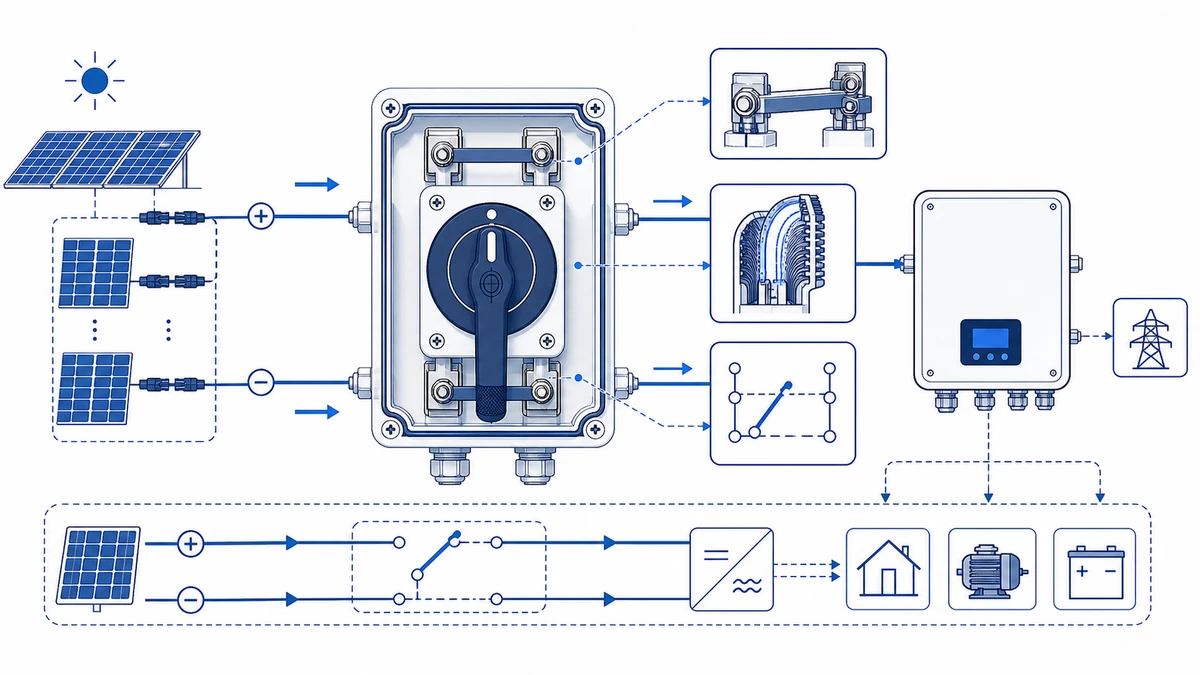
Figure 2. Selection checks should connect DC voltage, string current, pole count, enclosure, cable entry, and documentation.
What Happens If You Use a 1000V Isolator in a 1500V PV System
Understanding the failure modes makes the risk concrete and supports the documentation trail required for compliance audits.
Insulation Breakdown Under Field Stress
A 1000V-rated isolator is designed with clearance and creepage distances calibrated for a maximum working voltage of 1000V DC. When system voltage reaches 1500V DC under open-circuit conditions — which is common in cold-temperature, high-irradiance scenarios — the electric field stress across the insulating body, terminal housing, and pole barriers exceeds design limits. Partial discharge initiates in microvoids within the polymer insulation, accelerating thermal degradation. Over time, insulation resistance falls toward a breakdown threshold, resulting in tracking paths or catastrophic dielectric failure.
Arc Flash Risk During Switching Operations
A 1000V-rated isolator arc chamber — contact gap distance, deion plate count, and arc runner design — is not dimensioned to interrupt 1500V DC fault or load current. In a typical utility-scale string configuration carrying load current at 1500V DC, an under-rated isolator attempting to break the circuit can sustain a persistent arc that damages contacts, chars the enclosure interior, and escalates to an arc flash event with surrounding ignition risk. DC arc erosion is cumulative; a device that survives one misapplication event may fail on the next operation without any visible external indication of degradation.
Compliance and Certification Consequences
Using a 1000V isolator in a 1500V system voids the equipment safety certification scope under IEC 62109-1 and typically conflicts with IEC 60364-7-712 PV installation requirements. Insurance underwriters and grid-connection authorities increasingly audit component voltage ratings against declared system voltage. A mismatch creates a non-compliant installation that may trigger rejection at commissioning or denial of fault claims. The IEC 60947-3 standard publication defines the scope of conformity that must be demonstrated for each voltage class, and procurement documentation should reference the specific rated voltage confirmed by type-test certificate.
For 1500V system deployments, selecting a purpose-rated isolator designed and type-tested at 1500V DC reduces these risk categories by matching contact gap, insulation geometry, and arc suppression architecture to actual system voltage.
Figure 3. Application wiring context should be verified against the manufacturer contact chart before energizing.
How to Select the Correct DC Isolator Rating for Your Solar PV Project
The following checklist translates system parameters into a traceable, auditable isolator specification. Each step produces a documented input that can be reviewed at commissioning and included in the as-built package.
Step 1 — Calculate string open-circuit voltage at minimum temperature.
Multiply the module STC open-circuit voltage by the number of series modules, then apply the temperature correction coefficient for the lowest expected ambient temperature. This worst-case open-circuit voltage is the primary voltage reference for isolator selection.
Step 2 — Apply the required design margin from the applicable installation code and project specification.
The isolator rated voltage must exceed the temperature-corrected maximum string open-circuit voltage by the required margin. When the corrected value approaches the 1000V class limit, the practical route often moves to a 1500V DC-rated device.
Step 3 — Confirm string short-circuit current.
Identify the module short-circuit current at STC and apply any parallel-string multiplier. The isolator rated current must meet or exceed this value under continuous DC load conditions as defined in the product datasheet.
Step 4 — Determine pole count.
Ungrounded two-conductor DC strings typically require a 2-pole isolator. Confirm whether local wiring rules or the inverter manufacturer mandate a switched neutral or reference conductor — if so, a 4-pole configuration is required.
Step 5 — Verify utilization category.
IEC 60947-3 defines DC-PV1 for ungrounded PV systems and DC-PV2 for grounded PV systems. Confirm the applicable category for the installation and match it to the isolator datasheet declaration to ensure making and breaking capacity covers actual operating conditions.
Step 6 — Check enclosure and IP rating.
Rooftop and ground-mount string combiner environments typically require IP65 or IP66 minimum. For guidance on IP rating definitions and how they apply to outdoor isolator installations, see IEC 60529 IP rating guidance.
Step 7 — Confirm certification scope.
Verify that the chosen isolator carries IEC 60947-3 type-test certification covering the declared voltage and current ratings. A device certified only at 1000V DC must not be substituted into a 1500V DC string, even if physical dimensions appear identical. For projects requiring third-party validation, a TUV or CB scheme certificate traceable to the specific model code provides the audit trail required by grid-connection authorities.
Step 8 — Cross-check against the manufacturer datasheet.
Review the product datasheet for the exact rated insulation voltage, conditional short-circuit current, and pole configuration before issuing a purchase order. The full DC isolator switch range datasheet index allows buyers to match the confirmed model code to the declared system voltage class rather than relying on a generic product family reference.
Industry Context: Why 1500V DC Architecture Is Becoming the Default for Utility-Scale Solar
The specification fundamentals have a clear market direction. The 1500V DC bus voltage has moved from an emerging option to a common architecture for many new large-scale projects, and the isolator specification must follow the selected system voltage class.
The Economics of Higher Voltage
The primary driver is levelized cost of energy. By raising the DC bus voltage from 1000V to 1500V DC, system designers can use longer strings before reaching the inverter maximum input voltage. Fewer strings per inverter input means fewer combiner box connections, fewer fuse holders, and fewer isolator switch positions — all of which compress balance-of-system costs per megawatt-peak installed. Longer string runs also reduce total DC cable quantity, conduit fill requirements, and trench lengths at utility scale.
Isolator Switch Selection in the 1500V Market
For procurement engineers specifying protection hardware, this shift means 1000V-rated isolators are no longer fit-for-purpose in new utility designs. IEC 60947-3 requires that isolation devices be rated at or above the system maximum DC voltage, with appropriate making and breaking capacity for the applicable DC utilization category. As inverter manufacturers have standardized 1500V DC input ratings across their utility product lines, the isolator, combiner, and protection device specifications for new projects must reflect the same voltage class.
For panel builders and OEM buyers who need a deeper technical grounding in how PV DC isolator switches function before selecting between voltage classes, the introduction to PV DC isolator switches provides a useful reference baseline.
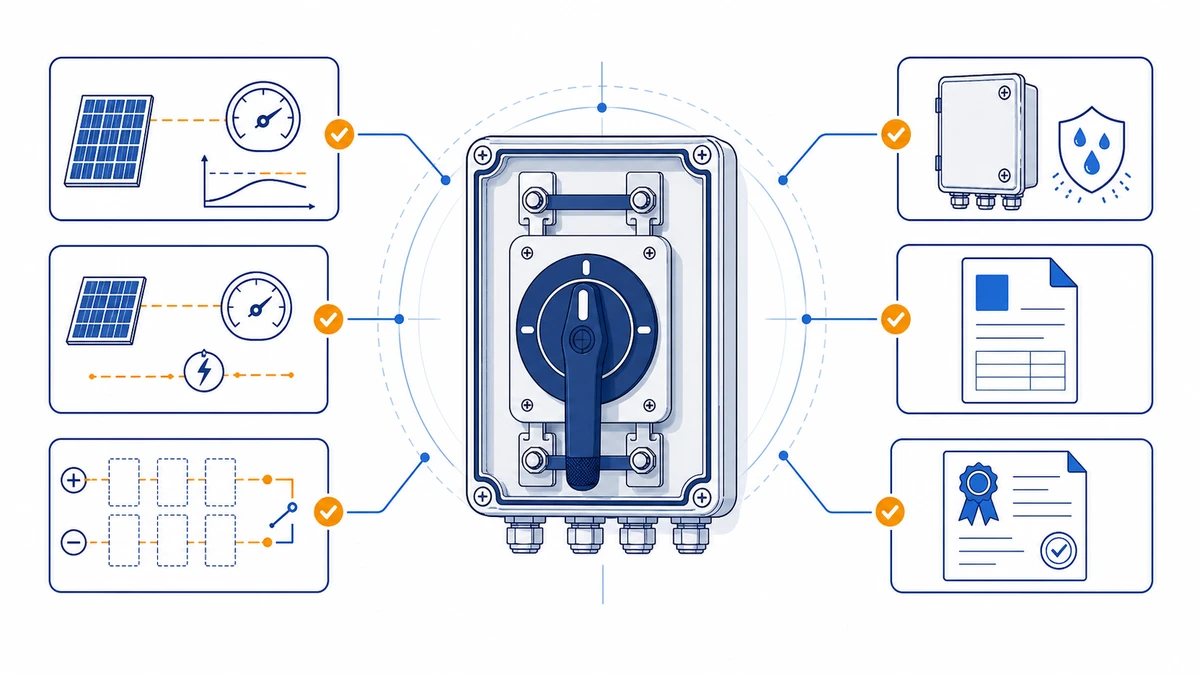
Figure 4. A complete inquiry should include rating, contact sequence, mounting, enclosure, and document requirements.
How Shieldhz Configures and Confirms 1000V and 1500V DC Isolator Switches for Solar Projects
The selection checklist defines what a specification must contain. This section describes how Shieldhz — the export brand of Zhejiang Shihe Electric Co., Ltd., founded in 2014 and operating from a 5,000+ square meter facility in Yueqing, Zhejiang — translates that specification into a confirmed, documented product.
Engineering Review Against Buyer System Parameters
For each DC isolator inquiry, Shieldhz engineers review the buyer submitted string configuration, maximum open-circuit voltage, short-circuit current rating, pole count, and applicable installation standard — such as IEC 62548 for PV array design or AS/NZS 5033 for Australian rooftop systems. This review determines whether the GF40 or GF41 series is appropriate for 1000V DC applications, or whether the GF51 series is required for 1500V DC, and whether the rated insulation voltage must be confirmed at 1000V DC or 1500V DC across 2-pole or 4-pole configurations.
Datasheet, Contact Program, and Wiring Diagram Confirmation
Each confirmed model is supported by a current datasheet specifying rated operational voltage, rated current, contact material, utilization category, and enclosure ingress protection rating. The contact program and wiring diagram are provided as part of the configuration package — buyers should verify that the pole connection topology on the wiring diagram matches the project installation before production is confirmed, particularly for 4-pole units where series-pole configurations change the wiring topology.
Certification and Documentation Package
Certification documentation includes IEC 60947-3 test reports and, where required by the destination market, CE declaration of conformity, TUV certificate, CB certificate, or UKCA declaration. Each certificate references the specific model code and declared voltage class. Shieldhz holds ISO 9001 quality management certification and produces components under RoHS compliance as standard. Buyers requiring UL or CCC certification for specific market requirements should confirm certificate scope at inquiry stage, as coverage varies by model series.
Structured Inquiry Process for Specification Accuracy
Buyers with defined system parameters — string voltage, maximum current, pole count, mounting constraints, IP rating requirement, and required certificates — can review the GF41 solar DC switch as a representative 1000V DC configuration entry point, or contact the Shieldhz technical team directly with a full specification package. This structured intake process reduces the risk of rating mismatch errors before production is confirmed and before the documentation package is issued for the project compliance file.
Frequently Asked Questions
Can a 1500V DC isolator be used safely in a 1000V PV system?
A 1500V-rated isolator can be acceptable in a 1000V system when its current rating, utilization category, enclosure rating, terminal layout, and certification scope also match the project requirements. The practical considerations are physical size and unit cost; 1500V units are typically larger and more expensive, so over-specification carries a project economics penalty rather than a safety one. For most 1000V residential and commercial projects, selecting a correctly rated 1000V unit from a confirmed datasheet is the more efficient approach.
What IEC standard governs DC isolator switches in solar PV installations?
IEC 60947-3:2020+AMD1:2025 applies to switches, disconnectors, switch-disconnectors, and fuse-combination units for distribution and motor circuits, with rated voltage up to 1000V AC or 1500V DC. This standard sets requirements for dielectric withstand, making and breaking capacity, and mechanical endurance. IEC 62548 governs the design of PV arrays and references switching device requirements within the context of string voltage and fault current calculations. IEC 60364-7-712 addresses low-voltage electrical installations for solar PV power supply systems; confirm the required voltage margin and calculation method from the edition and local rules adopted by the project.
How is the maximum DC string voltage calculated for isolator selection?
Multiply the module STC open-circuit voltage by the number of series modules, then apply the open-circuit voltage temperature coefficient correction for the lowest expected site temperature. The isolator rated voltage must exceed this temperature-corrected maximum string voltage by the margin required by the applicable installation code and project specification. Document this calculation in the as-built compliance package so the rating basis is auditable at commissioning.
Why does DC arc extinction require a different isolator design than AC?
AC current passes through zero volts 100 or 120 times per second depending on grid frequency, which naturally extinguishes an arc at each zero-crossing. DC current holds constant polarity, so an arc established across opening contacts sustains itself until the contact gap is wide enough — and the arc chute geometry aggressive enough — to stretch, cool, and extinguish the plasma column without zero-crossing assistance. This is the fundamental reason that a 1500V DC isolator requires a distinct contact and arc chamber design relative to a 1000V unit and cannot be treated as an interchangeable substitute.
What pole count should a DC PV isolator have?
Most ungrounded two-conductor DC string circuits use a 2-pole isolator, which switches both the positive and negative conductors simultaneously. Where local installation codes, authority having jurisdiction requirements, or inverter manufacturers require the neutral or a reference conductor to be switched, a 4-pole configuration is specified. For 4-pole units, confirm from the wiring diagram whether poles are connected in series to achieve the rated voltage — this affects the installation topology and fault-response behavior.
Is IP65 sufficient for an outdoor string-level DC isolator?
IP65 provides complete dust exclusion and protection against low-pressure water jets, which is adequate for most rooftop and ground-mount combiner environments. String-level isolators mounted in positions exposed to driving rain, standing water, or regular washdown should be rated IP66 or IP67. The marginal cost difference between IP classes is small relative to the replacement cost and system downtime associated with moisture ingress in a live DC circuit. Always confirm the specific IP rating from the product datasheet rather than from a family-level description.
What certifications should a DC isolator carry for a European utility-scale project?
At minimum, the isolator should carry IEC 60947-3 type-test certification covering the declared voltage and current ratings, together with a CE declaration of conformity referencing the Low Voltage Directive. The certificate must be traceable to the specific model code and voltage class — a certificate issued at 1000V DC does not cover a 1500V DC application. For projects requiring third-party validation, a TUV or CB scheme certificate provides the audit documentation that grid-connection authorities and insurance underwriters typically request. Buyers should obtain and retain the full certificate reference in the project compliance file.
Shi, Muxi
Shi, Muxi writes Shieldhz technical articles for industrial control and electrical component buyers, covering rotary cam switches, isolator switches, PV DC disconnects, push buttons, indicator lights, waterproof enclosures, and terminal blocks. The articles are based on Zhejiang Shihe Electric Co., Ltd.'s manufacturing and export experience, with practical emphasis on model selection, datasheets, drawings, certifications, IP ratings, and inquiry details buyers should confirm before ordering.