Forward-Off-Reverse Cam Switches: Contact Program and Motor Control Questions
Use a practical buyer checklist to evaluate forward off reverse cam switch inputs, documentation, approval controls and the exact rotary cam switch route.
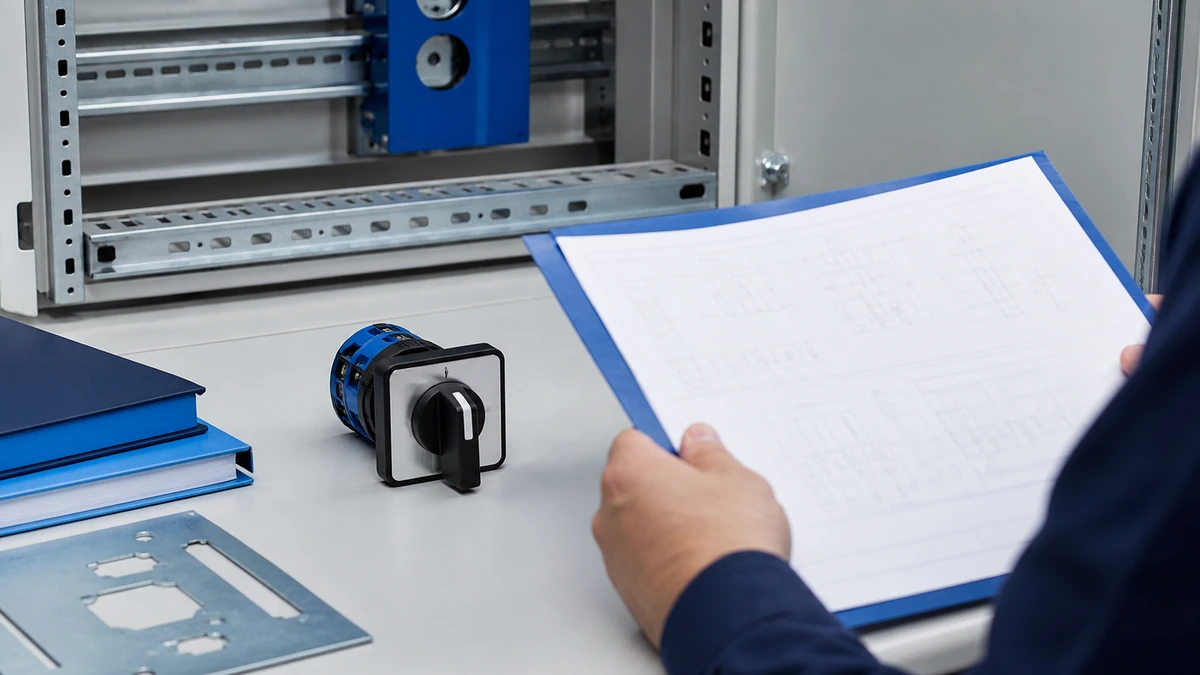
A forward off reverse cam switch is a commercial and engineering fit only after the contact program, duty information, pole arrangement, mounting route and documentation package are reviewed for the exact buyer application. The key decision is not the handle legend alone; it is whether the internal switching sequence matches the required forward, off and reverse states.
Ask for the contact program or switching diagram before comparing models.
Confirm AC/DC duty, voltage/current, utilization category and motor-control role against current documentation.
Treat drawings, datasheets and certificates as exact-model evidence, not family-wide assumptions.
When a forward off reverse cam switch is the right route to investigate
Use a forward off reverse cam switch as a candidate when the buyer needs a maintained rotary selector for reversing duty and can validate the switching sequence against the machine or panel design.
A FOR cam switch is commonly investigated where the operator needs a clear Forward-Off-Reverse command path. The purchasing risk is selecting by legend only, without confirming how the contacts open, close and overlap across the three positions.
An exact drawing identifies the interfaces that must be controlled for the approved model route.
Commercial fit
A FOR route is worth quoting when the required function can be expressed as a defined rotary position sequence. That sequence should be translated into poles, contact stages and connection references before the quotation is finalized.
Typical commercial inputs include:
Required function: Forward-Off-Reverse.
Number of positions and maintained or momentary behavior, if applicable.
Motor or load information supplied by the buyer.
Panel interface, handle style and marking requirement.
Destination market and requested document package.
Boundary of this article
This article focuses on contact program and documentation review. It does not provide a complete motor-control design and does not make a machine safety claim.
If the buyer needs additional protective, interlocking or safety-related functions, those must be engineered and validated separately within the full control system. Selecting a rotary operator or contact sequence does not validate the complete machine function.
Contact program is the first commercial specification
Specify the contact program before you compare prices, because two switches with the same Forward-Off-Reverse legend can have different internal switching sequences.
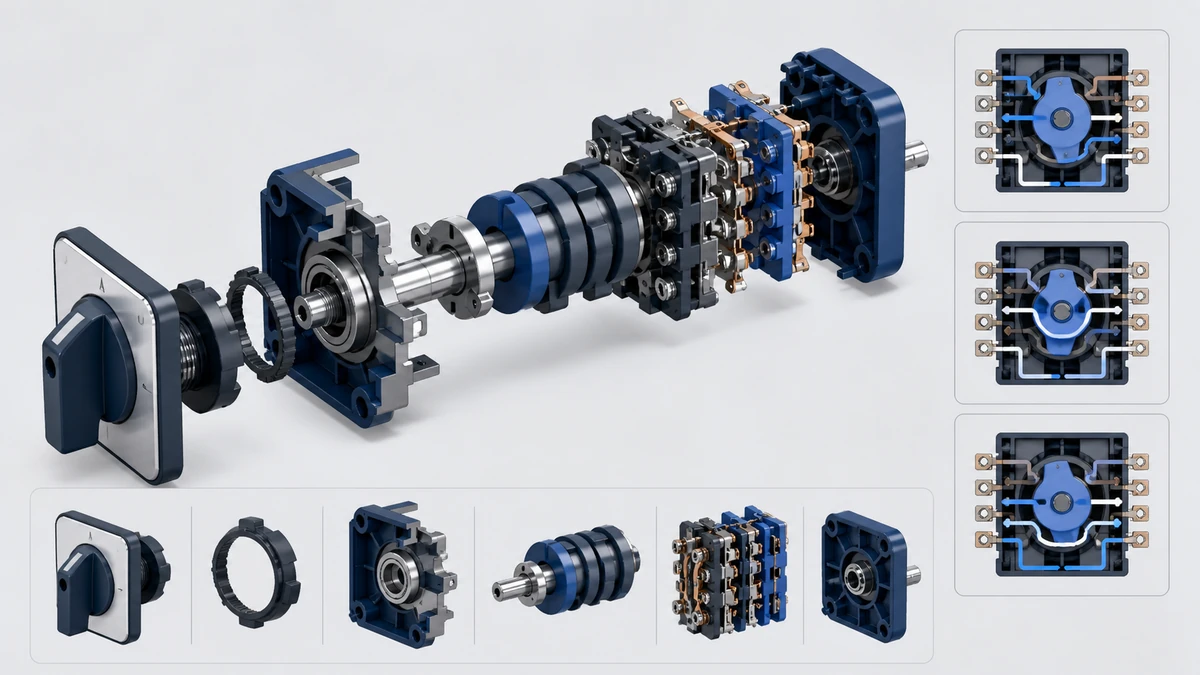
The contact program shows which contacts are closed in Forward, Off and Reverse. It also shows whether the Off position creates the expected open state for the relevant poles and whether the reversing relationship is achieved by the intended pole arrangement.
Sample review should connect the exact item to its current drawing and requested evidence package.
Reversal logic
A reversing contact program usually changes the relationship between selected conductors across Forward and Reverse positions. The exact arrangement depends on the motor type, control design and required switching duty.
Do not infer reversal from the nameplate wording alone. Ask for the actual switching diagram and compare it with the buyer’s schematic.
Contact-program decision table
Buyer decision
What the contact program must show
Why it matters
Forward position
Which contact pairs close in the Forward position
Confirms the intended operating state
Off position
Which contact pairs are open in the center position
Prevents assuming a function from the handle legend
Reverse position
Which contact pairs close in the Reverse position
Confirms the reversing relationship
Number of poles
How many independent circuits are switched
Affects whether the switch matches the buyer schematic
Stage arrangement
How contact elements are stacked and sequenced
Affects physical build and documentation review
Connection references
How the drawing identifies each contact path
Helps panel builders map the switch into drawings
Buyer action checklist
Before requesting a quotation, prepare:
A simple Forward-Off-Reverse truth table.
The required number of poles.
The buyer schematic section where the switch will be used.
Any required contact sequence restrictions.
Requested handle legend and position marking.
Required drawing format or document language, if specified.
Motor-control questions decide what must be reviewed before quotation
Resolve the motor-control questions before model selection, because the switch route depends on the actual duty, motor circuit and documentation evidence.
For motor applications, the switch cannot be selected from the word “motor” alone. The buyer should state the supply type, voltage, current, utilization category and how the switch is expected to operate within the control scheme.
The minimum review information should include AC or DC duty, voltage, current and utilization category. These items are exact-model and datasheet dependent.
If the switch will be used for reversing, the contact program must also be reviewed for the intended changeover relationship. Any timing, interlock or sequence requirement must be handled in the complete design, not assumed from a standard FOR marking.
Practical pre-quotation action list
Send the supplier:
Supply type: AC or DC.
Rated operating voltage required by the application.
Operating current or motor data supplied by the buyer.
Utilization category requested for review.
Forward-Off-Reverse contact truth table.
Required pole count and any spare contact requirement.
Panel mounting details and handle route.
Requested documents: drawing, datasheet and certificate package.
Ratings and standards are exact-model documentation questions
Treat ratings and standards as documentation checks for a named model, because they vary by switch construction, configuration, documentation date and destination-market requirement.
A catalog family name is not enough evidence for procurement approval. The sourcing team should request the current datasheet and any certificate or declaration package needed for the destination market.
Standard scope boundary
For standard scoping, use the IEC 60947-3 scope. IEC describes this scope as switches, disconnectors, switch-disconnectors and fuse-combination units within stated distribution- and motor-circuit AC/DC limits.
That scope statement should not be converted into a blanket claim for every configuration. The buyer still needs exact-model documentation for the selected switch route.
Evidence decision table
Decision area
Evidence to request
Do not assume
Voltage and current
Current datasheet for the exact model and configuration
That a family headline applies to every contact program
Utilization category
Datasheet entry or supplier confirmation tied to the selected route
That all motor duties are covered
Standard or certificate request
Applicable document package for the destination market
That one document covers all markets or versions
Switch-disconnector wording
Exact product documentation, if this function is required
That every rotary cam switch has that function
Environmental suitability
Product documentation and application review
That enclosure, handle or panel context is already covered
Panel interface and operator route affect the ordered assembly
Confirm the panel interface before releasing the order, because the electrical contact program and the mechanical operator route must match the same build.
A FOR cam switch quotation should identify how the unit is mounted, how the handle is presented and what the panel marking says. These details affect the ordered assembly and the documentation package.
Mounting and handle route
Panel builders should confirm the mounting style, shaft or handle arrangement, legend plate requirement and available space behind the panel. Exact dimensions and options are drawing dependent.
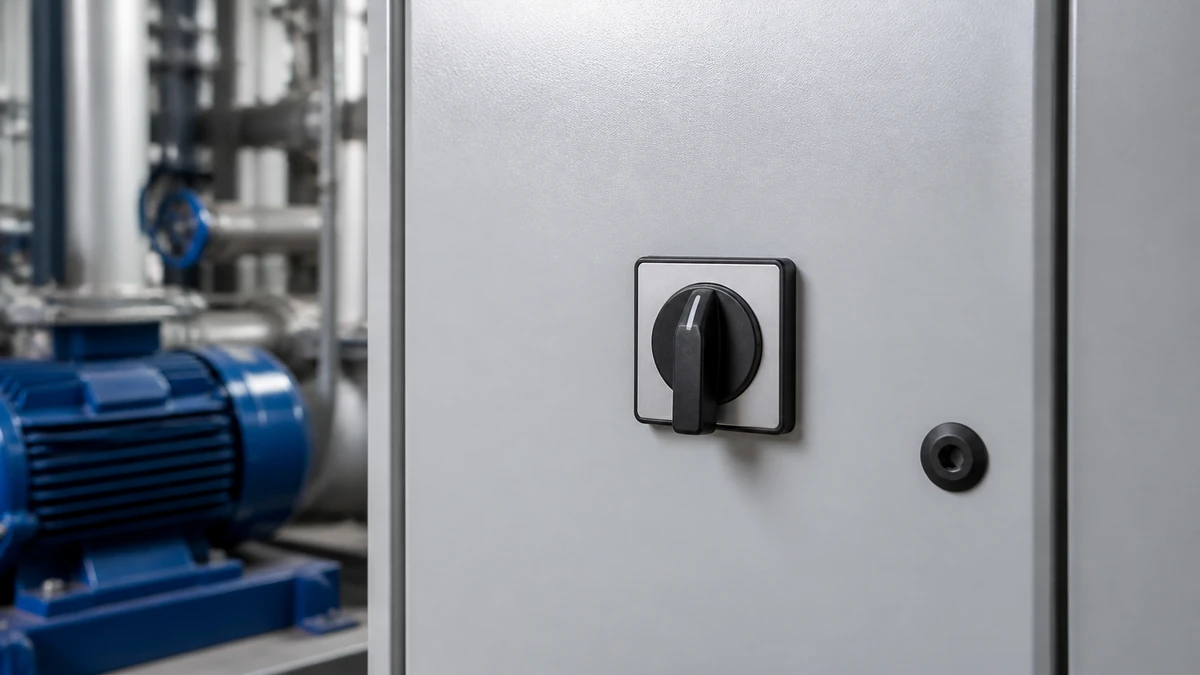
If the switch is installed in an enclosure or machine panel, the final environmental suitability depends on the complete assembly and current documentation for the chosen components. Do not treat a handle style or visual form as a universal environmental rating.
Marking and position language
Forward, Off and Reverse markings should match the buyer’s operating language and drawing convention. If the destination market requires a particular symbol, wording or color convention, state it during quotation.
Operator selection does not validate any complete safety function. If an emergency-stop or safety-related function is involved elsewhere in the machine, that function must be designed and validated separately.
Panel-interface checklist
Confirm these items before order release:
Panel cutout or mounting requirement.
Handle style and position indication.
Legend wording: Forward, Off, Reverse or buyer-specific text.
Rotation angle and number of positions, if specified.
Depth allowance behind the panel.
Required drawing showing mechanical dimensions.
Environmental or enclosure assumptions that must be checked against documentation.
How Shieldhz confirms a rotary cam switch route
Shieldhz confirms a route by matching the requested switching function, electrical duty and mechanical interface to current product documentation before quotation.
The review is a pre-quotation confirmation, not a complete machine design approval. Final suitability is confirmed against current product documentation and the buyer’s application.
Installation conditions change the product-route and document questions a buyer must resolve.
Required confirmation inputs
For a forward off reverse cam switch request, Shieldhz reviews:
Switching function: Forward-Off-Reverse and maintained or other required behavior.
AC/DC duty: supply type and operating conditions stated by the buyer.
Voltage/current and utilization category: values requested for documentation review.
Pole and contact program: switching diagram, truth table or schematic requirement.
Panel mounting and handle route: cutout, handle, legend and dimensional needs.
Environment: installation context and document-based checks.
Requested package: drawing, datasheet and certificate package.
Confirmation output
The quotation route should identify the proposed switch configuration, contact program reference and document package available for review. If the buyer’s information is incomplete, the quotation should state which assumptions require confirmation.
A good review outcome is not just a price. It is a model route that the panel builder, OEM or distributor can compare against the application drawing and procurement requirements.
Documentation package for distributors and OEM sourcing teams
Ask for a documentation package that lets engineering and purchasing review the same selected configuration, not only a product name.
Distributors often need enough information to quote quickly while avoiding substitution errors. OEM sourcing teams usually need a repeatable document set for internal release.
What to request
A practical package can include the drawing, contact program, datasheet and applicable certificate or declaration documents for the named model. The exact availability and content depend on the selected route and current documentation.
Request revision-sensitive documents when the project requires them. If the buyer has a destination-market requirement, state it before the supplier confirms the document package.
Alternative comparison table
Comparison point
Supplier A route
Supplier B route
Buyer review question
Contact program supplied
Yes/No
Yes/No
Can engineering confirm Forward, Off and Reverse states?
Pole count stated
Yes/No
Yes/No
Does it match the schematic?
Utilization category evidence
Yes/No
Yes/No
Is the duty supported by documentation?
Mechanical drawing supplied
Yes/No
Yes/No
Can the panel team confirm fit?
Certificate package stated
Yes/No
Yes/No
Does it match the destination-market request?
Legend and handle route stated
Yes/No
Yes/No
Does the ordered assembly match the operator interface?
Sourcing checklist
For a clean purchasing file, record:
Exact model or configuration route.
Contact program reference.
Datasheet revision or document date, if provided.
Drawing reference.
Certificate or declaration package requested.
Buyer application assumptions.
Any open items that must be resolved before production release.
Common contact-program mistakes to remove before order release
Remove contact-program ambiguity before order release, because most FOR selection errors start with missing or assumed switching details.
The visual operator can look correct while the contact sequence is unsuitable for the buyer schematic. The release review should therefore check the diagram, not only the handle label.
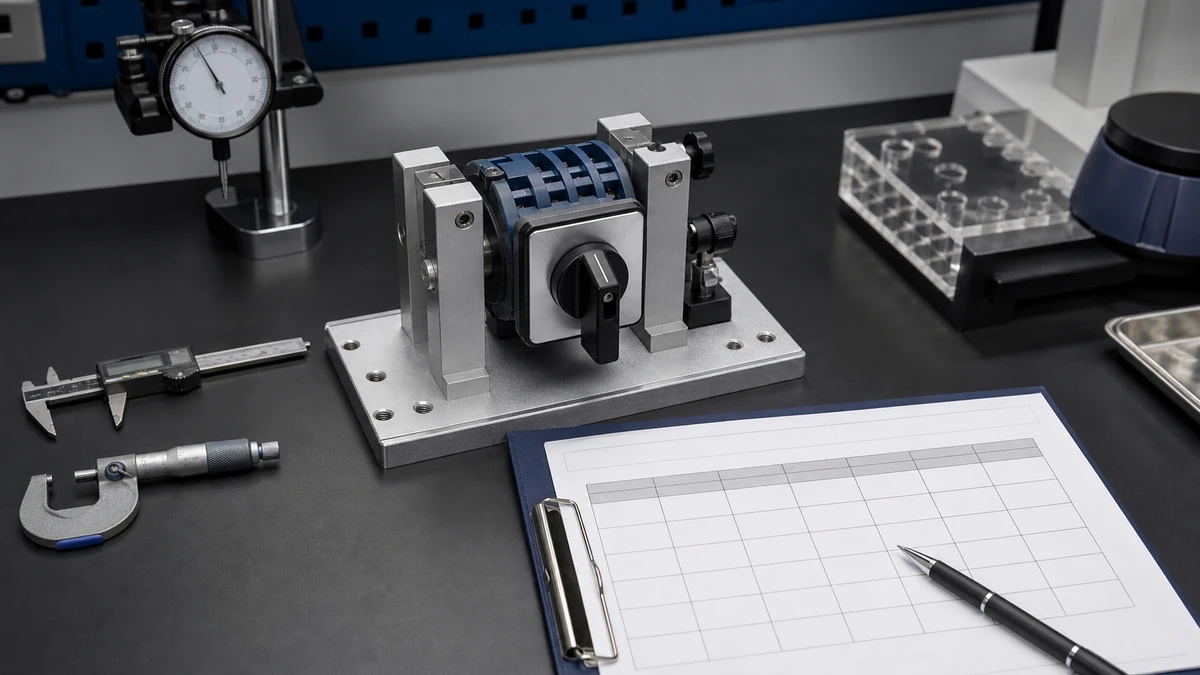
Documentation control, sample acceptance and protective packing are separate handover checks.
Mistake removal table
Common mistake
Why it creates risk
Practical correction
Selecting by “F-O-R” legend only
The internal contact sequence may differ
Request and review the contact program
Ignoring pole count
The switch may not match the drawing
Confirm all switched circuits before quotation
Treating Off as self-evident
The open/closed state must be verified
Review the Off column in the switching table
Assuming motor suitability from appearance
Duty depends on documentation
Check voltage, current and utilization category
Omitting mechanical details
The assembly may not fit the panel route
Review mounting drawing and handle requirement
Assuming document coverage
Certificates and declarations are route and market dependent
Request the exact package needed
Order-release action list
Before releasing the order, confirm:
The Forward-Off-Reverse contact program matches the buyer schematic.
The number of poles and stages is documented.
Voltage, current and utilization category have been checked against the selected route.
Mechanical drawing and handle details are approved.
The requested datasheet and certificate package are identified.
Any application assumptions are written into the quotation or purchasing file.
Final suitability has been reviewed against current documentation and the buyer’s application.
Conclusion
A forward off reverse cam switch should be selected by contact program and documentation evidence, not by handle text alone. The commercial decision is strongest when the buyer supplies duty data, pole requirements, panel details and the required document package before quotation.
Shieldhz can help confirm a rotary cam switch route from the switching function, AC/DC duty, voltage/current, utilization category, pole arrangement, mounting route, environment and documentation request. Final suitability remains dependent on the exact model, current product documentation and the buyer’s application.
Frequently Asked Questions
What is the most important document for a forward off reverse cam switch?
The contact program or switching diagram is usually the most important document. It shows which contacts close in Forward, Off and Reverse, allowing engineering to compare the switch with the buyer schematic.
Can I select a FOR cam switch from the handle legend only?
No. The Forward-Off-Reverse legend describes the operator positions, but it does not prove the internal contact sequence. Request the contact program before confirming the model.
What motor information should I provide before quotation?
Provide AC or DC duty, voltage, current or motor data, utilization category and the role of the switch in the control scheme. Also provide the required pole count and any contact sequence requirement.
Does every rotary cam switch have the same ratings?
No. Ratings depend on the exact model, configuration, datasheet and stated duty. Always review the current documentation for the selected route.
Can a forward off reverse operator validate an emergency-stop or safety function?
No. Selecting an operator or contact program does not validate a complete machine safety function. Any emergency-stop or safety-related function must be designed and validated within the full machine safety system.
What should distributors request to avoid substitution errors?
Distributors should request the exact model route, contact program, datasheet, mechanical drawing and required certificate package. They should also record buyer application assumptions and open items before releasing the order.
Shi, Muxi
Shi, Muxi writes Shieldhz technical articles for industrial control and electrical component buyers, covering rotary cam switches, isolator switches, PV DC disconnects, push buttons, indicator lights, waterproof enclosures, and terminal blocks. The articles are based on Zhejiang Shihe Electric Co., Ltd.'s manufacturing and export experience, with practical emphasis on model selection, datasheets, drawings, certifications, IP ratings, and inquiry details buyers should confirm before ordering.