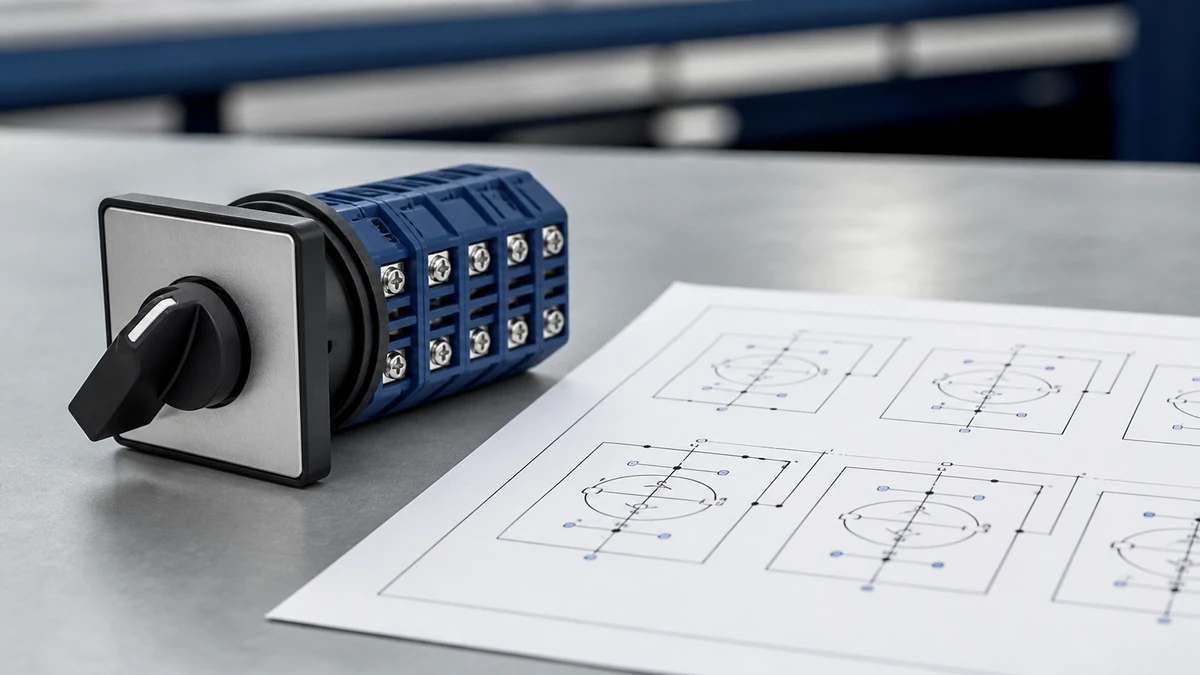
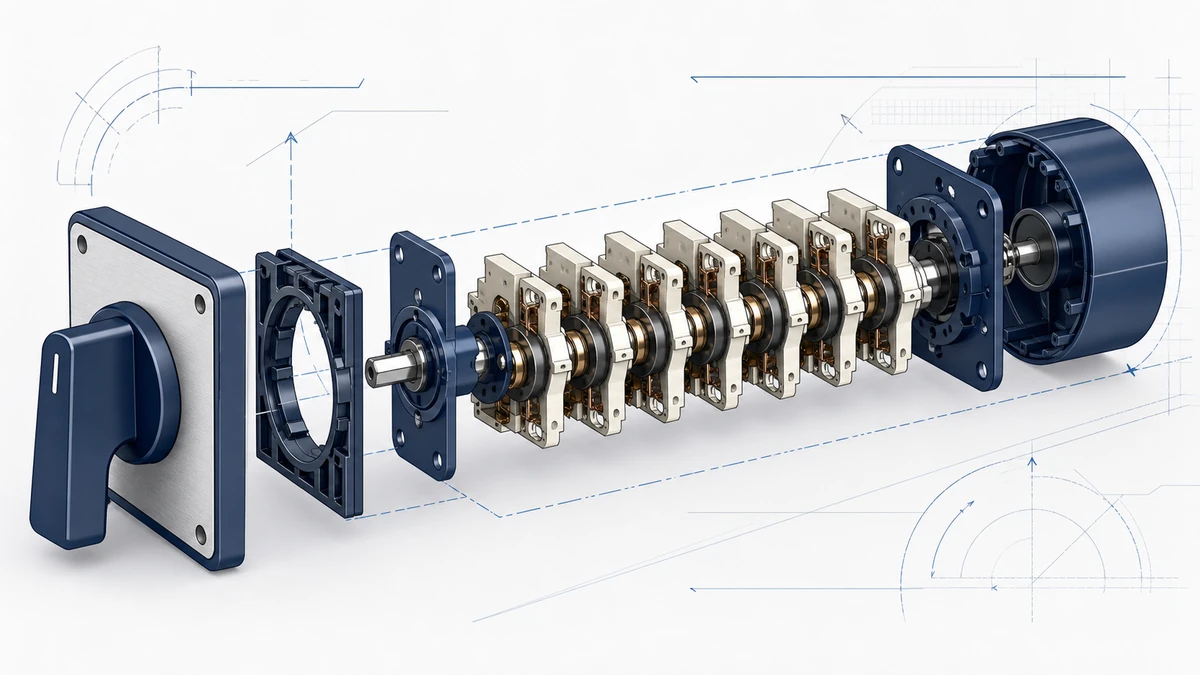
A rotary cam switch 6 pole is worth investigating when one operator must switch six separate conductive paths in a coordinated sequence, and the contact program matters as much as the headline pole count.
Map every switched path before requesting a quote: source, load, voltage, current, AC/DC duty, and required handle position.
Ask for the contact program or contact chart, not only a model name or front-panel layout.
Confirm the exact model against current drawings, datasheets, certificates where applicable, and the buyer’s application conditions.
Where a rotary cam switch 6 pole is the right commercial question
A six-pole route becomes relevant when the buyer needs six isolated switching paths controlled by one rotary operator, with timing defined by the cam arrangement.
This is not simply a “bigger” version of a lower-pole device. The commercial decision is whether one coordinated cam switch is cleaner, more documentable, and easier to panel-mount than multiple separate operators or a different control architecture.
When one handle must coordinate six paths
Typical reasons to investigate a six-pole configuration include simultaneous routing of multiple phases, separation of power and auxiliary paths, or a changeover sequence that must follow the same operator movement. The important buying input is not only how many paths are switched, but which paths close, open, overlap, or remain isolated at each position.
If your team is still aligning on the broader family of devices available, start with the rotary cam switch range and then return to the six-pole contact program.
When multiple lower-pole switches create risk or confusion
Using two or more separate switches may create wiring, labeling, or operating ambiguity if their positions must remain synchronized. A six-pole cam switch can be investigated when the machine design benefits from one front-panel operator and one defined switching table.
That does not make it automatically suitable. Suitability depends on the exact model, contact arrangement, electrical duty, mounting route, environment, documentation, and buyer application.
An exact drawing identifies the interfaces that must be controlled for the approved model route.
Six-pole application mapping: common buyer scenarios
The correct six-pole selection starts by mapping the application, not by copying a catalog line.
Panel builders and OEMs should describe what each pole is doing in each handle position. This allows the supplier to propose a contact stage arrangement that fits the intended function instead of guessing from a short description such as “6P changeover.”
Application routes to compare
Buyer scenario
Why six poles may be investigated
Key information to provide
Two three-phase circuits controlled by one operator
Six switched paths may be needed if both circuits must change state together
Circuit purpose, whether circuits are independent, current and voltage per circuit
Three-phase source selection with additional routed path
Extra paths may be needed for a control, indication, or neutral-related route where applicable
Source arrangement, load arrangement, required isolation between sources
Star-delta, reversing, or special motor sequence
Multiple paths may need a defined cam sequence rather than simple on/off operation
Motor data, duty, control philosophy, required switching sequence
Instrument or measurement selection
Several measurement paths may need stepped selection from one knob
Signal levels, isolation needs, number of positions, contact timing
Heater bank or multi-load selection
Several load circuits may need staged or grouped switching
Load type, step sequence, current per path, off position requirement
For motor-related work, use the rotary cam switch motor-control guide as the broader reference, then define the six-pole sequence for the exact machine circuit.
Two three-phase paths under one operator
A common commercial inquiry is whether one six-pole cam switch can route two three-phase circuits. The answer is application-dependent: it may be considered when the contact program, ratings, utilization category, mounting, and documentation match the exact use.
The buyer should make clear whether the two circuits are electrically independent, mechanically related, or part of a defined changeover. The drawing should show each conductor path separately so the supplier can avoid assuming that all six poles perform the same function.
Special sequences need a position-by-position table
If the handle has OFF, 1, 2, or more positions, the buyer should list every required contact state at each position. This is especially important where some contacts must open before others close, or where any overlap would be unacceptable.
A short verbal description is rarely enough for an engineered quotation. A compact switching table is usually the clearest input.
Contact-program inputs that decide the six-pole build
The contact program is the central buying document for a rotary cam switch 6 pole because it tells the supplier what the six paths do at each handle position.
Without this, two quotations can appear comparable while representing different electrical behavior. The contact program also helps avoid ordering a switch that has the right number of poles but the wrong sequence.
Minimum contact-program request list
Use this checklist before sending an RFQ:
Number of handle positions and position labels required on the front plate.
Required contact state of each pole in each position.
Whether contacts must be break-before-make, make-before-break, or non-overlapping, if applicable to the function.
Any circuits that must remain isolated from each other.
Whether all six poles carry similar duty or mixed duty.
Preferred schematic style or drawing format for engineering approval.
Any panel legend, knob style, shaft length, or mounting constraint known at RFQ stage.
Contact timing is a technical input, not a note to add later
Some six-pole applications can tolerate all switched paths changing at the same operator step. Others need defined opening or closing order.
If timing matters, state it in the RFQ and request confirmation in the drawing or contact chart. The feasible arrangement depends on the exact switch construction and current product documentation.
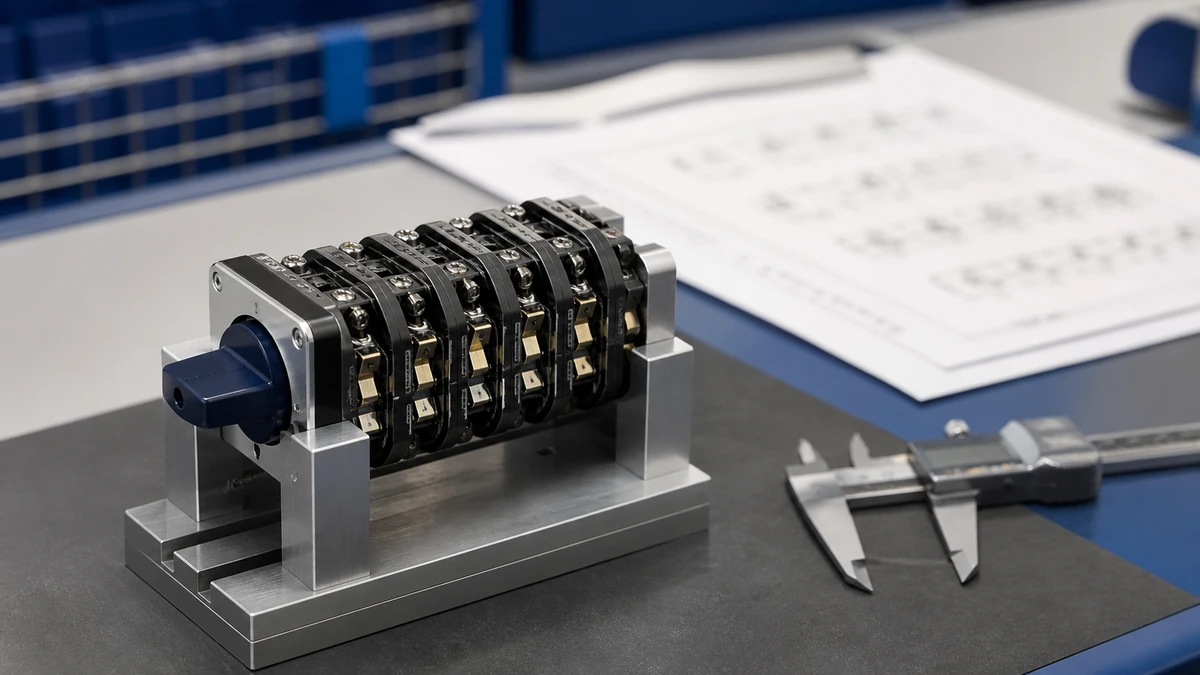
Sample review should connect the exact item to its current drawing and requested evidence package.
Electrical duty, voltage and utilization category must be confirmed before model selection
A six-pole cam switch should be evaluated against the actual electrical duty of every switched path, not selected by pole count alone.
IEC describes the IEC 60947-3 scope as switches, disconnectors, switch-disconnectors and fuse-combination units within stated distribution- and motor-circuit AC/DC limits. The applicable standard route, rating statement, and documentation package are exact-model, destination-market, and buyer-application dependent.
AC and DC duties are not interchangeable assumptions
AC and DC switching can impose different requirements on contact performance. The quotation request should identify AC or DC duty for each pole, plus voltage, current, load type, and expected switching condition.
If mixed circuits are present, do not assume that the highest or lowest value represents the whole device. List each path separately.
Utilization category and load type shape the decision
Input to confirm
Why it matters
Buyer action
AC or DC
Switching behavior and applicable ratings can differ
State separately for each switched path
Voltage and current
Selection must be checked against exact model documentation
Provide operating and maximum values used for selection
Utilization category
Load type influences applicable rating route
Request confirmation for the intended duty
Motor, heater, transformer, signal, or mixed load
Different loads can create different switching requirements
Identify the real load, not only the conductor count
Switching frequency or operation pattern
Endurance and thermal considerations are model- and application-dependent
Share realistic operating pattern where relevant
Destination market
Documentation and certification expectations may vary
State market and requested certificate package
The rotary cam switch selection guide provides the broader selection framework. For a six-pole inquiry, the critical step is to apply that framework to every pole in the proposed contact program.
Panel mounting, handle route and front-door decisions affect the quotation
A six-pole cam switch quotation should include the mechanical route because the electrical contact program is only part of the purchased assembly.
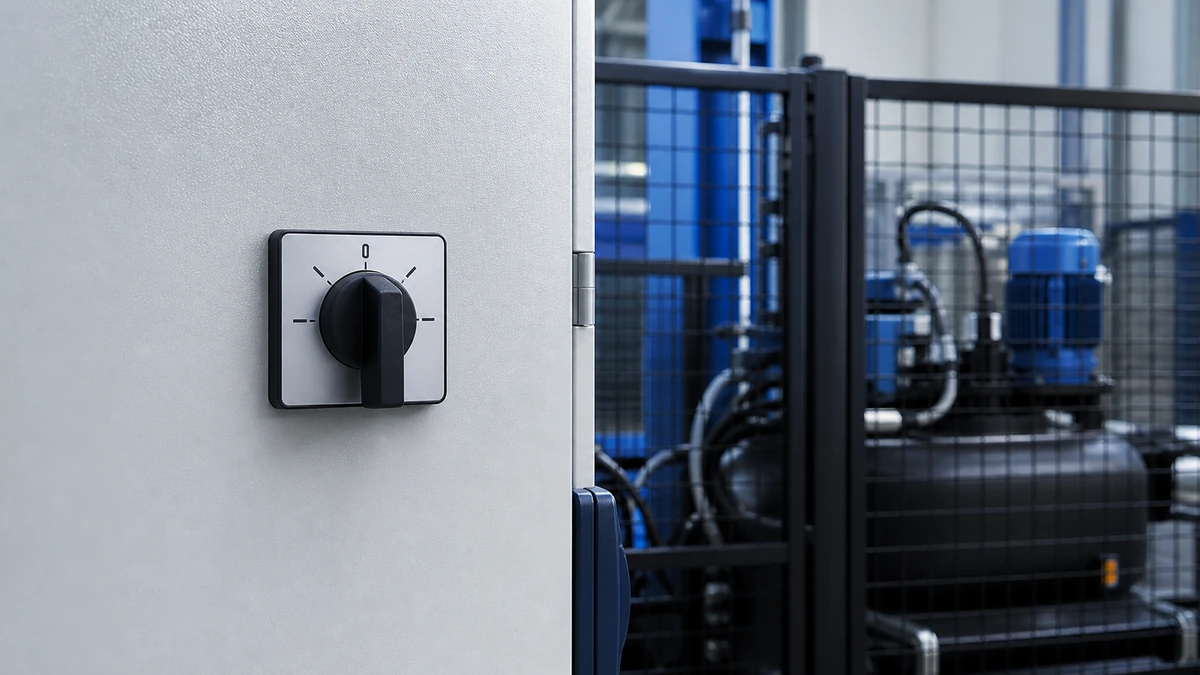
Panel builders need to know how the operator, shaft, escutcheon, legend, and switch body fit the enclosure or machine interface. Mechanical details are exact-model and drawing dependent.
Mounting route and operator interface
Specify whether the switch is mounted through a panel, behind a door, or in another permitted arrangement for the selected model. Include panel thickness, available depth, shaft requirements, and handle preference if known.
If the operator is part of a machine HMI, provide the desired position marking and viewing orientation. This helps the supplier align the front legend with the contact chart.
Panel-interface checklist
Before releasing a drawing for approval, check:
Panel cutout requirement for the exact model.
Available depth behind the mounting surface.
Handle type, color, and legend requirements.
Number and text of position markings.
Shaft length or extension requirement, if applicable.
Orientation of OFF and operating positions.
Environmental exposure at the operator and inside the panel.
Any buyer drawing format or approval workflow.
Installation conditions change the product-route and document questions a buyer must resolve.
Documentation package sourcing teams should request
A six-pole inquiry should request drawings and technical documents early, because the buying risk is often in the contact chart and mounting details rather than the price line.
Commercial comparison is easier when each supplier responds with the same documentation scope. The required documents may vary by model, market, and buyer quality procedure.
Drawing and contact chart
Request a drawing that shows the switch arrangement, handle positions, and contact program. For a custom or semi-custom sequence, the contact chart should be treated as an approval item before ordering.
If a drawing revision is referenced in the quotation, keep that revision tied to the purchase record. A model number without the associated contact chart may be insufficient for future replacement or panel replication.
Datasheet and certificate package
Ask for the current datasheet for the proposed model and any certificate documents needed for the destination market, if applicable. Do not assume that a certificate for one model, rating, or configuration applies to another.
A practical documentation request can include:
Model number or proposed type code.
Contact program or switching table.
Dimension drawing.
Electrical rating data for the stated duty.
Mounting and handle details.
Applicable certificate or declaration documents requested by the buyer.
Packing, marking, or labeling requirements if relevant to the sourcing process.
How Shieldhz confirms a rotary cam switch route
Shieldhz confirms a rotary cam switch route by checking the requested function, contact program, electrical duty, mechanical arrangement, environment, and documentation needs before finalizing the quotation path.
This is a pre-quotation engineering and sourcing confirmation step. Final suitability is confirmed against current product documentation and the buyer’s application.
Inputs requested before quotation confirmation
For a six-pole route, the useful inputs are:
Switching function: on/off, changeover, source selection, motor-related sequence, measurement selection, or other defined function.
AC/DC duty: identified for each switched path where mixed duty is possible.
Voltage, current, and utilization category: stated for the actual load and switching condition.
Pole and contact program: six paths mapped across every handle position.
Panel mounting and handle route: panel depth, cutout, shaft, handle, legend, and position marking needs.
Environment: indoor/outdoor exposure, dust, moisture, temperature, vibration, or other conditions relevant to the selected model.
Requested drawing, datasheet, and certificate package: including destination market and buyer approval requirements.
Output expected from the confirmation route
The response should identify the proposed model route, the contact program basis, and the documentation needed for buyer approval. If the application requires clarification, the next step is usually a revised contact table or drawing review rather than a price-only comparison.
Shieldhz does not need the buyer to over-format the first inquiry. A clear circuit sketch, position table, and electrical duty summary are usually the fastest way to move from inquiry to a technically checkable quotation.
Documentation control, sample acceptance and protective packing are separate handover checks.
Comparing a six-pole cam switch quotation without losing engineering control
Compare six-pole quotations by normalizing the contact program, duty, mechanical arrangement, and documentation package, not by price and pole count alone.
Two quotations can both say “6 pole” while using different contact sequences, handle legends, rating assumptions, or document scopes. That difference may only become visible after drawing review.
Quote comparison table
Comparison item
What to check
Why it matters
Contact program
Same contact state at every position
Confirms equivalent switching behavior
Electrical duty
Same voltage, current, AC/DC, utilization category
Prevents mismatched rating assumptions
Mechanical route
Same mounting, shaft, handle, legend, panel depth
Prevents panel-fit problems
Documentation
Same drawing, datasheet, certificate request
Supports buyer approval and future replacement
Revision control
Same drawing or contact chart revision
Avoids ordering against an outdated sequence
Destination market
Same certificate or compliance request where applicable
Prevents documentation gaps
Buyer action list before purchase
Before issuing the PO, confirm:
The approved contact chart matches the machine circuit.
The front-panel legend matches the handle positions.
The electrical duty has been confirmed against the proposed model documentation.
The mounting drawing matches the panel design.
The requested datasheet and certificate package are included where required.
Any substitution must be rechecked against the same contact program and application inputs.
Conclusion
A rotary cam switch 6 pole should be treated as an engineered switching route, not just a six-pole catalog search. The winning decision comes from mapping the six paths, defining the contact program, confirming electrical duty, and matching the mechanical route to the panel.
For panel builders, OEMs, machine designers, distributors, and sourcing teams, the most useful RFQ is concise but complete: function, AC/DC duty, voltage/current and utilization category, pole-by-pole contact table, mounting details, environment, and requested documentation. Final selection should always be checked against current product documentation and the buyer’s real application.
Frequently Asked Questions
When should I ask for a rotary cam switch 6 pole instead of a lower-pole model?
Ask for a six-pole route when six separate switched paths must be controlled by one rotary operator and one defined contact program. If fewer paths are actually switched, a lower-pole model or a different arrangement may be more appropriate, depending on the application.
Can a six-pole cam switch control two three-phase circuits?
It may be considered if the exact model, contact program, duty, mounting, and documentation match the application. Provide the circuit purpose, voltage, current, AC/DC duty, and required position sequence for both three-phase paths.
Do all six poles switch at the same handle position?
Not necessarily. The required behavior depends on the contact program, and the feasible arrangement depends on the exact switch construction and current documentation.
Is a six-pole rotary cam switch a substitute for a circuit breaker?
No. A rotary cam switch should not be treated as overcurrent protection. Any required protective devices must be selected separately by the machine or panel designer according to the application and applicable requirements.
What documents should I request before buying?
Request the proposed model information, dimension drawing, contact chart, datasheet, and any certificate documents needed for the destination market or buyer approval process. The exact documentation available depends on the model and configuration.
Can the same six-pole cam switch be used for both AC and DC applications?
Do not assume that. AC and DC duties can have different rating and application considerations, so the exact model must be checked against current documentation for the stated voltage, current, utilization category, and load type.
Shi, Muxi
Shi, Muxi writes Shieldhz technical articles for industrial control and electrical component buyers, covering rotary cam switches, isolator switches, PV DC disconnects, push buttons, indicator lights, waterproof enclosures, and terminal blocks. The articles are based on Zhejiang Shihe Electric Co., Ltd.'s manufacturing and export experience, with practical emphasis on model selection, datasheets, drawings, certifications, IP ratings, and inquiry details buyers should confirm before ordering.