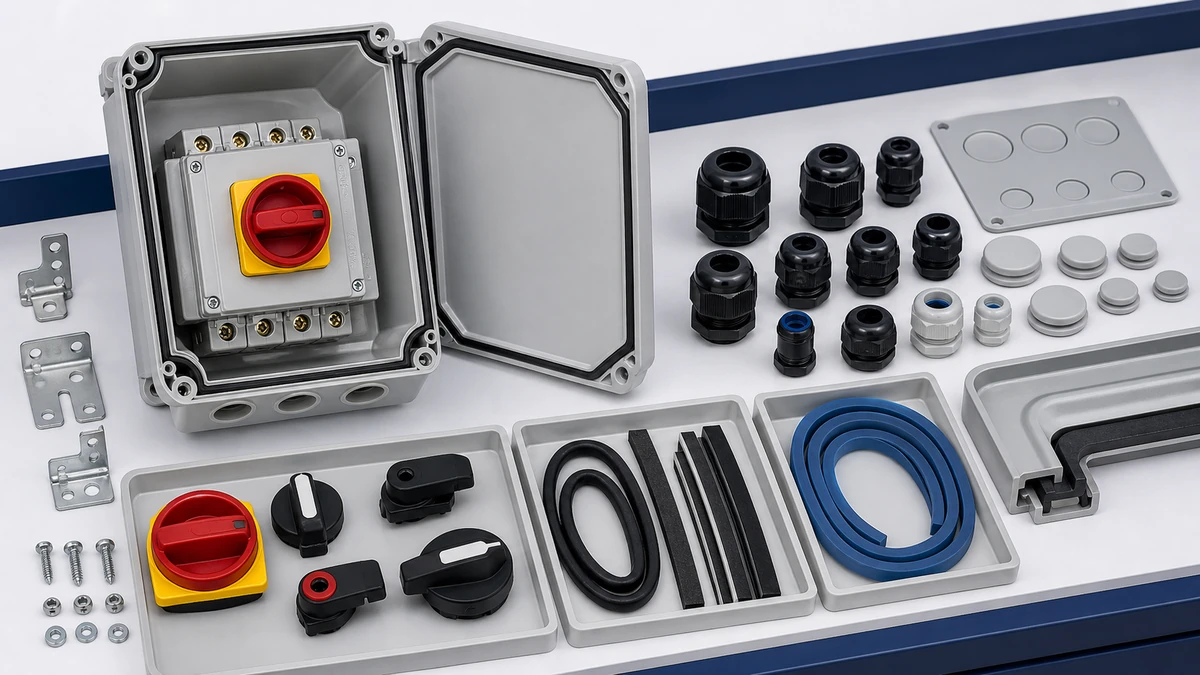
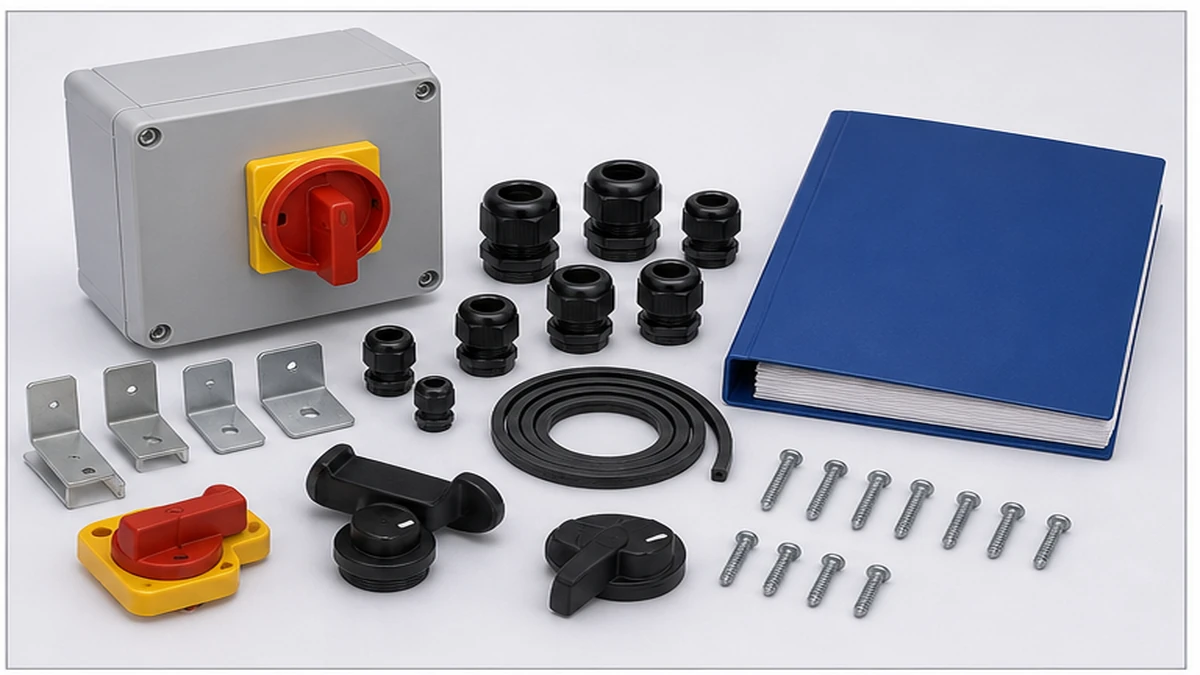
Selecting the right cable entry gasket and handle for a weatherproof switch box directly determines whether the enclosure maintains its IP rating in service. Gaskets seal the annular gap around each cable penetration; handles transmit rotary force to the internal switching mechanism while keeping the front-panel seal intact. Both components must be matched to the cable outer diameter, enclosure IP class, ambient temperature range, and any lockout requirement before the enclosure leaves the panel shop. Getting either selection wrong leads to water ingress, accelerated switch wear, failed site inspections, and voided certifications. The sections below work through every selection variable in sequence.
What Cable Entry Gaskets and Handles Actually Do
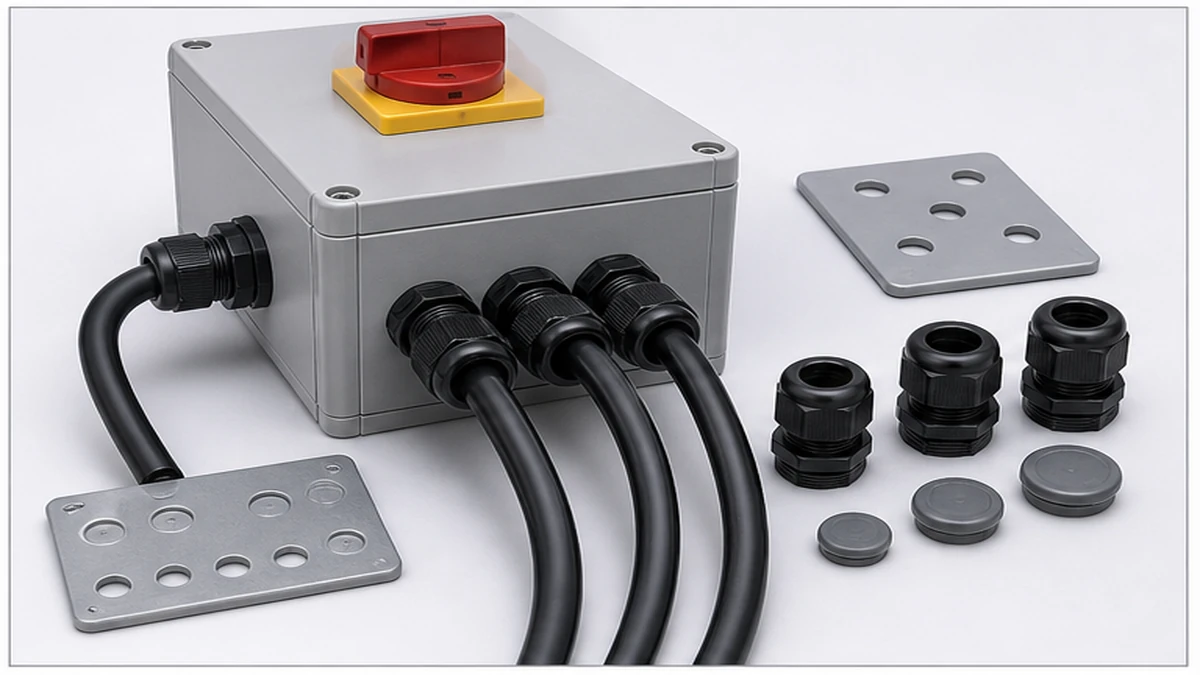
A cable entry gasket fills the annular space between an incoming cable and the enclosure wall knockout. In outdoor control enclosures — rooftop PV isolator boxes, motor control stations exposed to rain and industrial dust — even a small unsealed gap can compromise the enclosure IP rating under IEC 60529 water ingress tests. Those tests simulate a sustained water jet at 12.5 L/min from any direction for IP65, or submersion at 1 m depth for 30 minutes for IP67. The gasket must maintain compression contact across the full cable outer diameter (OD) range declared on the product datasheet; a gasket sized for a 10 mm cable OD will not seal reliably on a 20 mm cable.
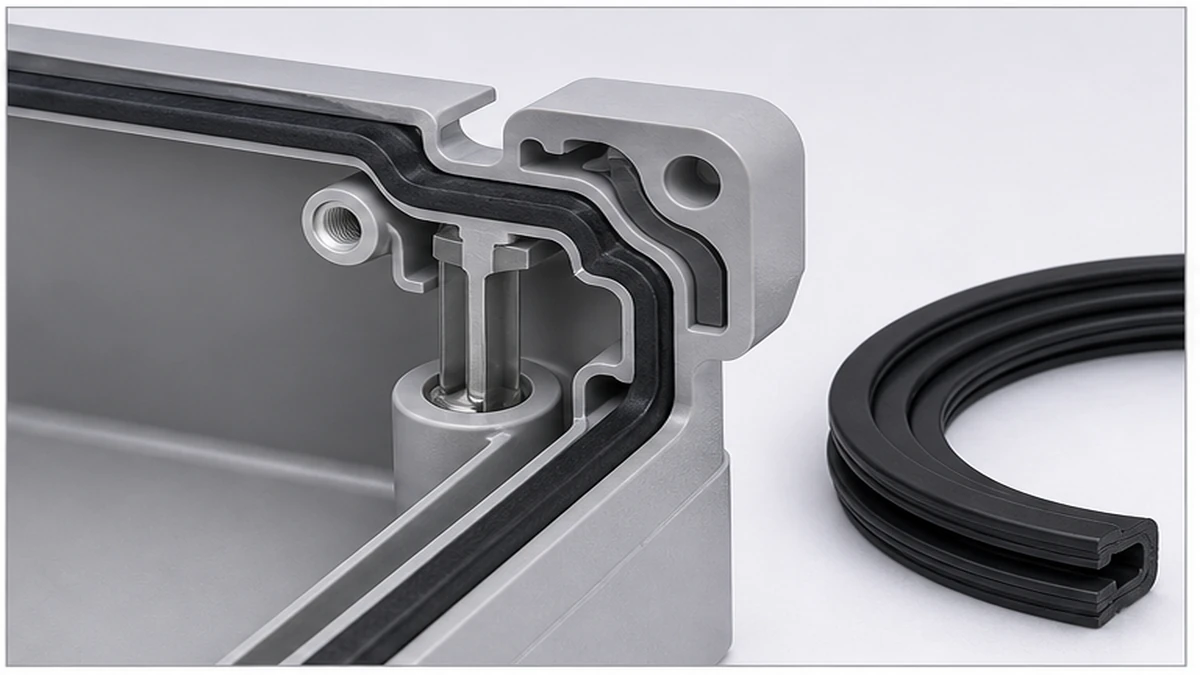
Handles serve two roles simultaneously: transmitting rotary or linear force to the switch shaft, and maintaining the enclosure front-panel seal at the actuation penetration point. IP-rated handle designs incorporate a shaft seal element — typically an O-ring or face gasket — pressed against the enclosure panel to block moisture at that opening. Mismatched shaft engagement length introduces misalignment that increases operating torque and accelerates seal wear.
Three standards frameworks appear most frequently in project specifications for weatherproof switch boxes.
IEC 60529 assigns the IP code based on solid particle and liquid ingress test outcomes. The second digit of the IP code is the relevant one for gasket selection: IP55 permits limited dust ingress and resists a low-pressure water jet; IP65 is dust-tight and resists a 12.5 L/min jet; IP66 withstands high-pressure jets; IP67 survives 1 m immersion for 30 minutes; IP68 covers supplier-defined greater depths and durations.
NEMA 250 classifies enclosures by construction type rather than by test outcome. Type 3R handles rain; Type 4 is watertight; Type 4X adds corrosion resistance; Type 6P covers prolonged submersion. NEMA Type 4X and IEC IP66 are often treated as interchangeable on project drawings, but Type 4X adds a salt-spray corrosion requirement that the IP code does not address. On coastal and marine sites, specify stainless fasteners and marine-grade handle alloys regardless of which standard governs.
UL 508A governs industrial control panel construction, including cable entry sealing and operator handle mounting. A critical UL 508A point that IEC 60529 does not replicate is this: cable entry points and handle cutouts must be sealed to maintain the enclosure original rating after field modification. An IP test report that covers only the unmodified enclosure body does not satisfy UL 508A when a knockout has been punched in the field.
How the Standards Interact
An integrator specifying a weatherproof isolator switch box must satisfy the most restrictive requirement across all applicable standards simultaneously. When a project must satisfy both IEC 60529 and UL 508A, obtain an IP test report that references the specific enclosure assembly after the handle cutout is made — not just the gasket component in isolation. Keep that report in the project file; regional inspectors regularly ask which standard governs the cable entry seal, and the answer is often all three.
The full IEC 60947-3:2020+AMD1:2025 standard — which applies to switches, disconnectors, switch-disconnectors, and fuse-combination units for distribution and motor circuits, with rated voltage up to 1000 V AC or 1500 V DC — is available directly from the IEC Webstore. For background on how this standard applies to the isolating function, the IEC 60947-3 application guide covers the key requirements in accessible language.
Cable Entry Gasket Types: Material, Compression Profile, and Sizing
Three variables drive gasket selection: elastomer material, compression profile, and cable OD range.
Elastomer material governs chemical and temperature resistance. EPDM (ethylene propylene diene monomer) performs well outdoors because it resists UV, ozone, and temperature cycling. Neoprene resists oils and moderate chemical splash. Silicone tolerates the widest temperature range and suits high-heat enclosures. NBR (nitrile) is the standard choice where hydrocarbon exposure is present in industrial control cabinets. Always confirm the material designation on the gasket datasheet; generic “rubber” is not a specification.
Compression profile determines how consistently the seal conforms to the cable jacket across the working OD range. A flat radial-squeeze gasket works well on round cables with a consistent jacket OD. A self-sealing slit membrane accommodates multiple cables through a single plate while maintaining individual seals around each conductor. A compression-nut gland applies concentrated radial force via a threaded body, achieving the highest IP ratings when correctly torqued.
Cable OD range is the most commonly underspecified variable. Each gasket type has a minimum and maximum sealing bore confirmed by the supplier datasheet. Confirm the actual cable OD — including any corrugated or UV-rated sheathing — before selecting the gasket size. Where a cable has a high-plasticiser PVC jacket, silicone is often the more chemically compatible choice even in outdoor applications where EPDM would otherwise be standard, because plasticiser migration into some EPDM grades causes compression-set degradation over time.
For solar PV rooftop and ground-mount installations, EPDM snap-in inserts and multi-hole silicone membranes are the two most common choices. Both must be confirmed against the assembly IP test report — IEC 60529 ratings apply to the complete sealed enclosure, not individual gasket components.
Figure 2. Selection checks should connect box route, current rating, IP rating, cable entry, gasket condition, handle type, mounting, and documentation.
Handle Types: Selector Guide for Weatherproof Applications
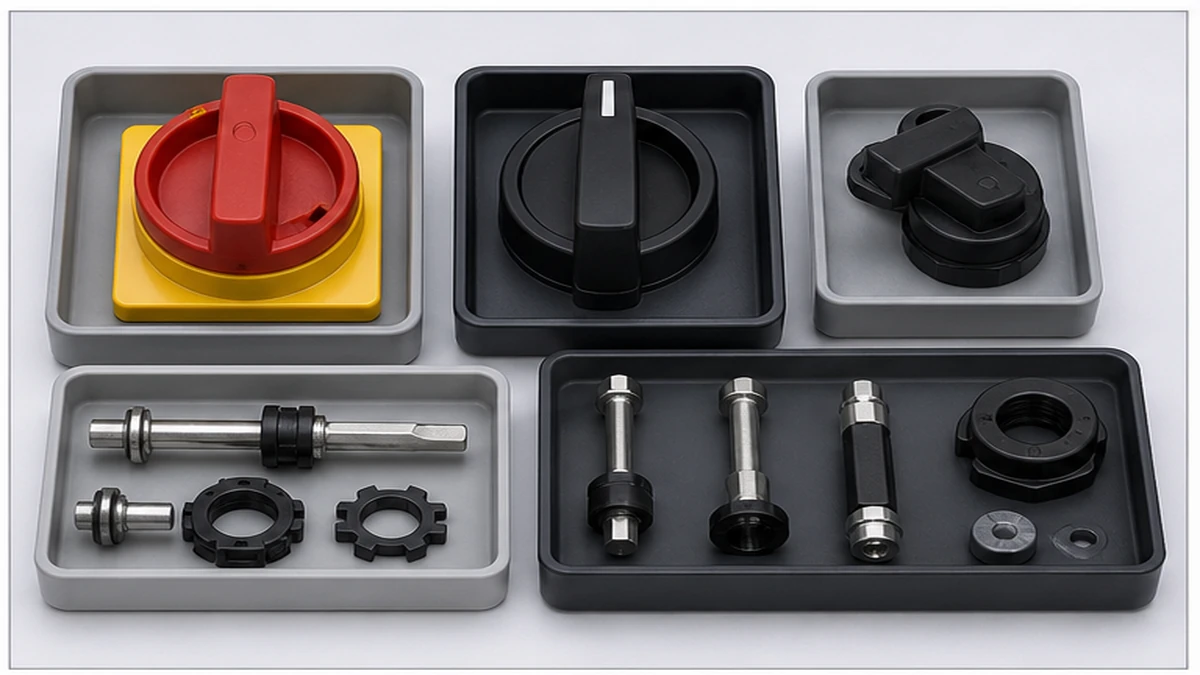
Four Handle Configurations and When Each Applies
Standard rotary knob. Suitable for general industrial panels and pump control stations where operator access is unrestricted and IP65 is the target. A flat EPDM face seal compresses against the enclosure panel to maintain the dust-tight and water-jet rating. An optional padlock collar can be added without changing the seal geometry on most enclosure families.
Extended rotary lever. Used in high-torque switching applications and on panels where gloved-hand operation is required, such as outdoor motor isolators. The extended grip radius reduces operator effort and is particularly useful where the cam switch mechanism has a high pole count. IP65 to IP66 is achievable depending on the shaft seal depth and face gasket design.
Door-interlock rotary. Required in MCC compartments and service isolation panels where the risk assessment identifies an energisation hazard from opening the enclosure while the switch is in the ON position. The mechanical interlock prevents the enclosure door from opening until the switch shaft reaches the OFF or disconnected position, reducing arc-flash exposure risk. Confirm the interlock mechanism travel against the specific cam switch contact program before ordering — the interlock release position must correspond to a confirmed open-circuit contact state on the wiring diagram.
Lockable rotary with padlock hasp. The standard specification for outdoor PV isolators, marine service panels, and any installation where lockout/tagout (LOTO) procedures must be enforced. Most padlock hasps accommodate up to three padlocks with a 6 mm shackle diameter, supporting group LOTO. To maintain IP66 or IP67 at the handle penetration, the shaft bushing must be a reinforced design — repeated padlock engagement on a lightweight bushing distorts the face seal over time. A corroded carbon steel shackle can seize in the hasp loop and force lateral stress on the shaft, which deflects the seal and creates an ingress path. Stainless steel shackles are mandatory on coastal, marine, and wash-down sites.
Shaft Engagement and Seal Compression
Handle-to-enclosure seal integrity depends on face gasket compression geometry. Confirm shaft-seal compression depth from the manufacturer assembly drawing; values outside the documented range — whether too shallow or over-compressed — both degrade the seal. Over-tightening the retaining nut is as damaging as under-tightening. At commissioning, rotate the shaft through full travel three times before final torque to confirm the face gasket seats concentrically; an off-centre seat is a common cause of IP65 test failure at the handle penetration point.
For rotary cam switch applications in weatherproof enclosures, the handle shaft length must match the internal cam mechanism engagement depth. The LW28 rotary cam switch series and the LW42 rotary cam switch series each have defined shaft engagement specifications that must be cross-referenced against the enclosure wall thickness before a handle is specified. Confirm these dimensions from the dimensional drawing, not from memory or catalogue text.
Figure 3. Application wiring context should be verified against the manufacturer contact chart before energizing.
Field Selection Checklist: Four Stages Before Ordering
Work through each stage in sequence. A failure at any stage means revisiting the specification before proceeding.
Stage 1 — Enclosure IP Rating Verification
Confirm the target IP rating marked on the enclosure body against IEC 60529 classification. For outdoor use, IP65 is the practical minimum; marine and wash-down sites typically require IP66 or IP67. Verify the rating against the enclosure product datasheet, not just the moulded marking, because some enclosures carry conditional IP ratings that only apply when all cable entries are sealed with the manufacturer-specified gland family.
Stage 2 — Cable Entry Gasket Sizing
Measure the cable outer diameter with a calibrated gauge, accounting for any corrugated or UV-rated oversheath. Match the measured OD to the gasket working range on the supplier datasheet. Confirm that the gasket material is rated for UV exposure and the site temperature range. On solar DC circuits, confirm that the gasket sealing range covers the specific DC cable OD used on that project — DC cable geometries vary more widely than standard power cable.
Stage 3 — Handle Torque, Travel, and Padlock Compatibility
Verify that the actuator handle can reach the OFF position with full rotary travel unobstructed — check conduit routing and any internal cable management before finalising layout. Confirm padlock shackle clearance of at least 6 mm where LOTO is required. For door-interlock handles, confirm the interlock release position against the contact wiring diagram supplied with the rotary cam switch.
Understanding how the cam switch itself operates helps at this stage; the rotary cam switch explanation guide covers the contact program logic and switching sequence in detail.
Stage 4 — Environmental and Chemical Compatibility
Compare the installation environment — UV index, ambient temperature range, chemical or fluid exposure — against gasket and handle material ratings as stated on datasheets. Temperature ratings listed as typical ranges in general guidance should be confirmed against the specific product datasheet for the deployment conditions. Where site conditions fall outside the documented material range, request alternative compound options from the supplier in writing and obtain a revised datasheet before committing to an order.
How Shieldhz Confirms Cable Entry and Handle Configurations
Shieldhz is the export brand of Zhejiang Shihe Electric Co., Ltd., founded in 2014 and based in Yueqing, Zhejiang, with a factory of over 5,000 square metres, more than 100 employees, and 40-plus production machines. Applicable certifications include ISO 9001, CE, RoHS, TUV, UL, UKCA, CCC, and CB; the relevant certifications for any specific product and market are confirmed per inquiry, not assumed universally.
When a buyer submits a request for a weatherproof isolator box with cable entry and handle requirements, the Shieldhz technical team collects the following inputs before confirming a configuration:
Cable outer diameter range and the number of cable entry points per enclosure face
Installation environment: outdoor, rooftop PV, marine, wash-down, or classified area
Operating voltage and rated current, as stated on the buyer’s circuit schedule
Required IP rating and the applicable regional standard — IEC 60529, UL 508A, or AS/NZS
Handle type preference: standard padlockable rotary, extended lever, door-interlock, or keyed-release
Certification and documentation requirements: CE declaration, IP test report, wiring diagram, dimensional drawing with cutout tolerances, IEC 60947-3 compliance document
Without confirmed cable OD and enclosure wall thickness, gasket bore and handle shaft engagement length cannot be matched to the internal cam mechanism. The engineering team cross-references the declared cable diameter range against available compression gasket families, confirming the minimum and maximum sealing bore for each entry port against the IP target.
Handle model selection follows the switch series. The SH30 rotary cam switch series used in weatherproof enclosure applications has a defined shaft geometry; the handle assembly is specified to match that geometry, the enclosure wall thickness, and the declared IP class as a confirmed package — not as three separately sourced items.
Once the gasket specification and handle model are confirmed, Shieldhz assembles the documentation package: IP test report referencing IEC 60529, relevant CE declaration, wiring diagram, dimensional drawing with cutout tolerances, and product datasheet. Buyers specifying DC isolator variants for PV applications also receive the applicable IEC 60947-3 compliance document covering the disconnection category. Buyers who need a broader overview of the available cam switch families before narrowing down to an enclosure configuration can review the full rotary cam switch range for model and rating context.
Figure 4. A complete inquiry should include rating, contact sequence, mounting, enclosure, and document requirements.
Procurement Checklist: What to Prepare Before Submitting an RFQ
Prepare the following before contacting any supplier. Incomplete inquiries delay confirmation and risk mismatched components being shipped.
Enclosure data
– Knockout diameter and wall thickness at each cable entry point
– Enclosure family and IP rating as stated on the enclosure datasheet
– Handle cutout diameter and shaft clearance depth from the enclosure drawing
Cable entry data
– Cable OD for each entry point, measured with a gauge on the actual cable to be installed
– Cable jacket material and any UV or chemical exposure the sheathing will face
– Number of cable entry points and whether a multi-hole membrane plate or individual glands are preferred
Handle data
– Required handle type and any locking provision — number of padlocks, shackle diameter
– Shaft engagement length requirement based on enclosure wall thickness
– Grip material preference where chemical splash or wash-down is present
Certification and documentation data
– Regional standard governing the installation — IEC 60529, UL 508A, or equivalent
– Certification marks required for the destination market
– Whether an IP test report for the complete assembly is required as a project deliverable
Buyers submitting a complete RFQ against this checklist enable the Shieldhz technical team to confirm model route, contact program, wiring diagram, dimensional drawing, and documentation package in a single response rather than through multiple clarification rounds.
Frequently Asked Questions
What is the difference between IP65 and IP67 for a cable entry gasket?
IP65 requires the sealed assembly to withstand a sustained water jet at 12.5 L/min from any direction. IP67 requires survival of submersion at 1 m depth for 30 minutes. A gasket assembly tested to IP67 satisfies both ratings, but the test must be conducted at the specific cable OD that will be used in service. A gasket confirmed at IP67 on a 10 mm cable is not automatically confirmed at IP67 on a 20 mm cable through the same gland body.
Can one gasket seal cables of different outer diameters in the same enclosure?
Multi-hole silicone membrane gaskets accommodate a range of cable ODs through self-sealing slits, but each slit has a defined minimum and maximum sealing range on the datasheet. Mixing cable diameters at the extremes of a single gasket range risks incomplete compression at one or more entry points. Where the cable OD spread is wide, use individual glands with gaskets sized per cable rather than a single membrane plate.
How do I know if the handle is the cause of an IP rating failure?
Check the face gasket compression depth at the handle mounting point during commissioning using a feeler gauge; contact depth below the value stated on the manufacturer assembly drawing indicates incomplete sealing. Repeated padlock engagement, retaining-nut overtightening, and mismatched shaft length are the three most common causes of handle-related ingress failures. A damaged or off-centre face seal is usually visible on inspection before reassembly.
Does padlock shackle material affect the handle seal over time?
Yes. A corroded carbon steel shackle can seize inside the hasp loop and transfer lateral stress to the handle shaft when an operator attempts removal. That lateral load deflects the shaft bushing and creates a gap in the face seal. Stainless steel shackles are the correct specification for outdoor, marine, wash-down, and coastal installations. Include shackle material in the procurement specification rather than leaving it to site discretion.
Is EPDM always the right gasket material for outdoor solar installations?
EPDM is the standard recommendation for rooftop and ground-mount PV isolator boxes because of its UV, ozone, and temperature resistance across the range documented on the specific product datasheet. However, where the cable jacket contains a high-plasticiser PVC formulation, plasticiser migration into some EPDM grades causes compression-set degradation over time, which reduces sealing force. In those cases, a silicone gasket confirmed against the specific cable jacket compound is the more reliable choice. Confirm material compatibility with both the gasket supplier and the cable manufacturer when in doubt.
What documentation should I request to verify a gasket meets IEC 60529?
Request an IP test report that covers the complete enclosure assembly with the gasket installed at the stated cable OD and clamping torque, not just the gasket component in isolation. The report should identify the test laboratory, its accreditation reference, the specific cable OD tested, the compression torque or clamping force applied, and the IP class achieved. A component-level test report does not demonstrate that the assembled enclosure meets the stated IP class after field installation.
When is a door-interlock handle required instead of a standard rotary knob?
A door-interlock handle is required where the site risk assessment identifies an arc-flash or live-contact hazard from opening the enclosure while the switch is in the ON position. This situation arises in MCC compartments, service isolation panels, and any location where the internal switch is the means of isolation for downstream equipment that remains energised when the door is opened. IEC 60947-3:2020+AMD1:2025 isolation requirements and site-specific electrical safety rules generally define the threshold at which the interlock provision becomes mandatory; confirm the requirement with the project safety engineer before specifying handle type.
Shi, Muxi
Shi, Muxi writes Shieldhz technical articles for industrial control and electrical component buyers, covering rotary cam switches, isolator switches, PV DC disconnects, push buttons, indicator lights, waterproof enclosures, and terminal blocks. The articles are based on Zhejiang Shihe Electric Co., Ltd.'s manufacturing and export experience, with practical emphasis on model selection, datasheets, drawings, certifications, IP ratings, and inquiry details buyers should confirm before ordering.