Cam Switch vs Selector Switch: Power-Switching and Control-Circuit Roles
Use a practical buyer checklist to evaluate cam switch vs selector switch inputs, documentation, approval controls and the exact rotary cam switch route.
For a cam switch vs selector switch decision, choose the device by role: use a rotary cam switch route when the manual operator must change power-circuit connections or a defined multi-contact switching program; use a selector switch route when the operator mainly sends a command to a relay, PLC, contactor coil, drive input or indicator circuit.
Confirm whether the operator carries load current or only sends a control signal.
Specify the contact program, pole count, positions, AC/DC duty, voltage/current and utilization category before comparing models.
Request current drawings, datasheets and destination-market documentation before locking a panel design or sourcing decision.
Decide first: power path or control command
The practical decision is not “which knob looks right”; it is whether the device must switch the power path or only create a control command. A cam switch route is usually considered when the handle position directly changes several electrical contacts in a planned sequence. A selector switch route is usually considered when the panel only needs an operator interface for a control circuit.
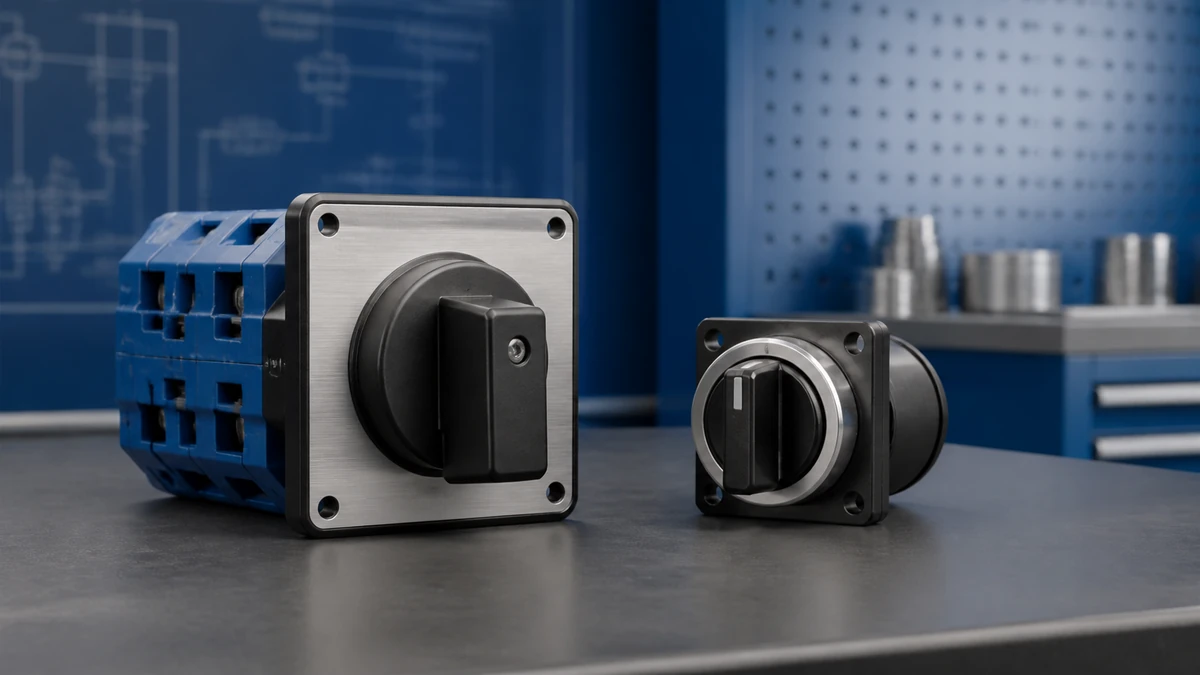
An exact drawing identifies the interfaces that must be controlled for the approved model route.
If the device carries the working circuit
If the device is expected to connect, disconnect, reverse, change taps or select sources in the working circuit, treat it as a power-switching specification. The buyer should ask for the exact contact program, rating evidence and mounting details for the proposed model.
This is where a rotary cam switch may be commercially attractive: one rotary device can be built around a defined switching sequence, rather than adding separate operators for every circuit state.
If the device only tells another device what to do
If the handle only tells a PLC input, relay, contactor coil or drive input which mode is requested, the selector switch route may be simpler. In that case, the downstream control design performs the electrical action.
The procurement risk is buying a control operator for a duty that actually requires switching a load circuit, or buying a power-switching assembly when the application only needs a low-energy command interface.
Buyer question
Cam switch route
Selector switch route
Does the device carry load current?
Possible, if the exact model, rating and duty match
Not assumed; check exact contact blocks and ratings
Does one handle need to change several contacts at once?
Often a strong fit
Possible only within the operator/contact arrangement
Is the function mainly Auto/Off/Manual, Local/Remote or Mode Select?
Possible, but may be more than needed
Often the cleaner control-panel route
Is a contact sequence drawing required?
Usually critical
Usually simpler, but still verify contact behavior
Is the decision mainly about panel operator interface?
Not the first route unless the contact program needs it
Usually the first route
Choose a cam switch when the switching program is the product decision
A cam switch is the better commercial route when the buyer needs a defined manual switching program, not just a named handle position. The value is in the contact arrangement, contact timing, pole count and duty rating for the specific circuit.
Multi-pole manual switching
A cam switch can be specified for applications where multiple contacts change together through several positions. This can reduce wiring complexity in some panel layouts, but only after the contact diagram confirms the required sequence.
For available product families, mounting styles and model-level options, review the Shieldhz rotary cam switch range rather than treating all rotary switches as interchangeable.
Situations that usually trigger a cam switch review
Use a cam switch review when the application includes:
Manual source selection or circuit selection.
Multi-pole ON/OFF switching.
Reversing or changeover contact logic.
Step selection, tap selection or staged manual control.
A need for a documented contact program behind each handle position.
Do not approve the route from the function name alone. Ask for the contact diagram, ratings and mounting drawing for the exact model under consideration.
Choose a selector switch when the panel needs a command interface
A selector switch is the better commercial route when the panel needs a human command input and the electrical work is performed elsewhere in the control system. It is commonly considered for mode selection, permissive selection or local operator commands, with final suitability dependent on the exact operator, contact blocks and circuit design.
Control-circuit decision points
A selector switch can be appropriate where the input is read by a relay, PLC, safety controller, drive input or contactor coil circuit. The key question is whether the operator’s contacts only carry the control-circuit duty stated in the product documentation.
Typical control-interface decisions include:
Maintained or spring-return action.
Number of positions.
Keyed, knob or lever operation.
Contact arrangement for the control circuit.
Panel cut-out and operator style.
Indication or legend requirements.
What not to expect from a selector switch
Do not assume a selector switch is suitable for power switching because the handle has similar positions to a cam switch. The exact contact rating, utilization category, wiring diagram and manufacturer documentation must match the buyer’s circuit.
A selector switch can be the lower-complexity option when the power switching is already handled by contactors, drives or other equipment specified for that role. It can be the wrong option if the panel drawing expects the operator itself to carry and change the working circuit.
Match electrical duty before comparing price
The correct purchase route depends on AC/DC duty, voltage, current and utilization category before it depends on unit price. Two devices with similar handle positions can have very different allowable duties depending on their exact construction and documentation.
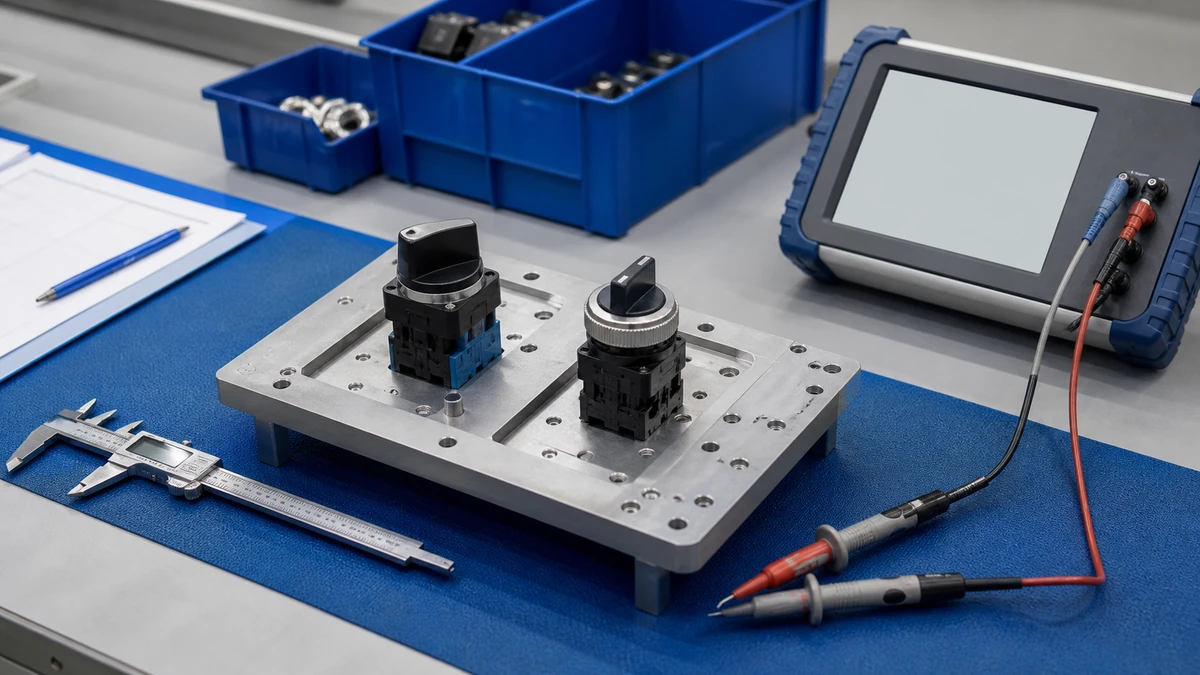
Sample review should connect the exact item to its current drawing and requested evidence package.
Ratings are model-specific, not category-wide
Do not compare “cam switch” and “selector switch” as generic rated objects. Compare exact part numbers, drawings, datasheets and certificates against the buyer’s circuit.
For rotary cam switch sizing and specification inputs, use the rotary cam switch selection guide as a foundation, then verify the current model documentation for the specific purchase.
Standards evidence has a defined boundary
IEC describes the IEC 60947-3 scope as switches, disconnectors, switch-disconnectors and fuse-combination units within stated distribution- and motor-circuit AC/DC limits. That scope statement does not automatically validate every device for every buyer application.
For purchasing, request the certificate or declaration package relevant to the exact model and destination market. Also check whether the buyer’s end product, panel standard or local acceptance process requires additional evidence.
Specification item
Why it matters
Buyer action
AC or DC circuit
Contact behavior and ratings can differ
State the supply type clearly
Voltage
Determines insulation and switching requirements
Match to the actual circuit voltage
Current
Determines thermal and switching duty needs
Use operating current and required margin policy from the buyer
Utilization category
Connects rating to duty type
Request the category shown in current documentation
Frequency of operation
Affects product selection and service expectations
Provide realistic operating pattern
Destination market
Documentation requirements can vary
Request the required certificate package before order release
Specify the contact program, not only the handle positions
The safe sourcing decision is to specify what each contact does in every handle position. Position labels such as 0-1-2, I-0-II or MAN-OFF-AUTO are not enough by themselves.
Positions, poles and contact stages drive the bill of materials
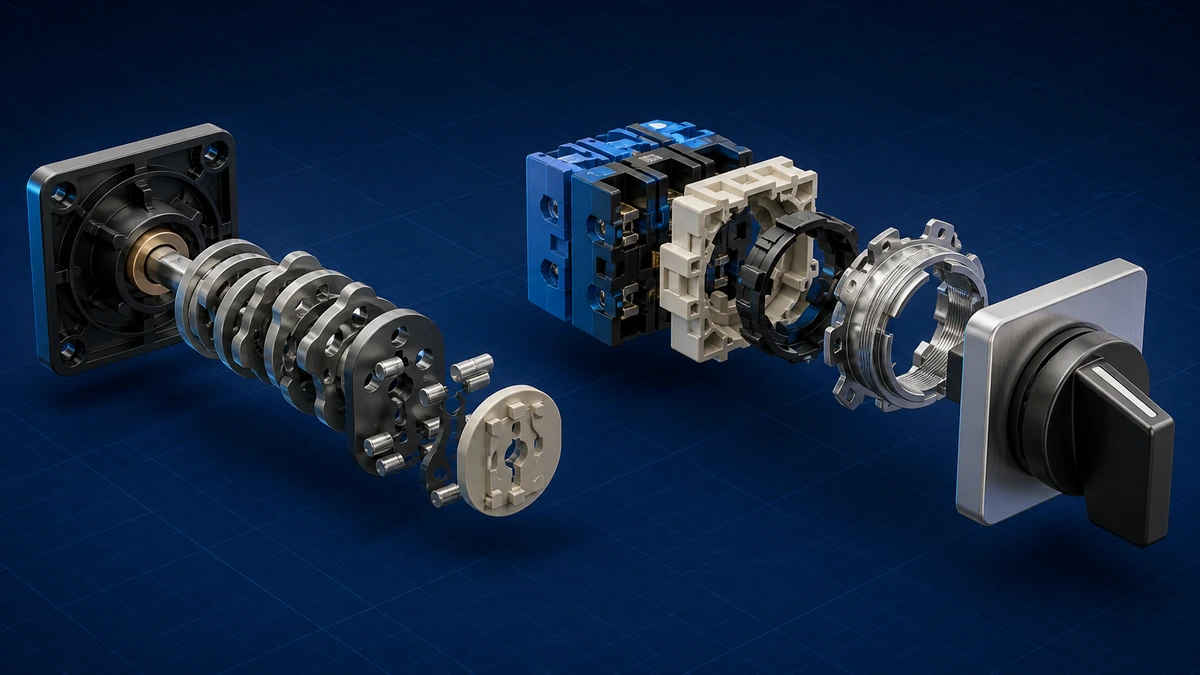
A rotary cam switch may have several contact stages behind one handle. The buyer must confirm how many poles are needed, which contacts open or close in each position and whether any positions require overlapping or non-overlapping contact behavior.
For a deeper foundation on these terms, use the Shieldhz positions, poles and contact stages guide rather than rewriting the whole switch-construction explanation in the purchasing note.
Contact-program checklist for sourcing
Before requesting price or substituting a model, prepare:
Handle position sequence and legend text.
Contact open/closed table for every position.
Number of poles and isolated circuits.
Required OFF or neutral position behavior.
Any changeover, reversing or staged function.
Required shaft, handle and mounting arrangement.
Drawing format needed by the panel engineering team.
If these details are missing, the quotation may be based on an assumed program. That creates rework risk when the panel drawing, wiring schedule or acceptance documentation is later checked.
Treat motor-control applications as a separate decision
Motor-control switching requires a separate engineering check because the duty is not the same as a simple indication or command input. A rotary cam switch may be considered for certain manual motor-control functions only when the exact model, circuit and duty rating match the application documentation.
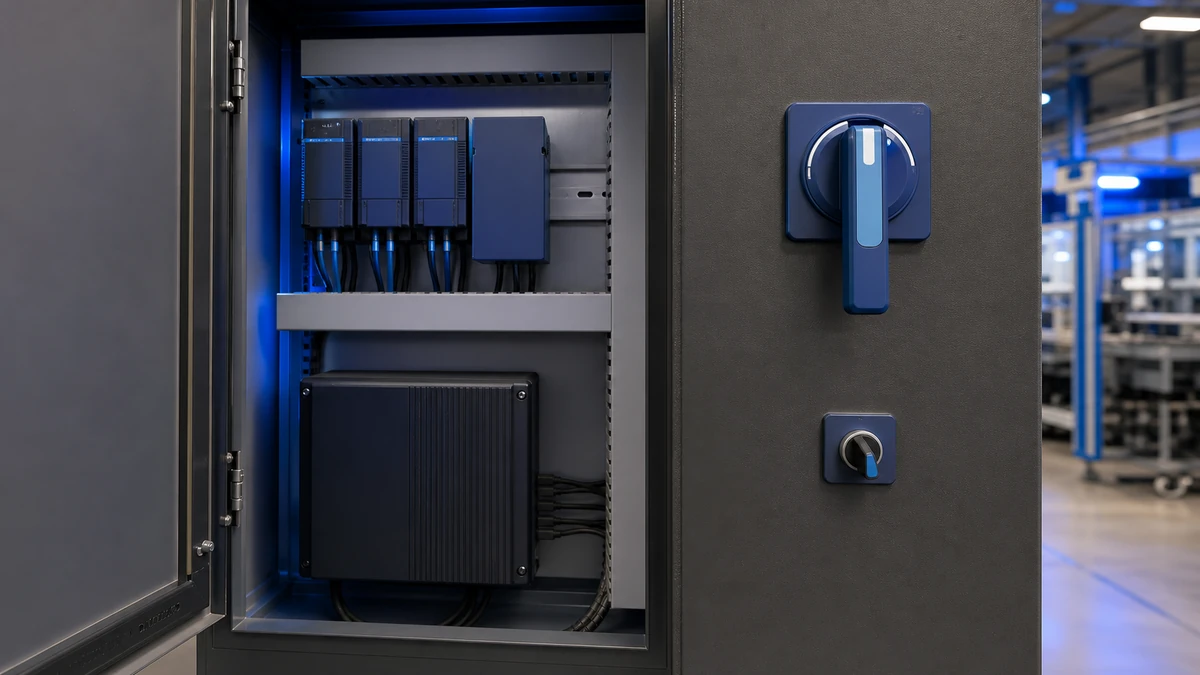
Installation conditions change the product-route and document questions a buyer must resolve.
Where a cam switch may be reviewed
A cam switch route may be reviewed for manual forward/reverse, star-delta, pole-change or local motor circuit selection where the required contact sequence can be built and documented. The purchase decision should be based on the circuit diagram and rated duty, not the function name alone.
For motor-specific considerations, refer to the rotary cam switch motor-control guide and then confirm the current documentation for the proposed model.
Where a control-interface route may be cleaner
If the motor is controlled by contactors, a soft starter or a drive, the front-panel selector may only need to send mode or direction commands. In that case, a selector switch can be the better operator choice while the downstream equipment performs the power switching.
A useful sourcing question is: “Does the handle switch the motor circuit, or does it request another device to switch the motor circuit?” The answer usually determines which product family should be quoted first.
How Shieldhz confirms a rotary cam switch route
Shieldhz confirms a rotary cam switch route by checking the buyer’s required switching function, electrical duty and mechanical installation before proposing a model. Final suitability is confirmed against current product documentation and the buyer’s application.
Documentation control, sample acceptance and protective packing are separate handover checks.
Pre-quotation inputs to provide
For a practical pre-quotation review, provide:
Switching function: ON/OFF, changeover, source selection, reversing, star-delta, step selection or another defined program.
AC/DC duty: supply type, circuit type and duty description.
Voltage/current and utilization category: values required by the application and acceptance route.
Pole and contact program: open/closed table or schematic by handle position.
Panel mounting and handle route: cut-out, shaft, handle style, front-plate or enclosure constraints.
Environment: indoor/outdoor location, dust, moisture, temperature expectations and any enclosure-level requirements.
Documentation package: requested drawing, datasheet and certificate set for the destination market.
What the buyer should review before release
The quotation stage should not end with a price line only. The engineering and sourcing teams should review the proposed function drawing, part number structure, mounting information and documentation package.
Use the rotary cam switch functions guide to align function language before requesting a custom or semi-standard contact program. Then confirm the issued drawing and datasheet for the exact product offered.
Compare procurement risk, not only unit cost
The lower-risk purchase is the route that matches the electrical role, documentation requirement and panel design with the least assumption. A selector switch may cost less and simplify the operator interface when only a command is needed. A cam switch may reduce added components or wiring steps when the manual switching program itself is required.
Commercial comparison table
Procurement factor
Cam switch route
Selector switch route
Main value
Defined multi-contact switching program
Operator input for a control circuit
Engineering document needed
Contact program and rating evidence are central
Contact block arrangement and operator details are central
Substitution risk
High if contact sequence is not identical
High if operator action or contact rating differs
Panel impact
May consolidate several switching actions
May be compact for command selection
Quotation clarity
Requires circuit/function detail early
Requires operator style and contact details early
Best review owner
Electrical design plus sourcing
Controls design plus sourcing
Shortlist actions for distributors and OEM buyers
Use this shortlist process before sending the RFQ:
Mark each operator on the panel drawing as “power switching” or “control command.”
For power-switching items, attach the contact program and duty data.
For command-interface items, attach the control-circuit rating and operator action.
State any required drawing, datasheet and certificate package.
Ask suppliers to quote against the application details, not only against a visual or positional match.
Review proposed alternatives for electrical equivalence, not only mechanical fit.
This approach keeps the commercial conversation focused on the real decision: whether the buyer needs a switching device with a defined contact program or a control operator for a downstream circuit.
Conclusion
The cam switch vs selector switch decision should be made by circuit role. If the handle must directly change a power-circuit or multi-contact switching program, evaluate a rotary cam switch route with model-specific ratings and a confirmed contact diagram. If the handle mainly sends a mode, permission or direction command to another control device, evaluate a selector switch route.
For procurement, do not approve a model from the handle positions alone. Confirm duty, contact behavior, mounting and documentation against current product information and the buyer’s actual application before releasing the order.
Frequently Asked Questions
Is a cam switch the same as a selector switch?
No. They can look similar from the front of a panel, but the purchasing decision is different. A cam switch route is usually about a defined switching program behind the handle, while a selector switch route is usually about sending a control command.
Can a selector switch switch power?
Do not assume that from the name or handle shape. Some operator contact arrangements may have documented ratings for specific duties, but suitability depends on the exact model, datasheet, utilization category and buyer circuit.
Can a cam switch be used only for a control circuit?
Yes, a cam switch can be specified for control-circuit functions when its contact program is useful and the exact model documentation matches the duty. However, if the application only needs a simple command input, a selector switch may be the more straightforward route.
What information should be sent before asking for a cam switch quote?
Send the switching function, AC/DC duty, voltage/current, utilization category, pole count, contact program, handle positions, mounting route, environment and required documentation package. A schematic or open/closed contact table is especially useful.
Are cam switches suitable for motor-control applications?
They may be reviewed for certain manual motor-control functions when the exact model, contact sequence and rated duty match the application. Do not approve the device from a motor-control function name alone; verify the drawing and documentation.
Can an emergency-stop operator be selected like a normal selector switch?
No. Selecting an emergency-stop operator or any panel operator does not validate a complete machine safety function. The safety function depends on the full machine risk assessment, circuit architecture, components, diagnostics, installation and validation process required for the buyer’s application.
Shi, Muxi
Shi, Muxi writes Shieldhz technical articles for industrial control and electrical component buyers, covering rotary cam switches, isolator switches, PV DC disconnects, push buttons, indicator lights, waterproof enclosures, and terminal blocks. The articles are based on Zhejiang Shihe Electric Co., Ltd.'s manufacturing and export experience, with practical emphasis on model selection, datasheets, drawings, certifications, IP ratings, and inquiry details buyers should confirm before ordering.